
Job vs Supervisor Jobs Kotlin: The Failure Rule That Shapes Your Coroutines
Job vs Supervisor Jobs Kotlin comes down to one question: should one failed coroutine stop the rest?
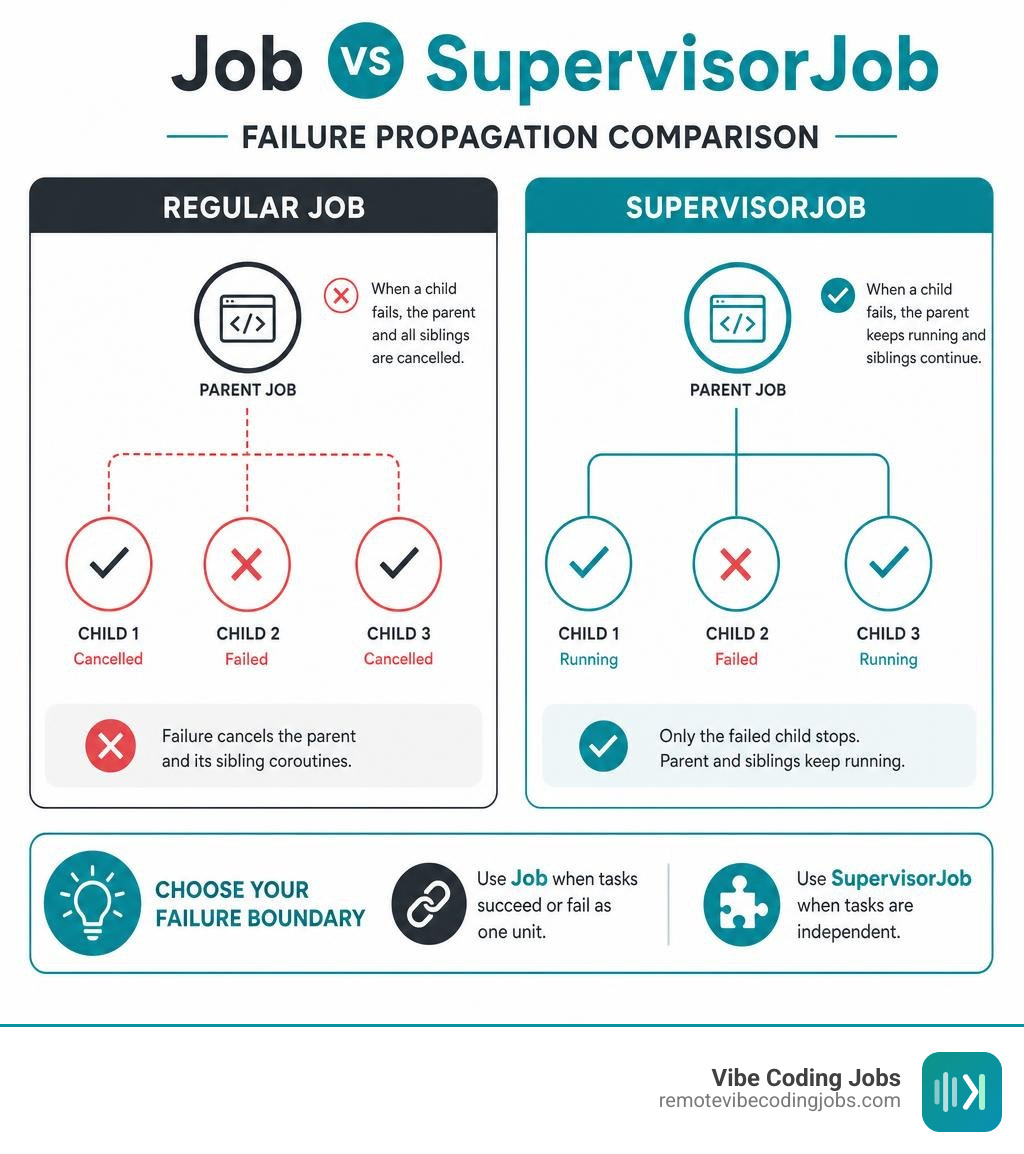
| Coroutine job type | What happens when a child fails? | Best fit |
|---|---|---|
Job |
The failure cancels the parent and its sibling coroutines. | Tasks that must succeed or fail as one unit |
SupervisorJob |
The failed child stops, but the parent and sibling coroutines keep running. | Independent tasks that can fail separately |
This choice defines your failure boundary. A regular Job treats child work as one connected operation, which makes sense for a transaction or tightly linked batch process. A SupervisorJob treats direct child tasks as separate units, which is useful when one failed API call should not stop other screen data, uploads, or background work.
The details matter: coroutineScope, supervisorScope, nested launch calls, and exception handling can all change the result. The wrong boundary can quietly cancel work you expected to continue.
I’m Di Su, a software engineer with more than 10 years of experience building scalable web products and improving developer workflows with Svelte, Python, and AI-assisted tools. In this guide to job vs supervisor jobs kotlin, I’ll help you read coroutine failure behavior quickly and choose a pattern that matches the work at hand.
Understanding the Core Difference: Job vs Supervisor Jobs Kotlin
When building concurrent applications in Kotlin, managing how background tasks start, complete, or fail is essential for application stability. At the center of Kotlin coroutines’ lifecycle management is the Job interface. Every coroutine launched inside a scope possesses a Job object in its context, serving as a handle to monitor its active, completing, or cancelled state.
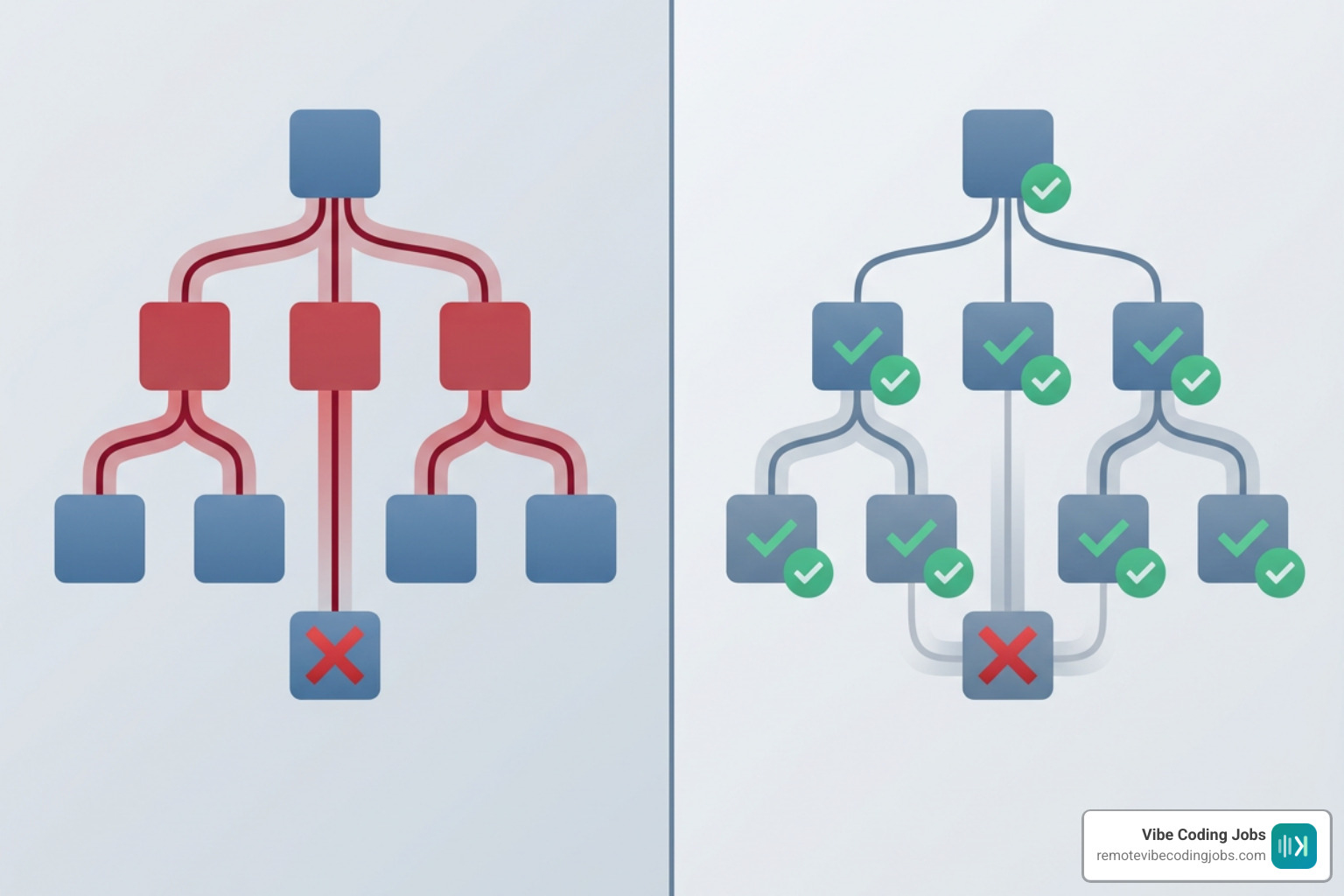
The fundamental difference between a standard Job and a SupervisorJob boils down to failure routing. Structured concurrency in Kotlin guarantees that child coroutines form a strict hierarchical tree under a parent scope. However, the exact implementation class backing that parent node determines whether an exception in one branch destroys the surrounding tree or leaves adjacent branches untouched.
| Feature / Behavior | Standard Job |
SupervisorJob |
|---|---|---|
| Primary Design Philosophy | All-or-nothing atomic unit of work | Independent resilient concurrency |
| Child Cancellation Propagation | Bidirectional (Upward to parent, sideways to siblings) | Downward only (Parent to children) |
childCancelled() Internal Function |
Returns true (Triggers parent cancellation) |
Returns false (Ignores child failure) |
| Sibling Effect on Failure | All sibling coroutines are immediately cancelled | Sibling coroutines continue executing |
| Exception Direction | Exception cancels parent, which cancels all children | Exception passes directly to handler without cancelling parent |
| Top-Down Cancellation | Parent cancellation cancels all child coroutines | Parent cancellation cancels all child coroutines |
| Primary Use Case | Coupled transactions, batch operations, database writes | Modular UI rendering, independent API calls, background loops |
Under the hood, both types implement the core job interface specified in the kotlinx-coroutines core source specification. When a child coroutine encounters an unhandled exception, it notifies its parent job via an internal method called childCancelled(). A standard Job implementation returns true upon receiving this signal, accepting the failure and initiating a teardown of the entire parent scope. Conversely, SupervisorJobImpl explicitly overrides childCancelled() to return false, effectively neutralizing the upward propagation of errors.
Standard Job Mechanics: Why Child Failures Cancel Siblings
In a standard coroutine Job, failure handling relies on bidirectional cancellation propagation. When a child coroutine throws an unhandled exception (other than a standard CancellationException), the following sequence occurs automatically:
- The child coroutine transitions to a failing state and cancels its own execution.
- The child sends the exception upward to its immediate parent
Job. - The parent
Jobcancels itself due to the uncaught exception. - The cancelling parent broadcasts a cancellation signal downward to every other active child coroutine (the siblings of the original failing task).
- All sibling coroutines terminate prematurely, ensuring no orphaned background tasks continue running in an inconsistent state.
This atomic work unit concept prevents resource leaks and partial updates. For example, if a background synchronization task consists of three steps—authenticating user credentials, downloading fresh records, and writing records to disk—allowing the disk write to proceed after the download fails would corrupt local memory. A standard Job ensures that if one step fails, the entire pipeline shuts down immediately.
It is critical to distinguish uncaught exceptions from normal CancellationException instances. Throwing a CancellationException or calling cancel() on a child job represents deliberate, cooperative cancellation. It stops the target child coroutine without cancelling the parent or sibling tasks, whereas any other uncaught exception triggers a full cascading failure.
SupervisorJob Mechanics: How Failure Isolation Works
A SupervisorJob alters default structured concurrency rules by establishing isolated failure domains. When a direct child coroutine of a SupervisorJob fails due to an uncaught exception, the supervisor ignores the failure propagation signal.

Because the SupervisorJob overrides childCancelled() to evaluate to false, the upward failure chain breaks. The failure sequence under a SupervisorJob operates as follows:
- The failing child coroutine terminates immediately.
- The child notifies its parent
SupervisorJobof the failure. - The
SupervisorJobrejects the failure signal, remaining active and healthy. - Active sibling coroutines continue running without interruption.
- The uncaught exception skips parent scope cancellation and routes directly to the surrounding
CoroutineExceptionHandleror global exception mechanism.
As detailed in the Official Kotlin SupervisorJob API Documentation, a supervisor only isolates failures from child to parent. Top-down cancellation remains fully active. If the parent scope holding the SupervisorJob is explicitly cancelled (such as when an application lifecycle ends), the SupervisorJob cancels all of its active children simultaneously.
Scope Builders: coroutineScope vs supervisorScope
In asynchronous Kotlin code, developers rarely construct Job or SupervisorJob instances manually inside suspending functions. Instead, structured concurrency relies on scope builders: coroutineScope and supervisorScope. Both scope builders suspend execution until all child coroutines started within their block finish, but they handle failures in fundamentally different ways.

coroutineScope for Interdependent Atomic Tasks
The coroutineScope builder creates a local structured scope backed by a standard regular Job. It inherits its parent CoroutineContext but wraps the job in a standard parent-child contract.
We use coroutineScope whenever a group of concurrent operations forms an all-or-nothing unit of work. Consider a batch payment processing system that fetches a payment token, verifies inventory, and charges a credit card concurrently. If inventory verification fails due to an out-of-stock item, continuing the credit card charge operation is dangerous. Wrapping these concurrent tasks inside coroutineScope guarantees that an exception in the inventory verification coroutine immediately cancels the payment token retrieval task and halts the entire suspend function.
Key characteristics of coroutineScope include:
- Immediate cancellation of all sibling coroutines the moment any single child coroutine fails.
- Re-throwing the original exception to the outer caller once all child tasks finish teardown.
- Strict enforcement of atomic execution guarantees inside suspending functions.
supervisorScope for Independent Parallel Operations
The supervisorScope builder creates a local structured scope backed by a newly instantiated SupervisorJob. It inherits the surrounding context but inserts a supervisor boundary between the outer calling coroutine and the inner child coroutines launched inside the block.
This architecture creates what coroutine developers call a “failure bubble.” Inside a supervisorScope, direct child coroutines can fail independently without cancelling sibling tasks or blowing up the scope itself.
A primary application for supervisorScope is loading independent components on a dashboard. Imagine an application dashboard that loads three distinct sections concurrently: user profile details, real-time weather alerts, and breaking news updates. If the weather service returns an internal server error and throws an exception, there is no reason to block or clear the user profile or news feed. Wrapping the concurrent fetches inside supervisorScope allows the weather task to fail cleanly while the profile and news requests complete and render successfully.
The Grandchild Problem and Job Inheritance Pitfalls
One of the most frequent sources of subtle production bugs in Kotlin coroutines stems from misunderstanding how context inheritance works with nested coroutine builders. Developers often attach a SupervisorJob to a top-level scope and assume every nested launch or async block under that scope automatically enjoys failure isolation. This assumption is incorrect and leads directly to the “grandchild problem.”

Why Job is Not Inherited by Children
To understand the grandchild problem, we must understand the fundamental rule of coroutine context inheritance: a Job context is NOT inherited by child coroutines.
When you invoke a coroutine builder like launch or async, Kotlin extracts elements from the parent CoroutineContext (such as dispatchers or exception handlers) to configure the new child. However, the builder does not copy or inherit the parent’s Job object. Instead, every call to launch creates a brand-new, standard regular Job instance.
This new regular Job establishes a parent-child relationship with the parent’s job, referencing it to form a hierarchy:
- You create a top-level
CoroutineScopebacked by aSupervisorJob. - You invoke an outer
launchblock (Child 1). Kotlin creates a standardJob(Job A) whose parent is theSupervisorJob. - Inside Child 1, you invoke two nested
launchblocks (Grandchild 1 and Grandchild 2). - Grandchild 1 and Grandchild 2 become direct children of Job A—which is a standard regular
Job, NOT aSupervisorJob.
If Grandchild 1 throws an uncaught exception, it notifies its immediate parent (Job A). Because Job A is a standard Job, it accepts the failure, cancels itself, and immediately cancels its other direct child (Grandchild 2). The supervisor status of the top-level scope is completely bypassed because the failing coroutine was a grandchild, not a direct child of the SupervisorJob.
Solving Nested Failures with supervisorScope in Job vs Supervisor Jobs Kotlin Code
To eliminate the grandchild problem and safely isolate failures across nested concurrent structures, you must re-establish a supervisor node at the level where the parallel tasks are defined.
As demonstrated in the SupervisorJob vs Regular Job Demonstration Code, replacing nested launch containers with a supervisorScope block solves the inheritance flaw.
When you wrap nested launches inside supervisorScope, the builder creates a new internal SupervisorJob specifically for that local block. This turns the nested launches into direct children of a supervisor, restoring failure isolation:
- Without
supervisorScope(Flawed Structure):SupervisorJobto Outerlaunch(RegularJob) to Nestedlaunch 1&launch 2. A failure inlaunch 1cancelslaunch 2. - With
supervisorScope(Isolated Structure):SupervisorJobto Outerlaunch(RegularJob) tosupervisorScope(SupervisorJob) to Nestedlaunch 1&launch 2. A failure inlaunch 1leaveslaunch 2running safely.
Using supervisorScope inside nested functions ensures that failure boundaries stay exactly where you intend, regardless of how deep the call stack goes.
Practical Decision Framework: When to Use Each Pattern
Choosing between job vs supervisor jobs kotlin constructs requires evaluating application boundaries, data lifecycles, and component independence.
Choosing Between Job Types in Architectural Components
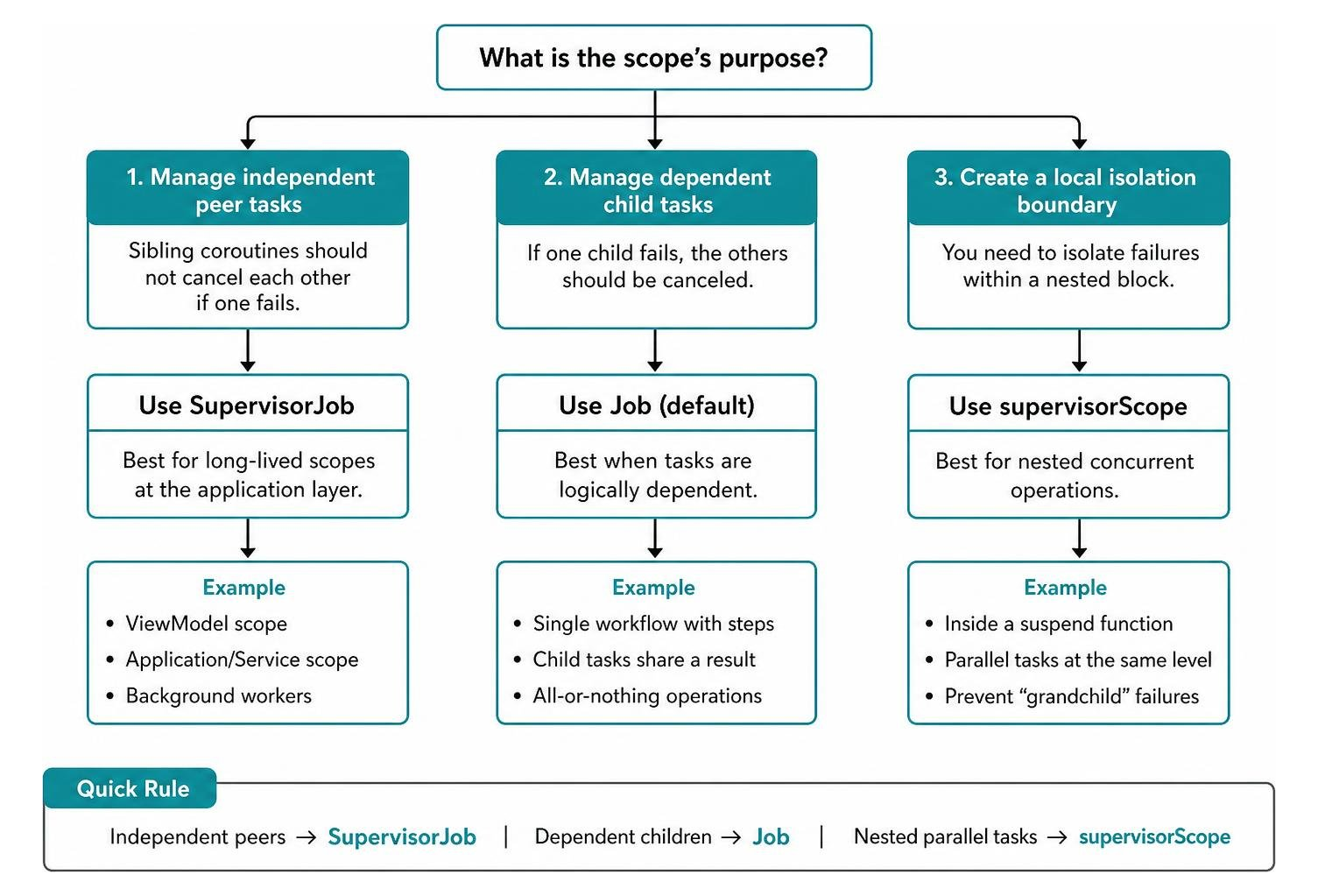
When designing architecture for modern applications—whether Android applications, backend microservices, or desktop tools—follow these guidelines to map job types to component lifecycles:
- Long-Lived Application Scopes (ViewModel, Service, Presenter):
- Use
SupervisorJob(). Long-lived component scopes manage multiple unrelated background tasks (e.g., listening to event streams, user interactions, analytics logging). If one background logging routine throws an exception, you do not want to terminate the entire component or stop UI event processing.
- Use
- Transient Suspending Utility Functions:
- Default to
coroutineScope. If a suspend function performs a specific operation broken into sub-tasks, treat those sub-tasks as an atomic unit. If one sub-task fails, the utility function should clean up and fail fast.
- Default to
- Independent Feature Aggregators inside Suspending Functions:
- Use
supervisorScope. When a single suspend function needs to execute multiple independent operations concurrently (like gathering metrics from three non-critical external APIs), wrap the parallel execution insupervisorScope.
- Use
- Batch Data Processing & Financial Transactions:
- Use standard
Job/coroutineScope. If consistency across data stores is required, standard jobs guarantee that a failure anywhere rolls back or aborts remaining steps.
- Use standard
Error Isolation Strategies in Job vs Supervisor Jobs Kotlin Applications
A common misconception is that using a SupervisorJob or supervisorScope eliminates the need for exception handling. In reality, supervisor constructs only stop cancellation from propagating upward—they do not catch or suppress exceptions.
If an uncaught exception occurs inside a coroutine started with launch under a SupervisorJob, the exception still escapes up the hierarchy looking for an unhandled error handler. If no handler exists, the application framework’s default uncaught exception handler will catch it, which often results in an application crash.
To properly isolate and handle errors when using job vs supervisor jobs kotlin patterns, combine these exception strategies:
- For
launchcoroutine builders: Attach aCoroutineExceptionHandlerto the scope context or pass it directly to the childlaunch. Alternatively, wrap the risky logic inside thelaunchblock with a standardtry-catchstatement. - For
asynccoroutine builders: Exceptions insideasyncblocks are deferred until.await()is called on the returnedDeferredhandle. Wrap the.await()call inside atry-catchblock to handle the exception gracefully without interrupting sibling coroutines.
By explicitly managing exception boundaries, you ensure high availability and application resilience.
Frequently Asked Questions
What happens if an exception is thrown inside a SupervisorJob without a CoroutineExceptionHandler?
When a child coroutine created with launch inside a SupervisorJob throws an exception and no CoroutineExceptionHandler is present, the failure does not cancel the parent SupervisorJob or its sibling coroutines. However, the uncaught exception travels to the root of the coroutine hierarchy and is delivered to the thread’s default uncaught exception handler. On platforms like Android or JVM servers, this usually results in an unhandled exception crash or thread death. Always supply a CoroutineExceptionHandler or use internal try-catch blocks inside launch calls.
Does cancelling a SupervisorJob cancel all of its active children?
Yes. Cancelling a SupervisorJob triggers standard top-down cancellation propagation. While a SupervisorJob blocks child-to-parent failure propagation, it fully respects parent-to-child cancellation. Calling cancel() on a SupervisorJob or cancelling the CoroutineScope that owns it immediately sends a cancellation signal to all active child coroutines, tearing down all resources cleanly.
Why doesn’t passing SupervisorJob() to a custom CoroutineScope insulate nested launch blocks?
Passing SupervisorJob() to a CoroutineScope only isolates direct child coroutines launched directly on that scope object (scope.launch). When you nest a launch inside another launch, the inner launch becomes a child of the outer launch‘s Job (which is a standard regular Job). Because Job context is not inherited by child coroutines, the nested launches sit under a standard Job hierarchy. A failure in one nested launch cancels its parent regular Job, which immediately cancels all sibling nested launches. To isolate failures across nested launches, wrap the inner launch calls in a supervisorScope block.
Conclusion
Understanding job vs supervisor jobs kotlin is fundamental to mastering structured concurrency and building resilient applications. Standard Job instances enforce strict atomic failure boundaries, ensuring that interdependent tasks fail together to prevent partial state corruption. SupervisorJob and supervisorScope establish isolated failure domains, allowing independent tasks to complete even when sibling operations encounter errors.
At RemoteVibeCodingJobs, we see how modern, AI-assisted development practices are transforming modern software engineering. Developers leveraging tools like Cursor and Claude to build complex asynchronous architectures must understand these underlying concurrency mechanisms to prevent subtle runtime bugs. If you are looking for your next career move, explore our curated daily listings for backend developer remote jobs at async-first companies today.