
Why Filtered Tech Coder Gigs Are Replacing the Traditional Developer Job Search
Filtered tech coder gigs are curated developer roles that go beyond raw coding ability — prioritizing AI integration, domain expertise, and business problem-solving skills. Here’s a quick look at what they are and where they pay:
| Gig Type | Key Skills | Typical Pay (2026) |
|---|---|---|
| AI Full Stack Contract | Claude Code, AWS Kiro, React | $70–$85/hr |
| Fractional Stabilization Engineer | Refactoring, AI code cleanup | 10–40 hrs/week, ~4-week engagements |
| Legacy Code Specialist (COBOL/ColdFusion) | Niche legacy stacks | Up to $1,000/hr (short-term) |
| AI Training Engineer (e.g., Alignerr) | GenAI, software evaluation | $120–$150/hr |
| Cleared Defense Engineer | Golang, Kubernetes, TS/SCI | $165,000–$205,000/yr |
The developer job market in July 2026 looks nothing like it did five years ago. AI tools have compressed what once took days of coding into a matter of minutes. That shift has created two very different outcomes for software engineers — and the gap between them is growing fast.
On one end, a software engineer who earned $150,000 a year lost his job to AI automation, applied to over 800 positions, and ended up doing DoorDash deliveries while living in a trailer. On the other end, developers who adapted to AI-assisted workflows are landing contracts paying $120–$150 per hour, working remotely on their own schedule.
The difference? Knowing which gigs to target — and how to filter out the noise.
I’m Dominic Zijlstra, co-founder of Adaptify.ai and a data scientist and DevOps engineer with over a decade of experience building automated systems — experience that maps directly onto the landscape of filtered tech coder gigs emerging today. In the sections below, I’ll break down exactly how to find, evaluate, and land the right roles in this new market.
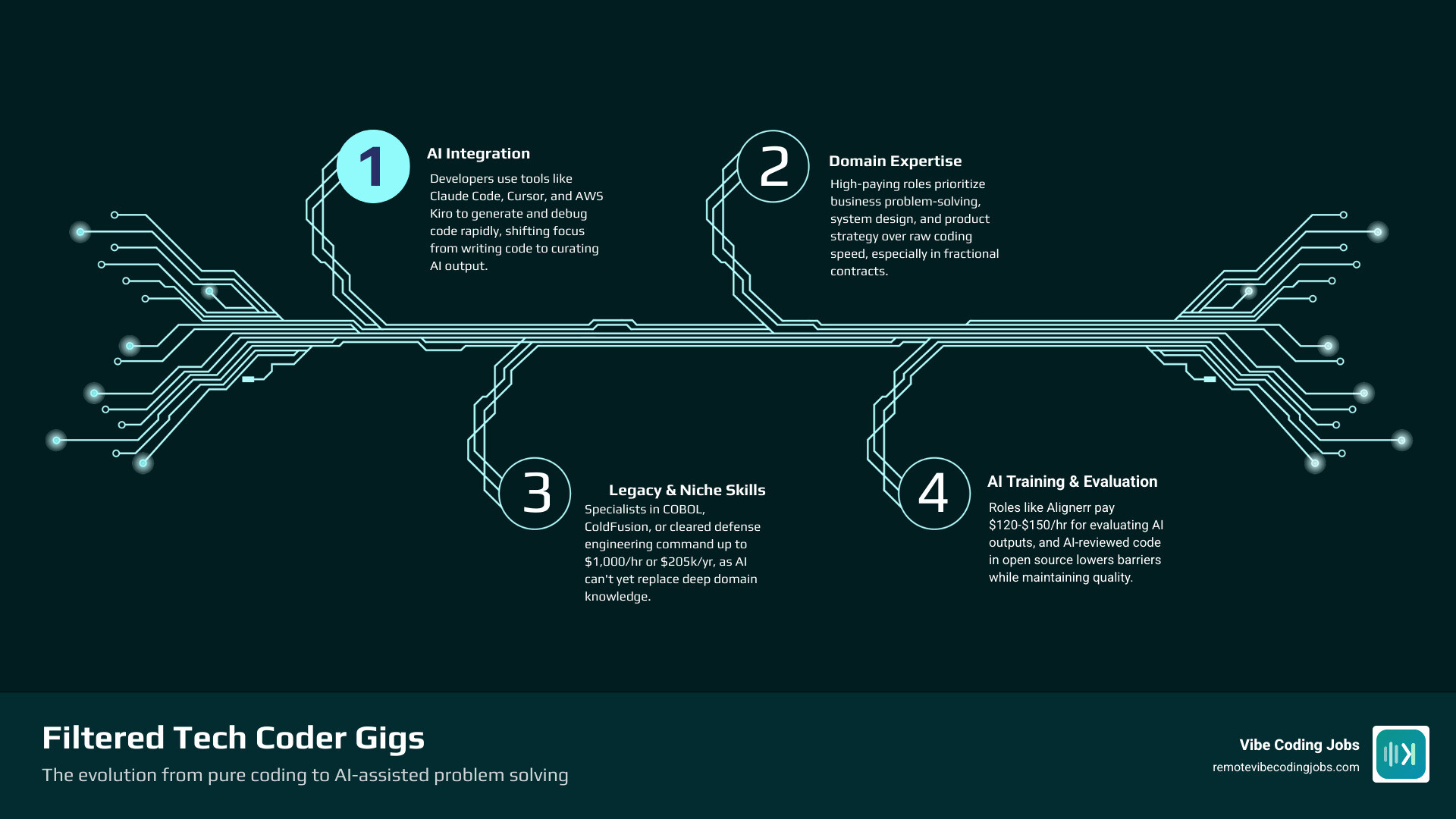
Basic filtered tech coder gigs terms:
The Reality of AI Displacement: A Case Study in Adaptation
The shift in our industry isn’t just a theoretical topic for late-night forum debates; it has real, sometimes harsh consequences for those who fail to adapt. Consider the widely shared case of a software engineer who lost his stable, $150,000-a-year job to AI automation. Despite holding solid traditional credentials, he faced a staggering 800 job rejections in the aftermath. With bills piling up, he was forced to deliver for DoorDash and move into a trailer just to make ends meet.
How does a high-earning tech professional fall through the cracks so quickly? The answer lies in the automation of syntax. When your primary value proposition is translating logic into lines of Python or JavaScript, you are competing directly with machines that can do it instantly and virtually for free. If you only know how to write code, your job security is fundamentally at risk.
To avoid a similar fate, we must transition from being “code monkeys” to “solution architects.” This means upskilling aggressively to master the tools of the modern era. By learning to orchestrate AI models, we can leverage automation to supercharge our output rather than let it replace us. Understanding the Vibe Coding Remote Jobs Benefits Growth Success framework is the first step toward building a highly resilient career in this automated landscape.
Navigating the Shift to Filtered Tech Coder Gigs
As traditional, mid-level engineering positions dry up, a highly lucrative alternative has emerged: filtered tech coder gigs. These are specialized, highly curated roles that explicitly seek out developers who know how to co-pilot with AI to solve complex technical bottlenecks.

One of the most prominent sub-sectors of this new market is “code stabilization.” Because non-technical founders and early-stage startups can now use AI to generate entire MVPs in a weekend, they frequently end up with fragile, inconsistent, or outright broken codebases. They don’t need someone to write more greenfield code; they need a senior engineer to step in, identify technical risks, implement secure authentication, and prepare the system for production scale.
For instance, companies are actively seeking roles like a Fractional Senior Full Stack Engineer (Stabilization / AI-Generated Code) | Flexgen to work 10 to 40 hours a week on short-term, high-impact engagements. These gigs don’t require you to sit in useless meetings; they require you to be the “clean-up crew” who understands how to make raw AI output robust and scalable.
Why Filtered Tech Coder Gigs Prioritize Business Problem-Solving
In the modern market, writing code has been reduced to a five-minute task. Historically, writing syntax was a necessary distraction—the only way to instruct a computer to solve a business problem. Now that AI has solved the translation layer, the true value of an engineer lies entirely in system design, product strategy, and domain expertise.
When we look at the difference between Vibe Coding vs Traditional Coding, the contrast is clear. Traditional coding focuses on compiling, debugging syntax, and memorizing framework APIs. Vibe coding, on the other hand, is about high-level orchestration. Your job is to deeply understand the business rules, design the architecture, and direct the AI to execute the technical details. If you can bridge the gap between business requirements and AI execution, you will never be out of work.
Essential Skills for Modern AI-Assisted Developer Roles
To remain competitive for these premium gigs, your resume needs to reflect a modern, AI-augmented workflow. It is no longer enough to list “React” and “Node.js.” You must demonstrate hands-on experience with agentic AI tooling and prompt engineering.
Modern job descriptions, such as the Frontend-Focused Full Stack Developer | Flexgen posting, explicitly look for developers who are comfortable using next-generation environments like Cursor, Copilot, or Claude Code. Additionally, you must know how to make codebases “AI-ready.” This involves structuring your repositories with clean, modular interfaces and strict type safety so that LLMs can easily parse, modify, and test the code without breaking peripheral systems.
By mastering these integrations, you can refer to our comprehensive guide on AI Coding Tools for Vibe Coding to build a workflow that makes you ten times faster than a traditional developer.
Compensation Models: Fractional Contracts vs. Full-Time Salaries
The financial structure of the tech industry is shifting away from rigid, full-time salaries toward highly flexible, fractional, and hourly contracts. Platforms like Alignerr are hiring remote Software Engineers to assist with advanced technical training and AI evaluation, commanding premium rates of $120 to $150 per hour.
Similarly, specialized contract roles, such as the Software Engineer – AI | Jobvectora position, offer independent contractors $70 to $85 per hour to integrate agentic AI tools like Claude Code and AWS Kiro into production systems.
To help visualize how these models compare in the current market, let’s look at the financial and structural trade-offs outlined in our Vibe Coding Salary Guide 2026:
| Contract Type | Typical Commitment | Rate / Salary Range | Pros | Cons |
|---|---|---|---|---|
| Traditional Full-Time | 40+ hours/week | $110,000 – $160,000/yr | High stability, health insurance | Lower hourly leverage, meeting fatigue |
| Fractional AI Contract | 10 – 30 hours/week | $70 – $150/hour | Ultimate flexibility, multiple clients | No corporate benefits, self-employment tax |
| Legacy Tech Gig | Short-term (2-8 weeks) | Up to $1,000/hour | Massive payout, zero long-term drama | High-stress debugging, irregular availability |
The Lucrative World of Legacy Code and Short-Term Contracts
While everyone else is chasing the latest Javascript framework, some of the highest-paying, lowest-stress filtered tech coder gigs are hiding in legacy systems.

For a seasoned contractor, a short-term contract (such as a two-month sprint) is music to the ears. It allows you to charge premium, “five-figure per week” rates to desperate companies that need immediate help, with zero long-term organizational politics or performance review drama.
Legacy tech stacks like ColdFusion and COBOL are gold mines for this exact reason. There is an extreme supply-and-demand imbalance. While the average full-time COBOL developer might make a standard salary at a bank, specialized contractors stepping in to resolve critical migration bottlenecks can command up to $1,000 per hour. Before dismissing these roles, it is worth weighing the options by reading our breakdown on Contract vs Full Time Remote Developer Pros Cons Which is Right.
How to Spot High-Paying Filtered Tech Coder Gigs
Finding these premium roles requires a keen eye for reading between the lines of job descriptions. You must learn to separate genuine, high-leverage remote opportunities from exploitative or bureaucratic traps.
One major red flag to watch out for is the “hybrid bait-and-switch.” For example, some job boards list positions as “remote” but bury strict physical requirements in the fine print. A prime example is the Software Engineer – Mid & Sr Level, (25% Hybrid) with Security Clearance | Taskium posting. While it offers a strong salary of $165,000 to $205,000 and an incredible 15% non-elective 401(k) contribution, it requires an active TS/SCI security clearance and a 25% hybrid presence in the Washington, D.C. metropolitan area. If you want true geographic freedom, you must filter these out.
Instead, focus your search on async-first companies that value output over physical presence. You can find high-paying roles that don’t subject you to arbitrary whiteboard tests by exploring Remote Coding Jobs No LeetCode Portfolio.
Open Source in the AI Era: Lower Barriers and the Rise of AI-Reviewed Code
AI is also fundamentally transforming the open-source landscape. We recently saw a fascinating case of a LinkedIn user who hadn’t coded professionally in 16 years. Over a single weekend, he used Claude Code to identify, debug, and submit a merged pull request (PR) for an open-source tagging plugin—written in a programming language he had never formally learned.
While this democratization is incredible, it has a clear double-edged sword. Maintainers are now being absolutely bombarded with what they call “slop PRs”—low-quality, AI-generated code changes that look correct on the surface but introduce subtle bugs or architectural inconsistencies. This influx has dramatically increased maintainer burnout.
To combat this, the open-source and enterprise worlds are rapidly moving toward an “AI reviewing AI” model. Modern development workflows, like those detailed in the Senior Java/Kotlin Engineer (AI-Driven DevOps & Automation) | Remotara role, require engineers to build automated CI/CD pipelines that use LLMs to perform static code analysis, validate git diffs, and score incoming PRs before a human ever looks at them.
To learn how to use these automated tools effectively without contributing to the noise, check out our Best Claude Code for Remote Developers in 2026 A Comprehensive Guide.
Frequently Asked Questions about Filtered Tech Coder Gigs
What are filtered tech coder gigs?
These are highly curated developer roles that prioritize modern technical workflows—such as AI-assisted development, code stabilization, and system architecture—over traditional, manual syntax writing. They focus heavily on your ability to solve business problems using AI tools.
How much do AI-assisted developer gigs pay in 2026?
Depending on the contract structure, pay rates typically range from $70 to $150 per hour. Highly specialized fractional roles or niche legacy contracts can command even higher premium rates, sometimes reaching up to $1,000 per hour for urgent, short-term system restorations.
Can I contribute to open source using AI tools?
Absolutely. Tools like Claude Code make it incredibly easy to parse unfamiliar codebases and suggest bug fixes. However, to maintain high code quality and respect open-source maintainers, you must always test the AI-generated code locally and ensure it adheres to the project’s architectural standards before submitting a PR.
Conclusion
The traditional software engineering landscape has shifted forever, but this change is an incredible opportunity for developers who know how to adapt. By moving away from generic job boards and focusing on high-leverage, filtered tech coder gigs, you can bypass the grueling 800-rejection cycles and secure roles that respect your time, autonomy, and expertise.
At RemoteVibeCodingJobs, we aggregate the absolute best remote “vibe coding” opportunities at async-first companies. We filter our daily listings by culture, tech stack, and modern AI tools like Cursor and Claude, helping you find your perfect match instantly.
Ready to transition to the next stage of your career? Read our comprehensive guide on What is Vibe Coding and grab our free playbook to start landing premium, AI-forward gigs today!