
Why Remote AI Documentation Specialist Roles Are One of 2026’s Fastest-Growing Tech Jobs
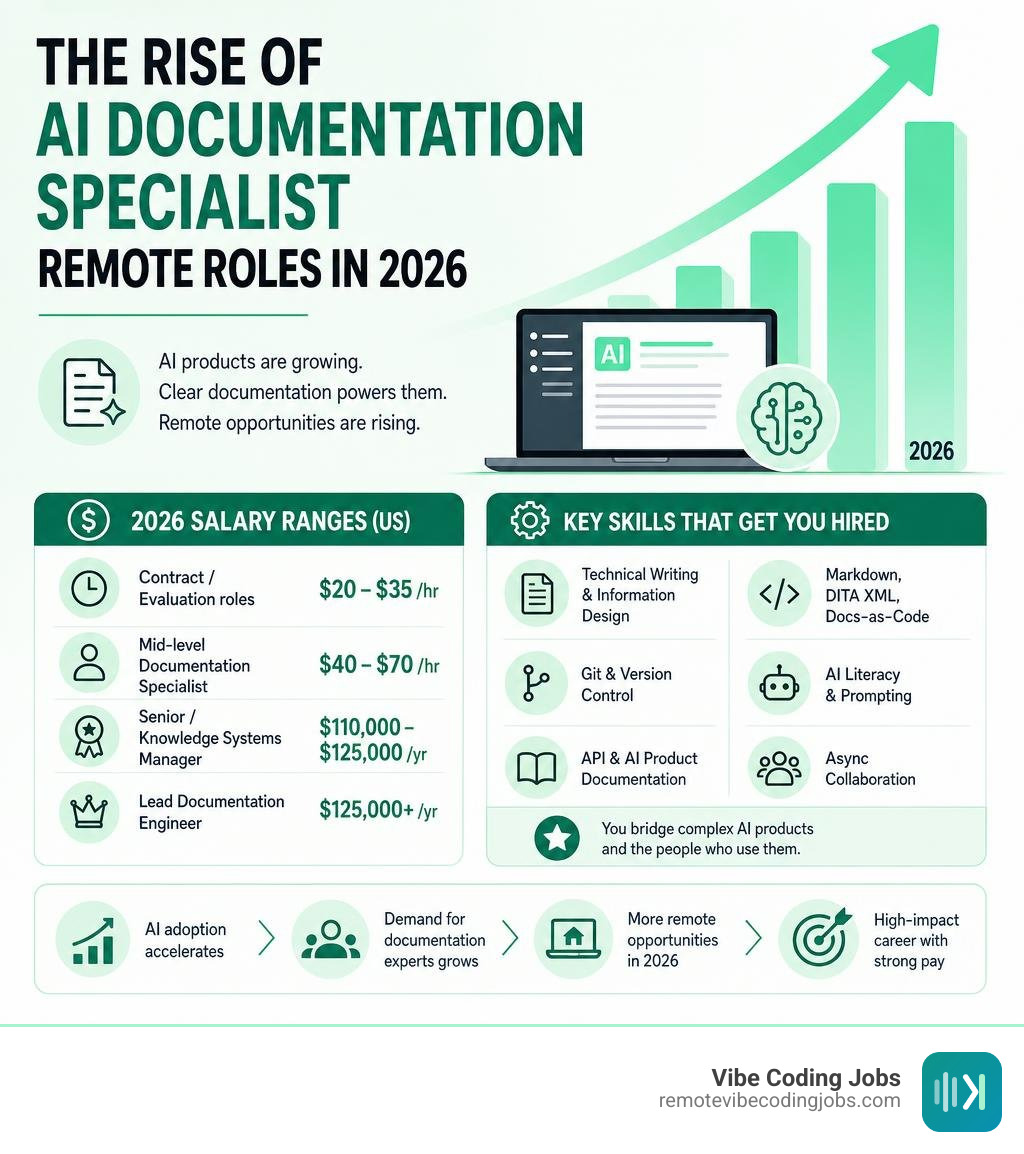
Landing a role as an ai documentation specialist remote worker is more achievable than ever — but you need to know exactly what employers want. Here’s the quick answer:
What does a remote AI Documentation Specialist do?
- Writes and maintains API references, user guides, and release notes for AI-powered products
- Structures content so both humans and LLMs (like RAG pipelines) can consume it reliably
- Works with tools like Markdown, DITA XML, Docusaurus, Git, and AI assistants like Cursor or Claude
- Collaborates async with engineering, product, and support teams across time zones
Typical salary ranges (US, 2026):
| Role Level | Pay Range |
|---|---|
| Contract / Evaluation roles | $20–$35/hr |
| Mid-level Documentation Specialist | $40–$70/hr |
| Senior / Knowledge Systems Manager | $110,000–$125,000/yr |
| Lead Documentation Engineer | $125,000+/yr |
The demand is real. Companies like AI startups, SaaS platforms, and even defense contractors are actively posting remote documentation roles — and the skill set they want goes well beyond traditional technical writing.
I’m RVCJ Editorial, the team behind Remote Vibe Coding Jobs, where we track remote hiring trends across AI-assisted development and documentation roles — including the rise of the ai documentation specialist remote job market. In the sections below, we break down exactly how to qualify, apply, and stand out.
Ai documentation specialist remote terms simplified:
What is an AI Documentation Specialist Remote Professional?
An AI Documentation Specialist is a specialized technical communicator who designs, writes, and structures documentation to support artificial intelligence products, platforms, and workflows. Unlike historical documentation roles that focused entirely on static PDFs or simple online help centers, this modern professional operates at the intersection of human usability and machine readability.
In 2026, organizations realize that documentation is no longer just a downstream task completed after a product launch. Instead, it is a strategic asset. Documentation serves as the foundation for Retrieval-Augmented Generation (RAG) systems, customer-facing AI agents, and internal development tools. When an organization has messy, unstructured documentation, its AI chatbots hallucinate, and its developers lose hours trying to integrate APIs.
The remote nature of this role allows specialists to collaborate with global product teams, engineering squads, and subject matter experts asynchronously. They write user guides, developer tutorials, API references, and system architectures that ensure AI systems are easy to deploy, understand, and maintain. Learn more about what it takes to enter this field to understand the shifting landscape of technical writing in the age of generative models.
How They Differ from Traditional Technical Writers
Traditional technical writers focus heavily on formatting, grammar, and delivering documentation solely for human consumption. They often work with desktop publishing software or basic content management systems to output static web pages.
By contrast, an AI Documentation Specialist approaches content with a systems-engineering mindset. They embrace a “docs-as-code” methodology, treating documentation files like software code. They utilize structured data, write Markdown metadata, and leverage prompt engineering to automate content creation and auditing.
| Feature | Traditional Technical Writer | AI Documentation Specialist |
|---|---|---|
| Primary Audience | Human end-users and developers | Humans and AI agents (LLMs/RAG pipelines) |
| Workflow | Linear drafting in Word, PDFs, or basic CMS | Docs-as-code, Git-based version control, CI/CD pipelines |
| Tooling | MS Word, RoboHelp, basic Wiki platforms | Markdown, Docusaurus, Sphinx, Cursor, Claude |
| Content Structure | Narrative chapters, long-form paragraphs | Modular chunks, JSON-LD, DITA XML, semantic metadata |
| Automation Level | Manual content updates and reviews | Automated freshness passes, AI-assisted translation |
Core Responsibilities of an AI Documentation Specialist Remote Expert
If you step into an ai documentation specialist remote position, your daily calendar will look quite different from a traditional writer’s. The core responsibilities include:
- Designing and Writing API References: Creating clear, interactive API guides that sync directly with OpenAPI or Swagger specifications.
- Structuring Content for RAG Pipelines: Organizing text, code snippets, and conceptual guides into logical “chunks” that Large Language Models can easily retrieve and reference without losing context.
- Building and Managing Metadata Models: Enriching structured content (like DITA XML or Markdown files) with custom taxonomy and tags to help AI agents categorize and query information accurately.
- Automating the Content Lifecycle: Managing version control via Git, integrating documentation updates into active CI/CD pipelines, and setting up automated checks for broken links or deprecated endpoints.
- Collaborating with AI Engineering Teams: Working closely with machine learning engineers and product managers to identify knowledge gaps, draft release notes for new model updates, and refine system prompts.
Essential Technical Skills and Tools for the Role
To land a remote role in this field, you must demonstrate a strong command of modern documentation toolchains. Employers look for candidates who can seamlessly bridge the gap between technical engineering concepts and clear, structured writing.
At a foundational level, you need to be comfortable with version control and collaborative developer environments. Markdown is the industry-standard formatting language for modern documentation, and Git is non-negotiable for tracking changes and participating in pull request workflows. You should also be familiar with static site generators like Docusaurus and Sphinx, which allow teams to build highly customizable, searchable, and responsive documentation websites. If you are looking to build up your background in these areas, you can Discover entry-level AI coding opportunities to get hands-on experience with developer-adjacent workflows.
Structured Content and CMS Platforms
Many enterprise organizations and regulated industries (such as healthcare and finance) rely on structured content standards to manage vast libraries of information. Understanding these tools will make your resume stand out:
- DITA XML: Darwin Information Typing Architecture (DITA) is an XML-based architecture for authoring and distributing structured content. AI Documentation Specialists use DITA because its highly modular structure makes it incredibly easy for AI agents to parse, chunk, and index.
- Oxygen XML Author: A popular editor used to write, edit, and validate DITA XML files.
- Paligo and MadCap Flare: Advanced component content management systems (CCMS) that allow teams to publish single-source content across multiple channels while maintaining strict version control and taxonomy.
AI and LLM Integration Tools
In 2026, the most productive documentation specialists do not write everything from scratch. They collaborate with AI tools to accelerate their workflows, acting as editors, architects, and prompt designers.
Knowing how to use AI-native code editors like Cursor or Claude Code allows you to audit existing documentation, generate code samples in multiple languages, and maintain consistency across thousands of pages. Understanding how Retrieval-Augmented Generation (RAG) pipelines ingest documentation helps you write content that is optimized for vector databases. To see how developers and writers use these technologies side-by-side, you can Learn how remote developers leverage AI tools.
Salary Benchmarks and Industry Demand in 2026
The market for remote documentation specialists is highly lucrative, reflecting the premium that companies place on structured, high-quality technical knowledge.

According to active job market data in 2026, compensation spans several tiers depending on technical depth, industry, and leadership responsibilities:
- AI Evaluation & Annotation Contracts: Many entry-level and adjacent roles, such as AI Evaluation Specialists, focus on testing model outputs and refining training rubrics. These flexible contract positions typically offer hourly rates between $20 and $35 per hour.
- Mid-Level Documentation Specialists: Professionals with 2 to 5 years of experience in technical writing, SaaS platforms, or structured content management command contract rates of $40 to $70 per hour, or annual salaries ranging from $70,000 to $95,000.
- Senior & Knowledge Systems Managers: Senior roles that require designing information architectures, managing cross-functional documentation systems, and implementing AI-driven workflows offer annual salaries between $110,000 and $125,000.
- Lead Documentation Engineers: High-level engineering roles at frontier AI companies, where candidates must write Python/TypeScript code and build custom RAG pipelines, easily command salaries exceeding $125,000 to $150,000+ per year.
To explore active listings and salary benchmarks across the United States, you can review industry compensation reports or browse active healthcare-specific documentation listings to see how organizations structure their compensation packages.
Typical Salaries for an AI Documentation Specialist Remote Position
Contract rates remain highly competitive. For example, specialized contract roles in healthcare and technical writing often pay between $45 and $60 per hour. These contract roles provide remote flexibility and allow specialists to work with multiple startups or enterprise clients simultaneously, establishing a diverse portfolio of AI-assisted projects.
Industries Actively Hiring
Several key sectors are driving the demand for remote AI documentation experts:
- SaaS and Software Infrastructure: Companies building developer platforms, APIs, and cloud infrastructure require specialists to document complex integration steps and maintain developer portals.
- Healthcare and Life Sciences: The medical sector is experiencing a massive wave of remote hiring, with over 1,000 active listings for remote documentation and clinical documentation improvement (CDI) specialists. These roles ensure that patient data, medical software, and compliance records are pristine and optimized for AI analysis.
- AI Startups: Fast-growing startups in natural language processing, automated customer support, and agentic workflows require agile writers who can document rapidly evolving product features.
- Finance and Regulated Industries: Financial institutions need structured documentation to support compliance, risk management, and automated auditing systems.
Best Practices for Creating AI-Ready Documentation
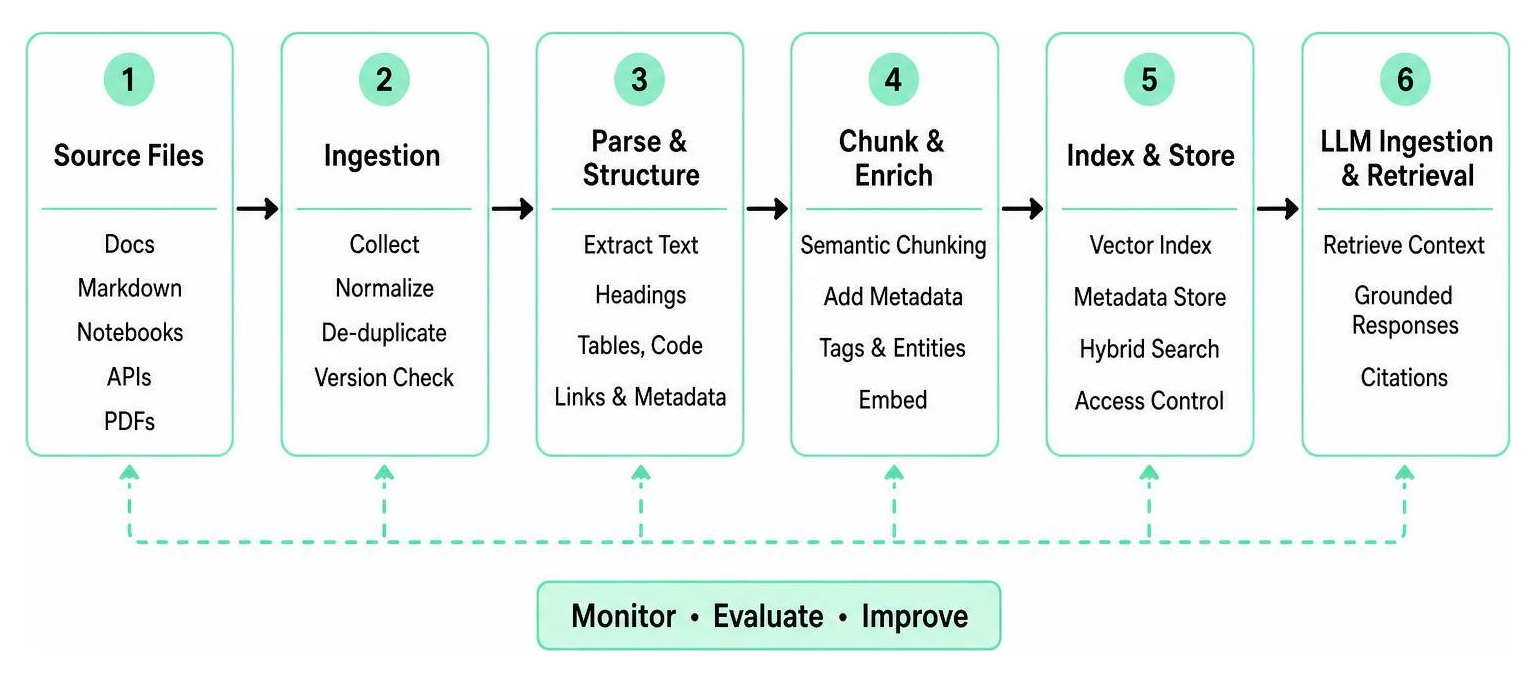
Creating documentation in 2026 requires a dual-focus approach: it must be delightfully clear to a human reader, yet perfectly structured for an LLM to ingest, index, and retrieve. If your documentation is poorly structured, AI search engines and customer support bots will pull incorrect, stale, or incomplete answers.
Optimizing for LLMs and RAG Pipelines
To make your documentation “AI-ready,” implement these architectural best practices:
- Use Semantic and Clear Hierarchies: Organize your content logically using clear H1, H2, and H3 headers. This helps parsing scripts split your files into clean, contextual chunks.
- Incorporate Rich Metadata: Add front-matter metadata to your Markdown files. Include fields like
tags,category,audience, andlast_updatedto help vector search engines filter results. - Write Declarative, Standalone Sentences: Avoid ambiguous pronouns like “it” or “this” when referring to complex systems. Instead, write explicit sentences: “The authentication token must be included in the header,” rather than, “It needs to go in the header.”
- Maintain Project Context Files: Utilize project configuration and context files (such as
ARCHITECTURE.mdorSKILL.md) to give AI agents a high-level roadmap of your system.
Maintaining Human Readability and Tone
While optimizing for machines is crucial, humans remain the ultimate decision-makers. Your documentation must stay engaging, accessible, and reader-friendly.
- Adhere to Clear Style Guides: Establish a consistent tone, whether it is highly technical for developer APIs or friendly and supportive for end-user guides.
- Keep Tutorials Actionable: Design tutorials that guide users from zero to a working prototype in under 20 minutes.
- Simplify Complex Architecture: Translate deep engineering concepts into plain, accessible English. Use diagrams (such as Mermaid or Excalidraw) to visualize complex data flows.
- Audit for Freshness Regularly: Conduct quarterly audits to prune deprecated endpoints, fix broken links, and update outdated code samples.
How to Apply and Demonstrate Your AI Documentation Skills
When applying for remote positions, simply stating that you are a “good writer” is no longer enough. You must actively demonstrate your familiarity with AI-assisted workflows, docs-as-code principles, and structured writing.
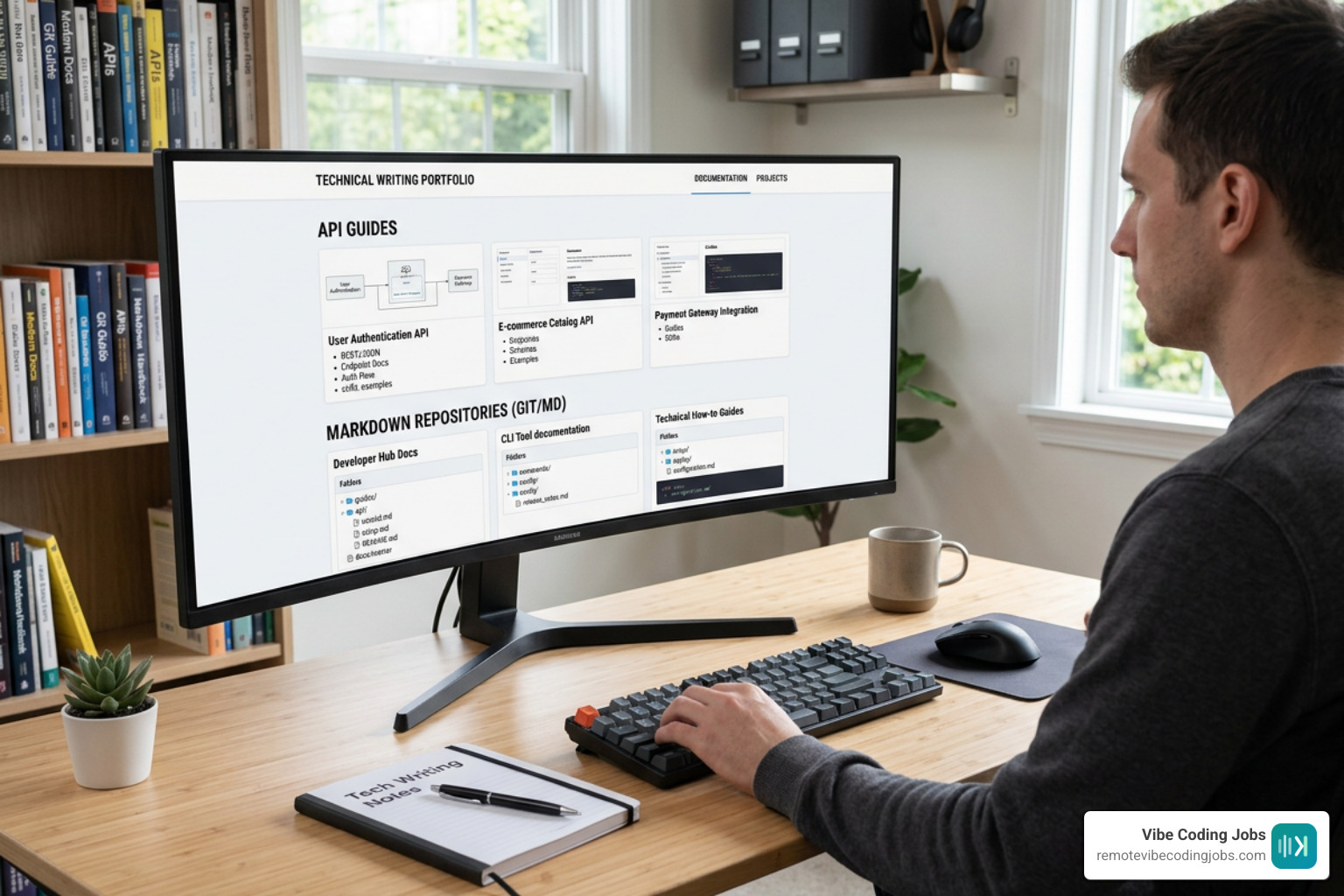
To stand out in a competitive hiring pool, you should build a portfolio that reflects modern engineering standards. Be sure to Read about landing remote vibe coding jobs to understand how companies evaluate candidates who leverage AI tools in their day-to-day work.
Building an AI-Assisted Documentation Portfolio
Your portfolio is your strongest asset. Instead of sending static PDF samples, host your portfolio publicly:
- Create a GitHub Repository: Host your writing samples in a public GitHub repository. This demonstrates to hiring managers that you understand Git, pull requests, and Markdown version control.
- Deploy a Live Docs Site: Use Docusaurus, Sphinx, or GitBook to publish a live, searchable documentation site. Include examples of API guides, troubleshooting FAQs, and quick-start tutorials.
- Document an AI Project: Write a comprehensive guide for an open-source AI project or a simple application. Show how you structured the content to be RAG-friendly.
If you want to see how top-tier teams structure their documentation and what they look for in senior hires, check out the AI Documentation Engineer Job Details | Bentley Systems to see how enterprise companies construct their documentation pipelines.
Showcasing Vibe Coding and AI Workflows
Hiring managers want to see that you know how to use AI to make yourself a highly efficient writer. In your cover letter and portfolio, explain how you use AI-native tools:
- Explain Your Prompting Strategy: Share how you use LLMs to generate initial drafts from Jira tickets, code commits, or developer notes, and how you edit those drafts for accuracy.
- Demonstrate Code Validation: Explain how you use tools like Cursor or Claude Code to test your documentation’s code snippets against staging environments to ensure they run flawlessly.
- Highlight Automation: Show how you automate translation, accessibility checks, or link auditing using AI scripts.
To prepare for technical interviews that focus on practical, real-world skills rather than abstract coding puzzles, check out our guide on Remote Coding Jobs No Leetcode Easy Interview Practical Skills.
Frequently Asked Questions about AI Documentation
What is the difference between an AI documentation specialist and an AI evaluation specialist?
An AI Evaluation Specialist (often paying $20 to $35/hr) focuses on testing LLM outputs, refining evaluation rubrics, and conducting quality assurance on model behaviors. Their work is analytical and repetitive, helping to train next-generation models.
An AI Documentation Specialist is a content creator and information architect. They write developer guides, design structured content systems, manage API portals, and build documentation pipelines that support product adoption and RAG systems.
Do I need to know how to code to be an AI documentation specialist?
You do not need to be a full-stack software engineer, but you do need to be technically literate. You should be able to read and understand basic code snippets in languages like Python or TypeScript, write structured Markdown and XML, and test API endpoints.
Embracing “vibe coding” (using AI assistants to write and debug code samples) is highly valuable, as it allows you to quickly generate and validate code tutorials for your documentation. To see how this approach is transforming modern tech careers, read about how Vibe Coding Jobs Remote Career Success can open doors to highly technical roles.
Where can I find remote AI documentation jobs?
You can find remote documentation roles on general job boards, but the best way to land a role at an AI-forward, async-first company is to use curated platforms that focus on AI-assisted workflows. Look for job boards that specialize in modern developer cultures, where companies actively seek candidates who know how to use Cursor, Claude, and modern docs-as-code toolchains.
Conclusion
The role of the technical writer has evolved. In 2026, landing an ai documentation specialist remote position requires a blend of clear, human-focused communication and a deep understanding of how AI systems consume structured data. By mastering tools like Markdown, Git, Docusaurus, and DITA XML, and by demonstrating your ability to collaborate with LLMs, you can position yourself at the forefront of this highly lucrative field.
At Remote Vibe Coding Jobs, we curate daily listings of remote, async-first positions for developers, writers, and technical specialists who leverage AI to work smarter. If you are ready to take the next step in your career and find companies that value modern, AI-assisted workflows, explore our curated listings and Find remote vibe coding and AI documentation jobs today.