
Why “Culture Fit” Is Broken — and What AI Is Doing About It
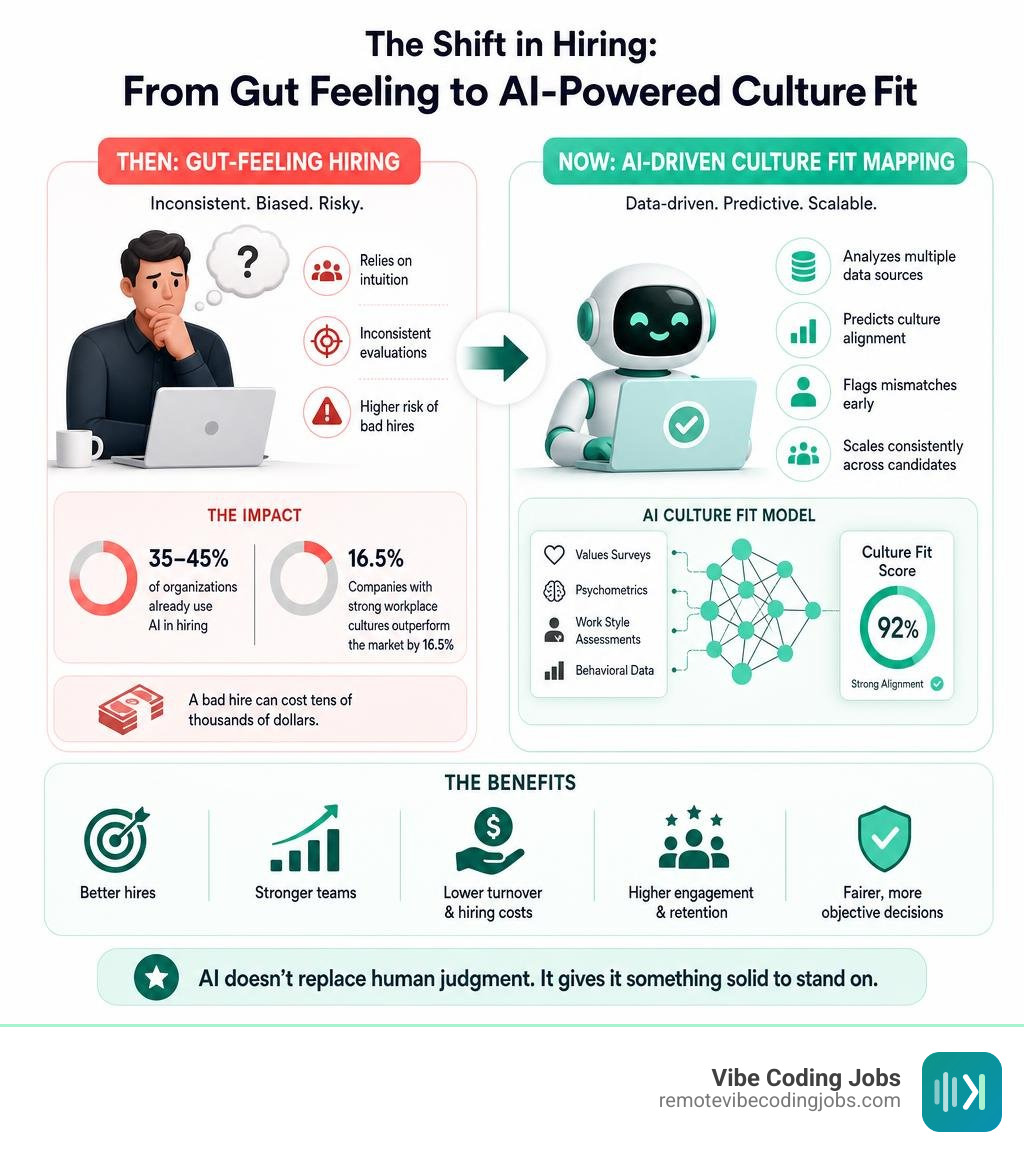
AI assisted culture fits are changing how companies decide who belongs on their team — moving away from gut feelings and toward data that actually predicts success.
Quick answer: How does AI assist with culture fit screening?
- Analyzes multiple data sources — values surveys, psychometrics, work style assessments, and behavioral data — simultaneously
- Removes gut-feel bias by replacing informal impressions with structured, consistent scoring
- Predicts alignment between a candidate and your actual lived culture, not just your stated values
- Flags mismatches early — before a bad hire costs you time, money, and team morale
- Scales consistently across hundreds of candidates without interviewer fatigue
Here is why this matters right now: between 35% and 45% of organizations already use AI in hiring, and companies with strong workplace cultures outperform the market by 16.5%. Culture is not a soft metric — it drives real business outcomes. Yet most hiring teams still rely on a 45-minute interview and a gut feeling to make a call that costs tens of thousands of dollars if it goes wrong.
The problem is not that hiring managers are bad at their jobs. It is that human judgment alone is too slow, too inconsistent, and too easy to skew — especially when evaluating something as layered and hard to define as culture.
AI does not replace that judgment. It gives it something solid to stand on.
I’m the RVCJ Editorial team — we cover AI-assisted development, remote hiring trends, and career tools for engineers at async-first companies, including how AI assisted culture fits are reshaping the way tech teams are built and evaluated. We’ve analyzed the leading platforms, governance frameworks, and real hiring workflows so you can cut through the noise and act.
Learn more about AI assisted culture fits:
Why Traditional Hiring Fails and How AI Assisted Culture Fits Bridge the Gap

Traditional hiring processes suffer from a foundational flaw: they treat “culture fit” as an amorphous vibe check. Interviewers sit across from a candidate and ask themselves, “Would I want to grab a coffee with this person?”
While this might determine whether two people share similar hobbies, it fails completely at predicting long-term alignment, retention, or performance. This “gut-feeling” approach is highly susceptible to unconscious bias, leading companies to hire carbon copies of their existing workforce instead of building diverse, high-performing teams.
By contrast, AI assisted culture fits turn qualitative, abstract values into structured, measurable dimensions. AI platforms analyze behavioral patterns, communication styles, and situational judgment to assess how a candidate’s working preferences align with an organization’s actual operational environment.
This is particularly critical for forward-thinking organizations. If you look at the Best Companies Hiring AI Developers Remote Culture Ratings, you will find that the top-performing teams are those that replace vague affinity checks with structured, objective cultural metrics.
| Hiring Dimension | Traditional Gut-Feeling Hiring | AI-Assisted Culture Screening |
|---|---|---|
| Primary Metric | Likability, shared hobbies, and verbal polish. | Values alignment, behavioral consistency, and work styles. |
| Consistency | Highly variable; dependent on interviewer mood and bias. | Standardized; identical evaluation criteria for every candidate. |
| Data Sources | Resume keyword matching and a 45-minute casual conversation. | Psychometrics, situational judgment scenarios, and communication data. |
| Bias Risk | High; prone to similarity bias and halo effects. | Low; structured algorithms focus strictly on pre-defined cultural markers. |
| Cost & Speed | High coordination cost; weeks of back-and-forth interviews. | Low cost; rapid pre-screening completed in under 15 minutes. |
The Cost of Cultural Mismatch in 2026
In July 2026, workplace dynamics are more distributed, , and reliant on high-agency execution than ever before. When a new hire does not align with your cultural operating system, the consequences are swift and expensive.
Research shows that culture alone accounts for up to 26.6% of individual employee performance. Furthermore, fostering a genuine sense of belonging in the workplace leads to a 56% increase in job performance and a 50% drop in turnover risk. For a 10,000-person enterprise, building this level of cultural alignment translates to up to $52 million in annual savings from reduced attrition alone.
When organizations fail to screen for cultural alignment, turnover rates spike, team productivity plummets, and burnout spreads. This is why leading companies are leveraging specialized assessment tools. For example, platforms like Culture Fit Assessment Platform for Hiring | MyCulture.ai help employers move away from speculative hiring by mapping a candidate’s core values directly to the team’s working reality before an offer letter is ever drafted.
Moving Beyond Personality Tests to True AI Assisted Culture Fits
For decades, HR departments relied on traditional personality tests like the Myers-Briggs Type Indicator (MBTI) or the Enneagram to evaluate candidates. While these tests are fun for team-building exercises, they have incredibly low predictive validity when it comes to job performance and actual cultural alignment. A person’s personality type does not tell you how they will handle a sudden shift in company direction, how they collaborate across time zones, or whether they value speed over perfection.
Modern AI systems move beyond static personality profiles by utilizing dynamic organizational development frameworks, such as the Organizational Culture Assessment Instrument (OCAI). By analyzing how candidates prioritize competing values—such as flexibility versus stability, or internal collaboration versus external market competition—AI paints a highly accurate picture of their work style.
Instead of asking “Who is this person?” AI-assisted culture screening asks, “How does this person solve problems, communicate under pressure, and align with our core operational values?”
How to Build an AI-Driven Culture Assessment Framework
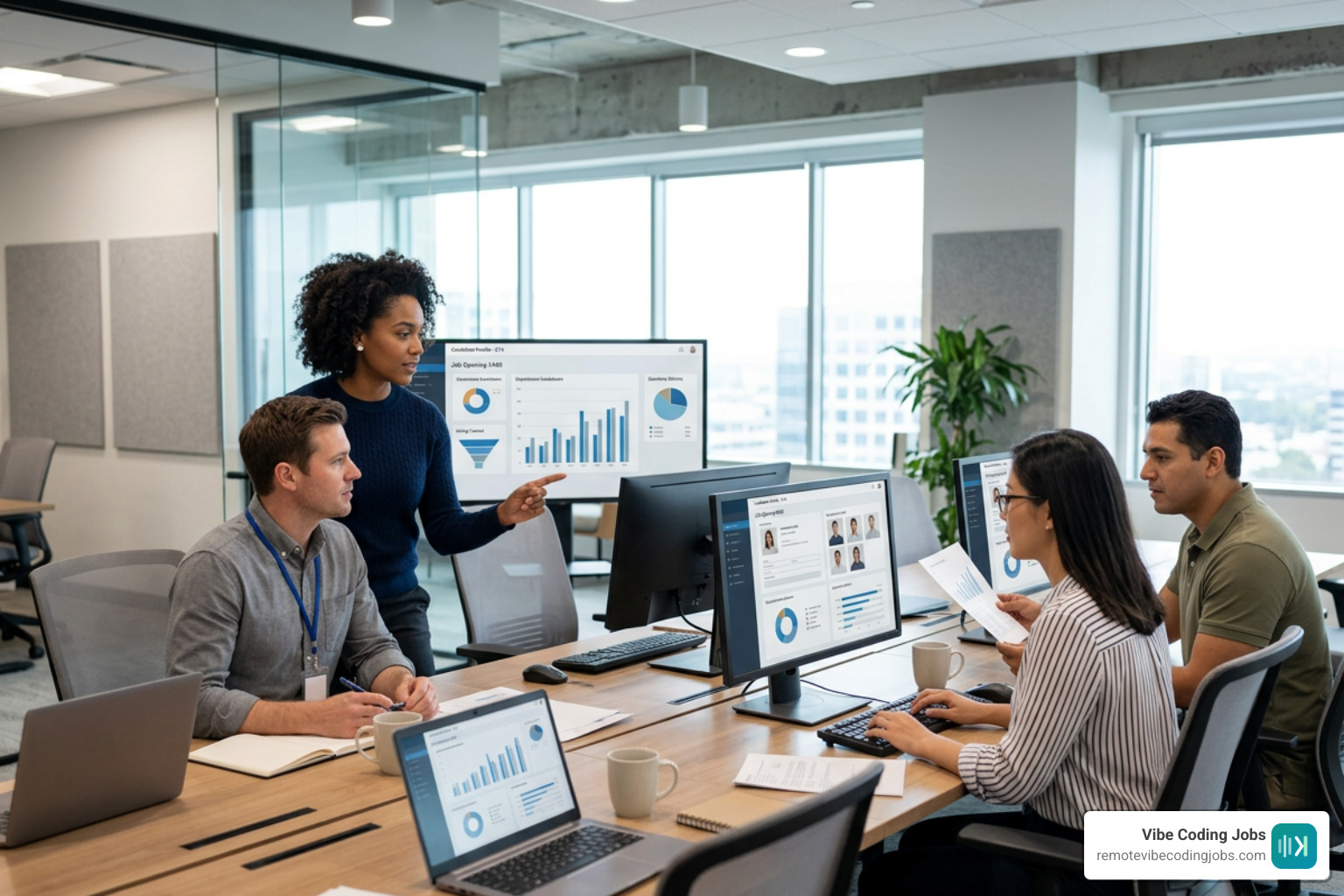
Building an effective AI-assisted culture framework requires moving away from isolated tools and creating an integrated data ecosystem. The goal is to establish a system that continuously feeds real-world organizational insights back into your hiring pipeline.
This is especially vital for Async First Companies Hiring Developers Find Your Dream Remote Job, where cultural traits like written clarity, asynchronous ownership, and documentation discipline are the literal lifeblood of daily operations.
Integrating Multi-Source Data for Deep Cultural Insights
An AI tool is only as good as the data it ingests. To build an accurate cultural baseline, your AI model must look beyond high-level mission statements and analyze the actual, lived behaviors within your teams.
Modern platforms achieve this by combining multiple data streams:
- Psychometric and Behavioral Assessments: Measuring cognitive styles, risk tolerance, and collaboration preferences.
- Internal Sentiment and Engagement Data: Analyzing anonymized pulse surveys and feedback loops to understand current team dynamics.
- Communication Patterns: Evaluating public Slack channels, documentation updates, and project management updates to map how work actually gets done.
Rather than relying on slow, outdated, and incredibly expensive traditional consulting firms that take months to deliver static reports, organizations are turning to automated systems. Advanced services like CultureAgent | The Future of Organizational Intelligence use AI to simultaneously analyze internal documentation, handbooks, and communication flows. This allows companies to map their actual cultural maturity and identify discrepancies between their “stated” values and their “lived” work styles in days instead of months.
Designing the Candidate Experience for AI Assisted Culture Fits
No one wants to go through a grueling, multi-hour assessment process just to apply for a job. If your culture screening process is tedious, your top-tier candidates will simply drop out of your hiring funnel.
To prevent candidate drop-off, the assessment must be lightweight, transparent, and engaging:
- Keep it Short: Restrict the core cultural assessment to a highly interactive, 10-to-15-minute experience.
- Use Situational Judgment Simulations: Replace boring multiple-choice questions with realistic, role-play scenarios that reflect actual daily challenges.
- Offer Immediate Value: Provide candidates with a brief, personalized summary of their work style and strengths upon completion. This turns a transactional screening step into a mutually beneficial learning experience.
- Maintain Absolute Transparency: Clearly explain why you are using AI, what data is being analyzed, and how the insights will be used to support—not replace—human hiring decisions.
Balancing Algorithmic Insights with Human Judgment
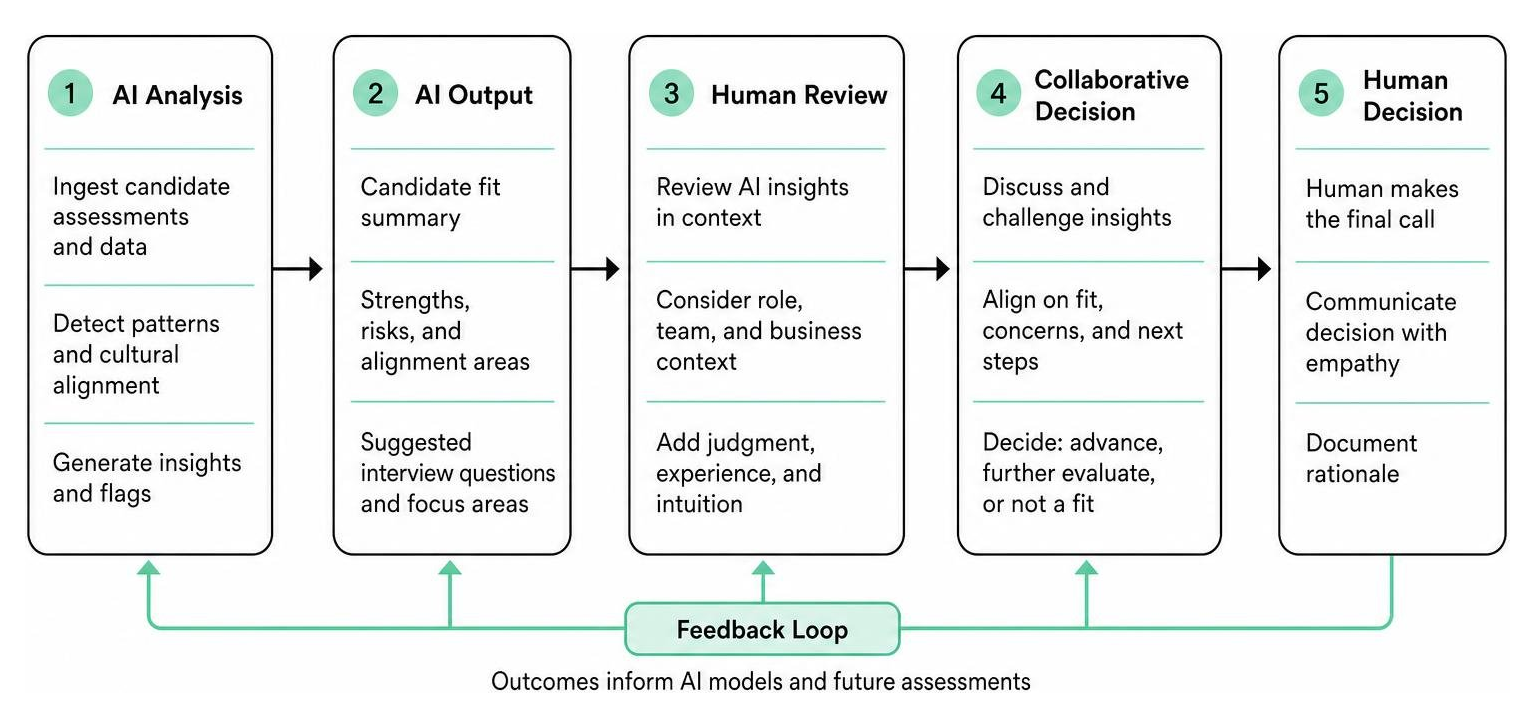
The most dangerous mistake an organization can make is treating AI as an autonomous decision-maker. AI is an exceptional pattern-recognition tool, but it lacks empathy, contextual understanding, and the ability to read between the lines.
To build a fair, inclusive, and highly effective hiring process, companies must implement a collaborative “human-in-the-loop” model. AI should highlight patterns and suggest tailored interview questions, but human hiring managers must always make the final decision.
Establishing Cross-Functional AI Governance
Deploying AI tools that analyze employee values, behaviors, and communication styles requires rigorous oversight. Organizations must establish clear internal policies to manage security, data privacy, and ethical alignment.
A highly effective blueprint for this is FIT’s Collaborative Approach to AI, which showcases how institutions can build cross-functional committees (such as an AURA committee) to oversee AI usage, responsibility, and adaptation.
To implement a similar governance structure in your business, consider the following checklist:
- [ ] Form a Cross-Functional AI Committee: Include representatives from HR, Legal, IT Security, and Engineering.
- [ ] Define Data Privacy Boundaries: Ensure all employee and candidate data is encrypted (using AES-256 standards) and complies with global data protection regulations (like GDPR or PDPA).
- [ ] Establish “Safe Paths to Yes”: Create clear guidelines for how teams can safely experiment with new generative AI tools without exposing sensitive corporate IP.
- [ ] Perform Annual Policy Audits: Review your AI integration guidelines at least once a year to keep pace with rapid technological advancements.
Auditing AI Outputs for Fairness and Inclusion
If an AI model is trained on historical hiring data from a company that historically hired a homogeneous workforce, the algorithm will naturally learn to replicate those exact biases. Left unchecked, AI can systematically filter out highly qualified, diverse candidates under the guise of “cultural fit.”
To prevent this, HR teams must run regular, structured audits of their AI systems. This includes checking for demographic parity to ensure the tool does not yield disparate pass rates across different genders, races, or age groups.
Furthermore, instead of relying on subjective “gut feelings” during the final interview stages, hiring teams must use structured, evidence-based evaluation rubrics. By combining objective AI metrics with diverse human review panels, organizations can design a hiring process that actively champions equity while maintaining an exceptionally high bar for cultural alignment.
Scaling Culture Beyond Hiring: Onboarding, Coaching, and Development
Cultural alignment does not end once a candidate signs their offer letter. In fact, that is exactly where it begins. The true power of AI assisted culture fits lies in their ability to support an employee throughout their entire lifecycle—accelerating onboarding, personalizing professional development, and strengthening team dynamics over time.
This continuous cultural development is particularly impactful in high-speed technical environments. As outlined in our AI Assisted Development Career Guide, the rise of AI-assisted engineering means that technical skills are compounding faster than ever. In this landscape, soft skills, adaptability, and cultural alignment become an employee’s ultimate long-term differentiators.
Accelerating Time-to-Proficiency with AI Coaching
Traditional corporate training programs are notoriously inefficient; studies show that up to 45% of standard training becomes “scrap learning” that employees never actually apply to their daily work.
AI-driven coaching platforms solve this by offering highly personalized, interactive role-play simulations that adapt to an employee’s specific cultural and behavioral gaps.
Using platforms like Culture Fit AI – Develop Talent Who Truly Thrive in Your Culture, companies can set up customized coaching modules in under three minutes. For example, a newly promoted engineering manager can engage in an interactive, voice-led AI simulation to practice delivering constructive feedback or navigating a difficult project delay.
These 15-minute micro-coaching sessions have been shown to increase manager confidence by 30% while reducing overall onboarding times by 25%.
Measuring and Improving Organizational Cultural Maturity
Instead of waiting for an annual engagement survey to tell you that your team is burnt out, modern organizations use AI sentiment analysis to monitor organizational health in real time.
By analyzing anonymized digital communication patterns, AI can spot early signs of cultural drift, siloed communication, or impending burnout before it leads to a wave of resignations.
Furthermore, these insights allow leaders to benchmark their cultural maturity across multiple domains—such as psychological safety, innovation, and execution speed. This transforms culture from a vague concept into a clear, dashboard-driven metric that can be actively measured, refined, and improved week over week.
Frequently Asked Questions about AI Culture Screening
Can AI truly understand and measure human workplace culture?
Yes, but not in the way a human does. AI does not “feel” culture; instead, it excels at recognizing the behavioral, linguistic, and operational patterns that define it. By analyzing structured data—such as situational judgment decisions, communication styles, and values prioritization—AI can map an individual’s working habits to an organization’s actual environment with a level of consistency and speed that human interviewers simply cannot match.
How do AI culture tools protect candidate and employee data privacy?
Reputable AI culture platforms prioritize data security by utilizing enterprise-grade AES-256 encryption for data both at rest and in transit. They operate in strict compliance with global privacy standards such as GDPR, CCPA, and PDPA. Furthermore, leading systems ensure that individual communication data is fully anonymized and aggregated before generating cultural insights, protecting individual employee privacy while still delivering actionable organizational metrics.
What is the difference between a personality test and an AI culture fit assessment?
Traditional personality tests measure static, individual traits (e.g., whether someone is an extrovert or an introvert) and have very low predictive validity for job performance. An AI-assisted culture assessment, on the other hand, measures dynamic operational alignment. It evaluates how a candidate’s values, communication preferences, and decision-making styles align with a specific team’s lived working environment, offering significantly higher predictive validity and legal defensibility.
Conclusion
The era of relying on unstructured interviews and intuitive “vibe checks” to build cohesive, high-performing teams is coming to an end. By leveraging AI assisted culture fits, companies can systematically eliminate bias, dramatically reduce turnover costs, and build inclusive workplaces where employees genuinely belong and thrive.
As the tech landscape shifts toward highly autonomous, AI-driven development workflows, aligning your team’s culture around speed, agency, and continuous learning is no longer optional—it is a business imperative.
At Vibe Coding Jobs, we curate the best remote opportunities at forward-thinking, async-first companies that value both cutting-edge AI tools and deep cultural alignment.
Ready to build the future of software? Learn more about the future of work and vibe coding and find a remote team that perfectly matches your development style today.