Remote PHP Web Developer Jobs Are Booming — Here’s What You Need to Know
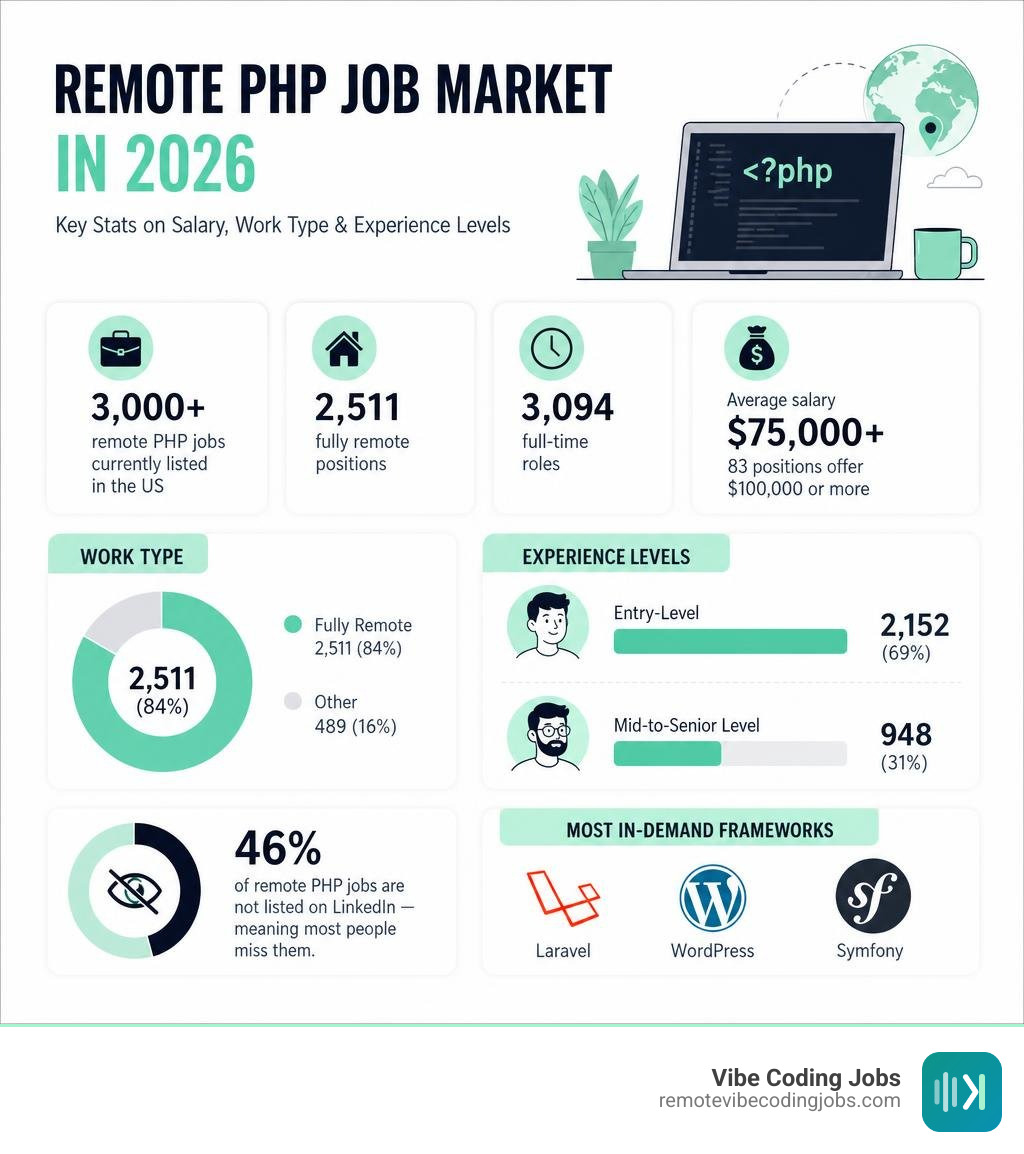
Remote PHP web developer jobs are plentiful right now, with over 3,000 active listings in the United States alone. If you want the quick picture:
Top facts about the remote PHP job market in 2026:
- 3,000+ remote PHP jobs currently listed in the US
- 2,511 of those are fully remote positions
- 3,094 are full-time roles
- Average salary starts at $75,000+, with 83 positions offering $100,000 or more
- 2,152 openings are entry-level; 948 are mid-to-senior level
- 46% of remote PHP jobs are not listed on LinkedIn — meaning most people miss them
- Most in-demand frameworks: Laravel, WordPress, Symfony
PHP has powered the web for decades, and it still does — running everything from massive publishing platforms delivering thousands of pages per second to lean startup products built with Laravel. The remote shift has made these roles accessible from anywhere, and companies are actively hiring across all experience levels right now.
I’m part of the RVCJ Editorial team at Remote Vibe Coding Jobs, where we cover remote developer hiring, AI-assisted workflows, and career guidance — including tracking trends in remote PHP web developer jobs across async-first companies and modern engineering teams. In this guide, we’ll map out everything you need to land one of these roles.
Remote php web developer jobs word guide:
The Landscape of Remote PHP Web Developer Jobs in 2026

The market for remote PHP web developer jobs in July 2026 is incredibly resilient. Despite periodic shifts in the broader tech sector, PHP remains the absolute backbone of the web, powering over 75% of all websites with an active backend language. Our latest research shows that out of 3,418 total PHP jobs listed in the United States, an overwhelming 2,511 are fully remote positions. Additionally, 3,094 of these roles are full-time, proving that companies are looking for dedicated long-term remote team members rather than just temporary gig workers.
However, finding these opportunities requires looking in the right places. Did you know that 46% of remote PHP jobs are not listed on LinkedIn? Relying solely on massive, generic job boards means you are missing out on nearly half of the available market. Instead, smart developers are finding success by exploring specialized networks and platforms.
If you are starting your search, some of the best places to look include:
- Remote PHP Developer Jobs for curated, AI-friendly, and async-first positions.
- 1000+ Remote Php jobs in United States to keep tabs on the main corporate listings.
Entry-Level vs. Senior Remote PHP Web Developer Jobs
One of the most surprising statistics in the July 2026 job market is the high volume of entry-level listings. There are currently 2,152 remote PHP jobs listed at the entry level, compared to 948 at the mid-to-senior level. This indicates a massive willingness among employers to bring on junior talent and train them up, provided they possess a strong foundation in PHP fundamentals and a high level of self-direction.
To help you understand how expectations shift as you progress, we have mapped out the career trajectory below:
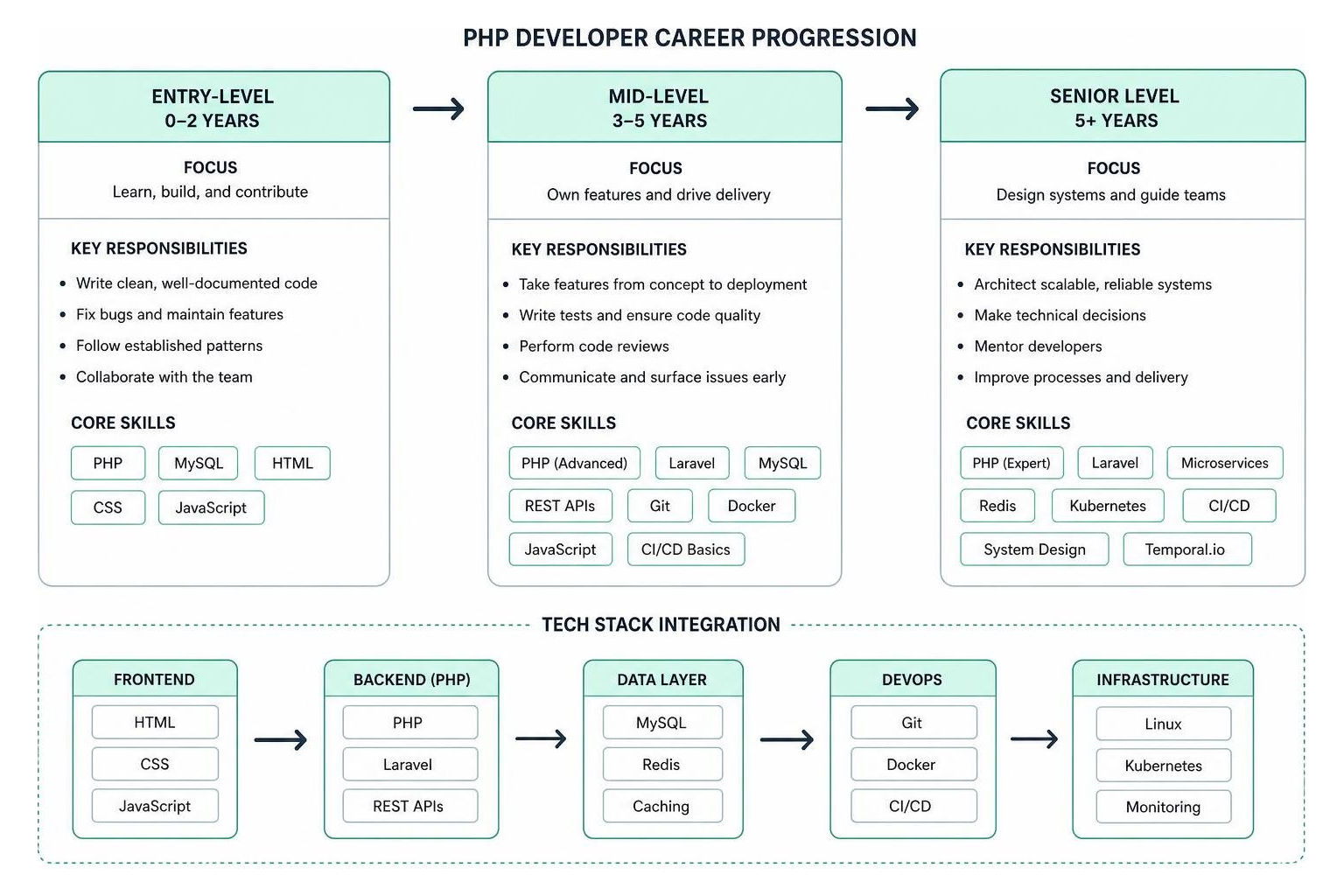
- Entry-Level (0-2 years of experience): At this stage, companies look for core PHP proficiency, basic MySQL database knowledge, and comfort with HTML, CSS, and JavaScript. You will mostly write clean, well-documented code, fix bugs, and help maintain existing features.
- Mid-Level (3-5 years of experience): As a mid-level developer, expectations shift toward system ownership and proactive communication. Companies look for candidates who can take a feature from concept to deployment, write detailed pull request descriptions, give thoughtful code reviews, and surface problems early.
- Senior Level (5+ years of experience): Senior roles require deep architectural knowledge. For instance, senior engineers are expected to build high-scale digital publishing platforms that deliver thousands of pages per second to hundreds of millions of users. At this level, you must master distributed systems, CI/CD pipelines, and workflow orchestration frameworks like Temporal.io.
Typical Work Arrangements for Remote PHP Web Developer Jobs
When browsing remote PHP web developer jobs, you will encounter three primary types of work arrangements:
- Fully Remote (Permanent): These accounts for the vast majority of listings (over 2,500 open roles). You can work from anywhere within specified timezone boundaries. Many of these companies run on async-first principles, prioritizing written documentation, clear Slack communication, and GitHub workflows over constant, disruptive meetings.
- Contract / Freelance: These are project-based roles, which typically last around 6 months with the possibility of ongoing maintenance. These roles are perfect for developers who love rebuilding legacy systems or migrating databases from scratch.
- Hybrid Remote: While less common for PHP roles, some companies still require occasional office visits. However, with modern PHP development being highly independent, fully remote is the gold standard.
To thrive in these environments, you must adapt to the communication rhythms of the company. For example, some European-based startups require a partial timezone overlap for daily standups (e.g., 09:00–09:30 CET), while others are entirely asynchronous and rely entirely on written updates.
Essential Tech Stacks and Frameworks for PHP Developers
Knowing “just PHP” is rarely enough to land a top-tier remote role. Modern web development relies heavily on frameworks, robust databases, and modern frontend tools. If you want to maximize your job options, keeping an eye on Open Source PHP Jobs will show you exactly what combinations employers are actively seeking.
Modern MVC Frameworks and Databases
Model-View-Controller (MVC) frameworks dominate the PHP ecosystem. Laravel is the undisputed king, with Symfony following closely behind for enterprise-level applications.
- Laravel 11: The latest iteration of Laravel is heavily featured in modern job postings. It streamlines authentication, routing, sessions, and caching.
- PostgreSQL & MySQL: You must know how to design efficient database schemas, write optimized queries, and manage migrations.
- ElasticSearch: High-traffic applications frequently pair PHP with ElasticSearch to handle massive datasets. Many modern roles focus on combining traditional backend development with search and AI-related functionality, processing millions of data records.
In 2026, the way we write these frameworks has changed. Modern developers leverage AI-assisted tools like Cursor, Claude, and GitHub Copilot to write boilerplate migrations, generate PHPUnit tests, and optimize complex SQL queries. Embracing these “vibe coding” practices allows you to build features up to five times faster.
Content Management Systems and Frontend Integration
Beyond MVC frameworks, a significant portion of the remote PHP market is centered around Content Management Systems (CMS) and modern frontend integrations.
- WordPress: WordPress powers over 40% of all websites. Many remote roles require strong PHP skills to build custom plugins, secure user-generated content, and optimize MySQL queries.
- Modern Frontends: Gone are the days of basic HTML and CSS. Modern PHP applications often use lightweight frontend tools like Alpine.js and TailwindCSS, or full JavaScript frameworks like React, TypeScript, and AngularJS.
- Legacy Modernization: Many companies hire remote developers to modernize legacy LAMP (Linux, Apache, MySQL, PHP) or WAMP (Windows, Apache, MySQL, PHP) stacks. Developers are often tasked with building responsive interfaces using Bootstrap and jQuery while integrating modern backend microservices.
Salary Benchmarks and Benefits in the 2026 Market
What can you expect to earn as a remote PHP developer in July 2026? The average salary for remote PHP developer roles starts at $75,000+, but top-tier senior positions easily push past the six-figure mark.
Here is a breakdown of what the current market offers:
| Experience Level | Annual Salary Range | Key Requirements |
|---|---|---|
| Entry-Level | $60,000 – $80,000 | Core PHP, Basic MySQL, HTML/CSS/JS, eager to learn |
| Mid-Level | $85,000 – $105,000 | 3-5 years experience, framework proficiency (Laravel/Symfony), system design |
| Senior Level | $110,000 – $150,000+ | 5+ years experience, high-scale architecture, CI/CD, team leadership |
In addition to base salaries, remote PHP roles come with excellent benefits packages. Standard perks include:
- Retirement & Financials: 401(k) matching and retirement plans.
- Health & Wellness: Comprehensive health insurance, Health Savings Accounts (HSA), and mental health support.
- Time Off: Generous leave policies. For example, some companies offer 15 days of vacation leave, 10 days of sick leave, and 5 days of emergency leave.
- Remote Work Stipends: Budgets for home office setups, high-speed internet, and continuous learning opportunities.
How to Stand Out and Apply for Remote PHP Roles
With thousands of developers applying for remote roles, you need a strategy to stand out. Here are our top tips for landing your next remote PHP role:
- Follow Application Instructions Verbatim: Many remote companies use “filter questions” or hidden prompts to weed out automated applications. For example, some companies require applicants to start their proposal with a specific keyword like “Tulip” and answer three specific technical questions about database optimization. Another company might ask you to name your favorite animal in your cover letter. Missing these details results in an instant rejection.
- Showcase Real, Working Code: Don’t just list skills on your resume. Provide links to your GitHub profile, public repositories, or active web applications.
- Highlight Your Written Communication: In a remote environment, writing is your primary tool. Write a clear, concise, and personalized cover letter. Keep your PR descriptions detailed and demonstrate that you can explain complex technical decisions in simple terms.
- Leverage AI Tools: Don’t be afraid to show that you use Cursor, Claude Code, or Copilot. Modern, forward-thinking companies love “vibe coders” who know how to use AI to build MVPs rapidly, write comprehensive unit tests, and maintain high code quality.
Navigating Other Remote Developer Paths
If you are open to exploring other languages alongside PHP, or are considering a transition, the remote job market offers incredible opportunities in other ecosystems. You can check out our dedicated guides to expand your horizons:
- Learn how to transition your backend skills with our Remote Python Developer Jobs 2026 Guide.
- Master modern frontend and full-stack development with our Remote TypeScript Developer Jobs 2026 Guide.
Frequently Asked Questions about Remote PHP Jobs
What is the average salary for remote PHP developers in 2026?
The average salary for remote PHP developers sits at $75,000+, with mid-level roles ranging from $85,000 to $105,000. Highly experienced senior developers and full-stack engineers can easily secure salaries between $110,000 and $150,000+ per year.
Which frameworks are most in demand for remote PHP roles?
Laravel remains the most demanded framework by a wide margin, especially with the release of Laravel 11. Symfony is highly sought after for corporate and enterprise-level applications, while WordPress development continues to dominate the CMS and digital marketing sectors.
How can I find remote PHP jobs that are not listed on traditional job boards?
Since nearly 46% of remote PHP jobs are not listed on LinkedIn, you should look at curated, specialized platforms. Using job boards that focus specifically on remote work, open-source tech, or AI-assisted development is the best way to bypass the noise and find direct, high-quality listings.
Conclusion
The market for remote PHP web developer jobs in July 2026 is full of potential. Whether you are an entry-level developer looking for your first break or a seasoned senior engineer ready to architect high-scale systems, there is a remote team looking for your skills.
At Remote Vibe Coding Jobs, we believe the future of development belongs to those who combine strong programming fundamentals with modern, AI-assisted workflows. We curate daily listings of remote “vibe coding” jobs at async-first companies that value productivity, culture, and modern tools like Cursor and Claude.
Ready to find your next remote role? Visit https://remotevibecodingjobs.com to browse our curated job board, grab our free playbook, and take the next step in your remote web development career today!