
The Web Development Market Value in 2026: What the Numbers Actually Mean
The web development market value is one of the clearest signals of how fast the digital economy is growing — and the numbers are hard to ignore.
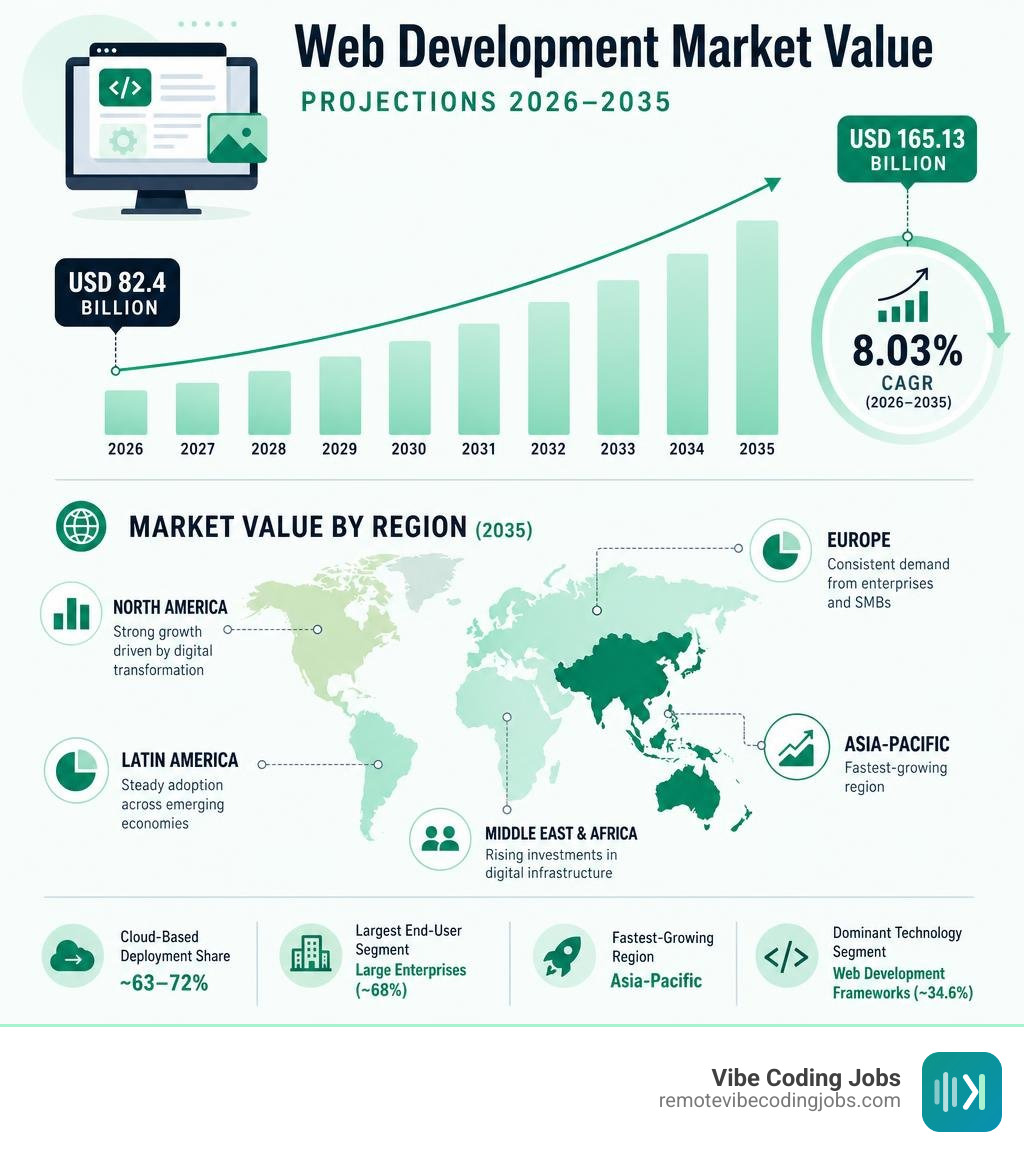
Here’s a quick snapshot for anyone who wants the short version:
| Metric | Figure |
|---|---|
| Market size in 2026 | USD 82.4 billion |
| Projected market size by 2035 | USD 165.13 billion |
| CAGR (2026–2035) | 8.03% |
| Cloud-based deployment share | ~63–72% |
| Largest end-user segment | Large Enterprises (~68%) |
| Fastest-growing region | Asia-Pacific |
| Dominant technology segment | Web Development Frameworks (~34.6%) |
The industry is roughly doubling in size over the next decade. That kind of growth doesn’t happen by accident — it’s being driven by e-commerce expansion, AI tooling, and a global push to digitize everything from healthcare to government services.
More than 71% of businesses now have a website. Over 5 billion people use the internet. And mobile devices account for roughly 60% of all web traffic. The demand for skilled web development — whether in-house or outsourced — is only going up.
We’re RVCJ Editorial, the team behind Remote Vibe Coding Jobs, where we track developer hiring trends, AI tooling, and remote work data across the web development market value landscape daily. This context shapes everything we publish here, and we’ll use it to break down exactly where the market is headed and what it means for developers and teams building with AI.
Common web development market value vocab:
Global Web Development Market Value: Current Sizing and 2035 Forecast

To understand where the web development industry is going, we first have to look at the sheer scale of the global digital footprint. In 2026, the global web development market has matured into a massive, multi-faceted ecosystem. It is no longer just about building static landing pages; it is about engineering complex, cloud-native web applications, managing composable commerce systems, and integrating artificial intelligence directly into the user interface.
According to the comprehensive Web Development Market Size, Trends & Outlook Report 2035, the market is entering a prolonged period of steady, high-value expansion. As organizations transition from basic web presence to highly interactive, personalized, and regulatory-compliant digital environments, the capital allocated to web engineering continues to break records.
Historical Growth and the Post-COVID Digital Acceleration
The trajectory of the web development market was permanently altered by the COVID-19 pandemic. Before 2020, digital transformation was a multi-year goal on most corporate roadmaps. When the pandemic hit, those multi-year plans had to be executed in a matter of weeks. Businesses without robust, interactive web platforms faced immediate operational irrelevance.
This period triggered an unprecedented e-commerce boom, with global retail e-commerce sales reaching $1,118.7 billion by 2023. To handle this surge, enterprises rushed to modernize legacy systems, migrate on-premises applications to the cloud, and optimize their digital storefronts. This transition shifted web development from a discretionary IT expense to a core business survival mechanism. Post-pandemic, this momentum did not slow down; instead, it evolved into a continuous cycle of modernization, security upgrades, and AI integration.
Projected Market Value and CAGR Through 2035
As we look forward from 2026, the financial projections highlight a highly lucrative decade for the industry:
- The Baseline Projection (8.03% CAGR): The global web development market is valued at USD 82.4 Billion in 2026 and is projected to reach USD 165.13 Billion by 2035, growing at an annual rate of 8.03%.
- The Conservative Model (6.3% CAGR): Other market analyses suggest a steady growth path from USD 55.12 Billion in 2024 to approximately USD 101.54 Billion by 2034, registering a 6.3% CAGR, driven primarily by business digitalization.
- The High-Growth Enterprise Model (9.7% CAGR): Some research models focusing heavily on advanced enterprise-level applications and AI-driven platforms project the market to scale from USD 112.4 Billion in 2026 to USD 258.6 Billion by 2035, accelerating at a 9.7% CAGR.
This massive influx of capital is directly impacting talent acquisition and compensation. Organizations are willing to pay a premium for engineers who can navigate this increasingly complex landscape. For a closer look at how these market dynamics are translating into developer compensation, check out our Remote Senior Software Engineer Salary Guide 2026.
Market Segmentation and Regional Growth Dynamics

The web development market is not a monolith. It is a complex puzzle of technologies, deployment models, service categories, and regional centers. To understand where the real value lies, we have to look at the individual segments driving this multi-billion-dollar industry, as detailed in the Web Developer Services Market Research Report 2034.
Technology Stack, Frameworks, and Deployment Models
The technical architecture of the web has shifted dramatically toward modularity, speed, and cloud-native scaling.
| Segment | Market Characteristics | Key Technologies |
|---|---|---|
| Frontend Development | Largest technology segment by volume; highly focused on user experience (UX) and performance. | React, Angular, Vue.js, Svelte, Next.js |
| Backend Development | Fastest-growing technical segment; driven by API creation, database scaling, and AI integrations. | Node.js, Python, PHP, Go, Ruby |
| Cloud-Based Deployment | Dominant deployment model, capturing 63.9% to 72.4% of all web engagements. | AWS, Azure, Google Cloud, Vercel |
| On-Premises Deployment | Shrinking but vital; retained by government and highly regulated industries for data sovereignty. | Private servers, secure local data centers |
The frontend landscape remains highly dynamic. React-based frontends, for instance, accounted for roughly 32.5% of all implementations. This framework’s dominance is creating massive demand in the remote job market; if you are looking to capitalize on this trend, explore our Remote React Developer Jobs: Your Ultimate 2026 Guide.
On the deployment side, serverless architectures are expanding at an impressive 18.10% CAGR. By shifting infrastructure management to cloud providers, companies are reducing their monthly hosting bills by up to 35% while ensuring their applications can scale instantly to meet traffic spikes.
Service Types and End-User Verticals
When businesses purchase web development services, they generally categorize their investments into three main areas:
- Web Design and Frontend UX: Representing about 24.9% of the service market, this is the visual and interactive layer. It is highly driven by the fact that users abandon websites that fail to load or look unprofessional within three seconds.
- Web Application Development: This is the fastest-growing service type, focusing on building custom, high-performance software that runs in the browser (such as SaaS platforms, internal portals, and interactive dashboards).
- E-Commerce and Content Management Systems (CMS): E-commerce development remains a massive margin generator, with companies spending heavily on custom shopfronts, subscription mechanics, and payment integrations.
From an end-user perspective, large enterprises command the majority of the market share (68.4%). These organizations have the capital to invest in custom-built, highly secure, and deeply integrated web systems. However, Small and Medium Enterprises (SMEs) represent the largest volume of buyers, rapidly adopting low-code platforms and SaaS-based web builders to establish their digital presence.
Regional Contributions to Global Web Development Market Value
The geographical distribution of the web development market reveals a fascinating balance between high-budget demand centers and rapid-growth engineering hubs:
- North America: Holding a dominant 36.8% market share (valued at over USD 20.28 Billion), North America leads the world in web development spending. High R&D budgets, a massive concentration of tech giants, and rapid adoption of AI tooling keep the US and Canada at the forefront of the industry.
- Asia-Pacific: This is the fastest-growing region globally, projected to expand at an outstanding 17.05% CAGR. This growth is fueled by rapid urbanization, massive investments in digital connectivity, and the expansion of cloud data centers.
- India: A vital engine of the global market, India hosts over 5.8 million professional developers and contributes approximately 12% of the global web development market value, serving as the world’s primary hub for engineering talent and platform modernization.
- China: Leading East Asian growth with an 8.8% CAGR in enterprise web outsourcing, China is heavily investing in localized cloud infrastructure and advanced web apps.
- Europe: Contributing roughly 31% to global market growth, European development is heavily influenced by strict data privacy laws (GDPR) and green computing standards, with Germany, France, and the UK leading the region’s digital ecosystem.
Industry Drivers, Restraints, and the AI Revolution
Every rapidly growing market faces a push-and-pull of catalysts and challenges. The web development industry is no exception, as highlighted in the Web Development Global Market Report 2026.
Key Market Drivers and Strategic Opportunities
Several technological shifts are driving the expansion of the web development market value:
- Mobile-First Optimization: With mobile devices generating about 60% of global web traffic, responsive design is no longer optional. It is a foundational business requirement.
- Progressive Web Apps (PWAs): Growing at a 13.45% CAGR, PWAs deliver app-like experiences directly through the browser. Brands like Pinterest, Starbucks, and Uber have reported double-digit lifts in conversion rates after migrating to PWA architectures.
- Headless CMS and Composable Commerce: By decoupling the frontend presentation layer from the backend database, composable commerce allows developers to swap out services (like checkout or search) without disrupting the entire site. This has trimmed enterprise release cycles from weeks to days.
Market Restraints, Regulatory Compliance, and Talent Shortages
Despite strong demand, the industry faces significant hurdles:
- Cybersecurity Vulnerabilities: Cyber threats are at an all-time high. In recent surveys, 24% of web development projects reported facing active security issues. With the average cost of a web application breach reaching $4.88 million, security is now a board-level concern.
- Strict Regulatory Environments: Developers must navigate a complex web of compliance mandates, including HIPAA (for healthcare), GDPR (in Europe), the EU AI Act (governing algorithmic transparency), and WCAG 2.2 accessibility standards. Failing to comply can result in catastrophic fines.
- The Developer Talent Shortage: Approximately 21% of SMEs cite a lack of skilled developers as a primary barrier to completing projects. This shortage has driven mid-level developer salaries up significantly over the past two years, lifting overall project costs by 10% to 15% annually.
How AI and Vibe Coding Impact Web Development Market Value
The most disruptive force in web development today is Artificial Intelligence. Far from replacing developers, AI is acting as an incredible force multiplier.
AI-powered pair-programming tools like GitHub Copilot, Cursor, and Claude are automating repetitive coding tasks, reducing software testing times by up to 50%, and boosting overall developer productivity by 35% to 40% per sprint.
This shift has birthed the concept of “vibe coding” — a development workflow where engineers use natural language to guide AI agents in writing, debugging, and deploying code. Instead of spending hours writing boilerplate CSS or repetitive SQL queries, developers can focus on high-level system architecture, security protocols, and creative UX design.
This transition is fundamentally changing the economics of web development. Startups and lean teams can now build and launch sophisticated web applications in days rather than months, redirecting their budgets toward custom features and market expansion. To explore how these AI tools are changing the career landscape and compensation models, dive into our guide on Remote Developer Jobs, AI Tools, Trends & Salary.
Competitive Landscape and Major Industry Players
The web development market is highly competitive, divided between massive SaaS platforms that democratize web building and specialized agencies that build bespoke enterprise solutions.
- SaaS and No-Code Giants: Companies like Wix, Shopify, WordPress (which powers over 43% of all websites globally), Squarespace, Adobe, and Salesforce dominate the volume market. They make it easy for small businesses and creators to launch highly functional websites instantly.
- Bespoke Engineering and Outsourcing Firms: For complex, high-security, and customized enterprise applications, organizations rely on global engineering firms such as ELEKS, OpenXcell, IndiaNIC, Unified Infotech, and Powercode. These players compete on their framework-specific expertise, cloud certifications, and compliance capabilities.
Frequently Asked Questions
What is the expected global web development market value by 2035?
The global web development market is anticipated to reach USD 165.13 Billion by 2035, growing at a steady Compound Annual Growth Rate (CAGR) of 8.03% from its 2026 valuation of USD 82.4 Billion. Some high-growth enterprise models project an even steeper climb, potentially reaching USD 258.6 Billion by 2035 if AI integration and cloud-native migrations continue at their current pace.
Which region dominates the web development industry?
North America currently dominates the web development market in terms of revenue, accounting for roughly 36.8% of the global share (valued at over USD 20.28 Billion). However, the Asia-Pacific region is the fastest-growing market in the world, projected to expand at an impressive 17.05% CAGR through the next decade, driven by rapid business digitization and massive developer hubs in India and China.
How is artificial intelligence affecting the web development market?
Artificial intelligence is transforming web development from a manual, line-by-line coding process into an architectural and strategic discipline. AI tools like Cursor, Claude, and GitHub Copilot are automating boilerplate code generation, cutting testing times in half, and enabling a new workflow called vibe coding. This shift allows developers to build complex applications faster, lowering entry barriers for startups while allowing enterprise engineers to focus on system security, scalability, and user experience.
Conclusion
The web development market value reflects an industry in the middle of a massive evolutionary leap. Driven by the relentless pace of digital transformation, the rise of Progressive Web Apps, and the integration of cloud-native architectures, the market is on track to double in value over the next decade.
At the heart of this growth is the AI revolution. AI-assisted development—or vibe coding—is not shrinking the market; it is expanding it. By making developers more productive, AI is lowering the cost of innovation, allowing companies to build more ambitious web applications than ever before. For developers, this means the future is not about writing repetitive code; it is about mastering system design, utilizing AI tools, and focusing on product strategy.
If you are a developer looking to stay ahead of these trends and find a team that embraces modern, AI-powered workflows, we can help. Explore Remote Developer Salaries on our platform today, browse curated daily job listings, and find your next remote role at an async-first company that values your vibe coding skills.