
Remote Java Developer Jobs Are Booming — Here’s What You Need to Know
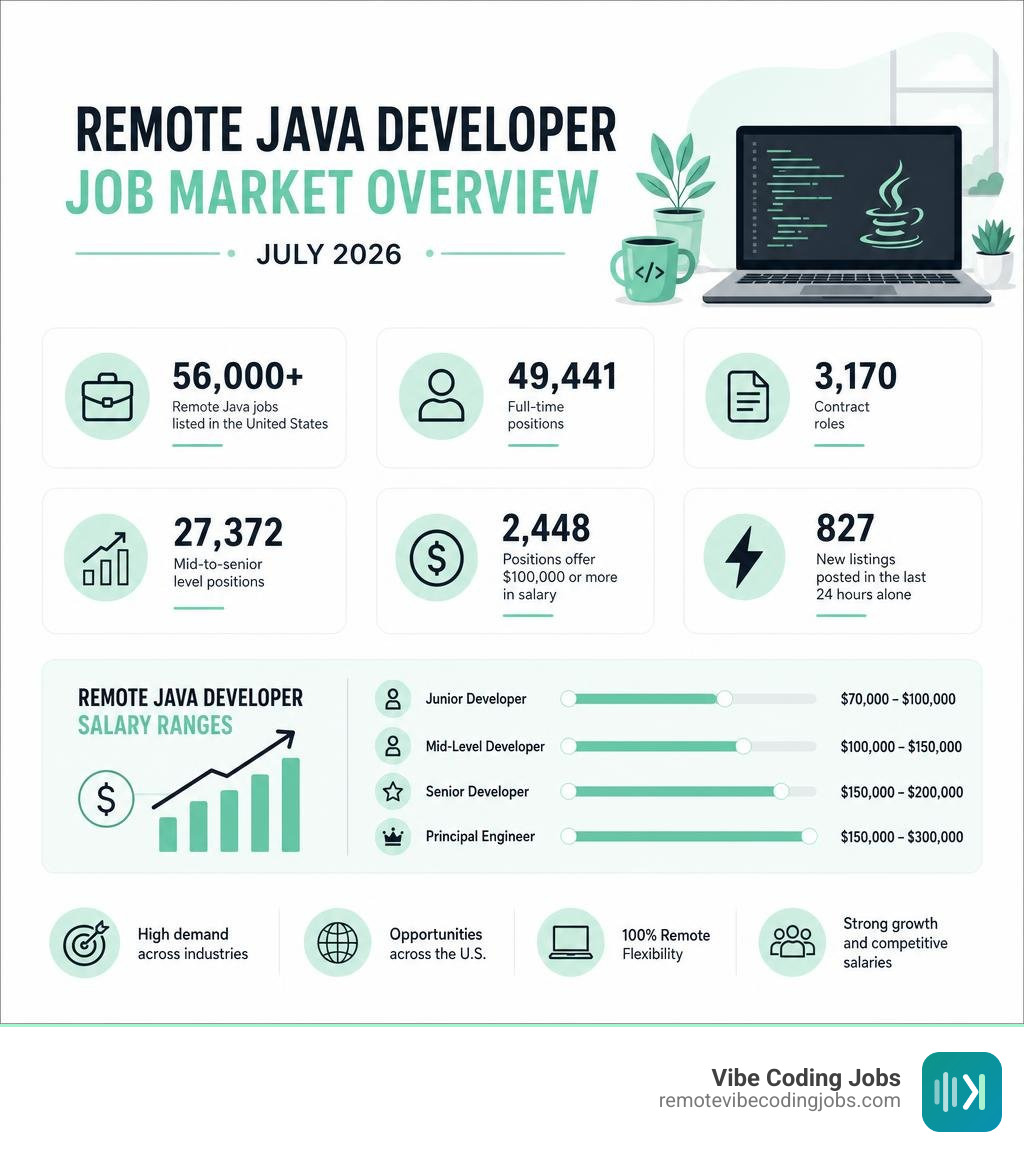
Remote Java developer jobs are one of the most in-demand opportunities in tech right now. If you want a quick lay of the land before diving deeper, here’s what the market looks like in July 2026:
- 56,000+ remote Java jobs listed in the United States
- 49,441 are full-time positions
- 3,170 are contract roles
- 27,372 are mid-to-senior level
- 2,448 positions offer $100,000 or more in salary
- 827 new listings posted in the last 24 hours alone
The market is active, competitive, and moving fast.
Java has been a backbone of enterprise software for decades — and it’s not slowing down. If anything, demand is accelerating. Companies in fintech, healthcare, SaaS, and government are all hiring remote Java developers right now. Roles range from junior backend positions to principal engineers earning $150,000–$300,000 a year.
What’s changed recently is how companies want Java developers to work. More job postings now mention AI-assisted development tools like Cursor, Claude, and GitHub Copilot alongside traditional skills like Spring Boot and AWS. The line between “classic Java developer” and “AI-first engineer” is blurring quickly.
At RVCJ Editorial, we cover remote developer hiring trends, AI-assisted development, and job-search strategy for engineers navigating the modern remote market — including the full spectrum of remote Java developer jobs across experience levels and tech stacks. Whether you’re scanning listings for your next contract or planning a long-term career move, the sections below will help you cut through the noise.
Basic remote java developer jobs glossary:
The Landscape of Remote Java Developer Jobs in July 2026
The market for remote Java engineering is incredibly robust as we navigate July 2026. While some industries have pushed for hybrid schedules, the sheer volume of enterprise systems built on Java means that remote opportunities remain highly abundant. In fact, there are over 56,000 Java remote jobs listed in the United States alone, with 28,586 highly active remote positions currently open for applications.
Hiring managers are moving fast to secure top talent. Within the past week, 21,784 Java remote jobs were posted, and 827 new roles popped up in just the last 24 hours. This massive volume indicates that companies are consistently backfilling roles, expanding teams, and launching new cloud-native modernization projects.

When we break down these listings by employment type, we see a heavy lean toward long-term stability:
- Full-Time vs. Contract: Out of the available roles, 49,441 are full-time remote positions, while 3,170 are structured as contract agreements.
- Experience Levels: Mid-to-senior level engineers are in the highest demand, with 27,372 listings targeted specifically at developers who can operate independently in async-first environments.
- High-Compensation Roles: At least 2,448 of these remote listings explicitly advertise base salaries of $100,000 or more, with many senior and principal roles scaling far beyond that threshold.
If you are actively searching for these positions, utilizing curated job boards is the most effective strategy. To find the most progressive teams that value modern workflows, searching our own remote java developer jobs feed can help you bypass rigid corporate structures and find teams that truly embrace remote flexibility.
Core Technical Requirements and Modern Tech Stacks
The technical requirements for Java developers have evolved significantly. Gone are the days when knowing basic Java syntax and MVC patterns was enough to land a comfortable work-from-home role. Today, remote employers expect you to be comfortable operating in cloud-native, highly distributed environments.
To give you a clear picture of how the expectations have shifted, let us look at how traditional Java development stacks compare to modern, remote-first cloud-native stacks:
| Technical Category | Traditional Java Stack | Modern Cloud-Native Java Stack |
|---|---|---|
| Java Version | Java 8 or Java 11 | Java 17 or Java 21 |
| Primary Framework | Spring MVC / Struts | Spring Boot 3 / Quarkus / Spring Webflux |
| Architecture | Monolithic Applications | Microservices / Event-Driven Systems |
| Cloud & Deployment | On-Premise Servers / VMs | AWS / GCP / Azure / Docker / Kubernetes |
| Data & Storage | Oracle DB / MS SQL | PostgreSQL / NoSQL (MongoDB, Redis) |
| CI/CD & Infrastructure | Manual Builds / Basic Jenkins | GitLab CI / GitHub Actions / Terraform |
As teams migrate toward serverless and microservices architectures, the demand for developers who understand deployment pipelines has skyrocketed. This is why having some crossover knowledge in DevOps is incredibly valuable. If you want to expand your marketability, keeping an eye on remote developer jobs can help you understand the infrastructure tools that modern engineering teams use to deploy Java applications seamlessly.
Essential Skills for Remote Java Developer Jobs
To secure a highly competitive remote position, you should focus on mastering a core set of skills that employers consistently ask for in job listings:
- Modern Java (17 & 21): You should be intimately familiar with modern features like Records, Pattern Matching, Virtual Threads (Project Loom), and Sequenced Collections. For deeper technical context on virtual threads, the official OpenJDK Project Loom page is a useful reference.
- Spring Boot & Microservices: Building, securing, and scaling RESTful APIs using Spring Boot, Spring Security, and Spring Cloud is a standard expectation.
- Containerization & Cloud: You need to know how to containerize your Java applications using Docker and deploy them to Kubernetes clusters running on AWS or Azure.
- Asynchronous Communication: Since you won’t be sitting next to your teammates, your ability to write clear documentation, maintain structured pull requests, and communicate progress asynchronously via Slack or Loom is just as important as your coding ability.
Many of these roles also require dual competency. For example, some teams look for developers who can handle both frontend and backend tasks, or bridge the gap between Java and other backend technologies, expecting developers to navigate multi-language microservices environments. Additionally, European and global teams regularly seek specialized expertise for long-term contract modernizations.
The Rise of Full-Stack and AI-First Java Roles
One of the most exciting shifts we are witnessing in July 2026 is the blending of Java development with frontend frameworks and artificial intelligence tools. Employers are actively seeking “Full-Stack” developers who can write robust Java backend services while contributing to React or Angular frontends. If you have frontend experience, you can check out remote developer jobs to see how modern React architectures pair with Java-based APIs.
Furthermore, forward-thinking companies are hiring developers who know how to integrate AI capabilities directly into enterprise Java applications. For instance, the job market has seen a surge in positions where developers split their time between core feature engineering and implementing LLM APIs, prompt engineering, and Retrieval-Augmented Generation (RAG) systems.
This has also given rise to “vibe coding” – a workflow where developers use AI assistants like Cursor, Claude, and GitHub Copilot to rapidly prototype, generate boilerplate code, and write automated tests. Instead of spending hours writing repetitive getter-setter methods or basic Spring configurations, modern Java developers use natural language prompts to orchestrate their code, allowing them to focus on high-level system architecture and business logic.
To stay ahead of the curve, it is highly beneficial to explore other specialized fields that leverage these AI workflows. You can browse remote developer jobs, remote developer jobs, remote developer jobs, or even remote developer jobs to see how different programming communities are adopting AI-native development practices to boost their daily output.
Compensation, Industries, and Work-Life Balance
Choosing a remote Java career path does not mean you have to sacrifice compensation or professional growth. In fact, remote Java developers often experience excellent compensation parity with their on-site counterparts, while enjoying the massive benefits of location freedom and zero commute time.

Several key industries are actively hiring for remote java developer jobs:
- Fintech & Banking: Financial institutions handle massive transaction volumes and rely heavily on Java’s security and concurrency models. These roles are often highly lucrative but require strict attention to detail and performance optimization.
- Healthcare & SaaS: Cloud-based software companies and healthcare platforms require scalable Java backends to manage sensitive user data and complex workflows securely.
- E-commerce & Logistics: Real-time inventory tracking, payment processing, and order routing systems are frequently powered by event-driven Spring Boot microservices.
If you want to dive deeper into how different industries and experience levels impact your earning potential, we highly recommend checking out our comprehensive remote developer salary guide.
Salary Expectations for Remote Java Developer Jobs
What can you actually expect to earn in today’s market? The numbers are highly encouraging. For mid-to-senior level remote Java roles, typical salary ranges span from $100,000 to $170,000 per year, depending on your experience and geographic location.
For highly experienced developers or specialized roles (such as Principal Engineers or Solutions Architects), base salaries can easily range from $150,000 to $300,000 per year. If you prefer contract work, hourly rates are also incredibly strong, typically ranging from $70.00 to $80.00+ per hour for senior-level contributions.
To get a highly granular breakdown of what you should negotiate for based on your specific background, refer to our guide on remote developer salary expectations.
How to Stand Out and Land Your Next Remote Role
With thousands of developers applying for remote roles, you need to make sure your profile stands out to hiring managers. Here is a checklist of actionable steps you can take to elevate your application:
- Optimize Your Resume: Make sure your resume explicitly highlights your experience with cloud platforms (AWS/GCP), microservices, and modern Java versions. Do not just list “Java” — specify “Java 17/21” and “Spring Boot 3.”
- Build an AI-First Portfolio: Show that you know how to build systems efficiently. Include a GitHub repository of a project where you utilized AI coding assistants (like Claude or Cursor) to build a fully functional microservice with robust test coverage.
- Get Certified: While not always mandatory, holding certifications like the AWS Certified Developer or Spring Professional can give you a significant edge, especially with enterprise clients.
- Highlight Async Communication Skills: In your interviews, emphasize your ability to write clear documentation, design specs, and collaborate across time zones without needing constant supervision.
- Practice Live Coding with AI: Some modern companies will allow — or even expect — you to use AI tools during technical assessments. Practice explaining your architectural decisions while letting AI handle the syntax generation.
For a deeper dive into navigating the modern interview process, check out our step-by-step playbook on how to get a remote developer job. You can also look at active job descriptions to see exactly how modern employers structure their requirements.
Frequently Asked Questions about Remote Java Careers
What are the most in-demand frameworks for remote Java developers?
Spring Boot remains the undisputed king of the Java ecosystem. The vast majority of remote Java listings require deep familiarity with Spring Boot, Spring Data JPA, and Spring Security. However, lightweight, cloud-native frameworks like Quarkus and Micronaut are gaining significant traction, particularly for serverless deployments where fast startup times and low memory footprints are critical.
How does the salary of a remote Java developer compare to on-site roles?
In July 2026, we see near-total compensation parity between remote and on-site Java roles, especially for mid-to-senior positions. While some traditional corporations scale salaries based on local cost-of-living metrics, progressive async-first companies offer global or national flat rates. This means you can secure a high-tier metropolitan salary while enjoying a much lower cost of living in your preferred location.
What role does AI play in modern remote Java development?
AI is no longer just an optional helper; it is becoming a core part of the development lifecycle. Remote Java developers use tools like Cursor and Claude to write boilerplate code, generate unit tests, explain complex legacy codebases, and debug errors in seconds. This shift allows developers to operate at a much higher velocity, transforming the role from manual syntax writing to high-level system orchestration and “vibe coding.”
Conclusion
The market for remote Java developer jobs in July 2026 is incredibly vibrant, offering fantastic compensation, long-term stability, and the freedom to work from anywhere. By pairing your deep understanding of core Java and Spring Boot with modern cloud-native practices and AI-assisted development workflows, you can position yourself as a highly valuable, highly productive asset to any engineering team.
At Vibe Coding Jobs, we specialize in connecting forward-thinking developers with async-first companies that embrace the future of software engineering. If you are ready to bypass rigid corporate application pipelines and find teams that actively encourage the use of modern AI tools like Cursor and Claude, we invite you to explore our curated listings and fast-track your remote career today.
Ready to find your next great role? Explore the latest opportunities on the Vibe Coding Jobs platform!