
The Remote AI Job Market in July 2026: What You Need to Know Fast
The market for remote software engineer AI roles has exploded in 2026. Here’s a quick snapshot if you’re ready to apply now:
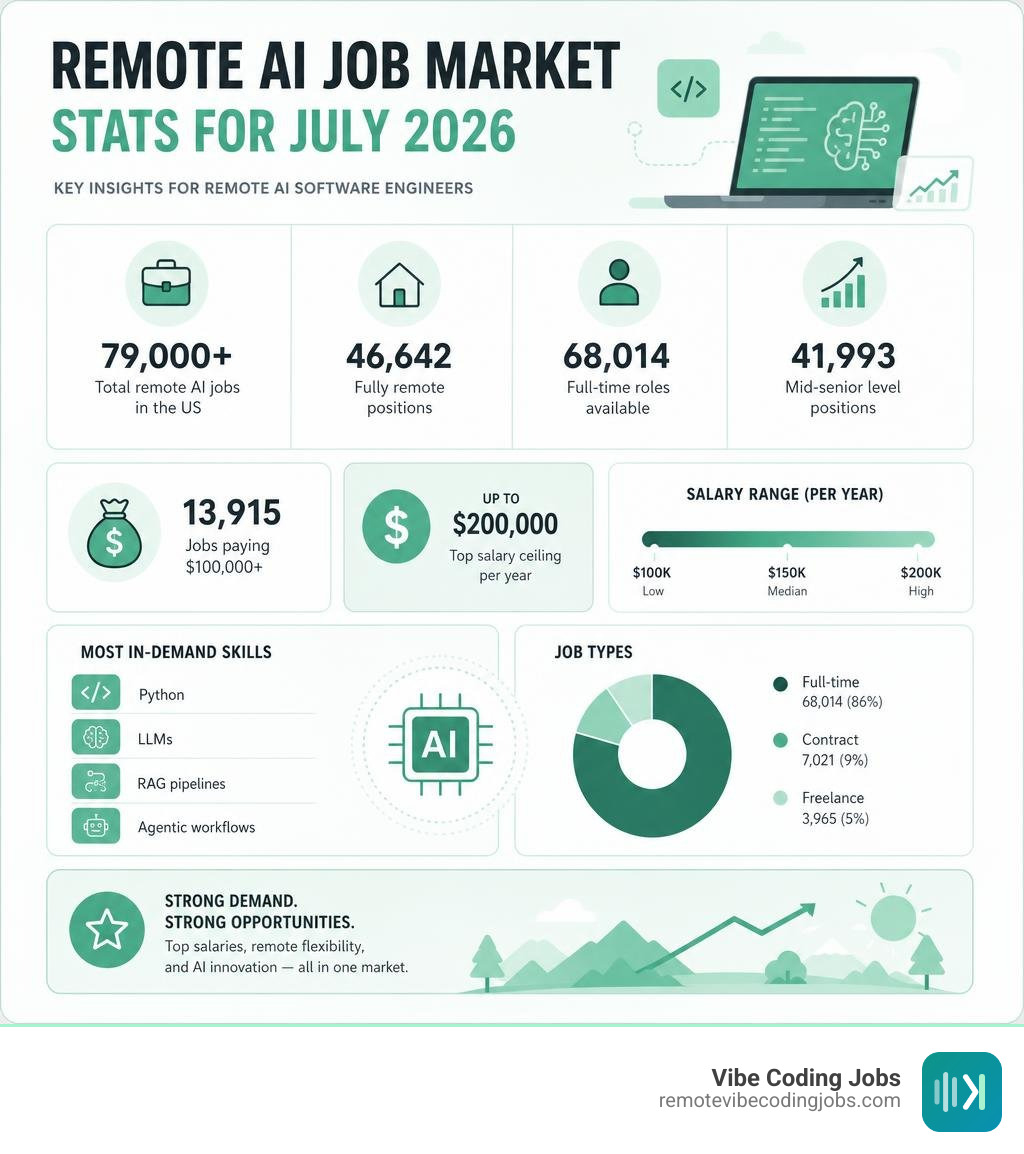
| What You Want to Know | The Answer |
|---|---|
| Total remote AI jobs in the US | 79,000+ |
| Fully remote positions | 46,642 |
| Full-time roles available | 68,014 |
| Mid-senior level positions | 41,993 |
| Jobs paying $100,000+ | 13,915 |
| Top salary ceiling | Up to $200,000/year |
| Most in-demand skills | Python, LLMs, RAG pipelines, agentic workflows |
| Best places to find curated roles | Vibe Coding Jobs |
The demand is real, the salaries are strong, and companies are hiring right now across full-time, contract, and freelance arrangements.
But here’s the problem most developers run into: the sheer volume of listings makes it hard to find roles that actually match your stack, experience level, and the kind of async-first culture where you’ll actually thrive.
That’s exactly what this guide cuts through.
At RVCJ Editorial, we cover AI-assisted development, remote hiring trends, and career guidance for engineers building with tools like Cursor, Claude, Copilot, and Windsurf — with a specific focus on helping remote software engineer AI candidates find culture-fit roles at no-BS companies. We’ve curated this guide to save you hours of scrolling and get you applying to the right roles faster.
Terms related to remote software engineer ai:
- Are there any platforms that curate coding jobs based on the specific AI tech stack a company uses?
- culture focused remote dev
- daily curated ai jobs
The Rise of the Remote Software Engineer AI in 2026

The year 2026 has solidified a massive paradigm shift in how software is designed, written, and deployed. We are no longer talking about AI as a simple autocomplete helper. Today, a remote software engineer AI is expected to architect entire agentic loops, manage semantic search databases, and leverage advanced generative models to ship products at speeds that would have seemed impossible just two years ago.
This shift has created a massive boom in the remote job market, with a clear focus on candidates who can blend traditional software engineering rigor with state-of-the-art AI orchestration. To understand how we got here and how to capitalize on it, let’s explore the current landscape of the AI Coding Jobs Market: Entry Level Remote Benefits.
Current Market Size and Growth Trends
If you take a quick scroll through major job platforms, the sheer volume of listings is staggering. There are currently more than 78,000 remote AI jobs in the United States. Out of those, a massive chunk of 46,642 jobs are listed as fully remote, with 68,014 designated as full-time positions.
This is not a temporary trend. Startups and enterprise companies alike are realizing that the best AI talent is globally distributed. By offering remote-first arrangements, companies can bypass local talent shortages and hire engineers who are native to the modern AI toolkit. We are seeing a major influx of mid-to-senior level roles (over 41,000 listings in the US alone), showing that companies are eager to hire engineers who can take immediate ownership of complex systems.
Remote vs On-Site and Hybrid Roles
When comparing remote AI roles to their on-site or hybrid counterparts, several distinct patterns emerge in 2026:
- Sourcing Freedom: On-site roles are heavily constrained by geography, leading to slower hiring times and mismatched skill sets. Remote roles allow companies to hire specialized engineers who have deep, practical experience building with specific frameworks.
- Compensation Parity: Remote compensation has rapidly caught up to on-site tech hubs. With over 13,000 remote AI jobs offering salaries north of $100,000—and elite roles scaling up to $200,000 or more—engineers no longer have to sacrifice pay for location flexibility.
- Cultural Alignment: Hybrid roles often try to balance the worst of both worlds—forcing commutes while still relying on Zoom calls. Fully remote roles, especially at async-first companies, allow developers to build deep, uninterrupted focus blocks, which are absolutely essential when debugging complex machine learning pipelines or designing multi-agent workflows.
For a deeper dive into how remote setups compare, check out our guide on AI Coding Jobs Market: Entry Level Remote Benefits.
Top Companies and Salaries for Remote AI Roles

If you are looking to land a high-paying, culture-first role, you need to know who is hiring and what they are willing to pay. The market in 2026 is highly competitive, but companies that prioritize developer experience and high-quality engineering are leading the pack. To see who stands out, read our breakdown of the Best Companies Hiring AI Developers: Culture, Growth, Salaries, Interview.
Salary Benchmarks for a Remote Software Engineer AI
Compensation in this space is incredibly lucrative. According to aggregated market data from platforms like Indeed and Wellfound:
- Entry-Level/Vibe Coders: Junior developers who are highly fluent in AI-assisted workflows can expect starting salaries between $70,000 and $100,000.
- Mid-to-Senior AI Engineers: Engineers with 3 to 7 years of experience who can build production-grade Retrieval-Augmented Generation (RAG) pipelines and integrate LLMs safely are commanding between $110,000 and $175,000.
- Elite/Lead AI Architects: Those designing custom orchestration layers, managing distributed training or fine-tuning runs, and scaling agentic systems earn anywhere from $150,000 to $270,000+ per year.
- Contract and Freelance Rates: High-end freelance AI developers and “vibe coders” are charging anywhere from $50 to $300/hour depending on project complexity.
For a complete breakdown of what to expect across different regions and specialties, read our analysis on Remote Developer Salaries in 2026: What to Expect.
Active Hiring Companies and Culture Fit
If you want to bypass generic corporate listings and find companies that actually understand how modern engineers work, you should target platforms that curate for quality. Fast-growing, venture-backed startups and mid-sized enterprises are actively hiring, with thousands of active listings across the globe.
However, the real golden ticket in 2026 is finding companies that are async-first. These organizations don’t care if you’re working from a coffee shop in Medellin or a home office in Portland, as long as you can communicate clearly in writing, document your architectural decisions, and ship clean, reliable code.
Essential Skills and Qualifications for Remote AI Engineers
To stand out in a sea of applicants, you need more than just a general software background. You need to prove that you can build systems that survive real-world traffic, edge cases, and API billing costs.
Key Skills Required for a Remote Software Engineer AI
If we look at the profiles of successful independent remote engineers, we see a clear set of core competencies. For instance, look at how these top remote developers structure their portfolios:
- Production-Grade Integrations: Engineers like Erick (Senior Full Stack AI Engineer) combine traditional full-stack frameworks (React, Next.js, Node.js) with native AI workflows to build highly responsive, real-time SaaS platforms.
- Framework-Free Fundamentals: Understanding the math and mechanics behind the tools is vital. For example, Hassan Naeem — Software Engineer & AI Engineer | Full-Stack, Mobile, GenAI highlights how to build minimal RAG pipelines and agentic tool-calling loops from scratch without relying on bloated third-party frameworks.
- Timezone Overlap and Async Communication: Technical skills are only half the battle. As Muhammad Hammad Asif | AI Engineer, LLM Engineer & Python Backend Developer demonstrates, successful remote engineers provide frictionless collaboration for Western teams through async-first execution, daily Loom updates, and clean Docker setups.
- Automation and Computer Vision: AI isn’t just about LLMs. Developers like Zakaria Masood – Software Engineer | AI & Automation Specialist | Cloud & Backend Developer show how integrating YOLO models, computer vision, and workflow platforms like n8n can drive massive operational cost reductions.
- Full Product Lifecycle Ownership: Startups love engineers who can take a product from zero to one. Hassan R. – Full-Stack & AI Engineer emphasizes the importance of post-launch maintenance, optimization, and continuous iteration for revenue-generating products.
- Scalability and Cost Management: As Haris Ahmed — AI Engineer & Full-Stack Software Engineer famously puts it: “Prototypes impress. Production systems pay.” Knowing how to implement smarter caching, leaner prompts, and content-anchored extraction is what keeps a company’s API costs from spiraling out of control.
If Python is your primary language for AI development, you’ll want to check out our Remote Python Jobs Hiring Now: 2026 Guide to find teams currently looking for these exact backend skills.
Vibe Coding and AI-Assisted Development Tools
One of the most exciting trends in 2026 is vibe coding—the practice of using natural language prompting and powerful AI agents to handle the tedious syntax generation while the human engineer focuses on system architecture, data flow, security, and product-market fit.
Tools like Cursor, Claude, GitHub Copilot, and v0 have completely redefined developer productivity. Instead of spending hours writing boilerplate code, developers are using AI to rapidly prototype MVPs and iterate on user feedback in real-time. To learn how to master these tools and find companies that actively encourage their use, check out our guide on Remote AI Developer Jobs: AI Tools.
Job Types, Experience Levels, and Hiring Automation
The remote AI job market in 2026 accommodates several different employment models. Depending on your lifestyle goals, you can choose the path that fits you best:
| Job Type | Average Compensation | Typical Commitment | Best For |
|---|---|---|---|
| Full-Time Remote | $110,000 – $210,000/year | 40+ hours/week | Long-term stability, equity, and deep product ownership. |
| Contract / Deel | $60 – $150/hour | 20 – 40 hours/week | High hourly rates, international flexibility, and diverse projects. |
| Freelance / MVP Builder | $100 – $300/hour (Project-based) | Flexible | Rapid prototyping, vibe coders, and serial entrepreneurs. |
If you are just starting out in your career, don’t let the “senior” labels discourage you. Read our roadmap on how to navigate the Entry Level AI Coding Jobs: Future Job Market.
Experience Levels and Career Paths
While mid-to-senior engineers make up the majority of current hiring listings, new career paths are opening up for AI-fluent professionals:
As you can see, the career ladder in 2026 looks very different than it did five years ago. Transitioning into these roles requires a strong focus on practical building and system design. For real-world inspiration and success stories, check out our collection of Vibe Coding Remote Career Paths: Success Reviews.
How Companies Use AI to Streamline Hiring
The recruitment process for a remote software engineer AI has also been heavily automated. Companies are increasingly moving away from traditional, anxiety-inducing LeetCode interviews in favor of practical skill assessments.
To filter through thousands of global applicants, remote-first companies are using:
- Interactive AI Screening: Chat-style technical interviews that evaluate your system-design thinking in real-time.
- Take-Home AI Challenges: Building a small, working AI feature (like a simple RAG agent) using tools like Cursor, where hiring managers evaluate your architectural choices and prompt structure.
- Proctored Cognitive Testing: Assessing problem-solving capabilities and learning agility rather than rote memorization.
If you hate whiteboard coding and want to focus on real-world engineering, read our guide on Remote Coding Jobs No LeetCode: Practical Skills.
Challenges, Benefits, and Future Trends in Remote AI Work
Working as a remote AI engineer is incredibly rewarding, but it requires a specific mindset to succeed over the long haul.
Navigating Remote Work Challenges and Benefits
The benefits are obvious: total location freedom, zero daily commute, and the ability to design your own optimal deep-work environment. However, remote developers must also navigate several unique challenges:
- Timezone Overlap: If your team is in San Francisco and you are in Munich, you must master async communication. Using tools like Loom, Slack, and detailed markdown documentation (like
SKILL.mdorARCHITECTURE.md) ensures your team stays aligned without needing 5 hours of daily meetings. - Isolation: Working from home can get lonely. Successful remote engineers often co-work, participate in active developer communities, and maintain clear boundaries between work and personal life.
- The “Black Box” of AI: Debugging non-deterministic systems is hard. When an LLM output fails, you can’t always step through the code line-by-line. Having a strong remote network of peers to bounce ideas off of is a massive advantage.
For a forward-looking perspective on where these roles are headed, check out AI Coding Jobs: Future Trends & Entry Level.
Future Trends: Agentic Workflows and Automation
As we look toward the second half of 2026 and beyond, the dominant architectural pattern is shifting from simple single-prompt APIs to complex multi-agent systems.
Instead of a human developer manually writing every integration, we are building autonomous agent networks that can use tools, self-correct their errors, and manage code repositories independently. This means your value as an engineer will increasingly depend on your ability to design resilient orchestration layers, monitor agent performance, and ensure strict data privacy and regulatory compliance.
Frequently Asked Questions about Remote AI Engineering
What is the average salary for a remote AI engineer in 2026?
In 2026, the average salary for a mid-level remote AI engineer ranges from $110,000 to $175,000 per year. Senior engineers and AI architects frequently command salaries between $150,000 and $250,000+, while junior “vibe coders” typically start between $70,000 and $100,000.
Do I need a computer science degree to get a remote AI job?
No. While a degree in Computer Science or Data Science is always helpful, the remote AI market in 2026 heavily prioritizes a proven portfolio of working applications. If you can show clean, deployed projects—such as custom agentic workflows, RAG systems, or automated LLM evaluation pipelines—you will easily stand out to hiring managers.
What are the best AI tools for remote software developers?
The industry favorites in 2026 are Cursor (for context-aware, multi-file editing), Claude (for deep reasoning, code generation, and system planning), GitHub Copilot (for fast, inline code completions), and v0 (for rapid frontend prototyping).
Conclusion
The market for remote software engineer AI roles is moving at breakneck speed. If you are tired of spending hours filtering through low-quality, hybrid, or non-responsive job boards, we are here to help.
At Vibe Coding Jobs, we curate the best daily listings specifically filtered by culture, tech stack, and modern AI tools. We focus on connecting talented developers with async-first companies that respect your focus blocks and value rapid, AI-assisted execution.
Ready to take the next step in your career?