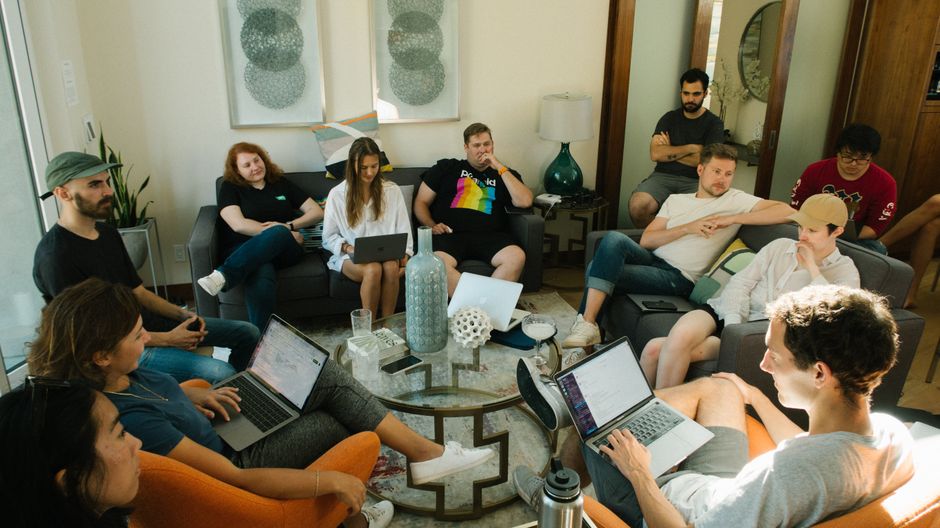
Finding Your Tribe in the World of Culture Focused Remote Development
Why Culture Focused Remote Dev Jobs Are Worth Searching For Carefully
Finding the right remote dev role isn’t just about the tech stack or the salary. The culture is what determines whether you’ll do your best work – or burn out within six months.
Here are the traits that often show up in remote-first development companies with strong engineering cultures:
| Company trait | What it usually looks like | Team setup |
|---|---|---|
| Handbook-first | Policies and decisions are documented and easy to find | Distributed across time zones |
| Async-friendly | Work moves forward without constant live meetings | Global or multi-region |
| Transparent by default | Expectations, priorities, and ownership are visible | Cross-functional teams |
| Deep-work protective | Calendars are designed to reduce interruption | Maker-friendly workflows |
| Outcome-focused | Performance is judged by shipped results, not presence | Remote-first operations |
The numbers tell a clear story. Only 21% of U.S. employees feel genuinely connected to their company’s culture. Yet 98% of people want to work remotely, and 91% report a positive experience when they do. The gap isn’t remote work itself – it’s how companies build culture around it.
Remote-first development teams that get culture right see 35-40% higher productivity and significantly better retention. Those that treat remote as an afterthought get the worst of both worlds: isolation, burnout, and high turnover.
The difference comes down to intentional design – async systems, clear values, psychological safety, and genuine belonging built across time zones.
I’m the RVCJ Editorial team from Remote Vibe Coding Jobs, and we’ve spent years tracking async-first companies, AI-native workflows, and culture focused remote dev environments across the globe. In this guide, we’ll break down exactly what to look for – and what to avoid – so you can find a remote dev team where you’ll actually thrive.
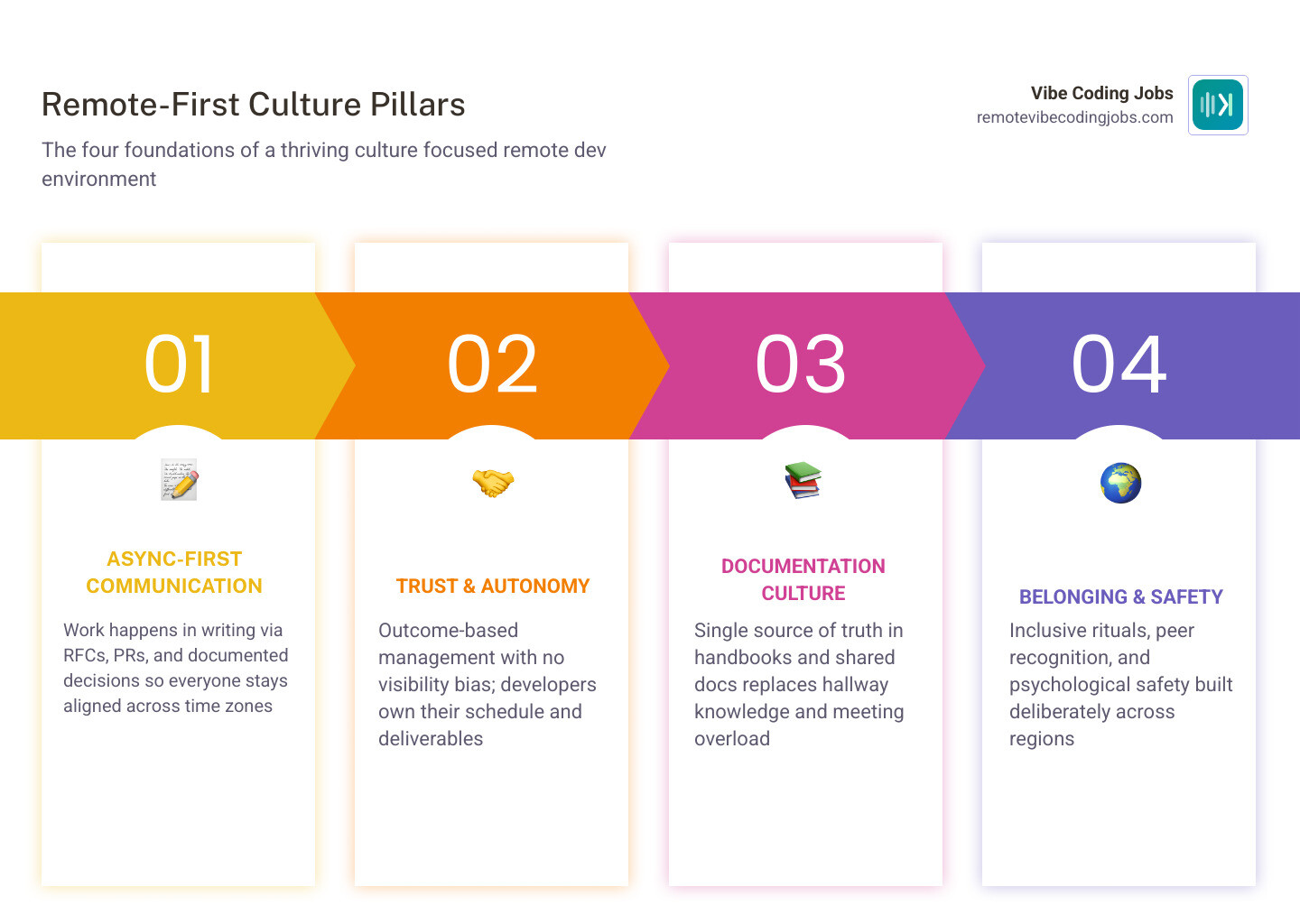
What Defines a Strong culture focused remote dev Company?
A strong remote-first dev culture is not just “people work from home.” It is a company that designs work assuming teammates are distributed, not temporarily absent from HQ.
That means:
- Trust over surveillance
- Documentation over hallway osmosis
- Outcomes over desk visibility
- Async by default, sync on purpose
- Equal access to information, regardless of time zone
The biggest difference between remote-first and remote-friendly is this: remote-friendly companies often keep power, context, and influence near the office. Remote-first companies remove office bias from the operating system itself.
The core traits of a culture focused remote dev environment
The best culture focused remote dev teams usually share a few traits:
- Strong written communication
- A clear handbook or source of truth
- Default async collaboration
- Inclusive rituals that do not depend on being online at the same moment
- Clear values used in hiring, feedback, and promotions
- Fair access to decisions, tools, and visibility
- Performance judged by shipped outcomes
Good remote cultures are “legible.” We can tell how decisions get made, how work moves, and where to find context.
How remote-first developer culture differs from office-based culture
Traditional office culture often runs on informal visibility:
- Who speaks most in meetings
- Who is physically nearby
- Who overhears the latest decision
- Who can grab a manager for five minutes
Remote-first culture replaces that with digital-first norms:
- Decisions written down
- Work tracked in public systems
- Status visible without chasing people
- Deep work protected by fewer interruptions
That matters because many developers do their best work with long focus blocks, not calendars that look like a game of Tetris.
It also changes tradeoffs. Remote developers usually gain flexibility, focus, and commute-free time. But they can also face loneliness, after-hours sprawl, and less spontaneous collaboration if the company is sloppy about culture.
Signs the culture is healthy and effective
Healthy remote dev culture leaves clues:
- New hires ramp up quickly
- Meetings are useful and often fewer
- Code reviews are clear and respectful
- Docs answer common questions
- Feedback happens regularly, not only during annual reviews
- People actually take PTO
- Burnout signals are noticed early
- Developers feel connected to the mission
One useful stat: employees with structured onboarding are 58% more likely to stay. Another: workers estimate roughly 43% of meetings could be canceled without consequence. Healthy remote teams act on both facts.
How to Find Remote-First Development Companies Where You’ll Actually Thrive
Search intent matters. If we are looking for companies where developers can truly thrive, we should evaluate culture like we evaluate architecture: by looking at the underlying system, not the homepage slogans.
A few practical signals matter more than shiny branding:
- Is the role truly remote-first or just remote-allowed?
- Are salary ranges transparent?
- Are time zone expectations explicit?
- Does the company explain how async work happens?
- Are tools, rituals, and management style described clearly?
- Do they mention AI-assisted workflows if that matters to the role?
How to evaluate culture focused remote dev employers before you apply
Before applying, we should check for:
- Core hours or overlap windows
- Async expectations and response norms
- Documentation habits
- Promotion and leveling clarity
- Manager philosophy
- Feedback cadence
- Equipment, coworking, or home office support
- Wellness and unplugging support
- Interview transparency
A useful benchmark is how openly companies document culture. Public culture pages, handbooks, and job descriptions can reveal a lot if we want examples of what strong remote cultures tend to look like. For broader remote-work research and definitions, the Wikipedia article on telecommuting is also a useful reference point.
Red flags that predict poor remote culture fit
Some warning signs are almost comically reliable:
- Surveillance software
- “We move fast” used to justify chaos
- Too many recurring meetings
- Vague values with no examples
- HQ favoritism or hidden in-office power
- Always-on chat expectations
- No onboarding plan
- No salary bands
- Rigid hours with no explanation
- Weak writing culture
If a company says it is async-first but every interview involves urgent Slack replies and calendar Tetris, believe the system, not the slogan.
What top culture pages and job posts reveal
The best job posts and culture pages usually reveal:
- Minimal meeting culture
- Public decisions and documented workflows
- Direct but respectful feedback
- Ownership and autonomy
- Clear expectations around communication
- Realistic descriptions of remote work
- Fluency with AI tools where relevant
Mature remote organizations often emphasize the same themes: writing, ownership, deep work, and explicit expectations.
Hiring, Onboarding, and Compensation for Distributed Developers
Remote culture starts before day one. Hiring, onboarding, and pay structure all shape whether distributed developers feel trusted, included, and fairly treated.
How companies should hire developers for remote-first success
Hiring remote developers well means assessing more than coding ability. We also need to evaluate:
- Clear writing
- Self-management
- Comfort with ambiguity
- Ability to work asynchronously
- Time zone practicality
- Values alignment
Good processes often include:
- Portfolio or Git history review
- Written assessments
- Async interview steps
- Practical take-home tasks
- Paid trial projects
- Communication-focused evaluation
Community referrals also matter. Research suggests a meaningful share of remote hires come through networks and communities, which makes sense: remote work runs heavily on trust and signal quality.
A strong remote job design usually makes the async model, communication norms, and performance expectations explicit before anyone reaches the offer stage.
Best onboarding practices for fast cultural integration
Remote onboarding should never depend on osmosis, because there is no office kitchen where context magically appears next to the coffee machine.
The best teams use:
- A documented onboarding hub
- Tool walkthroughs
- A 30-60-90 day plan
- A buddy system
- First-week wins
- Links to key handbook sections
- Decision guides and workflow docs
- Clear manager check-ins
This is not just nice-to-have. Structured onboarding directly improves retention and speed to productivity. In strong remote teams, new developers can become productive in weeks rather than months because the path is visible.
Compensation strategies across regions without losing fairness
Compensation is one of the trickiest parts of distributed hiring. Fairness does not always mean identical pay everywhere, but it must mean a transparent, defensible system.
Common approaches include:
- Global salary bands
- Location-based pay bands
- Cost-of-labor formulas
- Experience and level-based bands
- Equity plus localized perks
The key is transparency:
- Explain how pay is set
- Publish salary bands when possible
- Avoid arbitrary one-off exceptions
- Update bands for market competitiveness and exchange-rate realities
- Customize perks to employee needs
Remote developers also care about benefits beyond cash: equipment budgets, learning stipends, wellness support, coworking budgets, and travel support often matter a lot.
Communication, Meetings, and Time Zones That Help Remote Dev Teams Ship
This is where culture becomes visible in daily work.
If a company says it values async but every decision still happens in a live call, culture has a bug.
Async systems that support culture focused remote dev teams
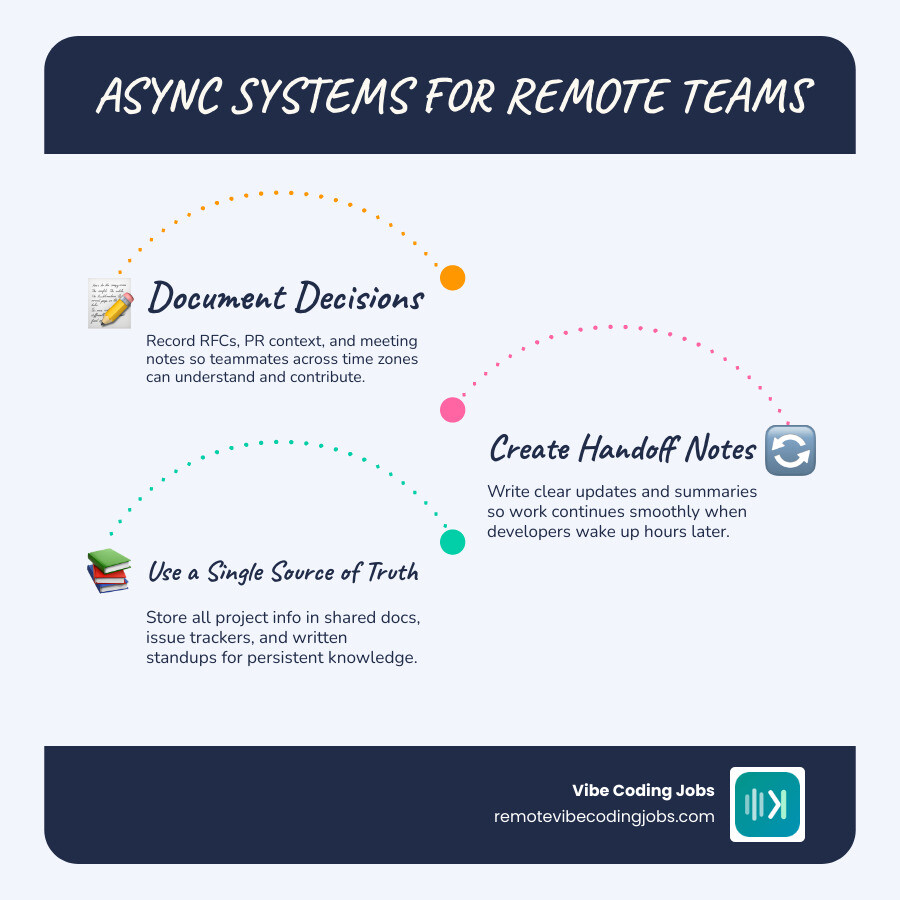
Great remote dev teams usually have a single source of truth for work. That may include:
- Issue tracking
- RFCs or decision docs
- Pull requests with context
- Written standups
- Recorded updates
- Meeting summaries
- Handoff notes
- Clear acceptance criteria
The basic rule is simple: write for the teammate who wakes up six hours later and still needs to move the work forward.
For developers exploring these environments, Async Remote Developer Jobs and Async First Remote Developer Jobs Workflow Productivity are useful reads.
| Team style | Async-first team | Sync-heavy team |
|---|---|---|
| Decisions | Documented | Mostly verbal |
| Status updates | Written or recorded | Meetings and pings |
| Time zones | Designed into workflow | Treated as friction |
| Focus time | Protected | Frequently interrupted |
| Knowledge sharing | Persistent docs | Tribal memory |
The best meeting structures for remote engineering teams
Meetings are not evil. Random, bloated, context-free meetings are evil.
The best remote engineering teams use:
- Clustered meetings instead of scattered calendars
- No-meeting blocks for deep work
- Clear agendas
- A facilitator for larger sessions
- Rotating times for global fairness
- Predictable sprint rituals
- Incident calls only when truly necessary
- Demo cadences that create visibility without excess chatter
One remote culture example we like: some companies preserve specific no-meeting days to protect maker schedules. That is the kind of policy developers remember with gratitude.
How to turn timezone differences into an advantage
Time zones do not have to be the villain. With good systems, they can create:
- Follow-the-sun progress
- Faster support coverage
- Better written decisions
- More intentional scheduling
The strongest strategies include:
- A defined overlap model
- Regional pods
- Handoff templates
- Shared docs
- Response time expectations
- Rotating inconvenience fairly
A helpful way to think about this is to treat time zones as something to design for, not complain about in Slack.
Belonging, Mental Health, and Career Growth in a Culture Focused Remote Dev Team
Remote developers do not just need tools and tickets. We need trust, belonging, growth, and enough psychological safety to ask dumb questions before they become expensive production incidents.
How teams build trust, belonging, and spontaneous connection remotely
Belonging in remote teams has to be designed intentionally.
That can include:
- Coffee chats or pair chats
- Demo days
- Peer recognition rituals
- Informal channels that stay inclusive
- Team retreats or offsites
- Cross-functional buddying
- Shared norms for communication
- Celebrating wins in public
This matters because remote isolation is real. Only 21% of employees feeling connected to culture should be a giant warning light for any company trying to retain developers.
The best remote teams also build psychological safety by encouraging direct feedback without punishment. Developers should be able to raise risks, challenge assumptions, and admit uncertainty without feeling like they are sabotaging their career.
Preventing burnout and helping developers unplug
Remote work is flexible, but flexibility can quietly mutate into “work all the time.”
Research shows:
- 48% of remote workers frequently work outside traditional hours
- 22% struggle to unplug
Burnout prevention should therefore be structural, not motivational-poster-based.
Good company practices include:
- Real PTO norms
- Workload balancing
- Explicit after-hours boundaries
- Manager modeling of logging off
- Flexible schedules without hidden always-on expectations
- Mental health support
- Reduced meeting load
- Clear ownership to prevent chaos paging everyone
For more on this, we recommend Remote Work Mental Health Developers and How to Avoid Burnout as a Remote Developer A Comprehensive Guide.
Performance management and career growth in remote environments
Remote performance management works best when it is explicit.
That means:
- Outcome-based metrics
- Documented feedback
- Clear promotion rubrics
- Growth plans
- Mentorship loops
- Recognition systems
- Skill visibility beyond who speaks most on Zoom
Communication is a core engineering skill in remote teams. So is documentation. So is review quality. These are not “soft extras.” They are part of seniority.
This is even more true in AI-assisted development environments. If developers use tools like Cursor, Claude, or Copilot, they need strong judgment, review discipline, and the ability to document context for both humans and agents.
Frequently Asked Questions About Culture Focused Remote Development
What benefits and perks matter most to remote developers in 2026?
The most valued perks tend to be practical:
- Home office stipend
- Learning and development budget
- Wellness support
- Flexible PTO
- Parental leave
- Coworking budget
- Travel stipend for offsites
- Equipment support
The best companies localize perks where needed but keep the overall philosophy consistent: help people do great work sustainably.
How do AI-assisted workflows change remote developer culture?
AI-assisted workflows reshape remote culture in a few major ways:
- Faster prototyping
- Smaller, more efficient teams
- Greater need for prompt literacy
- More emphasis on review discipline
- Better documentation for reusable context
- Stronger need for judgment over raw typing speed
We are seeing more remote roles explicitly value AI fluency, especially in companies that treat development as highly leveraged, async-friendly work. In those teams, docs are not just for coworkers anymore. They also support agent workflows, architecture context, and repeatable decision-making.
How can developers compare remote work with office roles before accepting an offer?
A good comparison checklist includes:
- Focus time versus interruption frequency
- Commute time saved
- Collaboration style
- Promotion clarity
- Flexibility of schedule
- Expectations around responsiveness
- Risk of loneliness or isolation
- Manager quality
- Real culture evidence
If we want a deeper comparison, see Remote Work vs Office Developers and Remote Work Pros Cons 2026.
Conclusion
A great remote dev job is not just remote. It is thoughtfully designed for distance, autonomy, focus, fairness, and belonging.
That is what we mean by culture focused remote dev.
If we want better odds of finding that fit, we should search for companies that are:
- Async-first
- Transparent about pay and expectations
- Strong in documentation
- Serious about onboarding
- Protective of deep work
- Supportive of mental health
- Clear about AI-assisted workflows
At Remote Vibe Coding Jobs, we built our platform around exactly that kind of search. We curate remote roles by culture, async maturity, tech stack, and AI tools so developers can spend less time guessing and more time applying to teams that actually fit.
Start with Async First Remote Developer Jobs, or explore Remote Vibe Coding Jobs to find remote AI coding roles where culture is not an afterthought.