
The Ultimate Guide to AI Tech Stack Coding Jobs
Why Are Developers Searching for Jobs Based on Specific AI Tech Stacks?
The software engineering landscape in 2026 has undergone a profound paradigm shift. The era of the generic “Full Stack Developer” or “Software Engineer II” is rapidly giving way to highly specialized, stack-aligned roles. As artificial intelligence moves from speculative research into production-grade enterprise software, the specific tools, frameworks, and models a company employs dictate the daily developer experience.

Traditional, broad-spectrum job boards are failing to keep pace with this evolution. When you search for “AI Engineer” on a generic platform, you are often met with a wall of noise: keyword-stuffed descriptions that conflate basic API integration with custom model pre-training, or legacy software roles rebranded as “AI-adjacent” to attract talent. These platforms fail because they treat “AI” as a singular, monolithic skill rather than a highly fragmented ecosystem of competing technologies.
For developers, matching by specific tech stack is no longer a luxury—it is a necessity to avoid application fatigue and ensure workflow alignment. An engineer who specializes in building low-latency retrieval-augmented generation (RAG) pipelines using LangChain, LlamaIndex, and Qdrant will find themselves completely misaligned in a role that requires training custom diffusion models using JAX and PyTorch on bare-metal GPU clusters.
Furthermore, the rise of “vibe coding”—a term that describes highly accelerated, AI-assisted development workflows where developers act as system architects while tools like Cursor and Claude handle raw syntax generation—has introduced a new class of AI-fluent professionals. These developers prioritize companies that actively support and integrate modern AI coding tools into their workflows, rather than those bound by legacy, rigid development practices.
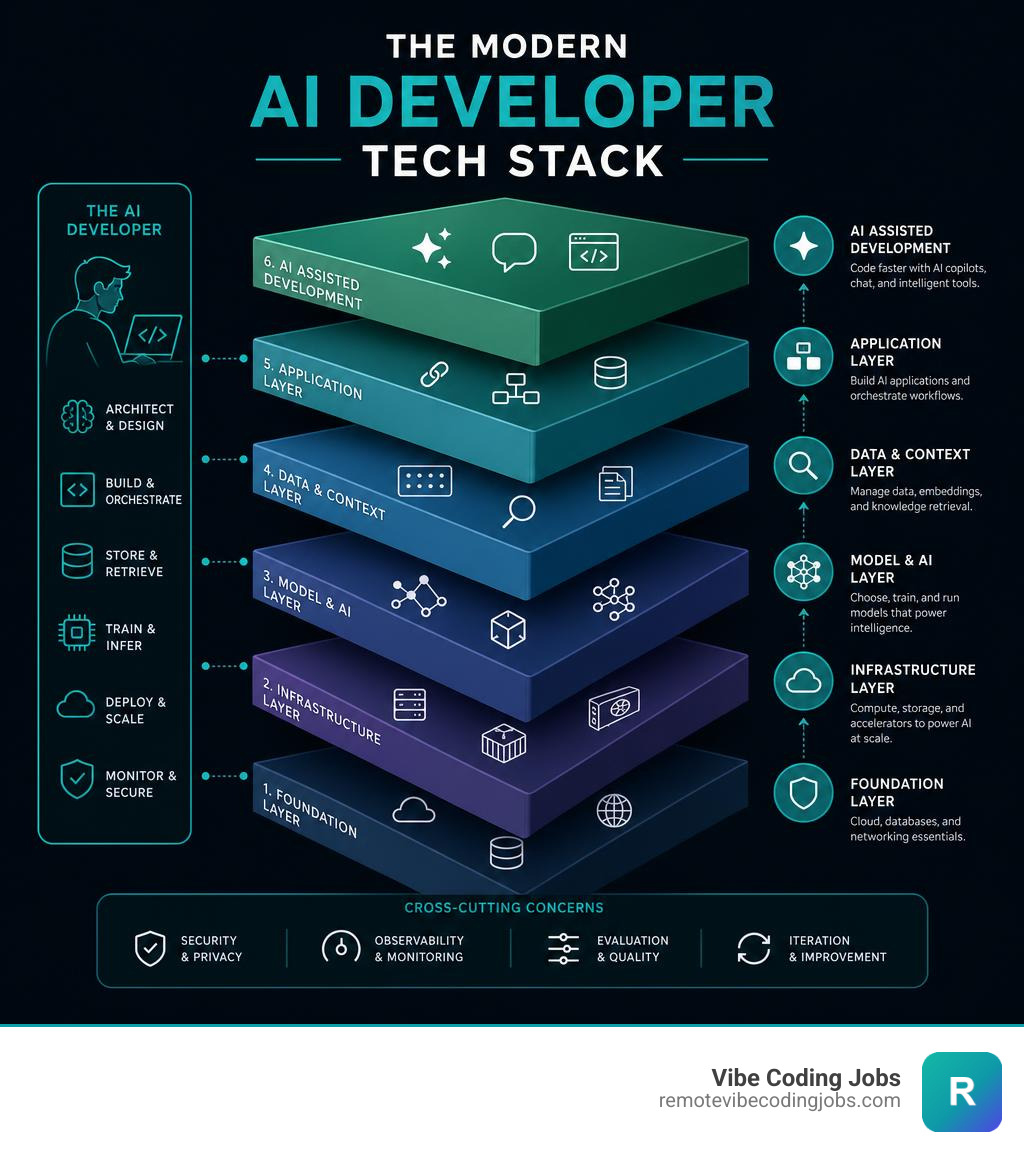
By filtering jobs strictly by the underlying AI tech stack, developers can target companies that align with their technical expertise, preferred workflows, and career trajectories, drastically reducing the time spent filtering through irrelevant listings.
Which Platforms Curate Coding Jobs Based on Specific AI Tech Stacks?
To address this fragmentation, a new ecosystem of niche job platforms has emerged. These platforms bypass the generic keyword matching of legacy sites, instead categorizing roles by specific framework dependencies, model architectures, and developer workflows.

To help you navigate this landscape, we have mapped out how these specialized platforms compare to traditional job sites:
| Feature | General Job Boards (e.g., LinkedIn, Indeed) | AI Stack-Specific Platforms | Vibe Coding Aggregators (e.g., RemoteVibeCodingJobs) |
|---|---|---|---|
| Primary Sourcing Method | Employer-paid postings & broad scraping | Direct career page parsing & API tracking | Daily curation of remote, async-first roles |
| Tech Stack Filtering | Basic keyword search (high noise) | Deep filtering by 50+ AI technologies | Filtered by AI tools (Cursor/Claude) & culture |
| Candidate Verification | Self-reported resumes & endorsements | Proof-first projects & verified stack skills | Focus on AI-fluent, high-productivity developers |
| Salary Data Accuracy | Often estimated or outdated | Real-time extraction from career pages | Transparent ranges for remote & freelance roles |
Automated Tech Stack Trackers
Automated tech stack trackers solve the discovery problem by scraping job data directly from company career pages and parsing the underlying requirements. Rather than relying on what an employer manually inputs into a job board, these platforms use machine learning to identify the exact libraries, frameworks, and hardware requirements mentioned in the job description.
These systems actively track dozens of distinct AI technologies. At any given time, they monitor thousands of live roles, categorizing them into specific buckets such as:
- Large Language Models (LLMs): Tracking thousands of active roles across hundreds of companies.
- AI Agents & Orchestration: Monitoring agent-centric positions across various companies.
- Core Frameworks: Tracking PyTorch-specific roles.
Similarly, market intelligence platforms track jobs across hundreds of companies. By pulling data directly from applicant tracking systems (ATS) daily, they extract real-time tech stack demand. Data shows that Python remains dominant, appearing in a vast majority of tracked postings, followed closely by API Development and cloud infrastructure. These trackers allow developers to bypass the marketing fluff of job descriptions and see the actual engineering requirements.
Developer-Centric Stack Matchers
Developer-centric platforms invert the traditional hiring model. Instead of forcing developers to search through endless employer listings, these platforms allow engineers to define their ideal technical environment first.
On these developer-first platforms, developers build a comprehensive profile detailing their bio, GitHub repositories, preferred tech stacks, specific skills, and cultural values. The platform’s algorithm then ranks and presents job opportunities based on how closely they align with the developer’s specified stack. This reverse-matching process ensures that developers are only alerted to roles that utilize the tools they enjoy working with daily, protecting their productivity and job satisfaction.
Proof-First AI Marketplaces
For highly specialized machine learning and LLM engineering roles, traditional resumes are increasingly seen as inadequate. Proof-first marketplaces address this by requiring candidates to demonstrate their technical capabilities through verifiable, shipped projects.
These marketplaces operate on a “proof-first” model where candidates build public profiles that foreground actual shipped use cases—such as building a document Q&A system for a major financial institution or deploying a domain-adaptive vision transformer.
These platforms host open AI roles and a curated pool of public talent profiles, maintaining a highly structured environment where both job listings and candidate profiles use an identical, strict tech stack vocabulary. This eliminates the risk of keyword inflation and ensures that an employer searching for “LangGraph” or “PyTorch Lightning” expertise finds candidates with verified, hands-on experience.
Remote Vibe Coding Aggregators
As the software engineering workflow evolves, there is a growing demand for platforms that cater specifically to developers who leverage AI to write code faster and more efficiently. This is where we focus our efforts at RemoteVibeCodingJobs.
We specialize in aggregating remote “vibe coding” and AI-assisted development roles at forward-thinking, async-first companies. Rather than focusing solely on traditional machine learning research, we curate daily listings for AI-fluent professionals who use tools like Cursor, Claude, Windsurf, and Copilot to achieve 2-5x productivity gains.
Our platform filters roles not just by the company’s production AI stack, but by their internal developer culture. We highlight companies that embrace modern, AI-first workflows and offer flexible, async-first environments. For developers looking to transition into this highly productive style of engineering, exploring Companies Hiring Vibe Coders Remote AI Coding and monitoring the Best Companies Hiring AI Developers Remote Positions provides a direct path to teams that value speed and system architecture over raw typing speed.
How Do Stack-Specific Platforms Filter and Match AI Jobs?
The magic of specialized AI job boards lies in their underlying matching and filtering mechanics. Unlike generic boards that rely on basic string matching (which often leads to a search for “Python” returning legacy scripting roles), stack-specific platforms utilize sophisticated parsing pipelines.

Sourcing and Parsing Sprints
Most niche platforms do not wait for employers to pay to post a listing. Instead, they run continuous scraping operations that target the career portals of companies known for strong engineering cultures. When a new job is posted, an AI parser analyzes the job description to extract:
- Core Frameworks: Distinguishing between PyTorch, TensorFlow, and JAX.
- Orchestration & Tooling: Identifying dependencies on LangChain, LlamaIndex, or LangGraph.
- Infrastructure & MLOps: Detecting Triton Inference Server, Kubernetes, Docker, or specific cloud provider tools.
- Required Experience Levels: Mapping the role to junior, mid, senior, or staff levels based on context rather than arbitrary year requirements.
This structured data is then tagged with custom category metadata, making the job highly discoverable via generative search and advanced filtering interfaces.
Proof-First Matching and Match Scores
On proof-first platforms, the matching process is driven by “proof density.” Instead of matching a candidate to a job based on a resume keyword, the platform calculates a match score (typically ranging from 80% to 92% for high-quality pairings) by comparing the structured tech stack of the job description against the verified projects on the candidate’s profile.
If an employer lists a requirement for “RAG pipelines with citation-only answers,” the platform looks for candidates who have documented a shipped project utilizing that exact architecture. This alignment of vocabulary between the hiring team’s stack and the developer’s portfolio drastically reduces time-to-screen for recruiters and ensures developers are interviewed for roles they are genuinely qualified to perform.
Aligning with Modern Developer Workflows
Understanding how engineers construct their workflows is critical to successful matching. Modern developers rely on a highly integrated suite of tools to maintain high velocity. To understand how these tools fit together, developers often reference guides on the Best AI tools for software engineers: how to build the right AI stack.
When job boards understand these workflow dynamics, they can match candidates based on their tool proficiency. For instance, a developer looking for remote roles that leverage advanced AI tooling can filter specifically for teams that support these environments by browsing Remote Developer Jobs AI Tools.
What Are the Benefits of Using Stack-Focused AI Job Boards Over Generic Sites?
Using a specialized, stack-focused job board offers several distinct advantages over relying on massive, general-purpose platforms like LinkedIn or Indeed.
- High Signal, Low Noise: Generic job boards suffer from extreme signal-to-noise ratios. A single “AI Engineer” posting on a major platform can attract thousands of low-quality, automated applications within hours. Stack-focused boards act as a natural filter, attracting only developers who possess the specific technical skills required, which in turn encourages employers to keep their listings active and updated.
- Unprecedented Salary Transparency: Because specialized platforms pull data directly from source career pages and ATS platforms, they bypass the vague salary ranges often found on third-party aggregators. This data reveals fascinating trends in the 2026 market: specialized roles like AI Alignment and Pre-training command premium average salaries of $340,000 and $338,000 respectively, while general LLM engineering roles average $245,000, and AI Agent developers average $232,000.
- Direct-to-Source Accuracy: Many niche platforms prioritize data integrity over ad revenue. Some platforms source their listings directly from company career sites, ensuring that every position is active and legitimate. This eliminates the frustration of applying to “ghost jobs”—listings that companies leave open indefinitely to build a resume pipeline without any active intent to hire.
- Alignment of Incentives: Traditional job boards are funded by employer advertising, which incentivizes them to maximize application volume, regardless of quality. In contrast, many niche platforms operate on developer-first or subscription-based models (such as models that charge job seekers a small fee to access highly curated, verified listings). This aligns the platform’s incentives directly with your goal: finding a high-quality, highly compatible role as quickly as possible.
For developers seeking to maximize their compensation and find employers at the cutting edge of technology, tracking the Best Companies Hiring AI Developers Remote Opportunities and identifying the Best Companies Hiring AI Developers Top Employers Innovative provides a significant competitive advantage.
How Can You Optimize Your Profile for AI Tech Stack Matching?
To stand out on specialized AI job boards, you must abandon the traditional, chronological resume format in favor of a highly structured, “proof-first” digital presence.
Here are actionable steps you can take to optimize your profile for automated parsers and technical recruiters:
- Build a Project-Centric Portfolio: Instead of listing vague responsibilities (e.g., “Worked on LLM integration”), structure your experience around specific, shipped projects. For each project, clearly define:
- The Use Case: e.g., “Built a multi-agent customer support system.”
- The Stack: e.g., “LangGraph, Claude 3.5 Sonnet, FastAPI, Pgvector.”
- The Outcome: e.g., “Reduced customer resolution times by 28%.”
- Standardize Your Tech Stack Vocabulary: Ensure your profile uses the exact terminology tracked by automated platforms. Use precise terms like PyTorch, LangChain, RAG, Fine-tuning, and MLOps rather than generic phrases like “Machine Learning” or “AI Development.”
- Highlight Your AI-Assisted Workflow: If you are a high-velocity developer, explicitly state your proficiency with modern AI coding environments. Mentioning your experience with tools like Cursor, Claude, and Windsurf signals to forward-thinking employers that you are capable of operating at a highly accelerated pace. To understand what tools are currently dominating the industry, consult resources like the guide on the 11 Best AI Coding Tools for Data Science & ML in 2026.
- Get Stack-Verified: When using developer-centric platforms, take advantage of their verification features. Getting verified in your primary tech stack (such as Python, PyTorch, or React) boosts your profile’s visibility to recruiters who are actively searching for pre-qualified talent.
- Understand Remote Requirements: If you are targeting remote roles, make sure your profile highlights your ability to work autonomously in async-first environments. Reviewing the Remote AI Developer Jobs Requirements can help you align your profile with the specific expectations of remote-first employers.
To accelerate your preparation, you can also explore specialized training institutes like JobStack Technologies – software training Institute in Chirala | www.jobstackai.com, which provides real-time project training and hands-on portfolio building to help developers get job-ready for modern full-stack and AI/ML roles.
How RemoteVibeCodingJobs Accelerates Your Search
At RemoteVibeCodingJobs, we are built specifically to support developers who have embraced the future of software engineering. We understand that the best developers in 2026 are those who act as architects, leveraging AI to build and deploy software at unprecedented speeds.
We curate remote, async-first roles daily, filtering out the noise to present only positions that align with modern developer workflows. Our platform is free for job seekers, and we provide a comprehensive playbook to help you transition into vibe coding and optimize your application strategy. By focusing exclusively on AI-fluent professionals and companies with progressive engineering cultures, we help you bypass the traditional application grind and land roles where your productivity is valued.
Frequently Asked Questions About AI Tech Stack Job Boards
Can I filter AI jobs by specific tools like TensorFlow, JAX, or diffusion models?
Yes. Specialized AI job boards are built specifically to handle this level of granular filtering. Unlike traditional sites where a search for “JAX” might return irrelevant text matches, niche platforms parse the job description’s technical requirements directly. This allows you to filter specifically for roles utilizing core libraries (TensorFlow, JAX, PyTorch), specific architectures (diffusion models, transformers, LLMs), or orchestration frameworks (LangChain, LlamaIndex) with near-perfect accuracy.
What are the limitations of using niche AI tech stack job boards?
While niche job boards offer incredibly high signal-to-noise ratios, they do have a few limitations:
- Geographic Constraints: Many specialized AI platforms focus heavily on US-based or remote-first roles, which can limit options for developers seeking local, on-site positions in other regions.
- Lower Overall Volume: Because these platforms prioritize quality and active curation, they host fewer total listings than massive aggregators like LinkedIn.
- Premium Paywalls: Some highly curated platforms require a subscription fee (e.g., $8/week or $18/month) to unlock their full database of matching jobs, which may not appeal to all job seekers.
Do these platforms provide accurate salary data for AI roles?
Yes, and their data is typically far more accurate than the self-reported or estimated ranges found on generic sites. Because specialized platforms extract salary data directly from live company career pages and applicant tracking systems daily, they reflect real-time market rates. This data shows that specialized fields like AI Alignment ($340k average) and Pre-training ($338k average) command the highest premiums in the industry, providing you with powerful leverage during compensation negotiations.
Conclusion: How Do You Take the Next Step in Your AI Coding Career?
The software engineering landscape has permanently changed. In 2026, finding a rewarding, high-paying role is no longer about submitting hundreds of generic resumes to legacy job boards. It is about aligning your specific technical expertise—and your preferred development workflows—with companies that are actively building the future of AI.
Whether you are a machine learning scientist specializing in PyTorch and custom pre-training, an LLM engineer building complex RAG pipelines, or an AI-fluent vibe coder leveraging Cursor and Claude to build products at breakneck speed, there is a platform designed to match you with your ideal stack.
By utilizing automated trackers, proof-first marketplaces, and developer-centric matchers, you can take control of your job search and target roles that respect your technical skills.
And if you are ready to find a remote, async-first role where your AI-assisted velocity is celebrated rather than restricted, we invite you to take the next step. Build your profile, download our free playbook, and explore our daily curated listings today on RemoteVibeCodingJobs. Your next high-impact role is just a match away.