
Why Async First Developer Roles Are the Antidote to Zoom Fatigue
Async first developer roles are remote positions where asynchronous communication — not real-time meetings — is the default way teams collaborate.
Here’s a quick breakdown of what that means in practice:
| Feature | Async First Role |
|---|---|
| Meetings | Rare, and only when truly necessary |
| Communication | Written, documented, time-shifted |
| Work hours | Flexible, results-focused |
| Deep work | Protected by design |
| Time zones | Welcomed, not fought |
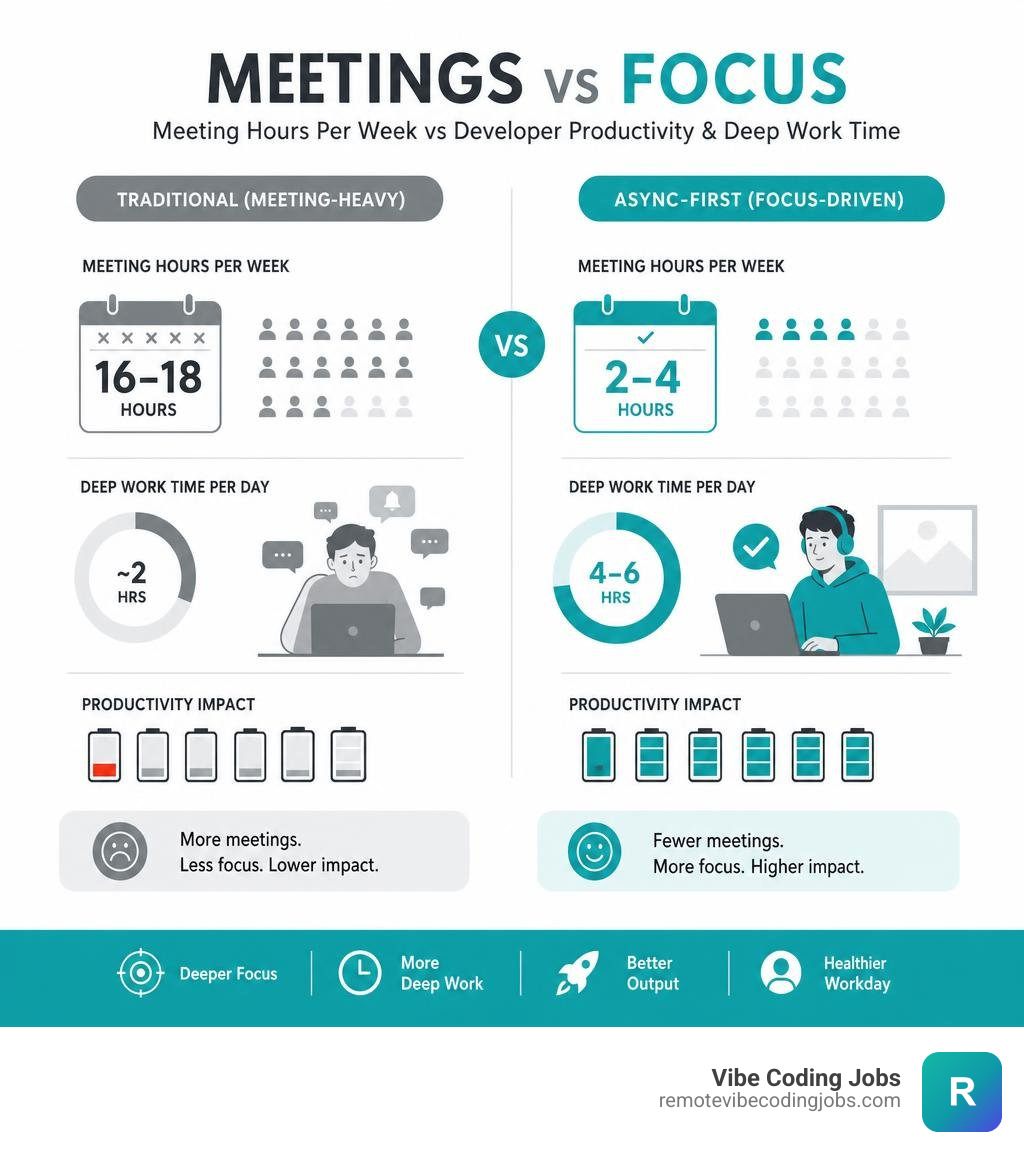
The numbers behind traditional dev work tell the story fast. The average IT worker spends 16–18 hours per week in meetings — roughly 2.5 days — and faces around 18 interruptions per day. That’s not a productivity culture. That’s a calendar problem.
Async first companies like GitLab, Shopify, and Automattic have flipped the model. Meetings are the last resort, not the default. Writing is the primary way information moves. And developers get back something rare: uninterrupted time to actually build things.
The demand is real. There are hundreds of open async roles right now across engineering, product, design, and more — at companies that have made async communication a core part of how they operate.
I’m RVCJ Editorial, the team behind Remote Vibe Coding Jobs — we cover async first developer roles, AI-assisted development, and remote hiring trends for engineers who build with tools like Cursor, Claude, and Copilot. Whether you’re burned out on back-to-back standups or just want more control over your workday, this guide will show you exactly how async developer work operates and how to land one of these roles.
Discover more about Async first developer roles:
What Are Async First Developer Roles?
To truly understand async first developer roles, we must look beyond the standard “work from home” label. Working remotely is a location; working asynchronously is a philosophy.
In a traditional remote setting, companies often try to replicate the physical office digitally. This results in constant Slack pings demanding immediate replies, daily standups that drag on, and calendars packed with “quick syncs.”
In contrast, an async-first culture defaults to time-shifted collaboration. It assumes that team members are distributed across multiple time zones and should not be expected to respond instantly. Instead of hopping on a call to explain a technical issue, developers write it down with context, code snippets, and loom recordings.
To dive deeper into this shift, explore how teams build these systems in Async First Remote Developer Jobs: Asynchronous Communication.
This way of working relies heavily on:
- Thorough Written Documentation: Decisions, project scopes, and technical architectures are documented in public workspaces rather than agreed upon in undocumented meetings.
- Acceptable Response Lags: Teams establish clear guidelines for response times (e.g., 4 to 12 hours for non-urgent matters), which removes the pressure of constant availability.
- Deep Focus Protection: By eliminating real-time interruptions, engineers can enter a state of flow and remain there.
For a comprehensive look at how this impacts your day-to-day schedule, you can read Async-First for Developers: Reclaim Your Deep Work Hours .
The Core Benefits of Asynchronous Software Engineering
Shifting to async-first is not just about avoiding meetings; it fundamentally changes developer productivity and lifestyle. When we eliminate the expectation of immediate availability, we unlock massive advantages for both engineering teams and individual creators.
Unparalleled Productivity and Deep Work
Context switching is the ultimate developer productivity killer. Every time a message notification pops up, it takes an average of 23 minutes to refocus on the complex logic of your codebase. In async-first engineering teams, uninterrupted blocks of 4 to 6 hours are standard. Developers can solve complex algorithmic problems, design clean system architectures, and write robust automated tests without the constant fear of a calendar event interrupting their flow state.
True Work-Life Balance and Autonomy
When your performance is measured by what you ship rather than when your Slack status dot is green, you gain complete agency over your life. Parents can pick up their children from school, digital nomads can travel without sacrificing their careers, and night owls can code when their brains are most active.

Inclusivity, Neurodiversity, and Accessibility
Synchronous meetings naturally favor fast talkers and those who process information instantly. Asynchronous communication level the playing field.
- Neurodiversity: Developers who are introverted or neurodivergent have the quiet space to process information, research solutions, and formulate structured, high-quality responses.
- Physical Disabilities: According to industry research, two-thirds of people with disabilities prefer remote work. Async-first environments remove physical office barriers entirely and accommodate flexible schedules for medical needs.
- Language Barriers: Non-native English speakers can read, translate, and write at their own pace, ensuring their technical expertise is never overshadowed by conversational speed.
To explore how these benefits combine to elevate engineering team output, check out Async First Remote Developer Jobs: Benefits and read our detailed breakdown in Async First Remote Developer Jobs: Benefits, Communication & Teamwork.
How to Succeed in Asynchronous Work Environments
Thriving in an async-first role requires a different set of professional skills than working in a physical office. You cannot rely on “management by walking around” or casual desk chats to keep your projects moving.
To build a stellar daily routine, read Async First Remote Developer Jobs: Workflow & Productivity.
Success in these roles comes down to three major pillars:
- Extreme Self-Management: You must be comfortable managing your own tasks, prioritizing your backlog, and unblocking yourself when you hit a wall.
- Writing Like a Journalist: Because your writing represents you, you must communicate with clarity, precision, and empathy. State the problem, provide the background, and outline the exact action required from the reader.
- Strict Git and Branching Workflows: Code reviews and pull requests become primary communication channels. Your PR descriptions must be detailed, explaining why a change was made, not just what was changed.
Essential Tools for Async First Developer Roles
To maintain a smooth workflow without real-time meetings, async-first teams rely on a highly integrated stack of collaborative software.

- Slack/Threads: Used with strict guidelines. Channels are structured, and long discussions are kept inside specific message threads to keep main channels clean.
- Notion/Confluence: The team’s central nervous system. Everything from engineering guidelines to product specs lives here, updated in real time.
- GitHub/GitLab: The absolute source of truth for code, task tracking, and technical review.
- Loom: Used to record quick walkthroughs of UI changes, complex bugs, or system architectures, saving hours of meeting time.
AI-Assisted Coding in Async First Developer Roles
In 2026, the rise of AI-assisted development—frequently called vibe coding—has become the ultimate force multiplier for async-first developers. When you don’t have a colleague sitting next to you to bounce ideas off of, AI engines like Cursor, Claude, and GitHub Copilot act as your always-on pair programming partners.
Vibe coding isn’t about letting AI do all the work; it is about high-agency engineering. Developers use precise prompt engineering to generate starter code, write unit tests, and refactor complex logic in seconds.
By leveraging agentic AI workflows, you can build, test, and debug features entirely on your own, minimizing the need to ping teammates for help and keeping the async engine running smoothly.
For a deeper dive into how AI tools are reshaping developer culture and salaries, read Async First Remote Developer Jobs: Culture, Tools & Salary.
How Top Tech Companies Structure Async Workflows
The world’s most successful async-first companies don’t succeed by accident; they build highly deliberate operating systems. Pioneers like GitLab, Shopify, and Automattic have proven that you can scale to thousands of employees without a corporate calendar.
To see which industry leaders are actively recruiting, browse Async First Remote Developer Jobs: Top Companies.
These organizations operate on three foundational concepts:
1. Handbook-First Culture
In these companies, if something isn’t documented in the public handbook, it doesn’t exist. When processes change, the handbook is updated first, and the team is notified second. This ensures that every developer, regardless of their time zone, has access to the exact same information.
2. The ConveRel Quadrants
Coined by industry experts, this framework helps teams decide when a meeting is actually necessary. It plots the strength of the team’s relationship against the complexity of the task:
- Low Complexity / High Relationship: Asynchronous (Slack thread or Notion doc).
- High Complexity / Low Relationship (e.g., onboarding a new team): Synchronous (Zoom call).
- High Complexity / High Relationship: Asynchronous first, with a brief sync call only if progress stalls.
3. Default to Action
To prevent decision paralysis across time zones, developers are empowered to make decisions and ship code independently. Because modern software development relies on continuous integration and continuous delivery (CI/CD), 99% of development decisions are completely reversible. If a feature has a bug, it can be rolled back or patched in minutes, making speed and autonomy far more valuable than waiting for a manager’s synchronous approval.
How to Find and Land Async Remote Programming Jobs
Finding an async-first role requires looking beyond traditional job boards. Because these roles are highly competitive, you need to target platforms that specifically filter for this work culture and showcase your ability to work independently.
Here are the best platforms to find your next opportunity:
- RemoteVibeCodingJobs: Our platform specializes in pairing remote, AI-fluent developers with async-first companies that value high-agency engineering.
To expand your search to verified employers, explore Async First Remote Developer Jobs: Companies Hiring Developers – Find Your Dream Remote Job.
Tailoring Your Application for Async Success
When applying, traditional resumes aren’t enough. You must actively demonstrate that you can thrive in a self-directed environment:
- Highlight AI Fluency: Showcase your experience with AI tools like Claude, Cursor, and Copilot. Companies are looking for developers who use AI as a force multiplier.
- Provide Written Samples: Share high-quality pull request descriptions, system design documents, or technical blog posts to prove your written communication skills.
- Showcase Independent Projects: Highlight open-source contributions or side projects where you had to manage your own roadmap and deliver clean code.
For those starting out, look for entry-level remote developer roles that offer structured onboarding and mentorship. If you are looking for early-career full-stack roles, focus on companies that support AI-first workflows and offer remote flexibility to help you grow your skills independently.
Frequently Asked Questions about Async Developer Jobs
How do async teams handle urgent production bugs?
When a critical system goes down, async teams don’t wait for someone to check Slack. They use structured incident response systems. Teams set up automated alert tools (like PagerDuty) linked to on-call rotations. When an incident occurs, the on-call engineer is paged directly. They spin up a temporary, highly focused war room (usually a dedicated Slack channel or a live call) to resolve the issue, and then document the post-mortem asynchronously so the entire team can learn from it.
To learn more about how async structures keep operations running smoothly, see Async First Remote Developer Jobs: Roles, Teams & Companies.
Can junior developers succeed in an async-first environment?
Yes, but it requires a company with mature documentation. In a great async-first company, a junior developer has access to structured onboarding paths, clear code style guides, and comprehensive documentation of the codebase. Mentorship happens through detailed, constructive code reviews and recorded video walkthroughs (via Loom) rather than physical shoulder-tapping.
If you’re eager to see how teams set up these pathways, check out Async First Remote Developer Jobs: Roles, Teams, Companies.
How do async-first companies measure developer performance?
Async-first companies focus entirely on output, not input. They don’t track your active keyboard time or care if you are online at 9 AM. Instead, performance is evaluated by the quality of your code, the clarity of your documentation, your pull request throughput, and your ability to meet sprint goals.
For a deeper analysis of how flexible hours and output tracking interact, check out Async First Remote Developer Jobs: Flexible Hours.
Conclusion
The era of back-to-back Zoom meetings, constant status updates, and fractured deep work is drawing to a close. As we move through 2026, async first developer roles represent the natural evolution of remote work—giving software engineers the quiet space, autonomy, and trust they need to build incredible software.
By combining asynchronous communication with modern AI-assisted coding tools, developers can reclaim their calendars and focus on what they do best: writing clean, high-impact code.
If you are ready to ditch the Zoom fatigue and take control of your career, we invite you to explore curated opportunities, including Sendbird careers and async opportunities, on our platform today. The future of work is asynchronous—come build it with us!