
Stop Debugging the Office and Start Working Remotely
The 2026 Market for Senior Backend Engineer Remote Roles Is Bigger Than Ever
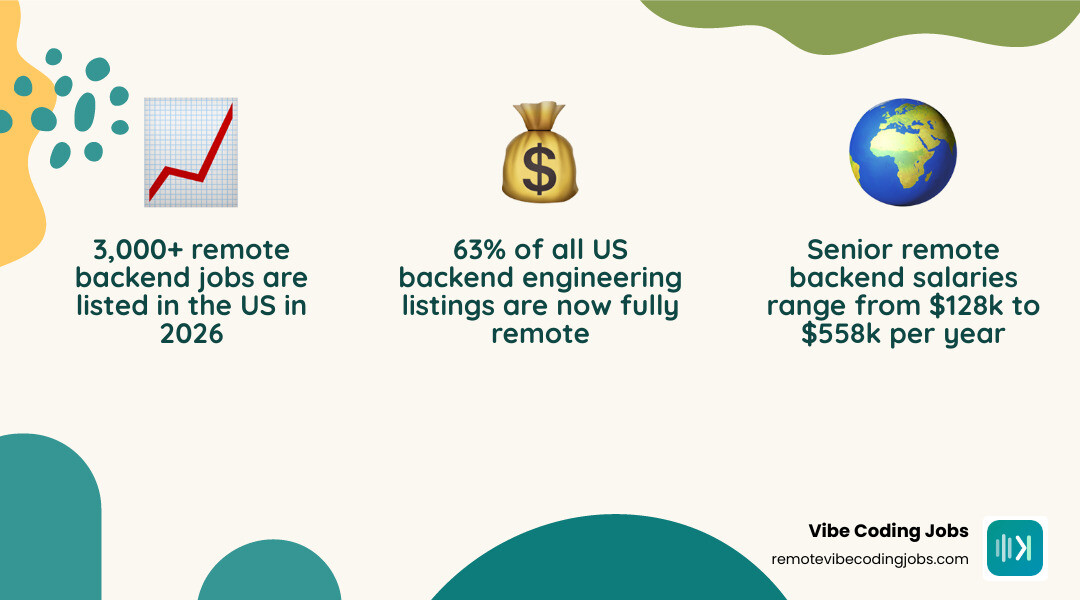
Senior backend engineer remote jobs have exploded in 2026 — and the numbers back it up.
Here’s a quick snapshot for anyone who wants the fast answer:
| What you want to know | The answer |
|---|---|
| How many remote backend jobs exist? | 3,000+ listed in the US right now |
| How many are senior/mid-senior level? | 2,137+ actively hiring |
| What’s the salary range? | $128,000 — $558,000/year (full-time) |
| Most in-demand skills? | Python, Go, AWS, Postgres, distributed systems |
| Are async-first roles common? | Yes — many roles have no daily standups |
| Contract rates available? | Yes — from $50/hr up to $95/hr for tech leads |
The shift is real. Around 63% of all backend engineering listings in the US are now remote. And companies aren’t just offering remote as a perk — they’re building entire engineering cultures around async work, flexible hours, and distributed teams spanning multiple continents.
What’s changed most in 2026 is the scope of what senior means. It’s no longer just clean APIs and fast databases. Senior backend engineers are now expected to own production systems end-to-end, lead incident response, mentor teammates, and increasingly — build and operate agentic AI systems alongside traditional infrastructure.
That’s a lot to navigate if you’re actively job searching.
I’m the RVCJ Editorial team at Vibe Coding Jobs — we cover remote hiring trends, AI-assisted development, and career strategy for engineers seeking senior backend engineer remote roles at async-first companies. We’ve curated thousands of remote backend listings and tracked the skills, salaries, and patterns that actually move applications forward.
Below, we break down exactly what these roles look like, what pays the most, and how to land one.
1. What Senior backend engineer remote roles actually look like in 2026
In 2026, a remote senior backend role is usually a blend of builder, operator, reviewer, mentor, and sometimes part-time detective. The code still matters, of course. But companies now expect senior engineers to own outcomes, not just tickets.
The most common responsibilities we see include:
- Designing and maintaining APIs and backend services
- Owning distributed systems and service reliability
- Building data pipelines and event-driven workflows
- Improving observability with metrics, tracing, and alerting
- Participating in on-call rotations and writing postmortems
- Making security and authentication decisions
- Reviewing architecture and mentoring less experienced engineers
- Partnering with product, data, SRE, and design teams
- Using AI tools and AI-powered workflows in day-to-day engineering
A lot of remote teams also expect strong written communication. When the team is spread across time zones, your design doc often walks into the meeting before you do.
The most common requirements employers ask for
Across current listings, a few patterns show up again and again. Most employers want senior backend candidates who can prove they have already operated production systems at meaningful scale.
Common requirements include:
- 7+ years of professional software engineering experience
- Experience building and operating production systems
- Strong background in microservices or service-oriented architecture
- Deep understanding of scalability, reliability, and failure modes
- Database design and query optimization experience
- Cloud architecture knowledge
- CI/CD and infrastructure as code experience
- Authentication knowledge, especially OAuth2 and OIDC
- Testing discipline, including unit, integration, and end-to-end testing
- Ability to lead code reviews and technical discussions
The “senior” bar usually means more than having touched these things once. Hiring teams want engineers who have owned them under pressure: launches, incidents, migrations, and ugly edge cases at 2 a.m.
The specialized skills that increasingly separate top candidates
This is where 2026 looks different from even a couple of years ago.
Traditional backend fundamentals are still the floor. But the candidates standing out most often have at least some experience with:
- Agentic systems
- RAG pipelines
- LLM tool calling
- MCP servers and tool registration
- Evaluation frameworks and guardrails
- Token economics and cost-per-query thinking
- Serverless deployment models
- Event-driven architectures
- Durable workflow engines
Why does this matter? Because more backend teams are now responsible for the infrastructure behind AI features, not just the UI that calls them. That means seniors need to think about correctness, retries, security, latency, and cost in a world where “one API request” might trigger a chain of model calls and tools behind the scenes.
If we had to summarize the new expectation in one line, it would be this: companies want backend engineers who can keep both classic systems and AI-native systems reliable.
2. The most in-demand tech stack for Senior backend engineer remote jobs
The remote market is broad, but it is not random. Certain languages and platforms appear far more often than others.

Languages and frameworks showing up most often in Senior backend engineer remote listings
The most in-demand languages in the research are:
- Python
- Go
- Java
- TypeScript
- Node.js
- Scala
- Elixir
Frameworks and patterns that commonly appear include:
- Spring Boot
- Phoenix
- REST API development
- Microservices
- Functional programming stacks in Scala
- Backend services in Node.js and TypeScript
Python stays strong because it covers so much ground: APIs, data processing, automation, and now AI-heavy backend systems. Go remains a favorite for infrastructure, concurrency, and high-performance services. Java and Spring Boot continue to dominate in enterprise, fintech, and regulated environments. TypeScript and Node.js are common in startup and SaaS teams that want fast product iteration across the stack.
Scala and Elixir show up less often by volume, but they are important signals. Roles using them often care deeply about distributed systems, fault tolerance, or highly concurrent applications. If you want a neutral technical reference on one of the patterns that keeps appearing in these listings, the overview of microservices is a useful refresher.
Cloud, databases, and infrastructure tools companies expect you to know
If we look past languages, the stack gets even more predictable.
Cloud platforms:
- AWS
- Azure
- GCP
Frequently cited cloud and infra tools:
- Azure Functions
- API Management
- Container Apps
- Azure OpenAI Service
- EKS
- Lambda
- Kubernetes
- Docker
- CI/CD platforms
- Infrastructure as code
Data and messaging tools:
- Postgres
- MongoDB
- Redis
- ElasticSearch
- Aerospike
- Kafka
- NATS
- Temporal
AWS appears especially often in remote backend hiring, and Postgres is one of the most common databases across listings. Kubernetes and Docker remain core signals for senior-level infra maturity. Messaging systems like Kafka and NATS matter more when roles involve distributed workflows, streaming, or decoupled microservices.
Temporal is worth calling out. It is showing up more in real portfolio work and production systems because it helps teams manage long-running, fault-tolerant workflows without building retry logic from scratch and regretting it later.

Portfolio examples that show what “senior” execution looks like
A good senior backend portfolio does not just list tools. It shows outcomes.
The strongest examples from the research highlight things like:
- High-throughput pipelines processing 100,000+ events per minute
- Systems supporting tens of millions of active users
- 99.9% availability targets
- Sub-100ms API latency
- ETL pipelines reconciling millions of records
- Multi-tenant SaaS architectures
- Payment and financial system integrations
- CI/CD improvements that drastically cut deployment time
When you present work like this in a portfolio or resume, focus on impact, architecture ownership, and scale without turning the page into a buzzword smoothie.
3. Salary, benefits, and remote policy trends by company type
Compensation for remote senior backend roles is wide because the market includes startups, enterprises, contract work, and top-tier companies with very different pay philosophies.
What senior remote backend engineers are earning in 2026
Based on the research, remote senior backend compensation commonly falls into these ranges:
- Full-time senior roles: $128,000 to $558,000 annually
- Many senior listings: $150,000 to $225,000
- Some city-tagged remote ranges: $98,000 to $282,000 and $110,000 to $286,000
- Contract roles: starting around $50/hour
- Technical lead contract roles: around $85 to $95/hour
- Some enterprise and defense-oriented roles: roughly $107,300 to $185,840
That top-end number exists, but it is not the median. In practice, many strong remote senior backend roles cluster in the low-to-mid six figures, with the highest packages usually tied to very high-scale systems, difficult domains, or companies competing aggressively for senior talent.
Here is the easier way to think about it:
| Role type | Typical pay pattern | Notes |
|---|---|---|
| Startup full-time | Moderate base + possible equity | More ownership, more ambiguity |
| Enterprise full-time | Strong base + benefits | More process, often stronger stability |
| Top-tier high-scale role | Very high total comp | Higher interview bar, bigger systems |
| Contract/freelance | Higher cash rate | Fewer benefits, more renewal risk |
Full-time vs contract freelance: what changes in pay and expectations
This choice is not just about money.
Full-time remote roles typically offer:
- Base salary
- Equity or stock options
- Paid time off
- Health coverage
- Parental leave
- Learning budget
- Longer-term architecture ownership
- More mentoring and leadership opportunities
Contract and freelance work often offers:
- Higher short-term cash rates
- Faster hiring cycles
- More flexibility
- Narrower scope
- Less job security
- No equity
- Fewer benefits
- More tax and admin overhead on your side
The tradeoff is simple: contracts can maximize short-term income and freedom, while full-time roles usually provide deeper ownership and more stable career growth. If you love building systems over multiple years, full-time often fits better. If you enjoy parachuting into specific technical problems and leaving before the recurring meeting invites find you, contract work can be great.
How remote work policies are being structured now
Remote does not always mean the same thing, and this matters a lot before you apply.
We see several common policy models:
- Fully remote, work from anywhere
- Remote within a specific country
- Global remote with overlap requirements
- Async-first with flexible hours
- Remote with scheduled collaboration windows
- Hybrid-leaning roles mislabeled as remote
The most attractive remote senior backend jobs often include:
- Flexible working hours
- Strong documentation culture
- Limited recurring meetings
- Clear on-call expectations
- Written decision-making
- Trust-based ownership
Some teams explicitly operate without daily standups and rely on async updates instead. Others are distributed across multiple continents and use overlap windows only when needed. That kind of structure tends to work especially well for senior engineers who can self-manage and communicate clearly.
4. The industries hiring the most and the trends reshaping backend work
Remote senior backend demand is spread across several industries, but some sectors are especially active because they run on complex infrastructure, regulated data, or high-throughput systems.
Where demand is strongest for remote senior backend talent
The strongest hiring patterns show up in:
- Fintech and payments
- Healthtech
- Enterprise SaaS
- Cybersecurity
- Insurance
- Defense and regulated industries
- Data platforms
- HR and payroll tech
- AI product companies
- Infrastructure and observability platforms
Common problem areas include:
- Payments and risk systems
- Observability and telemetry platforms
- Payroll and HR systems
- Healthcare data systems
- Retailer data onboarding and validation
- Customer support AI
- Enterprise integrations
- Cloud infrastructure platforms
If you want a broad view of active openings in this category, browse remote backend developer roles.
Emerging trends shaping the next wave of backend roles
A few trends are clearly reshaping what backend work looks like in 2026:
AI integration is now backend work Backend engineers are increasingly building the services behind AI assistants, tool execution, retrieval layers, and verification loops.
Multi-agent orchestration is becoming practical Teams are experimenting with systems where multiple specialized agents coordinate tasks. That creates new backend needs around state, retries, permissions, observability, and cost control.
Serverless is growing for AI-adjacent workflows Serverless infrastructure works well for bursty workloads, tool endpoints, and event-triggered AI actions, especially when speed of iteration matters.
Platform engineering is becoming more important Senior backend engineers are often expected to improve developer experience, deployment pipelines, and internal tooling, not just ship product features.
Event-driven and durable workflows are gaining ground As systems become more distributed, queues, brokers, and workflow engines are showing up more often in production stacks.
AI-assisted development is normalizing Some companies now expect engineers to use AI tools for scaffolding, testing, design exploration, and documentation. The bar is not “use AI blindly.” It is “use AI well without shipping nonsense.”
Sample role patterns job seekers should study
Studying real role shapes is one of the fastest ways to understand the market. Useful examples include backend openings focused on:
- Telemetry systems
- Session replay infrastructure
- Database-heavy performance platforms
- Application platform services
- Open-source infrastructure
For examples of how these jobs are framed, see Grafana Labs Senior Backend Engineer – Mimir OSS and Grafana Labs Staff Backend Engineer – Grafana App Platform. Even if the exact stack is not yours, these listings help you spot patterns in ownership, scale, and expectations.
5. How to stand out and win remote senior backend interviews
Most applicants look similar at a glance. The ones who stand out make hiring managers feel safe about giving them ownership.
Build a resume and portfolio around measurable backend outcomes
The strongest resumes do not say “worked on APIs.” They say what changed because of the work.
Good proof points include:
- Reduced p95 latency by 40%
- Maintained 99.9% uptime
- Cut deployment times significantly
- Lowered infrastructure costs
- Supported 10,000+ concurrent users
- Improved incident response time
- Led architecture decisions across services
- Mentored engineers and improved code review quality
The pattern is simple: measurable impact beats generic skill lists.
Prepare for the interview loops remote teams actually use
Remote senior backend interviews usually test both technical depth and independent communication.
Expect some combination of:
- System design interviews
- Debugging exercises
- API design discussions
- Database tradeoff questions
- Distributed systems scenarios
- Cloud architecture questions
- Async written exercises
- Take-home projects
- Incident review conversations
- Behavioral interviews focused on ownership and collaboration
A few practical ways to prepare:
- Practice explaining tradeoffs in writing, not just on a whiteboard
- Prepare 3 to 5 architecture stories with concrete metrics
- Review incidents you handled and what you changed afterward
- Be ready to discuss security, observability, and testing by default
- Know when you would choose queues, caches, synchronous APIs, or workflows
- If AI comes up, talk about verification, guardrails, latency, and cost
Senior candidates often lose interviews by staying too abstract. Interviewers want to hear how you make decisions in messy systems, with incomplete information, across teams.
Best practices for succeeding after you get hired
Landing the role is step one. Thriving in it is the real game.
The best remote senior backend engineers usually do these things well:
- Write clear documentation
- Give async updates without being chased
- Own problems end-to-end
- Build observability into services early
- Default to secure patterns
- Treat postmortems as learning tools
- Mentor through code reviews and design feedback
- Protect deep work time
- Set healthy boundaries around availability
Remote success is less about looking busy and more about being legible, reliable, and calm when systems get weird.
Frequently Asked Questions about Senior backend engineer remote jobs
How many remote senior backend opportunities are available in 2026?
The market is very active. The research shows:
- 3,000+ backend engineer jobs listed in the US
- 2,000+ explicitly remote roles
- 2,137+ mid-senior level openings
- 100+ new postings appearing in short time windows
That means two things: there is real volume, and fresh listings matter. Senior candidates should not rely on one weekly job-search session. Set alerts, watch for new openings, and prioritize recent posts.
What skills are most likely to get your application noticed?
The highest-signal skills from the research are:
- AWS
- Python
- Postgres
- Go
- Kubernetes
- Distributed systems
- API design
- Observability
- CI/CD
- Authentication and security
- Mentorship
- Strong writing skills
- AI workflow familiarity
The combination matters more than any one item. A candidate who can build services, reason about reliability, write clearly, and operate in an async team will usually beat someone with a longer but shallower keyword list.
Are remote senior backend roles better as full-time jobs or contracts?
It depends on your goals.
Choose full-time if you want:
- Stability
- Benefits
- Equity upside
- Long-term ownership
- Team leadership opportunities
Choose contract if you want:
- Higher cash flow
- More schedule flexibility
- Specialized short-term work
- Faster entry into some teams
Neither is universally better. Full-time is often better for engineers who want to shape systems over time. Contracting can be better for engineers who prefer autonomy and can handle income variability.
Conclusion: Find better-fit Senior backend engineer remote roles faster
The 2026 market for Senior backend engineer remote jobs is strong, but the best opportunities are not just about salary. Fit matters.
The strongest roles combine:
- Real technical ownership
- Async-friendly culture
- Clear remote expectations
- Modern backend infrastructure
- Healthy use of AI tools
- Compensation that matches the level of responsibility
That is exactly why we built Vibe Coding Jobs. We focus on remote, AI-assisted development roles and make it easier to find companies that care about culture, stack, and how work actually gets done.
If you want to understand what good remote engineering culture looks like, start with our guide to remote culture and careers. And if you want to explore a company page example right away, check out Sendbird on Vibe Coding Jobs.
If you are ready to stop debugging the office and start building from anywhere, we are ready to help you find the right role faster.