The Smart Developer’s Guide to Tech Stack Job Searching
Why Your Tech Stack is the Key to a Smarter Job Search
Tech stack job searching is the practice of finding roles based on the specific technologies you already know — or want to work with — rather than browsing generic job titles.
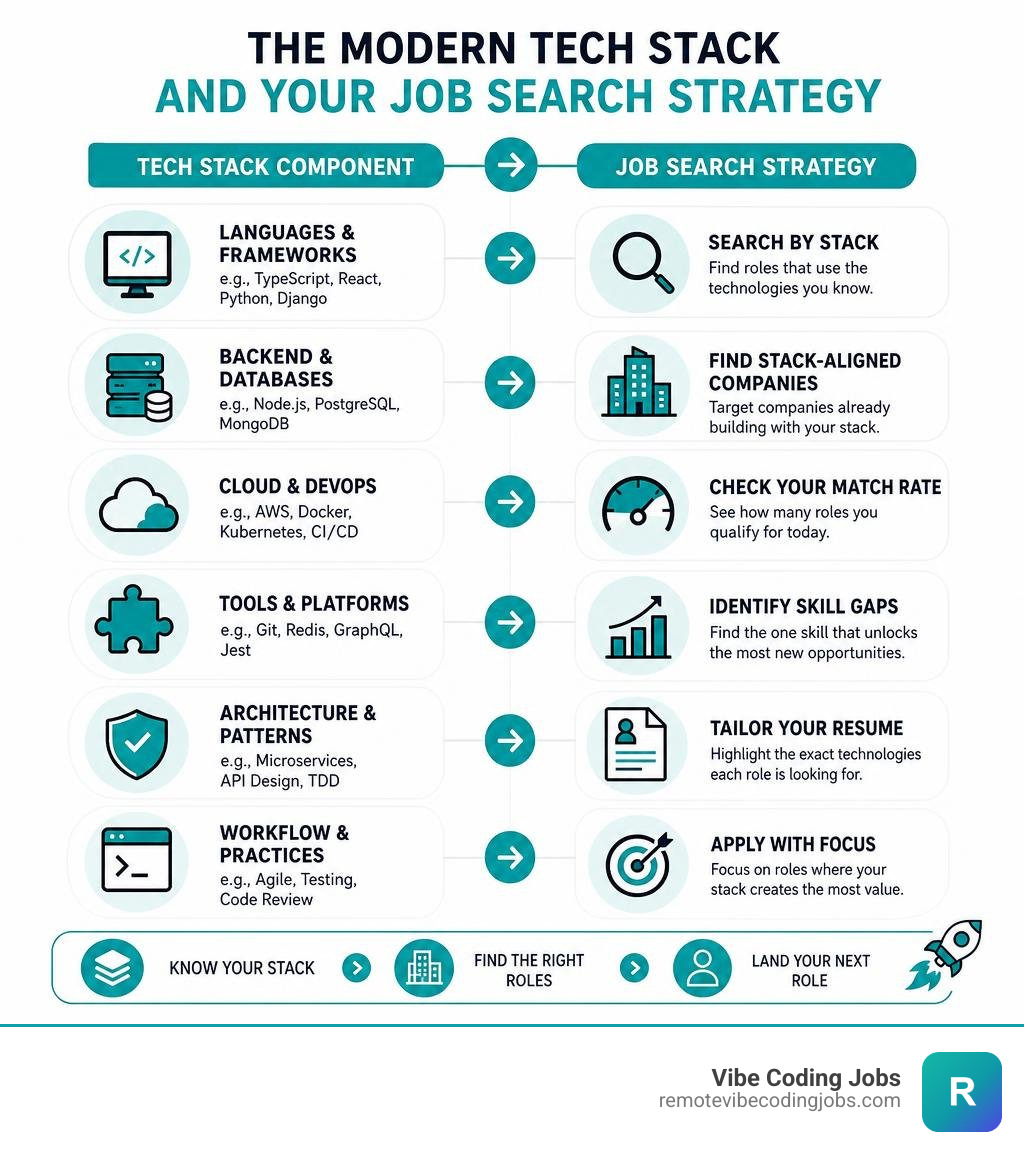
How to do a tech stack job search (quick steps):
- List your current skills — e.g. React, TypeScript, Node.js, Docker
- Search job boards by technology — filter by stack, not just job title
- Find companies using your stack — use tools that map technology usage to open roles
- Check your match rate — see what percentage of live listings you qualify for
- Identify skill gaps — find the one skill that would unlock the most new jobs
- Apply with a tailored resume — highlight the exact technologies each employer uses
Manual job searching is genuinely painful. You open LinkedIn, scroll for an hour, find something promising — then realize the role requires a totally different stack than what you’ve spent years building. You apply anyway. You hear nothing.
The problem isn’t your skills. It’s the method.
Most developers search by job title (“software engineer,” “frontend dev”) and hope the tech requirements match. That’s backwards. The smarter move is to start with the technology and work outward — finding companies and roles that are already built around what you know.
This works because a job listing’s tech stack is one of the most honest signals a company sends. It tells you how they build, how they think, and whether you’d actually enjoy working there. Matching on stack isn’t just about getting hired faster — it’s about landing somewhere you won’t dread Monday mornings.
Real data backs this up. One developer built a tool to match their stack against 435 live JavaScript job listings and found that adding just one skill — Node.js — pushed their match rate from roughly 60% to 75%. That’s not a career overhaul. That’s one targeted decision.
As the RVCJ Editorial team at Remote Vibe Coding Jobs, we cover AI-assisted development, remote hiring trends, and practical tech stack job search strategies for developers building with tools like Cursor, Claude, and Copilot. In this guide, we’ll walk you through exactly how to find, evaluate, and land roles that fit your stack — from identifying what’s in demand to automating the entire search pipeline.
Tech stack job search terms made easy:
What is a Tech Stack and Why Does It Matter?
At its core, a tech stack is the combination of programming languages, frameworks, libraries, databases, and cloud infrastructure used to build and run a software application. Think of it as the foundation and architectural building blocks of a digital product.
When you execute a tech stack job search, you shift the focus from what you are called (e.g., “Senior Developer”) to what you actually do and use daily. This alignment is crucial for long-term career satisfaction. Working with a stack you enjoy keeps you engaged, while forcing yourself into an outdated or frustrating ecosystem can quickly lead to burnout. To keep your competitive edge sharp, it helps to understand which Remote Developer Skills in Demand 2026 Future Proof Your Career are currently driving the industry forward.
Understanding the Core Components of a Tech Stack
Every modern application relies on a multi-layered ecosystem. To target your search effectively, you should understand how these components interact:
- Frontend (The Client Side): What the user sees and interacts with. This layer is dominated by JavaScript and TypeScript, powered by frameworks like React, Angular, and Vue.js.
- Backend (The Server Side): The logic engine behind the scenes. Common languages include Node.js, Python, Java, Go, and Ruby, often wrapped in frameworks like Express, Django, or Spring Boot.
- Database Layer: Where the application data lives. This includes relational databases (PostgreSQL, MySQL) and non-relational document stores (MongoDB, Redis).
- Cloud Platform and Hosting: The infrastructure hosting the application, such as AWS, Google Cloud Platform (GCP), or Microsoft Azure.
- DevOps and CI/CD: The tools that automate deployment, testing, and containerization, notably Docker and Kubernetes.
How a Tech Stack Job Search Aligns Your Skills with the Right Roles
When you search strictly by tech stack, you bypass the noise of arbitrary job titles. A “Software Engineer II” at one company might write purely React, while at another, they might be building C++ database engines.
By filtering job postings by your preferred technologies, you ensure that your active working hours are spent in your flow state. This matching directly impacts your day-to-day productivity and overall job satisfaction. If you want to dive deeper into configuring your personal development environment for maximum efficiency, check out our guide on the Remote Developer Tools Stack 2026.
High-Demand Tech Stacks in 2026: What Companies are Hiring For
The software development landscape in June 2026 is highly dynamic, yet certain technology combinations consistently dominate hiring pipelines. Organizations are prioritizing stacks that enable rapid deployment, scale efficiently, and integrate smoothly with modern AI tools.
One of the most popular combinations companies are actively hiring for is the React/Node.js/Docker/MongoDB stack. This combination provides a unified language experience (JavaScript or TypeScript) across the entire development pipeline, making it highly attractive to fast-moving teams. If you are specifically focused on frontend or full-stack roles, staying updated on Remote React Developer Jobs 2026 Trends Opportunities will help you position your skills where the demand is highest.
Frontend and Backend Standards
The battle for frontend supremacy continues, but React remains the clear market leader, heavily backed by its massive community and ecosystem. Angular, backed by Google, continues to hold a strong position in enterprise environments that require rigid, structured architectures. Vue.js remains a popular, lightweight alternative for budget-conscious or highly iterative projects.
On the backend, Java and Spring Boot remain the bedrock of high-load enterprise applications in finance, healthcare, and e-commerce. Far from being “dead,” Java is highly optimized for large-scale, robust systems. Meanwhile, Python (with Django and Flask) is the undisputed king of data-heavy applications, machine learning integrations, and rapid prototyping. Bridging these two worlds is TypeScript, which has quickly become the baseline standard for modern web development. To secure a competitive role in this space, read our Remote TypeScript Developer Jobs Guide to Landing Your Next Role.
Full-Stack, DevOps, and Mobile Ecosystems
The MERN Stack (MongoDB, Express.js, React, Node.js) is widely considered a highly futureproof stack as companies increasingly migrate toward React-based frameworks and serverless architectures. It has largely outpaced the older MEAN stack (which uses Angular) in terms of sheer job volume.

In the cloud and DevOps space, containerization with Docker has become a default expectation for developers of all levels, while Kubernetes is favored by high-traffic, complex systems requiring advanced orchestration. For mobile developers, native development (using Swift for iOS or Kotlin for Android) is preferred by well-funded companies aiming for peak performance, while hybrid frameworks (like React Native or Flutter) are highly sought after by startups looking to share codebases across platforms.
Data Engineering, Machine Learning, and AI Tooling
Data pipelines and AI infrastructure are seeing unprecedented investment in June 2026. High-demand roles frequently require a stack consisting of Python, Apache Airflow, and Terraform for infrastructure-as-code.
Furthermore, companies are increasingly looking for developers who are comfortable with “vibe coding” — using AI-assisted engineering tools like Claude, Cursor, and Copilot to accelerate development and maintain high code quality. These modern workflows frequently pair traditional languages with vector databases to fuel large-scale LLM integrations. To find organizations leading this charge, explore the Best Companies Hiring AI Developers Remote Opportunities.
How to Execute a Tech Stack Job Search Based on Real Market Data
To run a highly successful tech stack job search, you must look beyond basic search bars on generic job sites. Successful candidates use data-driven approaches to identify where their skills are truly valued.
Matching Your Existing Skills in a Tech Stack Job Search
Instead of guessing how qualified you are, you can use specialized tools to calculate your exact skill overlap against live listings. For example, a developer recently built a custom tool that matches user profiles against 435 live JavaScript job listings.
This data revealed that most modern listings require an average of 6 to 8 technologies. If you only know React and TypeScript, you might match around 60% of available roles. However, by identifying your missing skills through targeted analysis, you can strategically learn a single additional tool (like Node.js or Docker) to unlock a massive wave of new opportunities. Understanding this dynamic is key to optimizing your Remote Developer Jobs AI Tools Benefits Stack Workflow.
To see this in action, you can read the full case study: I Built a Tool That Matches Your Tech Stack Against 435 Live JavaScript Job Listings – DEV Community .
Discovering Companies by Their Technology Usage
Another highly effective strategy is targeting companies based on their tech stack footprint, even before they post a specific job opening. Platforms like TheirStack track over 205 million job postings across 195 countries, mapping the specific tools, databases, and SaaS platforms companies use.
By filtering for “Company Technology” rather than just “Job Technology,” you can find every company that builds with your favorite stack (e.g., PostgreSQL + React). Users of tech-stack-based targeting report a 3x increase in recruiter response rates and 60% more meetings booked because their outreach is highly relevant. To position yourself for these modern remote roles, check out the Best Remote Developer Jobs 2026 Future Proof Your Career.
Career Strategy: Specialization vs. Full-Stack and DevOps
One of the oldest debates in software engineering is whether to become a highly specialized master of one technology or a versatile generalist. Your choice will directly dictate your tech stack job search strategy and the types of companies you attract. To map out your long-term goals, consult our Remote Developer Career Path Junior to Senior Guide 2026.
The Value of Full-Stack with DevOps Skills
While standard full-stack developers (who handle basic frontend and backend) are highly common, full-stack developers who also possess strong DevOps skills are incredibly rare. In the industry, a standard full-stack developer is often compared to “gold,” but a full-stack engineer with DevOps expertise is considered a “diamond.”
By mastering infrastructure-as-code tools like Terraform or configuration management platforms like Ansible, you can take complete ownership of a feature from the first line of frontend code to its live deployment on AWS. This versatility makes you exceptionally valuable to lean engineering teams. To build out this highly profitable skill set, review our recommended Remote Developer Tools Stack 2026.
Hiring Expectations: Startups vs. Large Corporations
The size of your target employer drastically changes what they expect from your tech stack experience. Startups prioritize speed and flexibility, meaning they want versatile developers who can wear multiple hats. Large corporations, on the other hand, require deep, specialized knowledge to maintain massive, legacy systems.
| Hiring Criterion | Startups (Seed to Series B) | Large Corporations (Enterprise / MAANG) |
|---|---|---|
| Primary Role Focus | Full-Stack or Full-Stack + DevOps | Highly specialized (e.g., Java-only, React-only) |
| Experience Required | 2–3 years (but highly versatile and autonomous) | 7–8+ years of deep, specialized experience |
| Tech Stack Breadth | Expected to touch frontend, backend, and cloud | Restricted to a single layer of the application |
| Key Value Metric | Speed of feature delivery and adaptability | System stability, scale, and deep architectural knowledge |
Automating Your Job Search with AI and DevOps Pipelines
Manual applications are slow and exhausting. Fortunately, in 2026, developers are applying engineering principles to their own job searches by building automated pipelines that scrape, score, and tailor applications. This approach significantly increases efficiency, as detailed in our guide on the Remote Developer Jobs AI Tools Benefits Stack Workflow.
AI-Powered Resume Tailoring and Match Scoring
Modern AI pipelines can analyze a target job description, compare it against your master resume, identify skill gaps, and rewrite your bullet points to highlight the exact keywords the employer’s applicant tracking system (ATS) is looking for.
Open-source projects like BalaShankar9/hirestack-ai provide comprehensive, multi-agent AI pipelines. These platforms use specialized agents (such as a Gap Detector and a Document Architect) powered by Gemini AI to build highly tailored resumes, generate personalized cover letters, and even provide custom interview preparation based on the target company’s culture. You can learn more about integrating these systems into your routine in our guide on Remote Developer Jobs AI Tools Workflow.
Building a Self-Hosted Job Search Pipeline
For developers who want complete control over their data, self-hosted job search pipelines are becoming incredibly popular. A prime example is the open-source tool JobOps, which has over 800 users and has run more than 4,000 job searches since its launch. JobOps is so highly regarded that it ranked #3 on GitHub Trending for TypeScript repositories.
By self-hosting a tool like JobOps via Docker, you can scrape multiple job boards simultaneously, use local AI models (via Ollama) or cloud APIs to score job matches, and connect your email to track interview invitations and responses automatically. This DevOps-style pipeline keeps your search organized without sacrificing application quality. To explore how these automated workflows are changing the hiring landscape, read about Remote Developer Jobs AI Tools Workflow.
Frequently Asked Questions about Tech Stack Job Searching
What is the most futureproof tech stack to learn in 2026?
The MERN stack (MongoDB, Express.js, React, Node.js) combined with TypeScript is currently the most futureproof stack for web developers. As companies increasingly move toward React-based frameworks and serverless architectures, having strong TypeScript skills across both the frontend and backend ensures your skills remain in high demand.
How do I find remote jobs that use my specific tech stack?
To find remote roles built around your favorite technologies, skip generic job boards and use platforms that prioritize stack-based filtering. You can find highly curated daily listings that match your specific tools and culture preferences by looking through the Best Remote Developer Jobs 2026 Future Proof Your Career.
Should I learn DevOps tools if I am a frontend developer?
Yes, absolutely. Even a basic understanding of Docker and CI/CD pipelines will set you apart from other frontend developers. It allows you to understand how your code is packaged and deployed, making you a much more independent and valuable team member. To learn how to land great roles by focusing on practical, hands-on skills rather than algorithmic puzzles, read our guide on Remote Coding Jobs No Leetcode Practical Skills.
Conclusion
Executing a modern tech stack job search is all about working smarter, not harder. By aligning your search with the specific frameworks, databases, and languages you love, you bypass the frustration of generic job hunting and land roles where you can truly excel.
At RemoteVibeCodingJobs, we are dedicated to helping developers find high-quality, remote “vibe coding” roles at async-first companies that support modern, AI-assisted workflows. Ready to take the next step in your career with a team that values cutting-edge tools? Find your next role at Sendbird and start working with a stack that inspires you.