
No Commute, No Problem: Your Guide to Ruby on Rails Telecommute Jobs
The Real Market for Remote Ruby on Rails Jobs Part Time in 2026
Remote Ruby on Rails jobs part time are more available than most developers realize — and they pay well.
Here’s a quick snapshot of how the market is structured right now:
| Channel Type | Availability | Typical Focus |
|---|---|---|
| General Job Boards | Moderate | Broad range of contract and part-time roles |
| Specialized Developer Platforms | High | Niche, async-first, and AI-assisted roles |
| Direct Outreach & Networking | High | Unadvertised fractional and MVP projects |
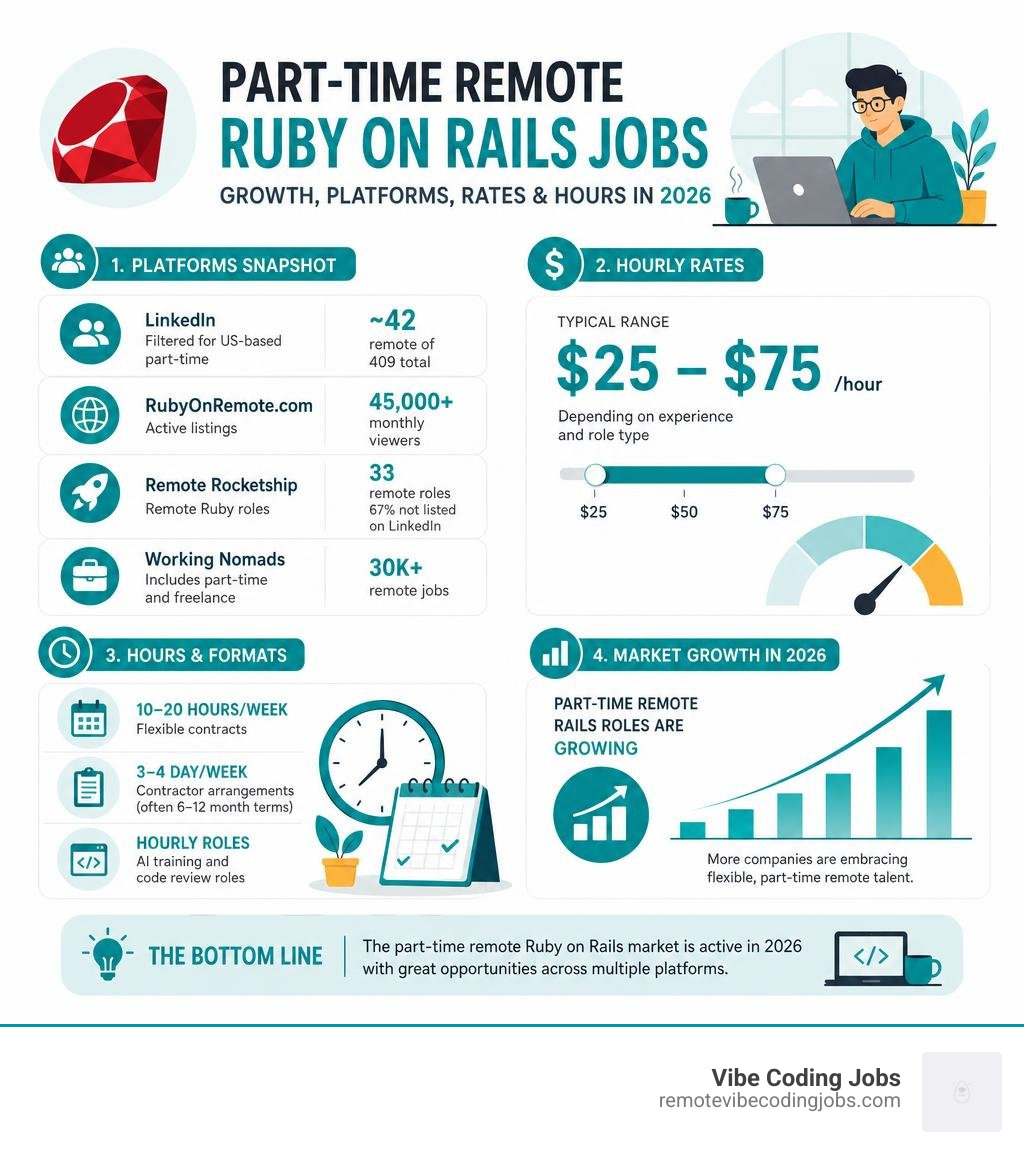
Typical hourly rates range from $25 to $75/hour, depending on experience and role type.
Common part-time formats include:
- 10-20 hours/week flexible contracts
- 3-4 day/week contractor arrangements (often 6-12 month terms)
- Hourly AI training and code review roles
The part-time remote Rails market is genuinely active in 2026 — but it’s spread across various channels, and many of the best roles never appear on mainstream job boards. That makes finding the right opportunity feel harder than it should be.
Whether you’re a senior Rails engineer looking to cut hours without cutting quality, or a mid-level developer wanting to run multiple client projects at once, the opportunities exist. You just need to know exactly where to look — and what companies are actually hiring for.
I’m RVCJ Editorial, the team behind Vibe Coding Jobs, where we cover remote work trends, AI-assisted development, and hiring patterns for engineers building with tools like Cursor and Claude — including the growing market for remote Ruby on Rails jobs part time. In the sections below, we’ll walk you through every practical step to find, evaluate, and land these roles.
Remote ruby on rails jobs part time terms simplified:
How to Find Remote Ruby on Rails Jobs Part Time

Finding a part-time telecommuting role requires a slightly different strategy than looking for a standard 9-to-5. While full-time roles dominate aggregators, part-time positions are frequently tucked away inside contract listings, specialized developer networks, or niche job boards.
In June 2026, the demand for flexible, fractional engineering talent is rising. Companies want to ship features quickly without taking on the overhead of a full-time salary and benefits package.
To help you visualize how these arrangements differ, we’ve put together a quick comparison:
| Feature | Part-Time Remote Rails | Full-Time Remote Rails |
|---|---|---|
| Weekly Hours | 10 to 30 hours | 40+ hours |
| Hiring Speed | Often faster (contract-to-hire or project-based) | Slower (multiple interview loops) |
| Primary Focus | Feature shipping, bug squashing, database optimization | Architecture, team leadership, daily meetings |
| Tooling Expectation | High efficiency, pragmatic use of AI (vibe coding) | Strict enterprise workflows, extensive sprint planning |
Why Companies Hire for Remote Ruby on Rails Jobs Part Time
Why would an organization look for a part-time Rails developer instead of a full-time engineer? It usually comes down to three main factors:
- Startup Needs & MVP Development: Early-stage startups often need to build a Minimum Viable Product (MVP) but lack the capital to hire a full-time senior developer. Hiring a fractional Rails developer for 15 hours a week allows them to launch their product on a budget.
- Cost Efficiency: Ruby on Rails is famously productive. A highly skilled developer using modern workflows can accomplish in 15 hours what a junior developer might take 40 hours to write.
- Scaling Engineering Teams on Demand: Companies experiencing seasonal traffic or embarking on a migration (e.g., updating a legacy Rails 5 app to Rails 8) hire part-time contractors to support their core team without long-term commitments.
Key Industries Offering Part-Time Rails Opportunities
Certain sectors are hotbeds for part-time Rails talent. If you are targeting your search, focus on these areas:
- EdTech: Educational platforms often scale their development teams based on school semesters. For example, large-scale educational games platforms reaching over 30 million active players frequently hire part-time contractors to maintain production stability, handle authentication, and ensure children’s data privacy compliance.
- E-Commerce: Online stores rely heavily on custom integrations. Whether it is a double-sided agricultural marketplace or a specialized seed-sales platform, e-commerce companies constantly need part-time help with checkout flows, database performance, and custom Shopify apps.
- AI Data Training: The boom in Large Language Models (LLMs) has created a unique niche. Major foundation model labs hire experienced Rails developers part-time to review AI-generated Ruby code, evaluate logical correctness, and write clean, idiomatic reference code to train AI models.
- Seed-Stage Startups: Small teams that have recently raised a pre-seed or seed round use part-time Rails talent to rapidly iterate on user feedback before their next funding round.
Top Platforms and Companies Hiring Part-Time Rails Developers

Knowing where to look is half the battle. If you only search general job boards, you will miss out on the majority of active listings.
Best Job Boards for Remote Ruby on Rails Jobs Part Time
To maximize your chances of landing a role, focus on platforms that cater to modern development workflows:
- LinkedIn: While competitive, it remains a major source of listings. There are currently over 400 part-time Ruby on Rails jobs in the United States listed on LinkedIn, with a portion of those being fully remote. To view them, check out the 1,000+ Part Time Ruby On Rails jobs in United States – LinkedIn feed and filter specifically for “Remote.”
- Vibe Coding Jobs: At Vibe Coding Jobs, we aggregate remote developer roles at async-first companies. We focus specifically on “vibe coding” positions — roles that welcome the use of AI tools like Cursor and Claude to build software faster. You can easily filter our daily listings by culture, tech stack, and flexible hours to find your next part-time gig.
- GitHub and Open Source Communities: Many companies look for contributors to open-source Rails projects or hire directly from GitHub discussions. Keeping an active profile and contributing to popular Rails gems can open doors to unadvertised part-time contract roles.
Contract and Freelance Strategies for Rails Engineers
If you prefer hourly contract work or project-based engagements, direct outreach and specialized networking are highly lucrative:
- Cold Outreach to Seed-Stage Startups: Startups that have recently raised pre-seed or seed funding often need senior Rails expertise but cannot afford a full-time salary. Reaching out directly to founders on platforms like Twitter/X or via email with a clear proposal for 10-15 hours of weekly support is an incredibly effective way to land high-paying contracts.
- Shopify Ecosystem Integration: Because Shopify’s backend and ecosystem are deeply tied to Ruby, there is a massive overlap. E-commerce brands frequently need part-time help with custom app development, checkout flows, and API integrations. Partnering directly with e-commerce agencies can provide a steady stream of part-time client work.
- Developer-Focused Communities: Joining private Slack groups, Discord servers, and local Ruby meetups is a great way to find fractional roles. Many founders and engineering managers post part-time contract opportunities directly in these communities before listing them publicly.
In-Demand Skills and Compensation for Part-Time Rails Roles
To stand out in the part-time market, you need to show that you can hit the ground running with minimal hand-holding.
Essential Tech Stack and Experience Levels
When companies hire part-time, they rarely have the resources to train junior developers. They look for mid-to-senior level engineers who are comfortable with the following technologies:
- Database Mastery (PostgreSQL): You must know how to write efficient queries, design clean schemas, and optimize indexes. Many part-time roles place database performance tuning and query optimization at the very center of their requirements.
- Background Jobs (Sidekiq): Knowing how to handle asynchronous processing, webhooks, and email queues is essential for keeping Rails applications snappy.
- Modern Frontend Integration: While classic Rails used Asset Pipeline, modern applications frequently use Tailwind CSS, StimulusJS, and Vite to deliver modern user interfaces without the complexity of a heavy SPA framework.
- LLM & AI Tool Literacy: In 2026, being a remote ruby on rails developer means knowing how to leverage AI tools. Whether you are building AI features into a Rails app or working on LLM code evaluation, understanding prompt engineering and code generation workflows is a massive advantage.
Typical Hourly Rates and Compensation Structures
How much can you expect to make? Part-time remote Rails work is generally structured in one of three ways:
- Hourly Pay: The most common structure. Rates typically range from $25 to $50 per hour for mid-level developers, while senior contractors and specialized Shopify developers easily command $50 to $75+ per hour.
- Retainer Agreements: A company pays you a set monthly fee to secure a guaranteed number of hours (e.g., $3,000/month for 15 hours of availability per week). This offers excellent income predictability.
- Project-Based Pricing: Common for building specific features or MVPs. You estimate the project scope and charge a flat fee, which can result in a very high effective hourly rate if you work efficiently.
Pros, Cons, and Challenges of Part-Time Remote Rails Work
Working part-time and remotely sounds like the ultimate lifestyle design, but it comes with its own unique set of trade-offs.
The Benefits of Part-Time Telecommuting
- Ultimate Flexibility: You can easily balance your development work with personal projects, family commitments, travel, or continuing education.
- Multiple Income Streams: Working 15 hours a week for two different clients diversifies your income. If one client runs out of budget, you still have a financial safety net.
- Rapid Portfolio Building: Working with different codebases, industries, and teams exposes you to a wider variety of architectural patterns and business models than staying at a single full-time job for years.
- Autonomy: Part-time contractors are typically judged strictly on their output. If you deliver high-quality, working code on time, how and when you work is entirely up to you.
Overcoming Common Remote Challenges
- Context Switching: Jumping between different codebases in a single week can be mentally exhausting. Solution: Dedicate specific days of the week to specific clients rather than trying to work on multiple projects in a single afternoon.
- Asynchronous Communication: When you only work 15 hours a week, you cannot afford to spend 3 hours waiting for a slack reply. Solution: Write incredibly detailed documentation, use video tools like Loom to explain your pull requests, and over-communicate your progress.
- Daily Standups & Meetings: If a client expects you to attend a 45-minute daily standup, that meeting can quickly eat up a massive percentage of your billable part-time hours. Solution: Establish upfront that your role is primarily asynchronous. Agree to provide written updates instead of attending live daily syncs.
Frequently Asked Questions about Part-Time Remote Rails Jobs
How many hours a week is a typical part-time Rails job?
Most part-time remote Rails roles require a commitment of 10 to 20 hours per week. However, contractor arrangements can sometimes scale up to 30 hours per week (often structured as 3 to 4 days of work) depending on the project’s urgency and lifecycle.
Can I use AI tools like Cursor or Claude in my Rails development?
Absolutely! In fact, at Vibe Coding Jobs, we highly encourage it. Using AI-assisted development tools (known as “vibe coding”) allows you to generate boilerplate code, write test suites, and debug database queries in a fraction of the time. This makes you incredibly valuable to part-time employers who are paying you by the hour for rapid feature delivery. Just make sure to verify the code for security and performance before pushing to production!
What is the average hourly rate for a part-time remote Rails developer?
In 2026, the average hourly rate ranges from $25 to $50 per hour for mid-level roles, while senior contractors, database optimization specialists, and expert Shopify developers routinely earn $50 to $75+ per hour.
Conclusion
Finding remote ruby on rails jobs part time is a fantastic way to design a flexible, high-income career on your own terms. By focusing on specialized job boards, mastering modern tools like PostgreSQL, Sidekiq, and Tailwind, and embracing the speed of AI-assisted development, you can secure rewarding projects that fit your lifestyle.
If you are ready to skip the endless scroll of generic job boards and find companies that value modern, efficient, and flexible workflows, check out our curated listings at remotevibecodingjobs.com. We aggregate the best remote “vibe coding” jobs at async-first companies, helping you land your next dream role fast. Let’s build something great together!