
How to Land Legit Fully Remote AI Positions Without the Spam
The Remote AI Job Market Is Huge — Here’s How to Navigate It Without Wasting Your Time
Fully remote AI positions are everywhere right now — over 105,000 listings in the U.S. alone, with 30,000+ updated daily across major job platforms. But if you’ve spent any time searching, you already know the problem: for every legit role, there’s noise, vague postings, and outright spam clogging the feed.
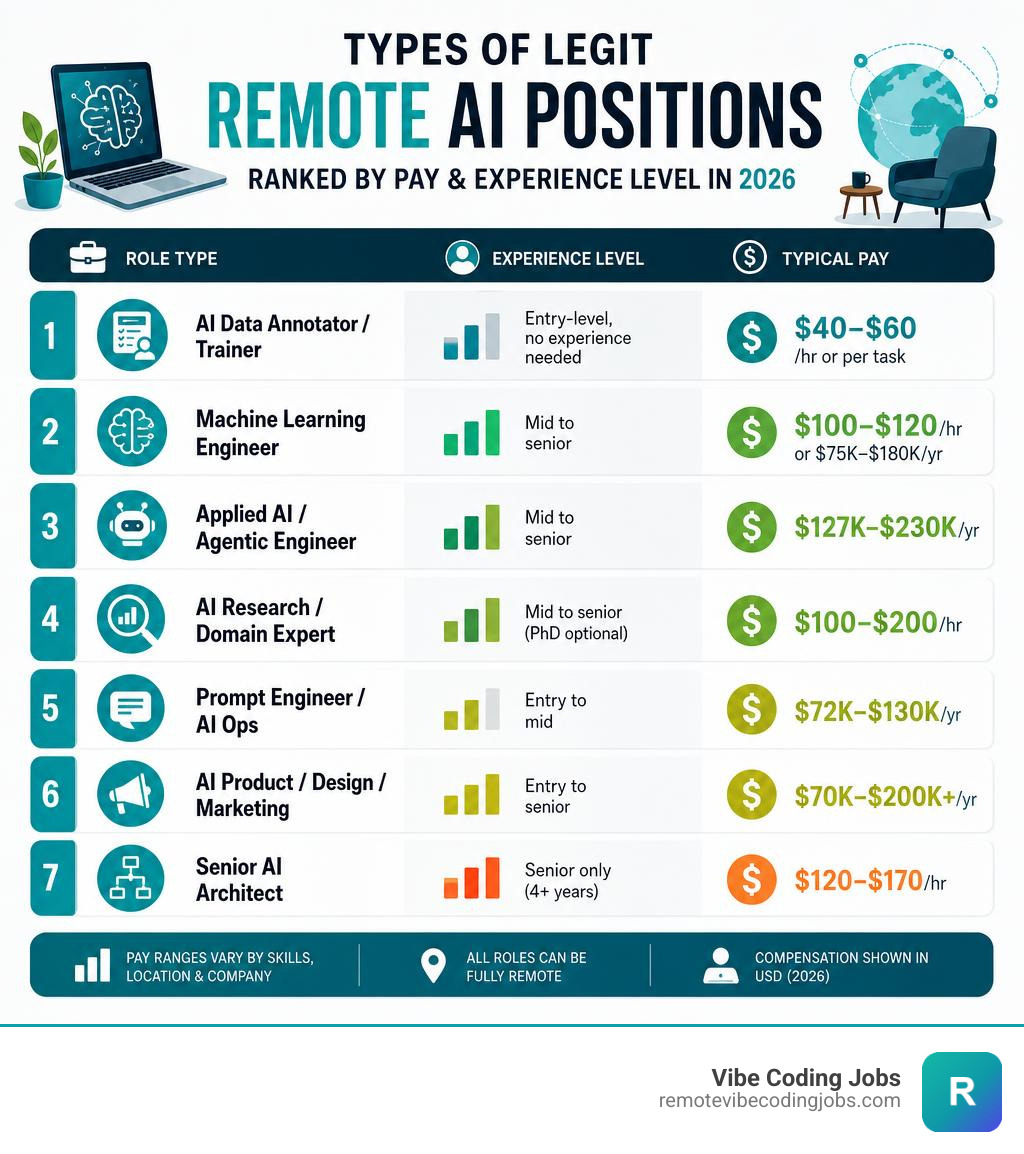
Here’s a quick snapshot of the most common legit remote AI roles available in May 2026:
| Role Type | Experience Level | Typical Pay |
|---|---|---|
| AI Data Annotator / Trainer | Entry-level, no experience needed | $40–$60/hr or per task |
| Machine Learning Engineer | Mid to senior | $100–$120/hr or $75K–$180K/yr |
| Applied AI / Agentic Engineer | Mid to senior | $127K–$230K/yr |
| AI Research / Domain Expert | Mid to senior (PhD optional) | $100–$200/hr |
| Prompt Engineer / AI Ops | Entry to mid | $72K–$130K/yr |
| AI Product / Design / Marketing | Entry to senior | $70K–$200K+/yr |
| Senior AI Architect | Senior only (4+ years) | $120–$170/hr |
The market is real and the pay is serious. But knowing which roles are legitimate — and how to find them fast without sifting through junk — is the actual challenge.
The volume is staggering, but the signal-to-noise ratio is low. A curated board like Vibe Coding Jobs narrows that down to 276 verified remote AI listings, filtered for async-first teams and modern AI tool stacks, so you’re not wading through recycled postings or shady gig traps.
I’m part of the RVCJ Editorial team at Vibe Coding Jobs, where we track hiring trends, compensation data, and company culture signals across fully remote AI positions to help developers find roles worth their time. The guide below cuts straight to what’s worth applying to and how to do it right.
Easy fully remote ai positions word list:
9 Legit Fully Remote AI Positions Worth Targeting in 2026
The landscape of fully remote ai positions in May 2026 has expanded far beyond traditional software engineering. From non-technical data preparation to high-level strategic architecture, companies are desperately seeking human partners to validate, guide, and deploy intelligent models.
Below is a breakdown of the top nine roles currently driving the remote AI job market.
1. Entry-Level AI Data Annotation and AI Training Roles
If you are looking to break into the AI space without a technical background, entry-level data annotation and AI training roles are your best starting point. These positions focus on human-in-the-loop training, ensuring that models understand context, nuances, and factual accuracy.
- Common Titles: AI Trainer, Data Annotator, Online Rater, Search Engine Evaluator, Ad Evaluator, Data Collector.
- Requirements: No prior technical experience is required. You must be at least 18 years old, possess strong language skills, and have a reliable computer with high-speed internet.
- How it Works: You will review text, audio, images, or video to label data or rate model responses based on strict quality guidelines. Many platforms offer flexible, part-time, freelance, or pay-per-task arrangements.
- Diverse Opportunities: These programs actively recruit bilingual or multilingual candidates to build localized datasets across various language pairs.
For a deeper dive into balancing these roles while building your career, check out our guide on Entry Level AI Coding Jobs: Career Growth & Work-Life Balance.
2. Machine Learning Engineer and Custom Model Roles
At the core of the AI revolution are Machine Learning (ML) Engineers who design, build, and fine-tune custom models. Unlike generalist developers, these professionals work directly with the mathematical and computational layers of AI.
- Focus Areas: Fine-tuning Large Language Models (LLMs), optimizing Retrieval-Augmented Generation (RAG) pipelines, and setting up secure model hosting.
- Tech Stack: PyTorch, TensorFlow, Python, and robust MLOps infrastructure for model evaluation and deployment.
- Hiring Trends: Global teams are looking for engineers to own the entire model lifecycle, from raw data assessment to production-grade endpoints. Top-tier, worldwide remote teams typically structure custom model units around evaluation quality, secure deployment, and close collaboration between product, infrastructure, and research teams.
- Work Style: Often involves cross-timezone collaboration and participating in Tier 2 or Tier 3 on-call rotations to keep high-scale models running smoothly.
3. Applied AI Software Engineer and Agentic AI Roles
While ML engineers focus on the models themselves, Applied AI Software Engineers focus on integrating those models into real-world applications. This is one of the fastest-growing categories of fully remote ai positions as companies rush to transition from simple chat interfaces to complex, multi-agent workflows.
- Key Responsibilities: Developing custom AI agents, managing tool use (MCPs), and building complex agentic patterns.
- Core Frameworks: LangChain, LangGraph, and cloud ecosystems like AWS Bedrock.
- The Goal: Moving past theoretical experimentation to deliver production-grade software that has a measurable business impact.
If you are curious about how these roles interface with modern development tools and affect long-term employment, read our analysis on Remote AI Developer Jobs: AI Tools Integration & Job Security.
4. AI Research, Evaluation, and Domain Expert Roles
Frontier AI labs need more than just developers; they need domain experts to evaluate and push the limits of scientific reasoning in modern models.
- Who They Hire: Mathematicians, physicists, astrophysicists, and healthcare research data annotators.
- The Mission: Evaluating complex analytical outputs, designing rigorous Reinforcement Learning from Human Feedback (RLHF) pathways, and setting up evaluation rubrics.
- Requirements: While a PhD can unlock high-paying consulting contracts, many platforms hire domain experts with strong undergraduate backgrounds.
- Compensation: These are highly specialized contract roles that often command premium hourly rates ranging from $100 to $200+ per hour.
5. Prompt Engineering, AI Ops, and Automation Roles
As organizations adopt AI, they require specialists who can construct efficient workflows and orchestrate internal operations using intelligent tools.
- Daily Tasks: Designing system prompts, building data pipelines, and linking APIs.
- Common Tech Stack: Zapier, Make, HubSpot, Notion, SQL, and scripting languages.
- Leverage: These roles allow small, agile teams to achieve massive operational output. For example, some 7-person startups are running operations equivalent to a 30-person company by deploying custom automation pipelines using OpenAI and Anthropic APIs.
6. AI Product, Design, Marketing, and Growth Roles
AI is fundamentally changing non-engineering disciplines, leading to a surge in creative and strategic remote roles.
- AI Product Managers: Defining the roadmap for AI-native features and balancing technical complexity with user needs.
- AI Designers (UX/UI): Crafting conversational interfaces, agentic workflow visualizations, and intuitive design systems.
- Marketing & Growth: AI SEO strategists and growth specialists who leverage generative tooling to scale content and customer acquisition.
- Key Success Factor: Showing a portfolio of projects where you’ve successfully shipped AI-driven solutions to achieve clear business outcomes.
Where to Find Legit Listings-and How to Filter Out Spam
Searching for fully remote ai positions on giant, uncurated boards can feel like a full-time job in itself. To protect your sanity and find high-quality postings, you need a structured approach.

How to Verify Fully Remote AI Positions Before You Apply
Before spending hours tailoring your resume or completing coding challenges, run through this verification checklist to avoid common job board scams:
- Check the Domain: Ensure the recruiter is contacting you from an official company email (e.g.,
name@company.com) rather than a generic Gmail address. - Verify on Official Portals: If you find a listing outside the company’s website, cross-reference it on the company’s official career page before applying.
- No Upfront Fees: Legitimate hiring processes will never charge you a fee to join, train, or apply.
- Analyze the Pay Structure: Be wary of listings that offer eye-watering salaries for zero experience, or conversely, those that refuse to provide a transparent pay range or clear contract terms.
- Confirm Geographic Eligibility: “Fully remote” often comes with tax or timezone constraints. Always verify if the role is open worldwide or restricted to specific regions (e.g., US-only, EMEA, or LATAM).
Hiring Trends: Who Is Posting Remote AI Roles Now
The hiring landscape in May 2026 is dominated by three main types of remote-first organizations:
- Enterprise Healthcare & Regulated Sectors: Companies like UnitedHealth Group are actively recruiting remote specialists to build secure, HIPAA-compliant AI pipelines. You can explore their standard requirements in this AI Engineer – Remote at UnitedHealth Group listing.
- Async-First Tech Leaders: Global software companies are setting the standard for worldwide, asynchronous AI development.
- High-Agency Startups: Small, aggressive teams are leveraging AI to scale rapidly. Many of these startups are looking for “AI-native” builders who can wear multiple hats. To see who is currently leading these hiring drives, browse our list of the Best Companies Hiring AI Developers.
Application Signals That Help You Beat Generic Applicants
To stand out in a sea of generic applications, you must provide concrete evidence of your builder mindset:
- Skip the Fluff: Instead of saying you “understand LLMs,” link directly to a GitHub repository or a live demo of an app you built.
- Show Operational Leverage: Explain how you use AI to write clean code, automate testing, or streamline workflows.
- Provide Written Specs: Show that you can write clear, concise documentation, an essential skill for asynchronous, remote teams.
For step-by-step guidance on crafting an outstanding application, see Remote AI Developer Jobs: AI Tools Description, Qualifications & Application.
Skills, Pay, Benefits, and Work Arrangements That Actually Get Offers
The compensation for fully remote ai positions is highly competitive, but it varies significantly based on technical depth, specialization, and the arrangement type.
| Role Category | Key Skills Required | Experience Level | Typical Pay Range | Work Arrangement |
|---|---|---|---|---|
| AI Trainer / Annotator | Language fluency, attention to detail | Entry (0-1 yrs) | $40-$60 / hour | Freelance / Part-time |
| Prompt / AI Ops Analyst | Zapier, HubSpot, basic Python/SQL | Junior to Mid (1-3 yrs) | $72,800-$130,000 / year | Full-time or Contract |
| Machine Learning Engineer | PyTorch, MLOps, Custom Models | Mid to Senior (3-5+ yrs) | $100-$120/hr or $75K-$180K/yr | Full-time / Worldwide |
| Senior AI Software Engineer | AWS Bedrock, Agentic patterns, Node.js | Senior (8+ yrs) | $127,000-$154,000 / year | Full-time |
| Senior Independent Architect | LLM infra, Enterprise AI stacks | Senior (4+ yrs) | $120-$170 / hour | Contract / Independent |
| Domain Expert (STEM/PhD) | Advanced mathematics, physics, RLHF | Senior / Academic | $100-$200 / hour | Contract / Flexible |
Where Fully Remote AI Positions Pay Best in 2026
If you are aiming for top-tier compensation, specialized senior roles offer the most lucrative terms:
- Independent AI Architecture Contracts: Senior architects working on enterprise AI stacks can command $120-$170/hr when they bring strong LLM infrastructure, security, and system design experience.
- Enterprise Software Engineering: High-agency, senior positions in established companies pay excellent salaries, with many senior AI software engineer roles ranging from $127,000 to $154,000 per year depending on scope, location policy, and benefits.
- AI-First Startups: Senior developers who can leverage AI tools for rapid prototyping can easily command $150,000 to $250,000+ per year, often supplemented with equity and performance bonuses.
To stay updated on the latest financial trends in this space, take a look at Remote AI Developer Jobs: AI Tools Trends & Salary.
Skills Recruiters Screen For at Each Level
The technical baseline for remote AI work is shifting. Recruiters are no longer just looking for traditional coding syntax mastery; they want to see deep architectural judgment and tool fluency.
- Languages & Frameworks: Python, TypeScript, JavaScript, React, Next.js, and SQL.
- Cloud & MLOps: AWS Bedrock, Azure AI Foundry, Google Vertex AI, and Docker containerization.
- Modern Workflows: Test-Driven Development (TDD), API integration, and code review capabilities.
For a complete breakdown of what you need to know, read Remote AI Developer Jobs: Requirements.
AI Tool Stack That Makes Remote Candidates Stand Out
If you want to capture the attention of modern tech companies, you need to show that you are an “AI-native” developer. This means integrating advanced AI assistants directly into your daily workflow to achieve extreme leverage.
- Coding Assistants: Cursor, Claude Code, GitHub Copilot, and Windsurf.
- Rapid Prototyping: Lovable, v0, and Replit Agents.
- Validation & Observability: Testcontainers, Playwright, OpenTelemetry, Prometheus, and Grafana.
We’ve detailed how these tools boost remote output in our guide on Remote AI Developer Jobs: AI Tools.
Junior, Mid-Level, and Senior Positioning
- Junior (0-2 years): Focus on showing that you are a fast learner who can use AI coding tools to ship functional features quickly.
- Mid-Level (3-5 years): Emphasize your ability to own features end-to-end, write robust tests, and integrate standard APIs securely.
- Senior/Staff (5+ years): Highlight your architectural judgment, technical leadership, and your ability to design scalable, secure, and compliant AI systems.
Learn more about this progression in Remote AI Developer Jobs: AI Tools Junior & Senior.
Remote AI Work Reality: Advantages, Challenges, Security, Growth, and Future Outlook
Working in a fully remote AI role is highly rewarding, but it requires a solid understanding of remote-first workflows and security compliance.
Advantages and Challenges of Fully Remote AI Work
- The Perks: Location freedom, highly flexible schedules, access to international teams, and long stretches of uninterrupted deep work.
- The Hurdles: Potential isolation, timezone gaps, and the risk of overwork. Async-first communication requires strict self-discipline and excellent written communication skills to prevent context loss.
Quality Controls for Remote AI Training and Evaluation
For remote data annotation and training communities, maintaining high data quality is critical. Platforms employ strict quality control measures:
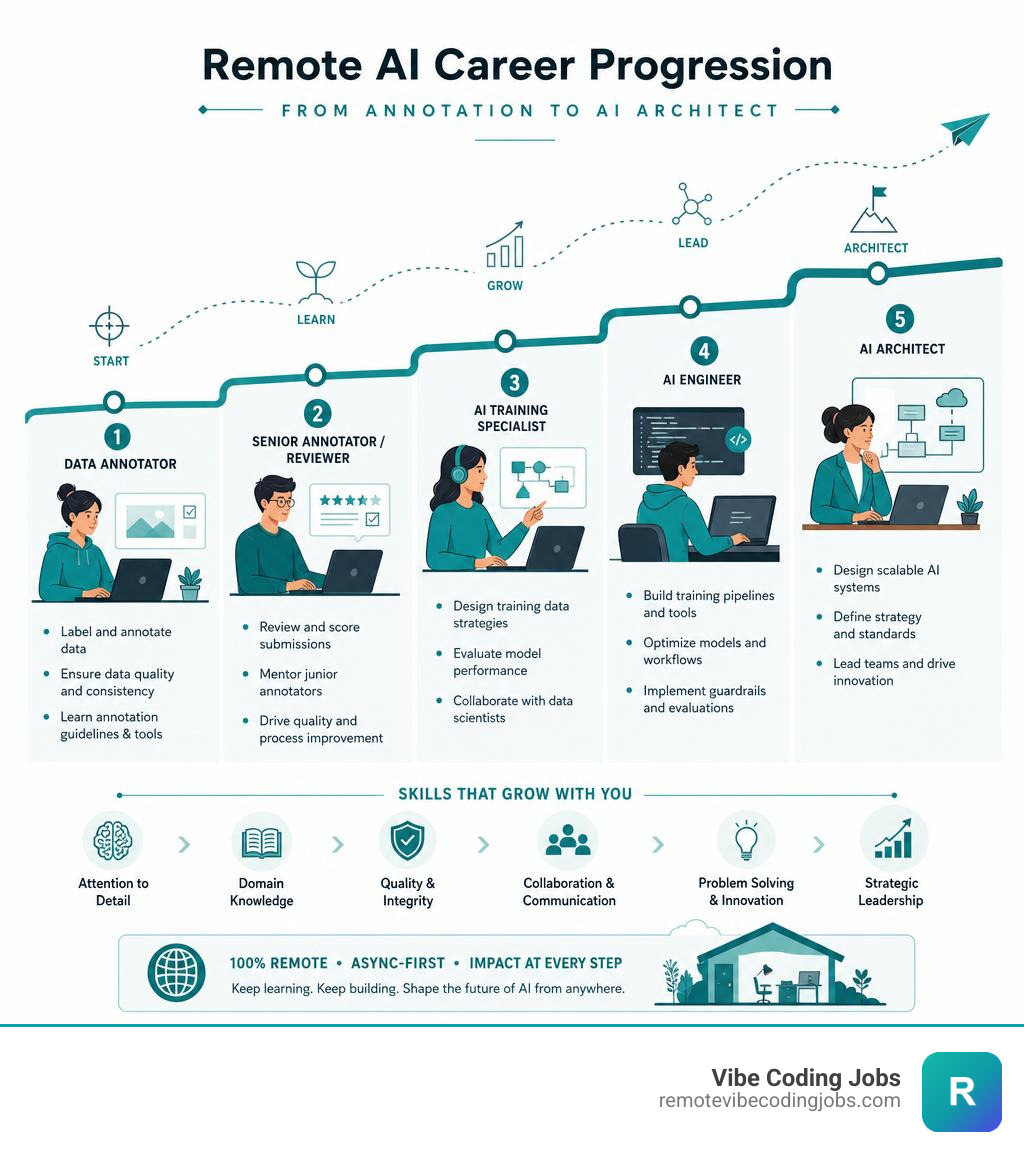
- Calibration Tests: Regular testing to ensure annotators align with task guidelines.
- Reviewer Scoring: Multi-tiered review systems where senior annotators score submissions.
- Audit Trails: Detailed logging of all data changes to ensure transparency and accountability.
Security and Compliance Practices for Sensitive AI Work
When working with sensitive data, especially in regulated industries like healthcare or finance, security is paramount:
- Compliance Awareness: Deep understanding of HIPAA, GDPR, and Responsible AI principles (fairness, transparency, and explainability).
- Model Security: Implementing robust guardrails to prevent prompt injection and reduce hallucinations.
- Ops Governance: Using private repositories, secure cloud environments, and robust model versioning and drift analysis.
Are Fully Remote AI Positions Accessible Without a Degree?
Yes. The AI job market is uniquely merit-ocratic. While advanced research roles may require academic credentials, many development, operations, and training positions care far more about what you can build.
- Self-Taught & Bootcamp Paths: Many successful AI developers transitioned from other fields by building strong portfolios and mastering modern AI tools.
- The Equalizer: AI-assisted development tools have lowered the barrier to entry, allowing non-traditional candidates to build complex software.
Explore how to get started in our article on AI Coding Jobs: Entry Level Remote Growth.
Career Development and Upskilling Paths That Compound
To ensure your career continues to grow, focus on skills that compound over time:
- Master testing methodologies: Learn how to write robust integration, contract, mutation, and property-based tests to validate AI-generated code.
- Build an automation portfolio: Create and document tools that solve real operational problems.
- Contribute to open-source: Participate in open-source AI projects to build your network and demonstrate your skills.
For actionable productivity tips, check out Remote AI Developer Jobs: AI Tools Productivity.
Future Outlook for Remote AI Employment
The future of remote AI work is incredibly bright. We are moving away from simple prompt engineering toward agentic software development and complex, production-grade AI systems.
As companies continue to adopt async-first workflows, the demand for developers who can leverage AI tools to build faster and more securely will only increase. Those who master the blend of human strategic thinking and AI-assisted execution will find themselves in high demand for years to come.
Conclusion: Apply Faster to Curated Remote AI Roles
Landing a legitimate, high-paying remote AI position doesn’t have to mean sifting through endless spam. By focusing on verified listings, mastering modern AI tools, and showcasing your real-world builds, you can stand out to top-tier employers.
At Vibe Coding Jobs, we make this process seamless. We curate daily listings from async-first companies, allowing you to filter by culture, tech stack, and your favorite AI tools like Cursor and Claude. Skip the noise and find your next career move today.
👉 Browse curated remote AI engineer roles and land your next role with confidence!