
The Vibe Coder’s Guide to AI Assisted Engineering
Vibe Coding AI Engineer: The 2026 Career Shift You Need to Understand
A vibe coding AI engineer is a developer who uses natural language prompts – instead of writing every line manually – to direct AI tools to generate, debug, and iterate on code at high speed.
Here’s what that means in practice:
- What they do: Describe what they want in plain English, let AI generate the code, then review, test, and refine it
- How they differ from traditional devs: They focus on intent, system design, and verification – not syntax
- Tools they use: Agentic IDEs and large language models inside AI-native workflows
- Where they work: Mostly remote, async-first teams building fast-moving products
- What makes them valuable: They ship dramatically faster – without losing engineering judgment
The software industry has been moving fast in this direction. Developers like Simon Willison have publicly reported going from around 200 lines of code per day to roughly 2,000 – a 10x jump – by leaning into AI coding agents. Teams using AI methodically have seen development speed increase by around 30%.
But it’s not all upside. In a 2025 survey of 18 CTOs, 16 reported production disasters tied directly to AI-generated code. Speed without guardrails is a liability.
That tension – between explosive productivity and real engineering risk – is exactly what this guide is here to unpack.
I’m RVCJ Editorial, the team behind Remote Vibe Coding Jobs, where we track remote roles, tools, and career paths for developers working at the intersection of AI and software engineering – including the fast-growing field of vibe coding AI engineering. We’ve analyzed hundreds of job listings, spoken with hiring teams, and mapped out what it actually takes to build a career in this space, so you can skip the noise and get straight to what works.
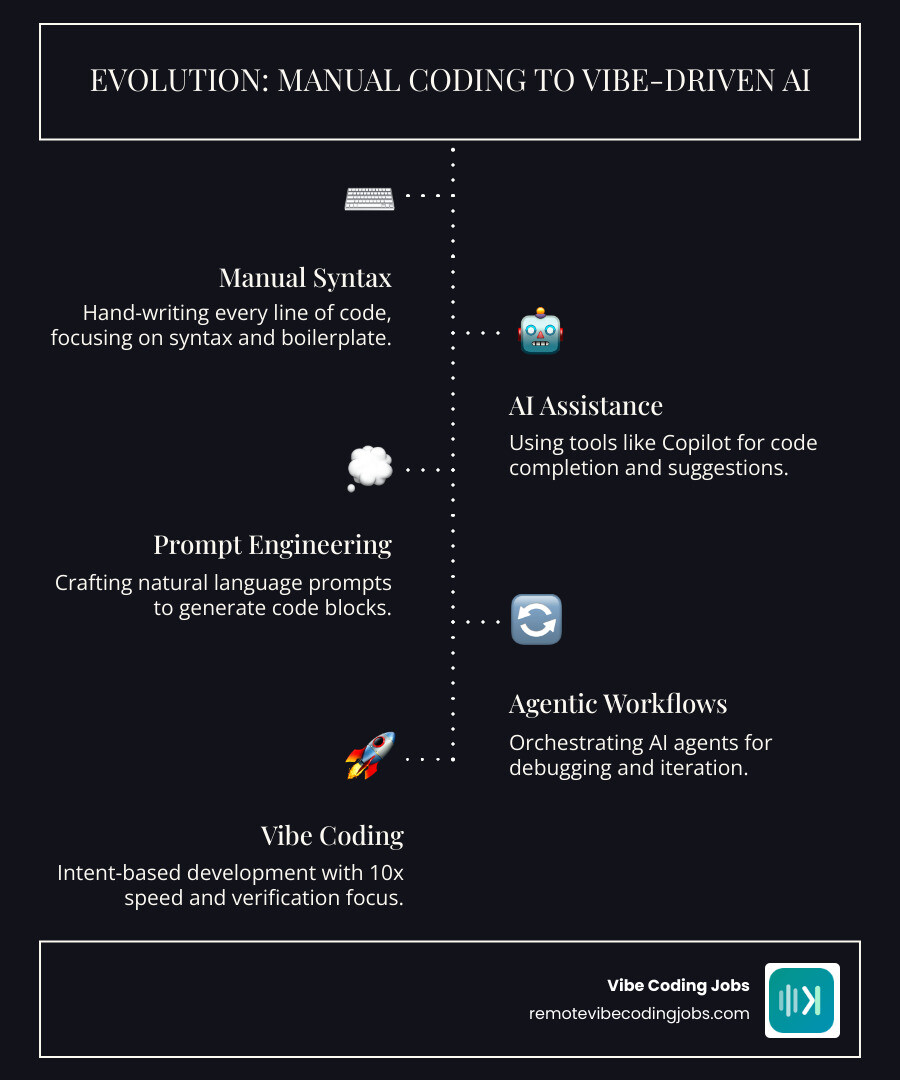
Defining the Vibe Coding AI Engineer: Beyond Traditional Syntax
At its core, vibe coding means building software by expressing intent in natural language, then letting AI generate much of the implementation. If traditional programming starts with syntax, vibe coding starts with outcomes.
That does not mean “no engineering required.” It means the center of gravity shifts.
Instead of spending most of our time remembering APIs, boilerplate, and framework quirks, we spend more time on:
- clarifying what the system should do
- decomposing problems into smaller tasks
- guiding AI through iterations
- checking whether the generated code is correct
- deciding what should never be left to vibes alone
If you want a broader foundational overview, our guide on What is Vibe Coding? is a good companion read.
It also helps to separate vibe coding from AI-assisted engineering. They overlap, but they are not identical. In broad terms, vibe coding often refers to a looser, faster, more exploratory workflow driven by prompts and iteration. AI-assisted engineering is usually more structured: AI is used inside established engineering processes such as specs, reviews, testing, and deployment controls. That distinction is discussed well in Vibe coding is not the same as AI-Assisted engineering.
The difference matters because a vibe coding AI engineer is most effective when they know when to stay in exploration mode and when to switch into disciplined engineering mode.
How Vibe Coding AI Engineers Differ from Traditional Devs
Traditional developers are often trained to think from code upward: data structures, functions, classes, implementation details. Vibe coders still need that knowledge, but they increasingly work from intent downward.
In practice, that means a vibe coding AI engineer often looks more like this:
- product thinker first
- system designer second
- AI orchestrator third
- code verifier always
The abstraction layer is higher. We are not necessarily typing every loop ourselves. We are telling the AI what business logic, architecture, constraints, and edge cases matter, then reviewing what comes back.
That changes the skill mix. A strong vibe coder still needs technical depth, but they also need:
- prompt clarity
- judgment about tradeoffs
- the ability to spot subtle errors quickly
- enough architecture sense to prevent messy AI-generated sprawl
For career planning, our Vibe Coding Career Path lays out how those skills stack from beginner to senior.
The Core Competencies of Vibe Code Engineering
The best vibe coders are not the people writing the fanciest prompts. They are the people who can consistently turn messy goals into reliable systems.
Core competencies include:
Problem decomposition
Break large requests into smaller units the model can execute accurately.AI orchestration
Use the right model, tool, and workflow for the task rather than asking one assistant to do everything.Debugging intuition
Notice when code “looks right” but is wrong. AI is excellent at plausible nonsense.Iterative prompting
Treat prompting like pair programming, not magic. Good results usually come from refinement.Logic verification
Check assumptions, inputs, outputs, and failure modes before trusting generated code.System design
Know where boundaries, interfaces, and data contracts belong.
A practical external perspective on disciplined AI-led building is in Vibe Code Engineering – How to Vibe Code With AI Properly.
The Productivity Paradox: 10x Output and Production Risks
The biggest reason vibe coding took off is simple: it is fast. Very fast.
Simon Willison has described AI coding agents as dramatically expanding the range of projects he can tackle, and reported output jumping from roughly 200 lines of code a day to around 2,000. That is not just a typing speed gain. It is a scope gain. We can attempt more experiments, more prototypes, and more integrations than before.

At the team level, the upside looks strongest when AI is added methodically. The research you provided notes that teams using AI-assisted coding inside mature software development lifecycles saw about a 30% increase in development speed. The key phrase there is “inside mature lifecycles.” AI performs best when it plugs into a good process rather than replacing one.
This is the productivity paradox:
- output goes up fast
- confidence often goes up too fast
- bottlenecks move rather than disappear
Instead of spending all our time writing code, we spend more time on:
- reviewing generated changes
- validating architecture
- writing and fixing tests
- checking security implications
- untangling AI-generated complexity
That is why State of Vibe Coding 2026 matters for anyone thinking long term about this field: the workflow is changing, but engineering responsibility is not.
Why Every Vibe Coding AI Engineer Needs a Safety Net
The scary side of the story is not theoretical. In the August 2025 Final Round AI survey mentioned in your research, 16 out of 18 CTOs said they had experienced production disasters caused directly by AI-generated code. That is 89%.
To be fair, that does not mean AI code is always bad. It means many teams deployed it carelessly.
Common failure modes include:
- hidden security vulnerabilities
- broken edge-case logic
- dependency misuse
- poor error handling
- duplicate or contradictory business rules
- technical debt generated faster than humans can understand it
This is why “ship fast” has to be paired with “verify harder.”
A senior-engineer-style workflow is less about rejecting vibe coding and more about controlling it. Vibe Coding Done the Senior Engineer Way captures that spirit well: use AI aggressively for speed, but put human judgment around requirements, architecture, review, and production readiness.
Balancing Speed and Stability in Professional Environments
In professional teams, the safest model is not “AI writes everything.” It is “AI accelerates each stage of engineering.”
That usually includes:
- technical design docs before implementation
- test-driven or test-conscious development
- code review by humans
- CI checks
- separate dev and production environments
- rollback paths
- monitoring after deployment
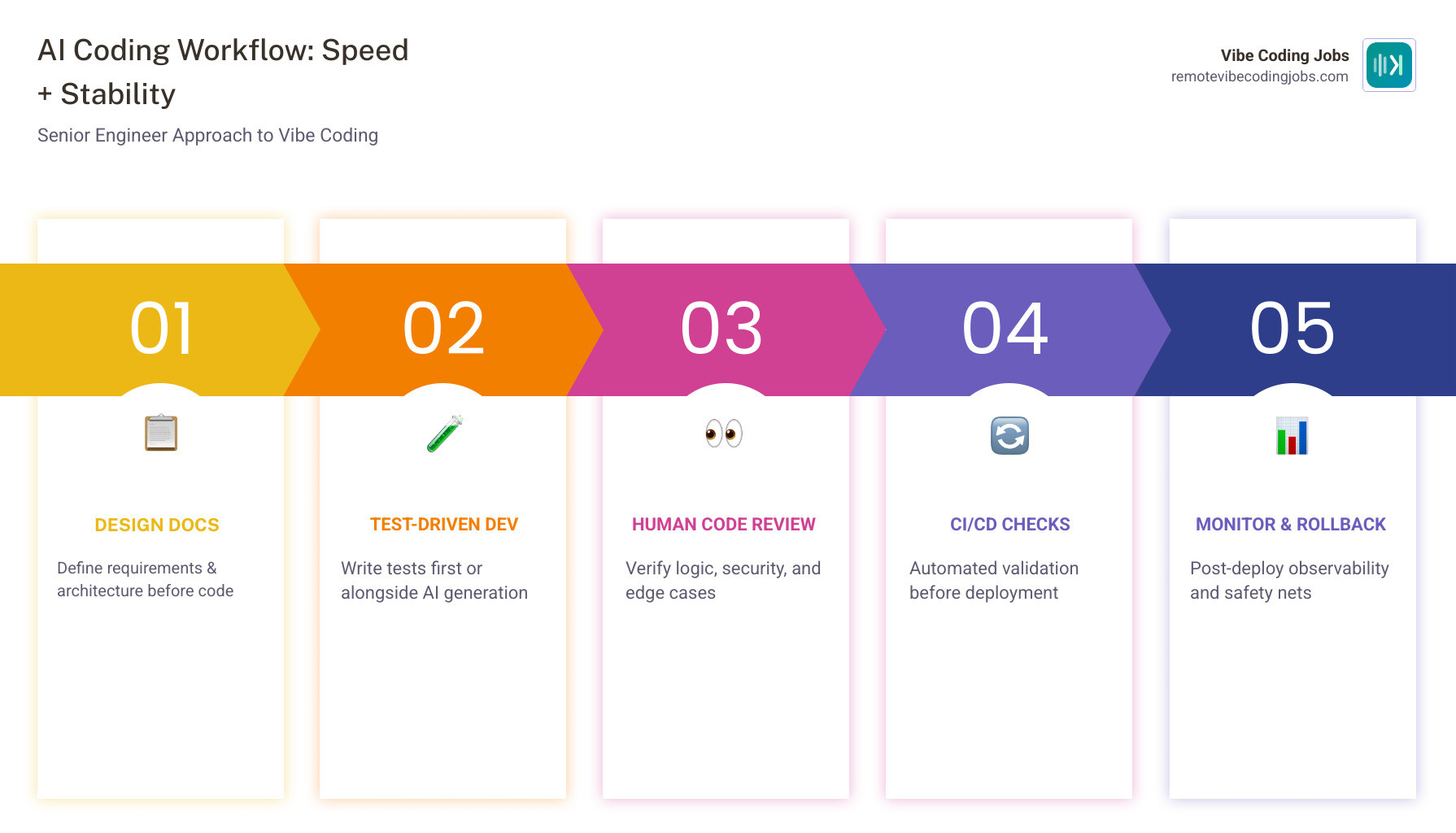
This is where newer agentic workflows are becoming useful. Instead of one model generating code and stopping there, we increasingly see chains of AI steps:
- interpret the task
- draft implementation
- generate tests
- run validation
- suggest fixes
- prepare changes for human review
That pattern is closer to engineering than improvisation. For a practical roadmap into this style of work, see Vibe coding: Your roadmap to becoming an AI developer.
Best Practices for Responsible Vibe Coding
Vibe coding is most effective when we treat it like a high-powered prototyping engine with guardrails.
Here is a simple comparison:
| Area | Vibe Coding | Structured Engineering |
|---|---|---|
| Goal | Explore and build fast | Build safely and maintainably |
| Input | Natural language prompts | Specs, tickets, design docs |
| Speed | Very high | Moderate |
| Risk | Higher if unchecked | Lower with process |
| Best use | Prototypes, internal tools, experiments | Production systems, critical workflows |
| Ownership | AI generates, human verifies | Human leads, AI assists |
The healthiest workflow combines both modes.
Best practices we recommend:
- start with a specification, even if it is short
- ask AI for small, reviewable chunks
- require tests for generated logic
- review all authentication, payments, and data-handling code manually
- refactor generated code before scaling it
- document assumptions and architecture decisions
- use AI to explain code back to us, not just create it
If you are building your toolkit, our Vibe Coding Tools AI-Powered Arsenal can help.
Transitioning from Vibes to Scalable Systems
Vibe coding shines brightest in:
- prototypes
- side projects
- MVPs
- design experiments
- one-off automation
- internal tooling
It is especially good when the cost of being wrong is low and the value of learning quickly is high.
But every successful prototype eventually asks an awkward question: “Do we actually want to maintain this thing?”
That is the moment to transition from vibes to structure.
Signs it is time:
- multiple developers are touching the codebase
- customers depend on uptime
- security or compliance matters
- product logic is becoming complex
- onboarding new teammates is getting painful
- no one can explain why the code works, only that it currently does
The move to production readiness should include:
- documented architecture
- naming cleanup
- test coverage
- dependency review
- code ownership
- observability
- clearer boundaries between components
For a broader explanation of vibe coding’s upside and tradeoffs in early-stage work, see The Complete Guide to Vibe Coding.
Leveraging Agentic Workflows for Safer Deployment
The next step beyond simple prompting is agentic engineering: AI systems that can plan, execute, inspect, and revise work across multiple steps.
Used well, these workflows can make vibe coding safer by adding validation loops. For example, an agent can:
- generate code
- run tests
- read stack traces
- propose fixes
- compare implementation against the spec
- flag uncertainty for human review
That is much better than blindly pasting code into production and hoping the demo gods are kind.
Still, autonomy should increase only where controls increase too. The right pattern is not full automation everywhere. It is bounded autonomy in low-risk environments, with humans approving important changes.
Our take on where this is heading is in Agentic Engineering Future.
Career Outlook for the Vibe Coding AI Engineer in 2026
In 2026, the market is not really asking, “Can you prompt an AI?” Almost everyone can do that at some level.
The stronger hiring question is: “Can you use AI to build useful software without creating chaos?”
That is why the vibe coding AI engineer role is becoming more defined. Employers increasingly value people who can move quickly with AI tools while still handling architecture, debugging, quality, and async collaboration.
In our view, the best opportunities are showing up in remote, async-first companies where speed matters but headcount stays lean. Teams want engineers who can prototype like a hacker and review like a staff engineer.
Helpful next reads include:
Will Vibe Coding Replace Software Engineers?
Short answer: no. But it will absolutely reshape the job.
Vibe coding does not remove the need for engineers. It changes what makes an engineer valuable.
The harder the problem, the more human judgment matters:
- defining ambiguous requirements
- making architecture tradeoffs
- understanding domain risk
- reviewing generated code critically
- coordinating across teams
- deciding when not to automate
AI is strongest at acceleration. Humans are strongest at responsibility.
So the likely outcome is not replacement, but amplification. Engineers who learn to use AI well can become much more productive. Engineers who ignore AI may find themselves slower than the market expects.
For people entering the field, that is encouraging. There are increasing ways to break in through AI-heavy workflows, prototypes, and support tasks before taking on complex system ownership. See AI Coding Jobs Entry Level Remote Opportunities.
Real-World Successes and Failures in Vibe-Driven Dev
The real-world pattern is pretty clear.
Successes tend to happen when teams use vibe coding for:
- rapid MVPs
- internal tooling
- product experiments
- migrations with strong review
- repetitive implementation work
Failures tend to happen when teams use it for:
- production-critical systems without tests
- security-sensitive code without review
- large refactors without understanding the existing architecture
- shipping generated code no one on the team can explain
Experienced engineers, including those with large-scale production backgrounds, generally do not treat vibe coding as a joke or a miracle. They treat it as leverage. The sensible FAANG-style view is usually some version of: AI is great for accelerating implementation, but the human still owns correctness, architecture, and operational risk. A useful discussion of that mindset is in What Vibe coding/Gen AI is and isn’t – an experienced FAANG dev’s view.
That perspective also answers a career question many people have: senior engineers are not being made obsolete by vibe coding. If anything, their judgment is becoming more valuable because there is more code, more quickly, and more of it needs to be evaluated.
Frequently Asked Questions about Vibe Coding
Is vibe coding suitable for enterprise production?
It can be, but not in its rawest form.
Pure vibe coding is best for exploration. Enterprise production needs controls. The 89% CTO disaster figure from 2025 is a loud warning that AI-generated code without guardrails is risky.
A better enterprise model is hybrid:
- use AI to accelerate implementation
- keep humans responsible for architecture and approvals
- enforce tests, reviews, and deployment controls
- separate development from production clearly
For people exploring why remote AI roles are attractive despite the complexity, see Remote AI Developer Jobs Benefits.
What tools are essential for a vibe coding workflow?
The stack changes fast, but the categories are stable:
- AI-native IDEs
- strong frontier models
- source control and PR workflows
- automated test tooling
- prompt libraries or reusable spec templates
- CI pipelines
- logging and monitoring tools
The important thing is not owning every tool. It is building a workflow where each tool has a job: generate, validate, review, deploy, observe.
For a fuller breakdown, visit Vibe Coding Tools AI-Powered Arsenal.
How do I get hired as a vibe coder?
The fastest path is to prove that you can build real things responsibly.
Focus on:
- a portfolio with AI-assisted projects
- clear write-ups of your process
- examples showing prompts, reviews, tests, and improvements
- public demos or GitHub repos
- evidence that you can work asynchronously
- comfort with modern AI coding tools
Hiring teams want more than “I used AI.” They want “I used AI to ship something useful, and I can explain how I kept it reliable.”
Our guide on How to Get a Vibe Coding Job goes deeper.
Conclusion
Vibe coding is not just a trend word for 2026. It is a real shift in how software gets built.
The important nuance is this: vibe coding works best as a force multiplier, not as a substitute for engineering discipline. It is incredible for prototyping, ideation, and speed. It becomes dangerous when we confuse generated code with verified software.
That is why the future of the vibe coding AI engineer looks strong. The market needs people who can sit in both worlds at once:
- fast with AI
- careful with production
- comfortable with agentic workflows
- grounded in testing, review, and system design
If that sounds like the kind of career you want, we built Remote Vibe Coding Jobs for exactly that path. We curate remote roles for AI-assisted developers at async-first companies, with filters for culture, stack, and tools like Cursor and Claude.
Explore our latest Remote AI Engineer Jobs, and if you want to keep learning, pair this guide with:
The vibes are real. The engineering still matters.