
Work From Anywhere While Vibe Coding Your Next Big Project
The Rise of Remote Vibe Jobs in 2026
The best remote vibe jobs right now sit at the intersection of AI-assisted development, async-first culture, and genuine location freedom — and demand is growing fast.
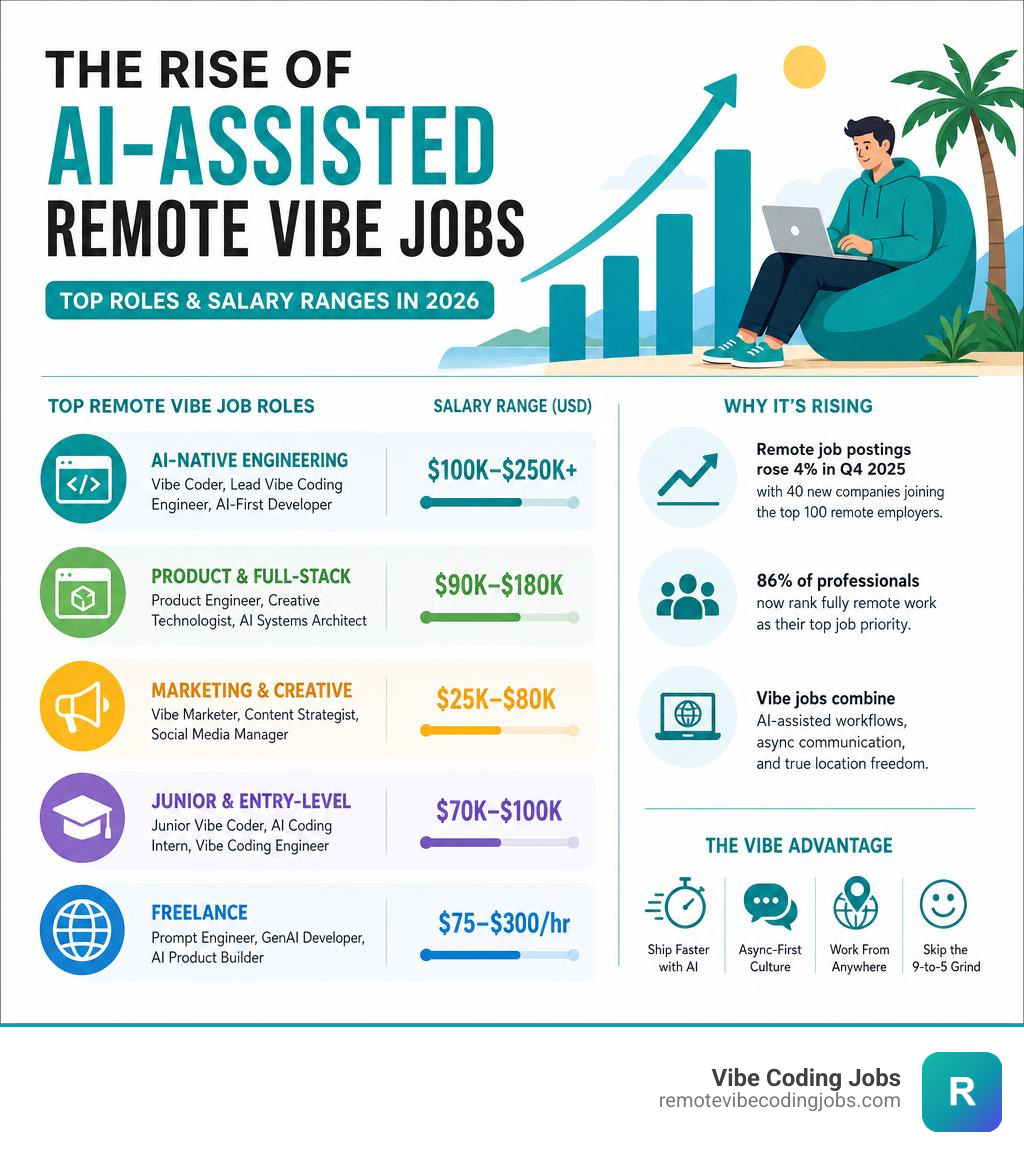
Quick answer: Here are the top remote vibe job categories in 2026:
| Role Type | Example Titles | Salary Range |
|---|---|---|
| AI-Native Engineering | Vibe Coder, Lead Vibe Coding Engineer, AI-First Developer | $100K–$250K+ |
| Product & Full-Stack | Product Engineer, Creative Technologist, AI Systems Architect | $90K–$180K |
| Marketing & Creative | Vibe Marketer, Content Strategist, Social Media Manager | $25K–$80K |
| Junior & Entry-Level | Junior Vibe Coder, AI Coding Intern, Vibe Coding Engineer | $70K–$100K |
| Freelance | Prompt Engineer, GenAI Developer, AI Product Builder | $75–$300/hr |
These aren’t just regular remote jobs with a trendy name. Vibe jobs are defined by how you work — using AI tools like Cursor, Claude, and Copilot to ship faster, communicate async, and skip the 9-to-5 meeting grind entirely.
The numbers back this up. Remote job postings rose 4% in Q4 2025, with 40 new companies joining the top 100 remote employers list. And 86% of professionals now rank fully remote work as their top job priority. The shift isn’t slowing down.
I’m RVCJ Editorial, the team behind Remote Vibe Coding Jobs — we cover AI-assisted development, async hiring trends, and career guidance for developers building with tools like Cursor, Claude, and Copilot, with a specific focus on helping you find the best remote vibe jobs matched to your stack and culture fit. Below, we break down exactly what makes a vibe job worth your time — and how to land one.
Glossary for best remote vibe jobs:
What Defines the Best Remote Vibe Jobs in 2026?
A “vibe job” isn’t your standard, run-of-the-mill corporate remote role where you’re expected to sit in front of a webcam for six hours of daily Zoom meetings while someone micromanages your keystrokes.
Instead, the best remote vibe jobs are built on autonomy, high-velocity output, and modern AI tools. In these roles, you aren’t paid for the hours you sit in a chair; you are paid for the value you ship. This is where “vibe coding” comes into play.
Vibe coding is an AI-native development workflow where you orchestrate code using natural language prompts rather than typing out every single semicolon by hand. You use tools like Cursor, Claude Code, and Windsurf to build, test, and deploy features at the speed of thought. By shifting your focus from syntax to system design, product experience, and logic, you get to work in a high-flow state—the ultimate “vibe.”
When you transition to a Vibe Coding Remote Career Path, you are choosing a lifestyle that prioritizes:
- Async-First Communication: No daily standups that could have been Slack messages. Teams document everything, allowing you to work when and where you are most productive.
- AI-First Tooling: Your employer doesn’t just tolerate AI tools; they require them. They provide unlimited AI tokens and encourage you to automate repetitive tasks.
- True Autonomy: You own features from idea to URL. You are trusted to manage your own time, allowing you to take an afternoon break, hit the gym, or travel without looking over your shoulder.
Top Industries, Roles, and Perks of Remote Vibe Employers

The landscape of remote work has shifted. To understand how the best remote vibe jobs differ from traditional work-from-home setups, let’s look at the core differences:
| Feature | Traditional Remote Work | Remote Vibe Jobs (2026) |
|---|---|---|
| Primary Tools | Legacy IDEs, Jira, Zoom, Microsoft Teams | Cursor, Claude, Slack (Async), Notion |
| Meeting Culture | Heavy (Daily standups, status updates) | Minimal (No-meeting days, async check-ins) |
| Performance Metric | Hours logged, ticket completion rate | Shipped features, product impact, documentation |
| Tech Stack Focus | Manual syntax writing, manual debugging | Prompt engineering, system architecture, UX flow |
| Perks & Stipends | Standard health insurance, basic laptop | Home office stipends, unlimited AI tokens, wellness budgets |
Software Engineering and AI-Native Development
The tech sector remains the largest host of remote-first employers, but the way software is built has evolved. Companies are actively recruiting developers who understand how to leverage AI as a primary collaborator.
In these roles, you will use tools like Claude Code and Cursor to rapidly prototype MVPs and build complex features. Because the AI handles the boilerplate code, you spend your time on high-level system design, security, and crafting intuitive user experiences.
If you are looking for teams that embrace this modern workflow, check out the Best Companies Hiring AI Developers Remote. You will find organizations hiring for forward-thinking positions like:
- The Vibe-Coding Talent / AI-Native Product Builder role, which focuses on rapid prototyping and revenue-sharing models for digital coaching products.
- The GTM Engineer position, where developers use tools like Claude and Cursor daily to build streaming TV advertising infrastructure.
- The Vibe Coder – Adaptify SEO Careers role, which offers a fully async environment across three continents with absolutely no tickets or standups.
Marketing and Creative Vibe Roles
The vibe movement isn’t just for software engineers. Marketing and creative roles have also adopted AI-native workflows to bypass manual, repetitive tasks.
A prime example of this is the rise of the “Vibe Marketer.” For instance, companies like Nansen have hired for Vibe Marketer positions. In this type of role, you act as the scale engine for the brand’s digital presence. Instead of writing endless drafts manually, you use advanced AI models to turn complex data into shareable social media content, threads, and explainers.
These roles value internet culture fluency, quick experimentation, and a “ship-it” mentality. Best of all, they often come with modern perks like unlimited AI tokens and dedicated deep-work days.
Async Culture and Work-Life Balance Perks
The absolute best remote vibe employers understand that remote work is an operating system, not a temporary perk. Fully remote-first companies like GitLab (which saw an impressive 29% year-over-year revenue growth in fiscal year 2026), Automattic, Zapier, and Buffer lead the way by designing systems that eliminate workplace friction.
To maintain employee satisfaction, these companies invest heavily in:
- Async Documentation: GitLab maintains a public 2,000-page handbook documenting all operations. This means you never have to wait for someone to wake up in another time zone to answer a question.
- No-Meeting Days: Many vibe employers institute 2 to 3 “no-meeting” days per week so you can sink into uninterrupted deep work.
- Generous Stipends: From home office setups and coworking space memberships to wellness programs and fertility benefits, these companies ensure your physical and mental health are supported.
Many established players with proven track records of location-blind promotions and excellent remote cultures are leading this shift, proving that async-first operations are highly sustainable.
How to Find and Land the Best Remote Vibe Jobs

Finding a true vibe job requires a different approach than sending out hundreds of generic resumes on traditional job boards. Because these companies value autonomy and modern workflows, your application strategy needs to reflect those exact traits.
Navigating Curated Job Boards for the Best Remote Vibe Jobs
Did you know that up to 73% of remote job listings on specialized platforms aren’t even cross-posted to LinkedIn or Indeed? Traditional job boards are often plagued by broken remote filters, outdated listings, and recruiter spam.
To find companies that are actively building with AI and prioritizing async cultures, you should focus on curated platforms. You can find up-to-date, hand-reviewed listings of Companies Hiring Vibe Coders Remote AI Coding directly on our platform.
By visiting Vibe Coding Jobs, you can filter opportunities by specific AI tools (like Cursor or Claude), async-first cultures, and tech stacks. Additionally, staying active in developer communities and monitoring curated platforms will give you a major competitive advantage.
Highlighting AI-Fluency and Vibe Coding Skills
When applying for a modern remote vibe role, your resume shouldn’t just list your years of experience. Instead, it should prove that you know how to use AI as a force multiplier.
To stand out during the hiring process:
- Showcase AI-Assisted Projects: Instead of just sending a static resume, send a link to a live app you built using Cursor or Claude. Include a short Loom video explaining your prompting process, how you structured the system architecture, and how you validated the AI-generated code.
- Highlight Async Skills: Genuinely remote companies value written communication above almost everything else. Emphasize your experience with documentation, self-management, and asynchronous toolkits.
- Prepare for Async Interviews: Be ready for take-home projects or written exercises rather than standard whiteboard interviews.
To learn more about what to expect during the interview process, read our guide on the Vibe Coding Jobs Remote Career Interview Culture.
Frequently Asked Questions About Remote Vibe Careers
What are the best remote vibe jobs for beginners?
If you are just starting out, look for junior developer, creative technologist, or AI pilot roles. Many startup environments are happy to hire self-taught builders who can demonstrate high curiosity and speed. Because AI tools lower the barrier to entry for writing syntax, your ability to learn quickly and solve problems matters far more than a formal background.
You can explore various entry points by reading about Vibe Coding Remote Career Paths.
What salary ranges can I expect in vibe coding roles?
Compensation for vibe coding and AI-fluent roles is highly competitive:
- Entry-Level / Junior: $70,000 to $100,000 per year.
- Mid-Level: $100,000 to $150,000 per year.
- Senior / Lead Engineers: $150,000 to $250,000+ per year (with some specialized roles reaching up to $400,000).
- Freelance / Contract: $75 to $300+ per hour, often accompanied by revenue-sharing opportunities for product builders.
Do I need a computer science degree to land these roles?
No! While understanding basic programming fundamentals (like JavaScript, Python, or React) is incredibly helpful for debugging and reading code, many top vibe employers value practical skills over formal degrees. A strong portfolio of AI-assisted builds, a clear understanding of prompt engineering, and a proven ability to ship working software will easily outweigh a traditional computer science degree.
Conclusion
The corporate landscape of endless meetings and rigid office hours is rapidly giving way to a more autonomous, high-flow way of working. The best remote vibe jobs of 2026 offer you the chance to work from anywhere, leverage cutting-edge AI tools, and own your schedule.
If you are ready to stop writing boilerplate code by hand and start orchestrating systems at the speed of thought, we are here to help you make the transition. Find your next remote, async-first role today by browsing the curated listings on Vibe Coding Jobs.