
Is the Kotlin Job Market Worth Exploring in 2026?
Yes. Kotlin remains a strong career skill in 2026, and the work now reaches beyond Android apps. Employers also use it for backend services and shared code across mobile platforms. The best prospects are for engineers who pair Kotlin with skills such as Jetpack Compose, Java, Spring Boot, testing, and cloud deployment.
The market is competitive, especially for beginners: one hiring snapshot found that 70% of Kotlin postings targeted mid- to senior-level candidates. If you are starting out, build a polished Android app or backend service that shows how you solve real problems, not just how you write Kotlin.
I’m Di Su, a software engineer with more than 10 years of experience building web products and scalable systems. I bring that practical hiring and product lens to this guide to the kotlin job market, from startups to large enterprises.
Simple kotlin job market glossary:
- kotlin developer remote jobs
- junior kotlin developer
- kotlin developer salaries and career growth in india
The State of the Kotlin Job Market in 2026: Macro Trends and Demand Drivers

The global software landscape has undergone a major correction over the past two years, moving away from hyper-growth hiring toward operational efficiency and direct business value. Within this landscape, Kotlin has cemented its position as a mature, enterprise-grade language. Over 12,224 unique job postings have featured Kotlin over recent 90-day tracking periods, maintaining an average of 878 weekly listings across 30 global markets.
According to data documented in the State of Kotlin 2026 Report, the global talent pool has expanded to 8.1 million developers with Kotlin experience. Over 80% of these engineers run Kotlin in live production environments, boasting an 87% satisfaction rating. While raw hiring volume normalized following the pandemic boom—even dropping temporarily in volatile quarters—the underlying foundation remains solid.
The nature of hiring demand has shifted. Generalist software engineering titles represent the largest share of Kotlin listings, followed by specialized mobile, backend, and full-stack positions.
| Role Focus | Share of Tracked Listings | Primary Technical Requirements | Typical Seniority Target |
|---|---|---|---|
| Full Stack Engineer | 55% | Kotlin, React / TypeScript, SQL, AWS | Mid to Senior |
| Mobile / Android Engineer | 25% | Jetpack Compose, Coroutines, MVVM, KMP | Junior to Senior |
| Backend Engineer | 15% | Spring Boot, Ktor, Microservices, PostgreSQL | Mid to Staff |
| Systems / Infrastructure / SRE | 5% | Cloud Platforms, JVM Tuning, CI/CD, Docker | Senior to Lead |
The Expansion Beyond Mobile into Enterprise Backend and KMP
Kotlin is no longer just “the Android language.” While over 95% of the top 1,000 Android apps rely on Kotlin, its expansion into server-side architectures and multiplatform systems represents its fastest-growing segment. JetBrains developer ecosystem metrics show that Kotlin Multiplatform (KMP) adoption surged from 7% to 18% in a single year, enabling engineering organizations to share critical business logic across iOS, Android, and web targets without sacrificing native performance.
On the server side, Spring Boot formalized an official partnership with JetBrains in 2025, treating Kotlin as a first-class language alongside Java. Modern engineering organizations are migrating microservices to Kotlin to reduce boilerplate and eliminate null-pointer exceptions. Challenger bank N26 migrated 60% of its microservices to Kotlin within two years, while banking giant ING reported that Kotlin is actively used across 8% of its 20,000-plus technical staff repositories. This server-side momentum aligns with the broader demand for modern programming languages that provide strong type safety and lean runtimes.
Regional Disparities Across the Global Kotlin Job Market
Demand for Kotlin engineers is heavily concentrated in major global tech hubs and expanding offshore centers. The United States leads global demand with 2,783 open listings, followed closely by India with 1,447 listings. In metropolitan centers like New York City (accounting for over 4.3% of global volume), San Francisco, London, Bengaluru, Berlin, and Toronto, engineering teams compete actively for senior JVM talent.
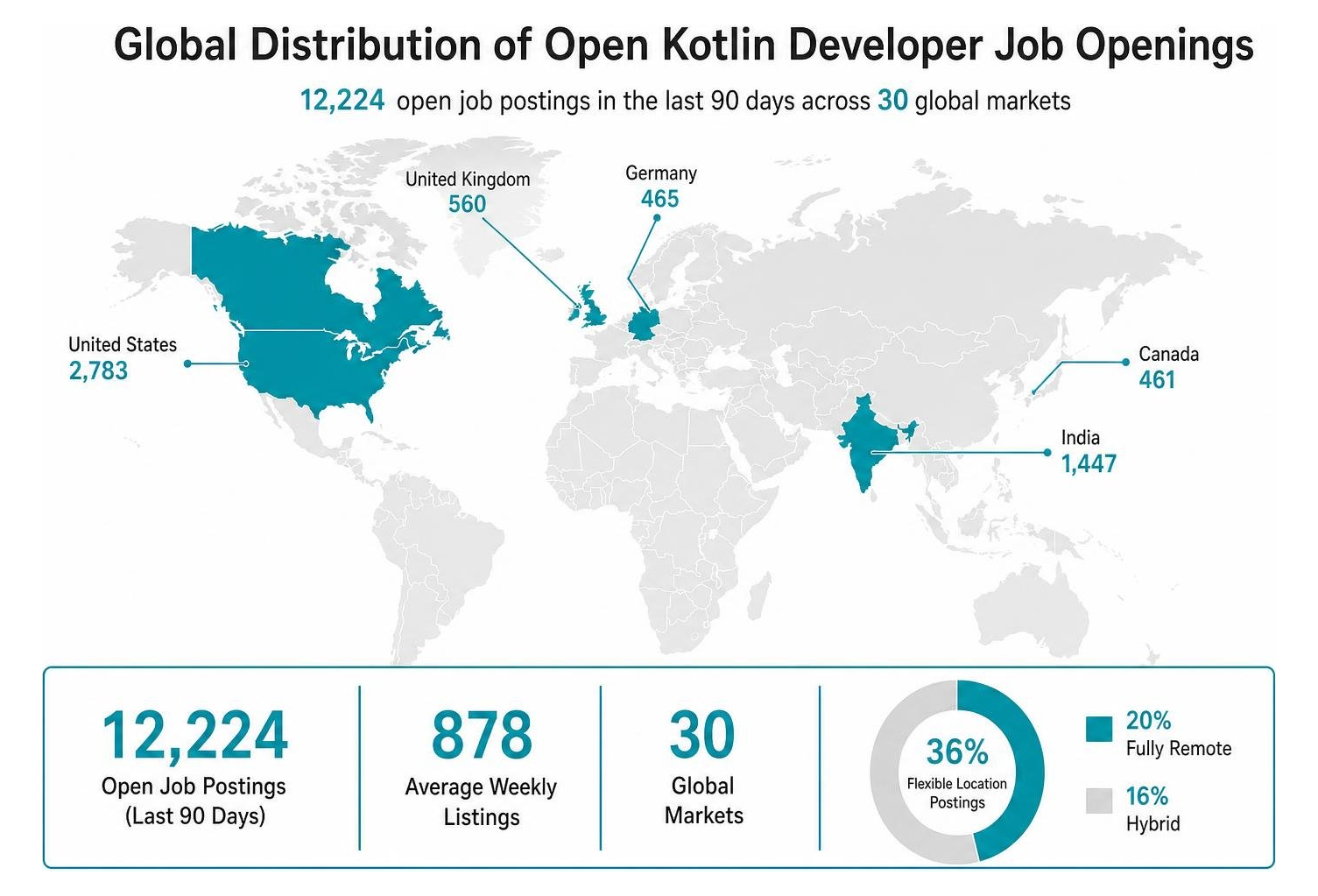
Simultaneously, remote-first hiring has become a permanent feature of modern tech infrastructure. Around 36% of all Kotlin job postings offer flexible location arrangements—20% fully remote and 16% hybrid. This shift provides distributed developers access to competitive tiers of compensation, tracking alongside growth trends across remote coding markets.
Kotlin Compensation Benchmarks: Salaries, Seniority, and High-Earning Roles

Compensation for Kotlin talent reflects its evolution from a niche mobile tool into a foundational language for distributed systems. Aggregated job market disclosures indicate an advertised median salary of $169,125 per year across all disclosed roles, with the top decile commanding over $219,876. On platform-specific benchmarks tracking JVM languages, median listings often reach $183,000.
Base salaries tell only part of the story. For senior and staff engineers in tier-1 tech hubs and high-growth startups, equity grants, annual performance bonuses, and sign-on incentives push total compensation considerably higher.
| Experience Level | US Base Salary (Industry Benchmark Average) | US Top Tier Base / Startup Average | Total Comp Range (Base + Equity + Bonus) |
|---|---|---|---|
| Junior / Entry (0-2 yrs) | $75,000 – $105,000 | $105,000 – $115,000 | $80,000 – $120,000 |
| Mid-Level (3-5 yrs) | $105,000 – $145,000 | $145,000 – $165,000 | $130,000 – $185,000 |
| Senior (5-8 yrs) | $145,000 – $190,000 | $170,000 – $210,000 | $190,000 – $290,000 |
| Staff / Principal (8+ yrs) | $185,000 – $225,000+ | $215,000 – $260,000+ | $280,000 – $360,000+ |
Salary Distributions from Entry-Level to Staff Engineer
Entry-level roles remain competitive and comparatively scarce, representing under 5% of active job postings. However, entry-level engineers with verified Kotlin capabilities command a 10% to 15% salary premium over peers with Java-only backgrounds due to immediate productivity gains in modern codebases.
At the upper end of the spectrum, senior backend engineers and mobile architects command compensation between $190,000 and $360,000 in major US metro areas and remote-first enterprises. Developers evaluating offers can benchmark their numbers against our guide on evaluating remote developer compensation benchmarks and apply structured salary negotiation strategies for senior engineers to maximize equity and variable bonuses.
Industry Verticals and Enterprise Adoption from Startups to Tier-1 Tech
Kotlin adoption is widespread across varied business verticals:
- Fintech and Banking: Over 22% of enterprise Kotlin backend developers work in financial services. Firms like Affirm, JPMorgan, N26, and Brex rely on Kotlin’s compiler-enforced safety to protect transaction logic and reduce financial edge-case bugs.
- Big Tech and Cloud: Google leads hiring volume with over 159 active listings across its Android and cloud infrastructure divisions, accompanied by major infrastructure investments from Amazon and Netflix.
- Automotive and Mobility: Companies like Tesla use Kotlin across customer-facing vehicle management mobile applications and real-time backend communication services.
- EdTech, Retail, and SaaS: Enterprise operations platforms like LINQ and e-commerce leaders leverage Kotlin to handle high-concurrency event pipelines and multiplatform app features.
These diverse organizations increasingly embrace distributed workflows, reflecting emerging remote developer hiring trends that prioritize asynchronous collaboration over physical office presence.
Technical Differentiation: What Separates Junior Devs from High-Earning Engineers
The gap between a developer who writes basic Kotlin syntax and a high-earning engineer lies in deep platform knowledge, architectural judgment, and systems-level problem solving.
High-income Kotlin engineers demonstrate mastery across these key areas:
- Structured Concurrency: Deep understanding of coroutine scopes, custom supervisor jobs, non-blocking cancellations, and flow backpressure handling.
- JVM Runtime Optimization: Ability to profile garbage collection (GC) pauses, tune memory allocation, and resolve tail latency spikes in high-throughput services.
- Architectural Modularity: Designing multi-module applications using Clean Architecture, robust dependency injection (Dagger-Hilt, Koin), and explicit domain boundaries.
- Cross-Platform Engineering: Structuring clean shared libraries with Kotlin Multiplatform using
expect/actualdeclarations without leaking platform-specific abstractions. - Modern UI Tooling: Building performant, recomposition-optimized user interfaces using Jetpack Compose and Compose Multiplatform.
Core Engineering Competencies: Coroutines, JVM Performance, and Concurrency
Junior developers often make the mistake of treating coroutines simply as lightweight threads, launching unmanaged scopes on Dispatchers.Default or Dispatchers.IO without lifecycle safety. Senior engineers reason about dispatcher starvation, exception propagation across parent-child coroutine trees, and cold vs. hot stream dynamics via SharedFlow and StateFlow.
On backend services handling tens of thousands of requests per second, high-earning engineers understand how Kotlin byte code runs on the JVM. They know when to use inline value classes to eliminate heap allocations, how to design database persistence layers with Room or Exposed, and how to configure Ktor or Spring Boot engines to minimize CPU context switches. Cultivating these capabilities ensures engineers build future-proof developer skills in demand.
Integrating AI-Assisted Workflows and Compile-Time Type Safety
The emergence of AI development tools (such as Claude, Cursor, and automated coding agents) has altered developer expectations. While AI models generate standard UI templates in seconds, they frequently struggle with nuanced thread safety, coroutine scope lifecycles, and complex enterprise domain logic.
Kotlin provides a significant advantage in an AI-accelerated workflow: its strict static type system and null safety act as a compile-time safeguard. When AI agents hallucinate non-existent methods or create implicit null mismatches, the Kotlin compiler flags the error immediately before execution. Teams combining experienced engineers with AI workflows report 15% to 20% shorter feature delivery cycles, allowing senior developers to act as systems architects rather than line-by-line coders.
Strategic Career Pathways: Breaking into Kotlin and Navigating the Market
Securing high-paying Kotlin positions requires a shift in how engineers present their value. Modern engineering hiring teams are moving away from abstract trivia toward take-home systems design, code reviews, and live architecture assessments, making it vital to understand evaluating modern developer assessment formats.
Transitioning from Java and Modernizing the Backend Stack
For existing backend developers, the transition into Kotlin is one of the smoothest in the industry. Over 71% of professional Kotlin engineers originally transitioned from Java. Because Kotlin offers 100% bidirectional interoperability with Java, teams can introduce Kotlin files directly into existing Java repositories without breaking legacy systems.
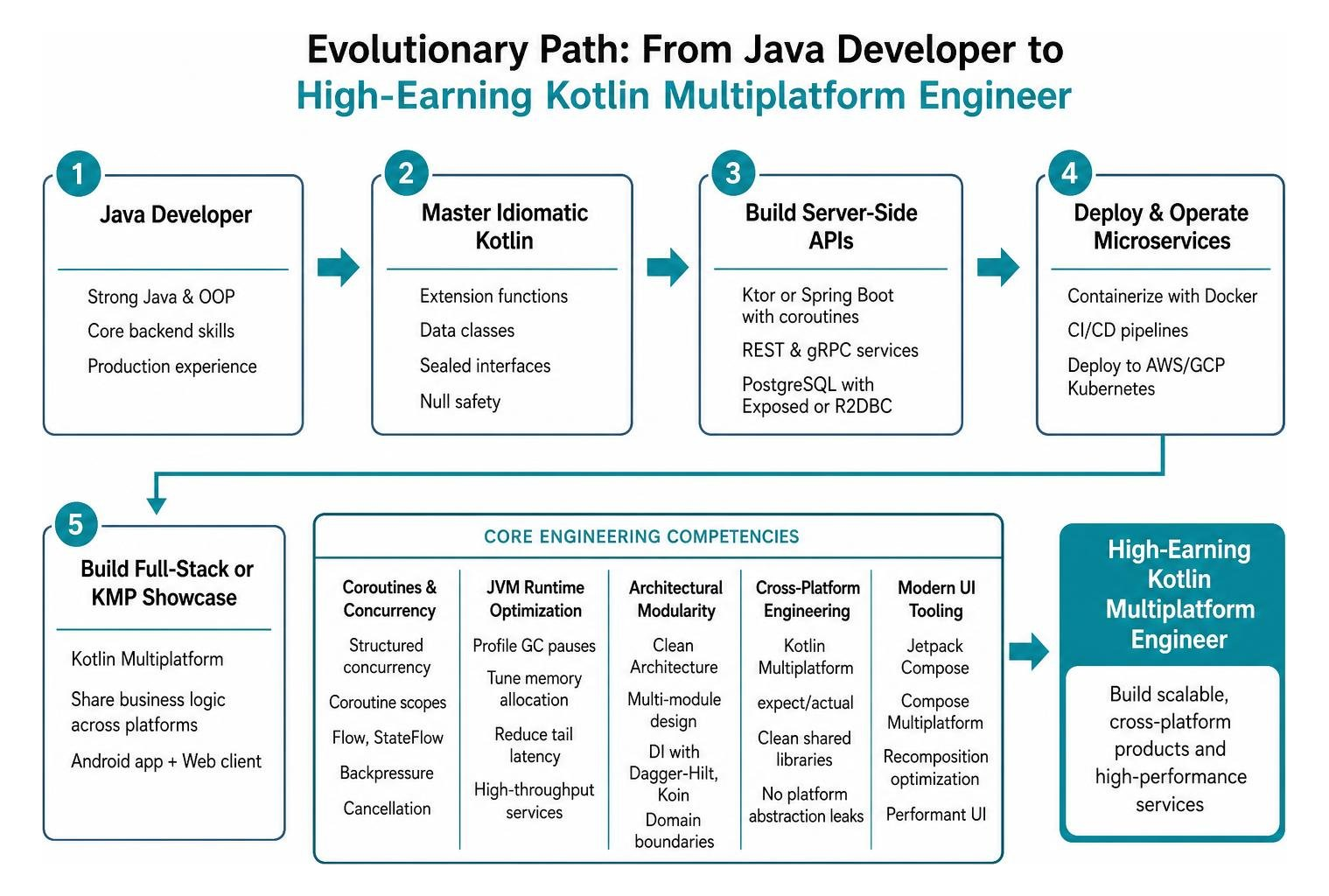
Engineers looking to level up their careers should follow this practical progression:
- Master Idiomatic Kotlin: Eliminate Java patterns like explicit getters/setters and heavy utility classes in favor of extension functions, data classes, and sealed interfaces.
- Implement Server-Side APIs: Build modular REST and gRPC microservices using Ktor or Spring Boot with Coroutine support, connecting to PostgreSQL via Exposed or R2DBC.
- Deploy Containerized Microservices: Package services using Docker, configure automated CI/CD pipelines, and deploy them onto managed AWS/GCP Kubernetes clusters.
- Build a Full-Stack or KMP Showcase: Implement a multiplatform library sharing networking and business logic across an Android app and a web client.
Following this roadmap provides a reliable blueprint for structuring a modern developer career path.
Overcoming Top Misconceptions in the Modern Kotlin Job Market
Navigating tech hiring effectively requires dispelling several common myths:
- Misconception 1: “Kotlin is strictly for Android.” Reality: With 53% of Kotlin developers building backend services and KMP adoption more than doubling, server-side and multiplatform development represent the language’s primary growth engines.
- Misconception 2: “Kotlin is just syntactic sugar on top of Java.” Reality: Advanced features such as coroutines, structured concurrency, inline value classes, reified type parameters, and DSL builders fundamentally change software design patterns.
- Misconception 3: “Technical skills alone guarantee hiring.” Reality: As engineering teams consolidate headcount, they prioritize developers who can tie their work directly to business outcomes. High-performing candidates position themselves around revenue preservation, application stability, and developer velocity rather than just programming syntax.
Learning to articulate technical decisions in terms of business impact is essential to discovering how to secure high-growth developer jobs.
Frequently Asked Questions About the Kotlin Job Market
Is Kotlin still in demand in 2026 beyond Android?
Yes. Over 53% of professional Kotlin developers work on backend projects, supported by official Spring Boot framework integrations and growing Ktor adoption. Additionally, Kotlin Multiplatform adoption has risen to 18%, making Kotlin a standard language for cross-platform enterprise logic.
What is the average salary for a Kotlin engineer in 2026?
The median advertised salary for Kotlin roles is $169,125 per year, with benchmark platforms recording median listing rates of $183,000. Senior and staff-level backend engineers frequently earn total compensation packages between $190,000 and $360,000 when factoring in equity and bonuses.
Can Java developers transition easily to high-paying Kotlin roles?
Yes. Over 71% of current Kotlin developers transitioned directly from Java. Because Kotlin runs on the JVM and maintains complete interoperability with existing Java codebases, experienced Java developers can transition into production Kotlin development quickly.
Conclusion
The Kotlin ecosystem has matured from a developer-friendly mobile tool into an enterprise staple running high-performance microservices, native mobile architectures, and cross-platform business layers. While entry-level competition is real, experienced engineers who combine deep coroutine fundamentals, backend architectural fluency, and modern AI-assisted workflows will continue to command premium compensation packages.
At RemoteVibeCodingJobs, we curate daily remote engineering listings at forward-thinking, async-first companies embracing modern JVM stacks and AI-driven development. If you are ready to take your next career step, explore high-paying remote backend developer jobs and find your next opportunity today.