
Why Hire a Vue JS Remote Developer in 2026?
Finding the right vue js remote developer is the fastest way to build a high-performance web application without the overhead of a traditional office.
To help you hire fast, here is a quick overview of the current remote market in July 2026:
- Average Salary: $118,865 per year (ranging from $80,000 for junior roles to $215,000+ for Lead developers).
- In-Demand Stack: Vue 3 (Composition API), Pinia, TypeScript, Vite, and Nuxt.js.
- Average Time-to-Hire: 37 days.
- The AI Advantage: High-performing developers now leverage “vibe coding” tools like Cursor and Claude to build, test, and deploy clean code much faster.
The frontend landscape has changed. It is no longer just about building pretty layouts. Today, modern frontend development is an enterprise-grade software system. Your team needs builders who know how to optimize bundle sizes, hit perfect Core Web Vitals scores, and manage global state without writing endless boilerplate.
I am Di Su, a software engineer at Adaptify SEO with over 10 years of experience building scalable web solutions and helping teams find the perfect vue js remote developer to scale their frontend pipelines. My background in engineering and growth helps me understand exactly how clean frontend performance translates directly into real business revenue.
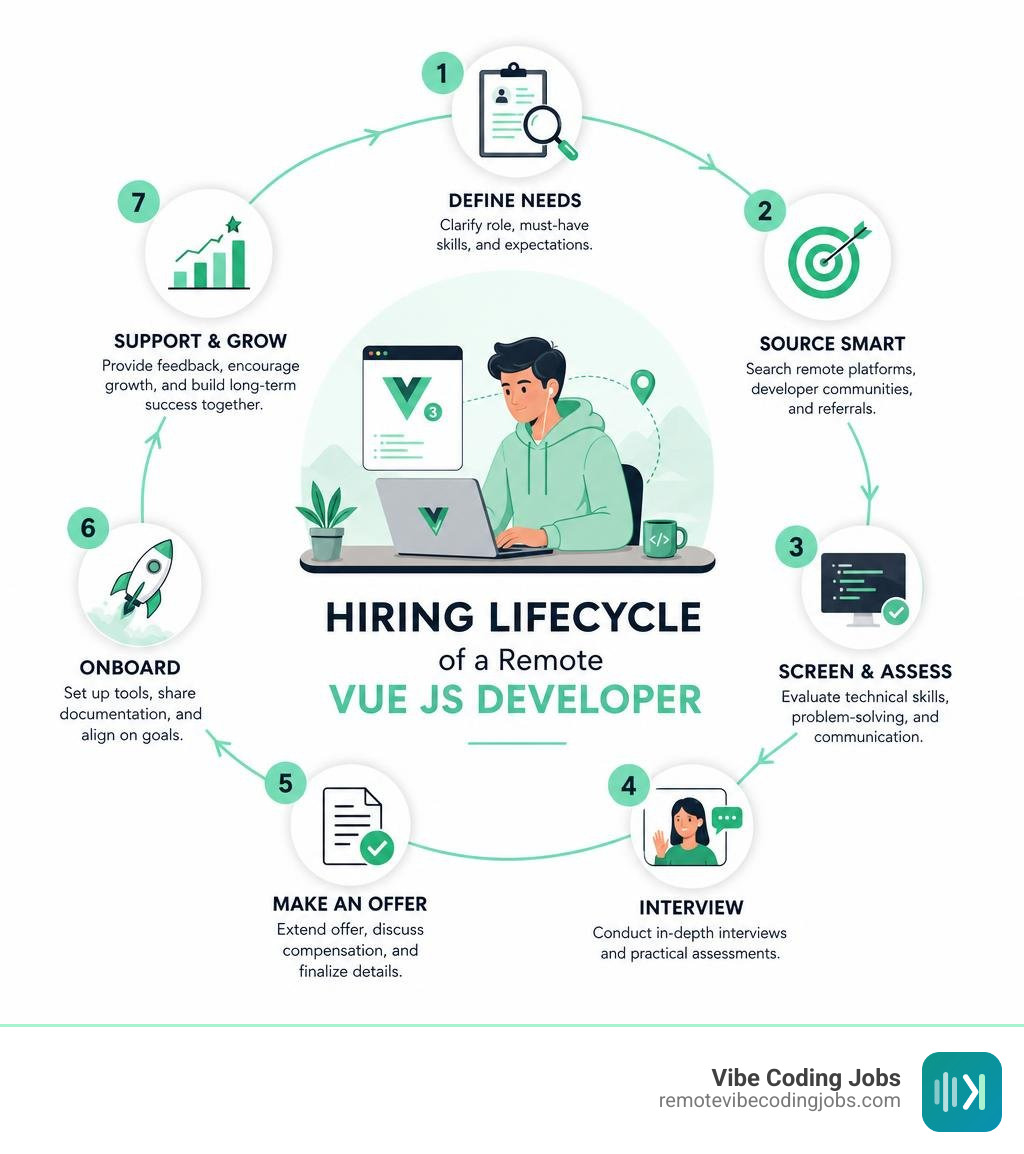
Vue js remote developer terms made easy:

In 2026, building a digital product requires speed, agility, and an uncompromising focus on user experience. Vue.js has solidified its place as a powerhouse for modern web development. It occupies a unique “sweet spot” in the frontend ecosystem: it is more structured and cohesive than React, yet significantly lighter and more approachable than Angular.
When you hire a dedicated vue js remote developer, you are not just adding a resource to your payroll. You are onboarding a specialist who can build highly reactive, lightning-fast interfaces that directly impact your bottom line. Since the official End-of-Life (EOL) of Vue 2 in late 2023, the ecosystem has fully matured around Vue 3. This means modern developers are equipped with native TypeScript support, highly optimized build chains, and powerful Server-Side Rendering (SSR) capabilities.
Expanding your search to remote talent unlocks a global pool of elite engineers. Whether you need to find specialized contract platforms or target regional talent via 1000+ Remote Vue Js jobs in United States , going remote ensures you are not limited by local geographical constraints.
To help you visualize where Vue.js fits compared to its main competitors, we have put together a comparison table of how the three major frontend frameworks stack up for remote engineering teams.
| Metric / Feature | Vue.js | React | Angular |
|---|---|---|---|
| Learning Curve | Gentle (HTML-based templates) | Moderate (JSX, complex re-renders) | Steep (TypeScript-heavy, rigid) |
| State Management | Pinia (extremely low boilerplate) | Redux / Context (often complex) | RxJS / NgRx (steep learning curve) |
| Performance | Excellent (Vite-powered, light weight) | Good (requires manual optimization) | Moderate (heavy enterprise bundle) |
| Onboarding Speed | Very Fast (highly readable syntax) | Moderate | Slow (complex architecture) |
| AI Tool Synergy | High (highly predictable templates) | High | Moderate (complex boilerplate) |
The Business Case for Vue.js vs React and Angular
From a business perspective, Vue.js offers an unmatched return on investment due to its architectural flexibility and rapid onboarding times. While React dominates overall market volume, its flexibility can occasionally lead to “spaghetti code” and highly inconsistent architecture across different teams. Angular provides strict structure but introduces massive boilerplate and a steep learning curve that slows down product shipping speeds.
Vue.js bridges this gap. Its template syntax maps naturally to standard HTML, CSS, and JavaScript. This means backend developers can easily read and contribute to the frontend codebase when necessary, simplifying cross-functional collaboration. For businesses looking to scale quickly, the lightweight bundle size of Vue.js ensures faster initial load times, directly boosting conversion rates and search engine visibility. If you are currently debating between different frontend stacks, it is worth exploring how other ecosystems operate by checking out our Remote React Developer Jobs Your Ultimate 2026 Guide to make an informed architectural decision.
Average Salary and Market Rates for a Vue JS Remote Developer
Understanding the financial landscape is critical before opening a new job requisition. Based on recent market data across hundreds of active listings, the compensation for a vue js remote developer varies significantly by experience level and geographic alignment:
- Junior Developers (0-2 years): Average around $80,000 to $89,117 per year. At this stage, developers focus on translating UI designs into components and handling basic API integrations.
- Mid-Level Developers (3-5 years): Range from $110,000 to $129,817 per year. These developers are comfortable architecting applications, writing unit tests, and managing global state.
- Senior Developers (5-9 years): Average $122,789 to $150,000 per year. Elite senior developers are expected to manage complex performance optimization, design reusable component libraries, and configure advanced build configurations.
- Lead/Architect Level (10+ years): Can command salaries from $215,000 up to $250,000 per year, especially in high-growth US-based companies.
For companies looking to hire on a flexible basis, contract rates typically hover between $60 and $150 per hour. Elite specialists who bring deep expertise in Nuxt.js, advanced performance tuning, and complex state architectures frequently command premium rates ranging from $100 to $175 per hour. If you are looking to benchmark entry-level talent or structure your compensation packages, review our comprehensive Vibe Coding Salary Guide Remote Entry Level.
Essential Technical Skills and Ecosystem Expertise
When vetting a vue js remote developer, you must look beyond basic JavaScript knowledge. The modern Vue ecosystem is highly specialized. A competent developer must be fully fluent in the Vue 3 ecosystem, build tools, state management, and type safety systems.
To ensure your new hire can jump straight into a production codebase without extensive hand-holding, they should possess deep mastery over the following core pillars of the modern Vue stack.
Vue 3 Composition API, Pinia, and Vite
The release of Vue 3 introduced a fundamental shift in how developers write and organize code. The legacy Vue 2 Options API grouped code by option types (data, methods, computed), which often led to fragmented logic in large files. The modern Vue 3 Composition API allows developers to group code by logical concerns, creating highly reusable, self-contained functions called “composables.”
- The Reactivity Model: Ensure your candidate understands the differences between reactive variables (using
refandreactive) and how Vue tracks dependencies under the hood. - Pinia State Management: Pinia is the official state management library for Vue 3, completely replacing Vuex. It provides native TypeScript support and reduces boilerplate code by up to 70%. An experienced developer should know how to type state stores directly from API schemas to surface errors at compile time rather than runtime.
- Vite Build Tool: Vite is the standard build chain for modern Vue.js development. It offers lightning-fast Hot Module Replacement (HMR) and optimized dependency pre-bundling. Your ideal candidate should know how to configure Vite for code-splitting and asset optimization.
For teams looking to hire developers who also possess backend capabilities, pairing Vue with other typed backend languages is common. You can learn more about finding these multi-disciplinary engineers in our Remote TypeScript Developer Jobs Guide to Landing Your Next Role.
How to Assess a Vue JS Remote Developer on Nuxt.js and SSR
If your application is public-facing, e-commerce, or content-heavy, standard client-side rendering (CSR) is often insufficient. Search engine crawlers can struggle to index JavaScript-heavy single-page applications, and users may experience slow initial load times. This is where Nuxt.js comes in.
Nuxt.js is a full-stack framework built on top of Vue 3 that adds Server-Side Rendering (SSR), Static Site Generation (SSG), and hybrid rendering. When interviewing candidates, ask how they would decide between rendering strategies:
- Server-Side Rendering (SSR): Ideal for highly dynamic, authenticated pages where real-time data is critical but SEO remains important.
- Static Site Generation (SSG): Best for marketing websites or documentation where pages can be pre-rendered at build time for instant loading.
- Incremental Static Regeneration (ISR): Allows updating static pages in the background without rebuilding the entire application.
An elite developer should know how to configure Nuxt server routes, manage middleware, and optimize global SEO tags. If you want to see what a top-tier expert profile looks like, check out the services of Tetiana Nazarova — Senior Vue 3 & Nuxt 4 Frontend Developer | Hire Now or explore the specialized offerings on Vue Development – Kegan Quimby to understand the technical depth required for high-end Nuxt.js architectures.
Best Practices for Evaluating Remote Vue Candidates

Hiring remotely requires a highly structured evaluation process. Traditional whiteboard interviews and complex algorithmic puzzles rarely reflect a developer’s real-world capability to ship clean, performant frontend code. Instead, your vetting process should focus on practical application, code quality, and performance auditing.
To bypass generic hiring hurdles and find engineers with a proven track record, we recommend focusing on real-world portfolios and practical code reviews over abstract tests. For a deep dive into structured hiring without generic hurdles, read our guide on Remote Coding Jobs No Leetcode Practical Portfolio.
Performance Optimization and Core Web Vitals Auditing
A senior vue js remote developer must treat performance as a core feature. Slow websites lose users and rank poorly on search engines. Your candidate should be comfortable using tools like Google Lighthouse and WebPageTest to diagnose performance bottlenecks. Ask them to walk you through how they optimize Core Web Vitals:
- Largest Contentful Paint (LCP): How do they ensure the main content loads quickly? (e.g., optimizing critical rendering paths, prioritizing LCP images, and utilizing modern image formats).
- Interaction to Next Paint (INP): How do they keep the UI responsive? (e.g., avoiding long-running JavaScript execution, debouncing user inputs, and breaking up heavy tasks).
- Cumulative Layout Shift (CLS): How do they prevent unexpected layout shifts? (e.g., setting explicit dimensions on images and dynamic containers).
They should also demonstrate hands-on experience with bundle size budget enforcement, lazy loading routes, and dynamic component importing to keep initial load times under 2 seconds. For inspiration on how top engineers structure maintainable, high-performance UIs, look at Hire Vue.js Developer | Clean & Maintainable UI Development .
Testing, Component Architecture, and Clean Code Standards
Writing code that works is only half the battle; writing code that lasts is what defines a senior engineer. When reviewing a candidate’s portfolio or test project, evaluate their approach to component architecture and testing:
- Component Reusability: Do they design components following the single-responsibility principle? Are their components highly customizable via props and slots, or are they rigidly tied to a specific page’s logic?
- Testing Stack: A modern Vue testing setup should leverage Vitest for fast, isolated unit testing of composables and Pinia stores, alongside Cypress or Playwright for end-to-end (E2E) testing of critical user flows.
- Accessibility (a11y): Ensure your candidate understands WCAG 2.1 AA standards. They should know how to use semantic HTML, manage keyboard focus, and write ARIA attributes so that your application is accessible to all users.
To see real-world examples of how veteran engineers manage these standards across massive user bases, look for senior developers who have successfully scaled SaaS platforms to hundreds of thousands of active users.
Frequently Asked Questions about Hiring Vue.js Developers
What is the average time to hire a remote Vue.js developer?
On average, it takes employers approximately 37 days to close a remote Vue.js developer job opening. This timeline includes sourcing, technical assessments, cultural interviews, and final negotiations. However, you can significantly accelerate this cycle by using specialized platforms and targeting active developer networks.
How do Vue 3 and Nuxt 4 differ in terms of SEO and rendering?
Vue 3 is a client-side library. By default, it renders your application in the user’s browser (Client-Side Rendering). This means search engine crawlers initially receive an empty HTML file, which can hurt SEO. Nuxt 4 is a full-stack framework built on top of Vue 3 that supports Server-Side Rendering (SSR). With SSR, the server pre-renders the HTML page with all dynamic content before sending it to the user, ensuring immediate search engine indexability and faster perceived load times.
Should remote Vue.js developers have experience with AI-assisted coding tools?
Absolutely. In 2026, the highest-performing developers are leveraging AI-assisted workflows (often called “vibe coding”) to write code, generate tests, and automate repetitive tasks. Tools like Cursor and Claude allow developers to focus on architecture, performance, and user experience rather than manual syntax typing.
At Vibe Coding Jobs, we actively curate and promote roles that embrace this shift. Encouraging your developers to use AI tools can speed up your development lifecycle by up to 50%. To understand how this integration impacts long-term engineering stability, read our analysis on Remote Developer Jobs AI Tools Integration Job Security.
Conclusion
Hiring a vue js remote developer in 2026 is one of the most effective ways to build a fast, modern, and highly scalable web application. By focusing your search on candidates who have mastered Vue 3, Pinia, TypeScript, and Nuxt.js, you ensure your frontend is built to enterprise-grade standards.
To set your remote engineering team up for long-term success, keep these key takeaways in mind:
- Prioritize Practical Skills: Evaluate candidates on real-world performance auditing, Core Web Vitals, and clean component architecture over abstract algorithmic tests.
- Look for Modern Tooling: Ensure your hires are fluent in Vue 3 Composition API, Pinia, and Vite rather than outdated Vue 2/Vuex setups.
- Embrace the AI Revolution: Developers who utilize AI-assisted tools like Cursor and Claude ship code faster, write better tests, and deliver higher ROI.
- Target Specialized Channels: Avoid general job boards and focus on niche platforms or curated talent pools.
If you are ready to find elite frontend engineers who leverage cutting-edge AI tools to build high-performance products, we are here to help. Explore our curated listings of Remote Vue Developer Jobs or visit Remote Vibe Coding Jobs to connect with top-tier, modern remote developers today!