
Where vibe coding careers are taking developers
Vibe coding careers are software jobs where developers use AI tools to turn ideas into working code, then review, test, and ship the result. Look beyond the title “vibe coder”: relevant roles include AI-assisted software engineer, product engineer, agentic engineer, and forward-deployed engineer. To find a good fit, filter remote listings by your tech stack, experience level, time-zone needs, and whether the team supports focused, async work.
The shift is not from knowing code to ignoring code. It is from writing every line yourself to guiding AI while staying responsible for quality and security. That makes strong engineering judgment more valuable, not less.
I’m Dominic Zijlstra, cofounder of an SEO automation platform and founder of a learning app. My work in software, data science, and DevOps shapes how I assess vibe coding careers: by what developers can build, maintain, and ship.
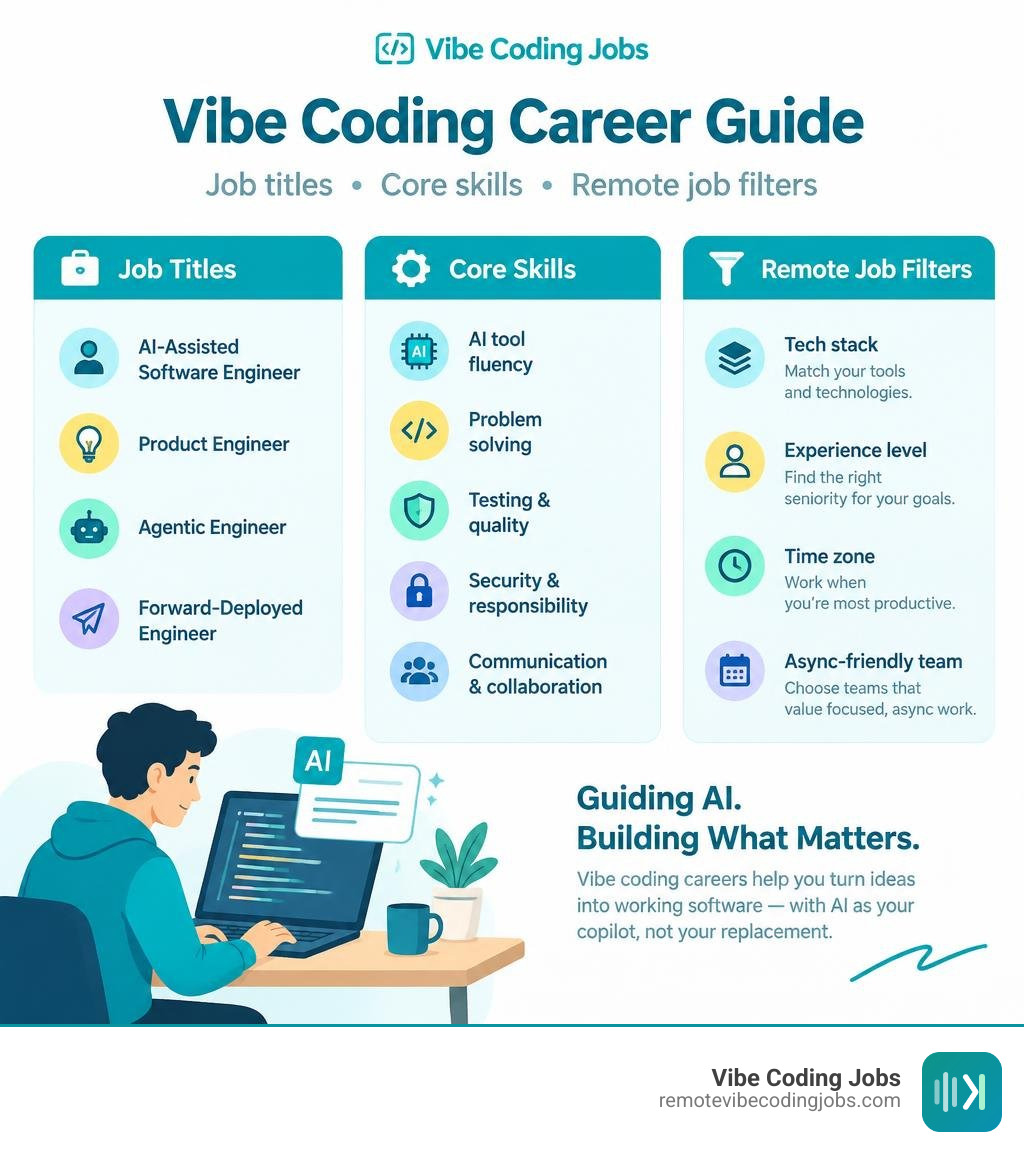
Simple vibe coding careers word guide:
Defining the Paradigm: Intent Over Syntax
Software engineering has crossed a permanent threshold. When computer scientist Andrej Karpathy coined the phrase in early 2025, describing a workflow where one gives in to natural language prompts and “forgets that the code even exists,” it sparked an industry-wide realization. The practice of Vibe coding is no longer a hobbyist novelty; it has matured into a disciplined, intent-first approach to building production systems.
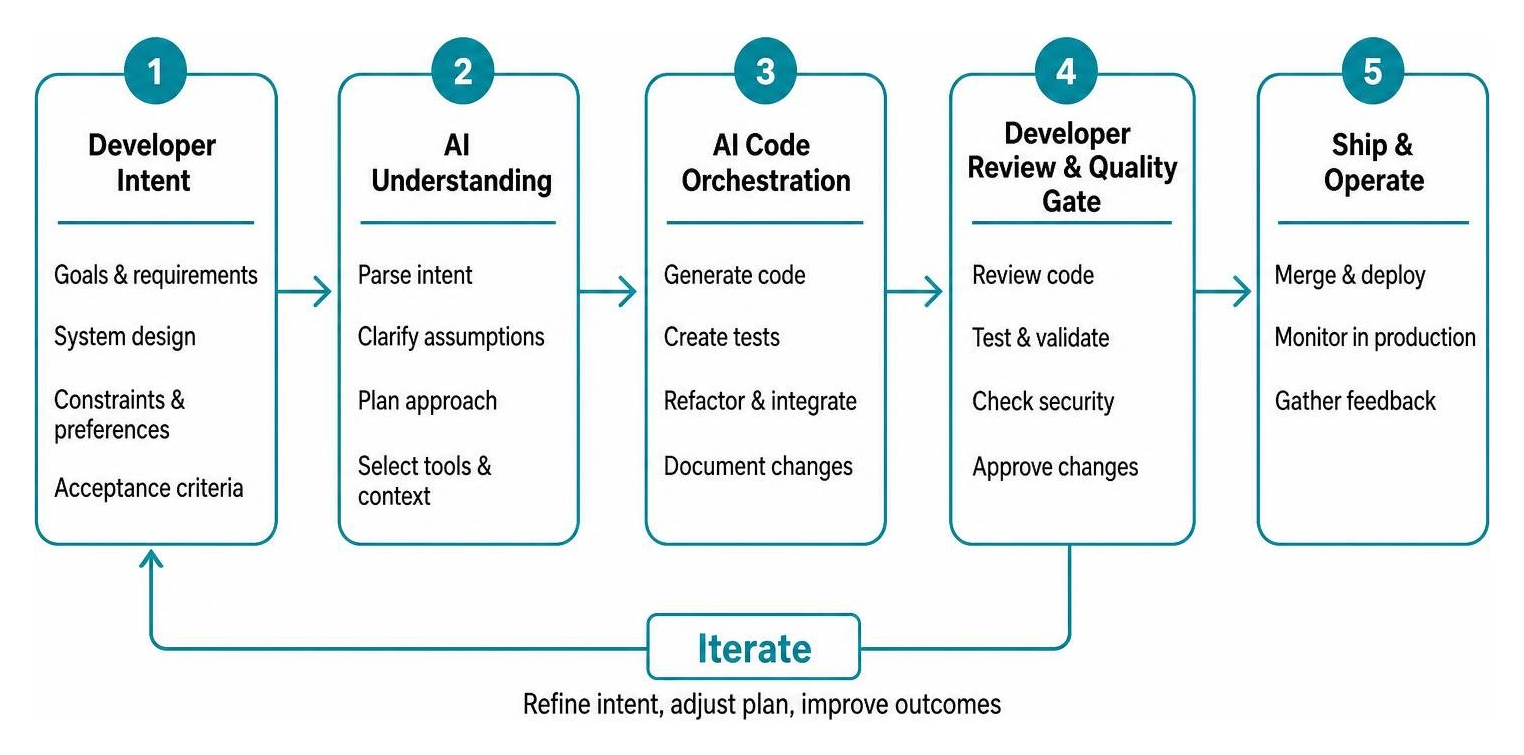
In this model, developers focus on systems architecture, data modeling, business constraints, and product nuance. The cognitive burden of typing boilerplate syntax, looking up API signatures, and scaffolding framework templates is offloaded to large language models and autonomous coding agents. Understanding the fundamental differences between traditional coding and vibe coding helps engineering teams reorganize workflows around high-level problem solving rather than manual syntax generation.
| Criterion | Traditional Software Engineering | Vibe Coding / AI-Native Engineering |
|---|---|---|
| Core Workflow | Manual writing of syntax, functions, and tests | Directing AI agents via prompts, reviewing output, iterating |
| Primary Skill Demands | Language syntax recall, algorithmic puzzles, typing speed | System architecture, intent articulation, code auditing |
| Debugging Method | Manual stack trace tracing and line-by-line debugging | Automated agent verification, root-cause prompt analysis |
| Release Velocity | Sprints measured in weeks, manual boilerplate creation | Continuous daily delivery, rapid full-stack prototyping |
| Role of Developer | Author and craftsman of every line | System architect, product director, and quality gatekeeper |
Modern builders leverage breakthroughs in agentic workflows to orchestrate multi-step programming tasks. By examining how modern AI coding agents work, engineers can better structure context windows, coordinate background processes, and automate testing pipelines.
Productivity Realities and Technical Debt
While AI tooling accelerates development velocity, it introduces nuanced operational trade-offs. GitHub Copilot writes an average of 46% of code across files where it is enabled, and 25% of startups in Y Combinator’s Winter 2025 batch operated codebases that were 95% AI-generated. However, unchecked code generation carries clear risks.

Industry benchmarks reveal that AI co-authored code contains approximately 1.7 times more “major” issues and 2.74 times more security vulnerabilities than human-authored equivalents. Unchecked code generation caused global code duplication to quadruple between 2020 and 2024. For instance, in an audit of rapid-prototyping platforms, 170 out of 1,645 Lovable-created web applications exhibited security misconfigurations exposing personal data. Furthermore, without proper architectural direction, developers can become 19% slower across complex tasks due to debugging convoluted AI outputs. Maintaining comprehensive security and automation in remote developer jobs ensures teams ship resilient software rather than accumulating hidden debt.
The Evolution of Vibe Coding Careers and Market Demand
The hiring landscape has responded decisively to these productivity shifts. Demand for AI-assisted development skills surged 300% year-over-year, establishing AI fluency as a baseline requirement across forward-looking tech companies. Analysis from publications like Vibe Coding: A New Career Path in Software Development highlights how organizations are restructuring teams around builders who leverage AI to ship functional software faster.
Today, there are more than 2,300 active remote roles and over 310 companies actively recruiting for AI-native developers. This hiring momentum creates substantial career growth in AI-assisted development, particularly within remote and distributed engineering cultures where autonomous delivery is prioritized over rigid office hours.
Emerging Job Roles in Vibe Coding Careers
As companies transition from legacy coding practices to AI orchestration, specialized job titles have emerged to reflect the evolving division of labor:
- Agentic Engineer: Focuses on designing, chaining, and supervising autonomous coding agents to build, test, and refactor features independently.
- AI Systems Architect: Oversees overall system design, context window management, repository hygiene, and integration patterns for AI pipelines.
- Builder / Creative Technologist: Cross-functional product generalists who conceptualize, prototype, and ship user-facing applications directly using AI suites.
- Forward Deployed AI Engineer: Technical practitioners embedded with clients or internal stakeholders to rapidly unblock workflows and deploy custom AI solutions.
These paths open distinct remote vibe coding career path opportunities that reward product intuition and system-level thinking. To explore how these roles fit into broader industry trends, review our software engineering salary benchmarks across current job markets.
Compensation Benchmarks and Remote Premiums
Remote work and AI adoption continue to reinforce each other. With 98% of remote workers expressing a desire to work remotely at least part of the time and remote tech postings climbing 25% year-over-year, compensation models have shifted to reward output over physical location.
Senior engineers at AI-forward organizations earn a 15% to 25% premium above market medians. The table below details current compensation ranges across experience tiers.
| Experience Level | Base Salary Range (USD) | Equity & Bonus Potential | Remote Flexibility |
|---|---|---|---|
| Junior / Associate Builder | $70,000 – $100,000 | Early-stage equity / 5-10% bonus | Fully Remote / Async-First |
| Mid-Level AI Engineer | $120,000 – $180,000 | Meaningful stock grants / 10-15% bonus | Global / Flexible Timezones |
| Senior / Staff Architect | $200,000 – $300,000+ | Substantial equity / Performance incentives | Location-Agnostic Top Tier |
For an exhaustive breakdown of geographic variations and company policies, consult our vibe coding salary guide across remote and office positions.
The Technical Arsenal: Skills, Tooling, and Architecture
Succeeding in modern AI-assisted engineering requires a specialized software toolkit. Rather than relying solely on traditional text editors, developers operate in environments designed for real-time model interaction, continuous agent feedback, and seamless repository indexing.

Staying up to date with the remote developer tool stack in 2026 is critical for shipping scalable applications. Choosing the right environment often starts with reviewing our in-depth comparison of Cursor vs Windsurf to see how context caching and deep-file indexing perform under real engineering constraints.
Essential Skills and Tooling for Vibe Coding Careers
To excel in AI-driven environments, developers balance fundamental software knowledge with AI orchestration:
- AI-Native IDEs: Proficiency with environments like Cursor, Windsurf, and modern extensions for GitHub Copilot.
- Model Orchestration: Practical experience prompting frontier models like Claude 3.7 Sonnet and OpenAI reasoning models to execute complex multi-file edits.
- Systematic Architecture & Schema Design: The ability to structure databases, define API contracts, and map component trees before prompting code generation.
- Automated Verification & Testing: Using unit, integration, and security test suites to validate AI-generated output systematically.
- Async Communication: Communicating requirements, constraints, and architecture clearly in writing for distributed engineering teams.
Mastering these areas provides the practical skills needed to land remote vibe coding jobs across leading tech companies.
Hiring and Transitioning: How Companies Evaluate Builders in 2026
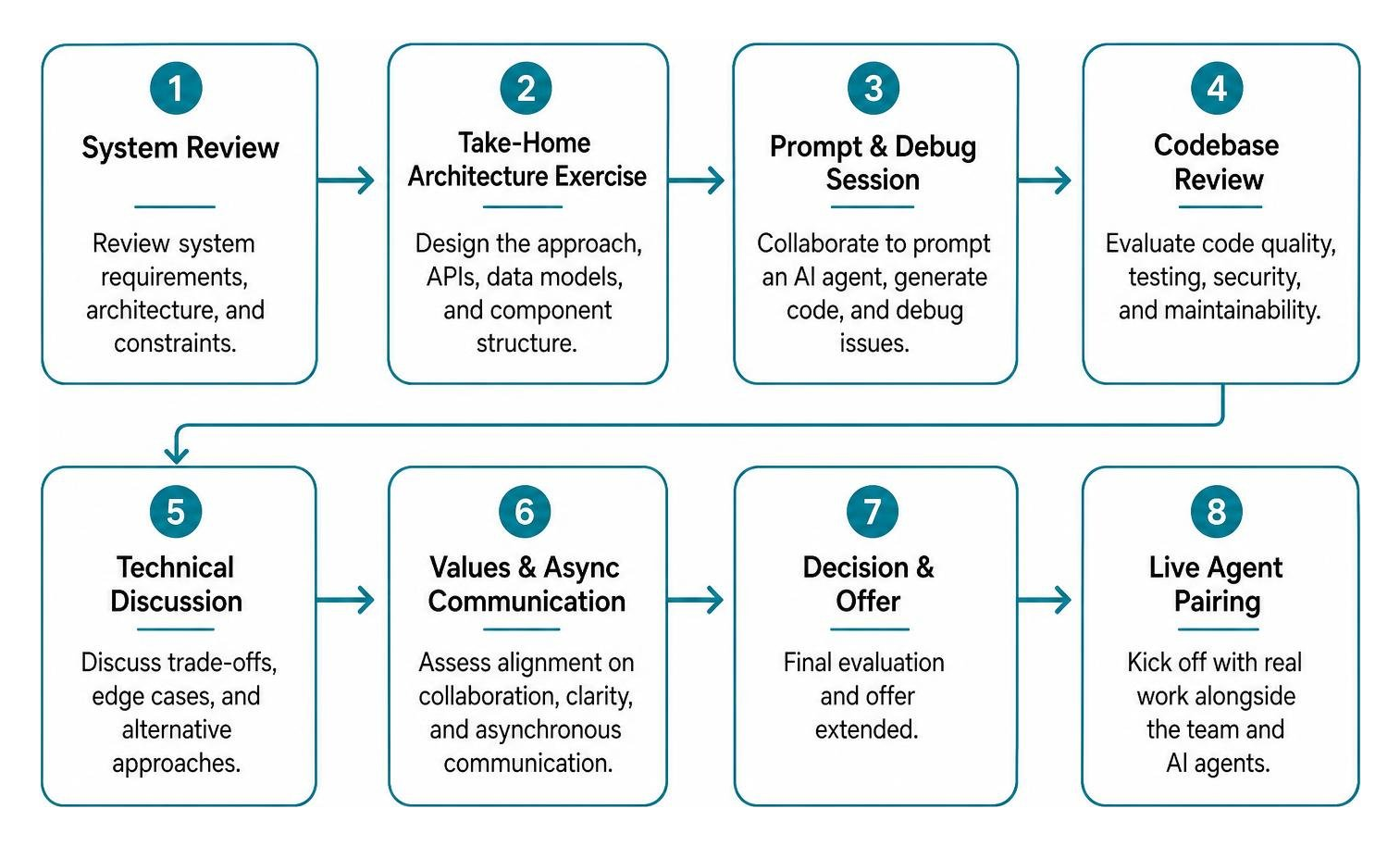
The traditional interview playbook is evolving. Algorithmic whiteboarding and isolated syntax tests are increasingly replaced by real-world, practical evaluations. Hiring managers want to see how candidates think, decompose problems, and leverage modern tools.
More employers are navigating practical remote coding jobs without LeetCode, opting instead for take-home architecture exercises, prompt-and-debug pairing sessions, and codebase reviews. For a step-by-step roadmap on landing your next role, see the complete guide on how to get a vibe coding job.
Building an AI-Native Portfolio
The most effective way to prove competence is to ship. Static GitHub profiles with unmaintained repository forks are giving way to live, working web and mobile applications deployed to production.
Demonstrating that you can bring an idea from concept to a live deployment showcases both product sense and technical rigor. Our hands-on walkthrough on how to vibe code a full-stack application outlines the process of scaffolding frontends, provisioning databases, and deploying scalable architectures using AI-native workflows.
Frequently Asked Questions About Vibe Coding Careers
What qualifications are required to start a vibe coding career?
A successful career does not demand decades of rote syntax memorization, but it does require solid fundamentals in programming logic, data structures, and system design. You must understand what good architecture looks like to guide the AI and catch subtle errors. Beginners can tap into structured entry-level AI coding career opportunities to build experience by shipping live projects with AI assistance.
How does vibe coding affect long-term code quality and security?
AI models can introduce hallucinations, subtle edge-case bugs, and security oversights if left unmonitored. High-performing teams address this by embedding static analysis, automated vulnerability scanners, and strict code review gates into their continuous integration workflows. Learning robust developer security workflows and AI tool integration ensures that development speed does not compromise code maintainability.
Can junior developers thrive in vibe coding roles without decades of syntax experience?
Yes. Developers unencumbered by legacy syntax habits often adapt to prompt orchestration, agent supervision, and product-focused development faster than traditionalists. Because the tooling handles boilerplate mechanics, juniors with strong analytical reasoning can focus on user experience and business logic early on. Understanding why junior developers excel in the AI era highlights how product thinking and fast feedback loops level the playing field.
Conclusion
The emergence of AI-assisted engineering represents an evolutionary leap in how software is created. As intent replaces syntax as the primary driver of development, the industry values engineers who combine strong architectural judgment, security awareness, and rapid product execution.
At RemoteVibeCodingJobs, we curate remote positions at async-first companies that empower engineers to build at full speed with cutting-edge AI tools. Whether you are refactoring legacy infrastructure or launching new products from scratch, discovering the best AI tools for coding is the first step toward accelerating your engineering career.