
The Remote Java Development Guide: Tools, Tips, and Tricks for Success
Remote Java Development in 2026: What You Need to Know Before You Start
Remote Java development is one of the most active corners of the tech job market right now — with over 56,000 remote Java positions listed in the US alone as of 2026.
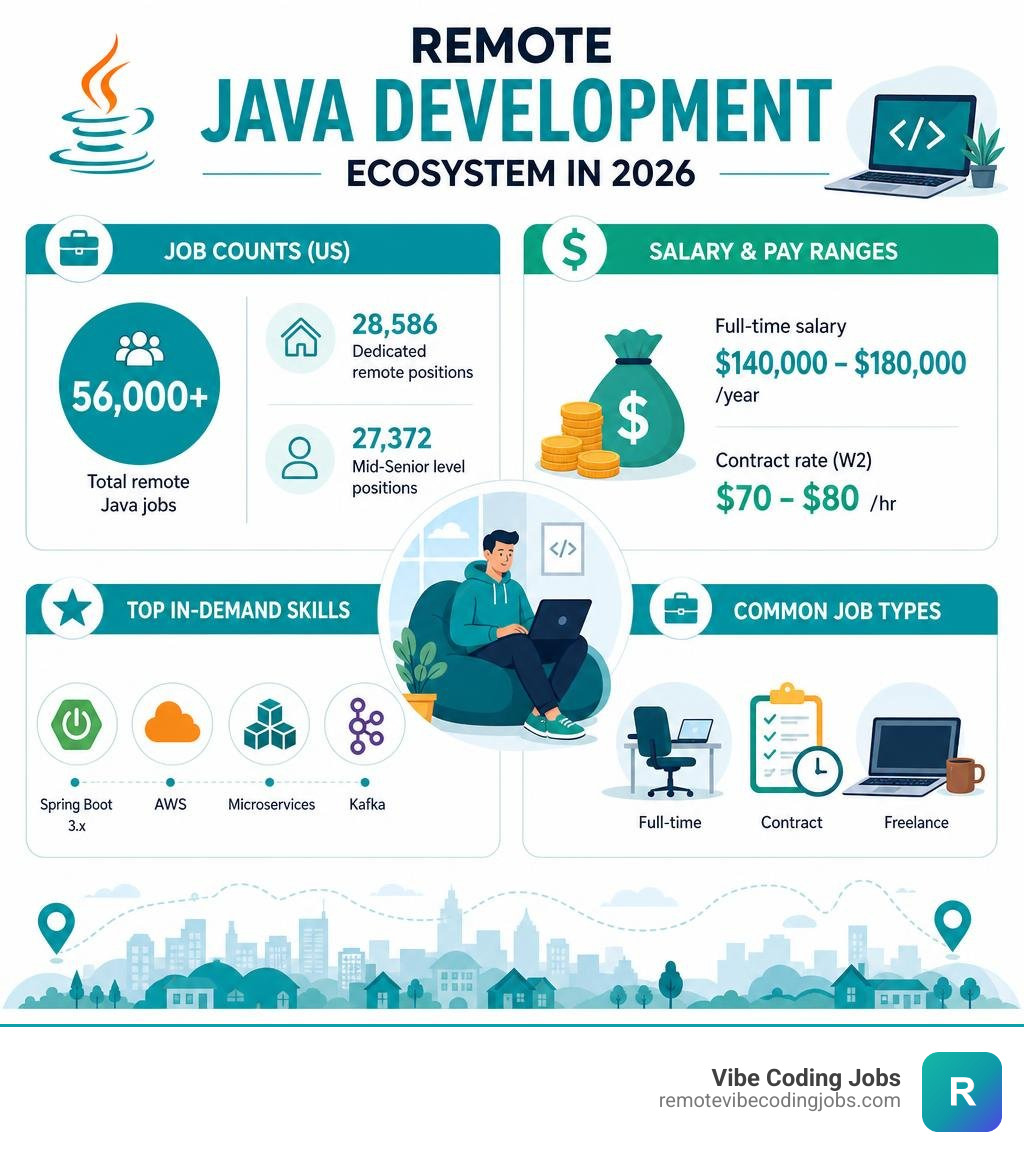
Here’s a quick snapshot of what to expect:
| Topic | Key Facts |
|---|---|
| Total remote Java jobs (US) | 56,000+ listings |
| Dedicated remote positions | 28,586 |
| Most common experience level | Mid-Senior (27,372 positions) |
| Typical full-time salary | $140,000 – $180,000/year |
| Typical contract rate | $70 – $80/hr (W2) |
| Most in-demand skills | Spring Boot 3.x, AWS, microservices, Kafka |
| Common job types | Full-time, contract, freelance |
Java has been a backbone of enterprise software for decades. But the way teams hire, collaborate, and ship Java code has shifted fast. Async-first workflows, AI-assisted coding tools like GitHub Copilot and Claude Code, and cloud-native architectures are now standard expectations — not nice-to-haves.
Whether you’re targeting a full-time role at a fintech company or a contract gig building microservices for a government agency, the landscape is bigger and more varied than ever.
But knowing where to look, what to learn, and how to position yourself makes all the difference.
This guide covers exactly that — from the tools and frameworks employers actually want, to how the hiring process works and where to find the best opportunities.
I’m RVCJ Editorial, the team behind Remote Vibe Coding Jobs, where we cover AI-assisted development, remote hiring trends, and career guidance for developers navigating the remote Java development market and beyond. We’ve tracked thousands of remote developer job listings and hiring patterns so you can cut through the noise faster.
Easy remote java development word list:
The State of Remote Java Development in 2026
The market for remote java development is thriving. If you have been hearing whispers that native enterprise development is slowing down, the data says otherwise. Out of more than 56,000 active Java listings in the United States, a massive 28,586 are listed as fully remote positions.
This means that nearly half of all Java engineering roles no longer require a physical office presence. When it comes to job types, the vast majority of these listings (over 49,400) are full-time corporate roles, though contract options remain incredibly lucrative for senior engineers looking for flexibility.
To understand where you fit in this ecosystem, it helps to look at how different work arrangements stack up in 2026. For a deeper dive into general market shifts, check out our analysis on remote developer salaries in 2026 what to expect.
Contract vs. Full-Time vs. Freelance Remote Java Roles
| Metric | Full-Time Employee (FTE) | W2 / C2C Contractor | Freelancer / Marketplace |
|---|---|---|---|
| Average Compensation | $140,000 – $180,000 / year | $70 – $80 / hour | $20 – $50 / hour |
| Benefits & Perks | Health insurance, 401(k) matching, paid time off | Usually none (or basic W2 agency benefits) | None; self-managed |
| Job Security | High; long-term placement | Medium; project-based (6–12 months) | Low; transactional / task-based |
| Vetting Rigor | Multi-stage live interviews & systems design | Fast-tracked technical screen | Short portfolio review or test task |
| AI Tool Adoption | Highly encouraged for productivity gains | Expected to hit tight sprint deadlines | Crucial to complete tasks 3-10x faster |
While full-time roles offer stability and comprehensive benefits, many seasoned Java developers prefer W2 contract structures. These contracts frequently pay between $70 and $80 per hour, allowing developers to maximize their earnings while avoiding corporate administrative overhead.
At the other end of the spectrum, freelance and agency-backed models are increasingly popular for rapid MVP building and legacy migrations, where developers leverage AI tools to deliver projects at record speeds.
Essential Technical Skills and Frameworks
To land a premium role in remote java development, your technical stack needs to reflect modern enterprise standards. Gone are the days when simply knowing core Java syntax and basic SQL was enough to secure a comfortable work-from-home setup.

Today’s remote teams expect you to build high-volume, low-latency applications that run seamlessly in the cloud. The modern remote Java developer’s toolkit includes:
- Java 17 and 21 (LTS): Modern language features like records, sealed classes, virtual threads (Project Loom), and pattern matching are standard requirements.
- Spring Boot 3.x: The undisputed king of Java backend frameworks. You must be comfortable with dependency injection, auto-configuration, Spring Security, and Spring Data JPA.
- Cloud-Native Architecture: Hands-on experience with AWS (including AWS Lambda, DynamoDB, and Amazon MSK) is highly prioritized.
- Event-Driven Microservices: Knowledge of Apache Kafka for managing real-time, asynchronous message streams.
- Extreme Programming (XP) & Testing: Mastery of Test-Driven Development (TDD) using the Red-Green-Refactor cycle, along with unit testing (JUnit, Mockito) and continuous integration (CI/CD) pipelines.
Modern Tools for Remote Java Development
In 2026, the definition of a “productive developer” has completely changed. Top-performing remote engineers do not write every line of boilerplate code by hand. Instead, they practice “vibe coding”—a workflow where developers act as directors, utilizing advanced AI coding assistants to handle implementation details while they focus on system architecture, security, and business logic.
If you want to stay competitive, you should integrate these modern tools into your daily workflow:
- Cursor & Windsurf: AI-first code editors that allow you to navigate massive Java codebases and generate complex Spring Boot components using natural language.
- Claude Code & GitHub Copilot: Excellent for debugging legacy code, writing comprehensive unit tests, and explaining intricate transaction management logic.
To learn more about optimizing your remote setup with these tools, check out our guide on the remote developer tools stack 2026.
Using these tools effectively can dramatically increase your daily throughput. For practical strategies on integrating AI assistants without sacrificing code quality, take a look at our remote developer productivity tips tools boost your output and explore how teams assess these skills in remote developer jobs ai tools.
Security Clearances and Compliance in Remote Java Development
One unique aspect of the US remote java development market is the high concentration of roles requiring security clearances. Because Java is widely used by government agencies, financial institutions, and defense contractors, many job listings require:
- US Citizenship: A strict prerequisite for federal compliance and defense-related projects.
- Active Security Clearances: Roles frequently call for “Secret” or “TS/SCI” (Top Secret / Sensitive Compartmented Information) clearances. Even if a position is fully remote, you must meet these federal criteria to be considered.
- Background Checks: Expect rigorous background screenings, including fingerprinting and credit checks, especially when working with state projects or sensitive financial data.
If you don’t have a clearance, don’t worry—there are still tens of thousands of commercial roles in fintech, healthtech, and SaaS that only require standard background checks.
Navigating the Remote Java Hiring Process
The hiring process for remote Java positions has evolved to accommodate distributed teams. While some traditional enterprises still rely on multi-week, multi-stage interview loops, progressive companies are moving toward faster, more practical evaluations.

A typical hiring timeline in 2026 looks like this:
- Application & Resume Screen (1-3 days): Hiring managers look for specific experience with Spring Boot 3.x, cloud deployment, and AI-assisted workflows.
- Initial Technical Assessment (3-5 days): This may involve a take-home project or a proctored test.
- Live Technical Interview (1 hour): A hands-on coding session. While some companies still use algorithmic puzzles, many are shifting toward real-world scenarios, such as debugging a broken REST API or designing a microservice.
If you dread whiteboard style interviews, there is good news. Many modern companies are moving away from traditional algorithmic testing. You can read more about this trend in our article on remote coding jobs no leetcode.
Where to Find Remote Java Jobs
Finding the right remote role requires using the right platforms. While general job boards can be overwhelming, a targeted approach will save you hours of useless applications.
- Specialized Platforms: At RemoteVibeCodingJobs, we curate daily listings specifically filtered for async-first companies that support AI-assisted development. If you are looking to combine your Java expertise with cutting-edge tools, you can Explore AI-native developer roles on Vibe Coding Jobs.
- General Job Boards: Platforms like Flexible Remote Java Developer Jobs – Indeed , remote java developer jobs | Dice.com , and 1,000+ Java Remote jobs in United States – LinkedIn are great for high-volume searches and finding traditional corporate roles.
- Startup & Agency Marketplaces: If you want to work with fast-moving startups, check out Remotebase | Remote java developer jobs at silicon valley startups . For direct contract-to-hire opportunities, look at listings like the Full Stack Java Developer – Attadale Partners, LLC or offshore/nearshore models such as Java Developer | Offshore | Zenvok .
- Staffing Platforms: Services like Hire Remote Java Developers Starting at RocketDevs, Hire Dedicated Java Developer – Fast & Flexible Hiring Model , and Hire Remote Java Developer | Engineer Master Labs connect pre-vetted global talent with businesses looking to scale their engineering teams quickly.
Frequently Asked Questions about Remote Java Development
What are the typical salary ranges for remote Java developers in 2026?
Full-time remote Java software engineers in the United States typically earn between $140,000 and $180,000 per year, depending on their experience and the complexity of the tech stack. Senior developers with expertise in cloud architecture and distributed systems can easily command salaries upwards of $190,000 to $250,000.
For contract positions, standard W2 rates range from $70 to $80 per hour, while highly specialized principal consultants can charge $100+ per hour. For a complete breakdown of compensation trends across various tech roles, see our guide on remote developer salary expectations by experience level 2026.
How do time zones and regions affect remote Java roles in the US?
Even though a job is labeled “remote,” geographic location still matters. Many US-based companies require a specific timezone overlap (usually a minimum of 4 to 6 hours) to facilitate collaborative sessions, daily stand-ups, and synchronous debugging.
For example, East Coast companies often hire developers who can work within Eastern or Central time zones, while West Coast tech hubs look for Pacific timezone alignment. Additionally, some remote roles are geographically restricted to specific US states due to local tax laws and employment regulations.
What experience level is most in demand for remote Java positions?
Mid-to-senior level developers are by far the most sought-after candidates in the remote market. Out of the active listings we track, over 27,372 positions are designated for mid-to-senior level engineers.
Because remote work requires a high degree of autonomy, self-management, and architectural decision-making, employers are willing to pay a premium for developers who can hit the ground running without hand-holding. However, entry-level opportunities do exist for proactive developers who can demonstrate strong practical skills. If you are trying to break into the market, read our playbook on how to get remote developer job.
Conclusion
The landscape of remote java development in 2026 is incredibly rewarding for engineers who balance deep foundational knowledge with modern development practices. By mastering Spring Boot 3.x, cloud-native deployments, and event-driven architectures—and combining them with AI-assisted “vibe coding” tools like Cursor and Claude Code—you can position yourself at the very top of the applicant pool.
At RemoteVibeCodingJobs, we believe the future of software engineering belongs to those who collaborate with AI to build systems faster and more reliably. If you are ready to find your next remote challenge at an async-first, forward-thinking company, Explore AI-native developer roles on Vibe Coding Jobs today!