
How to Build the Web Without Leaving Your Bed
Remote Web Development Is One of the Best Careers You Can Build From Anywhere
Remote web development is the practice of building, maintaining, and shipping websites and web applications entirely online — no office required.
Here’s a quick snapshot of what that looks like in 2026:
| What You Need to Know | Quick Answer |
|---|---|
| Types of roles | Frontend, full-stack, backend, DevOps, senior engineer |
| Top skills | React, TypeScript, Node.js, Python, AI tools (Cursor, Claude Code) |
| Salary range | ~$72,000 on the lower end to $185,000+ for senior roles |
| Experience needed | 2–5+ years for most roles; some junior positions exist |
| Where to find jobs | Remote Vibe Coding Jobs, specialized tech boards, LinkedIn |
| Key soft skills | Async communication, self-management, written clarity |
The remote tech job market has grown fast. Job boards now list tens of thousands of updated remote web developer roles every day, spanning full-time, part-time, freelance, and contract formats — across the US, Europe, LATAM, Asia, and beyond.
And the work itself is changing. AI-assisted development tools like Cursor and Claude Code are reshaping how developers write, review, and ship code. Productivity gains of 2–5x are being reported by developers who adopt these workflows. New job titles — AI-First Developer, Agentic Engineer, Vibe Coder — are showing up in real listings at real companies.
Whether you’re just starting out or you’re a senior engineer looking to go fully remote, there has never been more opportunity to build the web from wherever you are.
We’re the RVCJ Editorial team at Remote Vibe Coding Jobs — we cover remote web development hiring trends, AI-assisted workflows, and async-first engineering careers for developers who build with tools like Cursor, Copilot, and Claude. In this guide, we’ll walk you through everything you need to know to find, land, and thrive in a remote web development role in 2026.
The Landscape of Remote Web Development in 2026
By May 2026, remote web development has moved far beyond the “work from home” experiment of the early 2020s. It is now a sophisticated, global ecosystem. We are seeing a massive surge in companies that don’t just “allow” remote work but are built for it from the ground up—what we call “async-first” organizations.
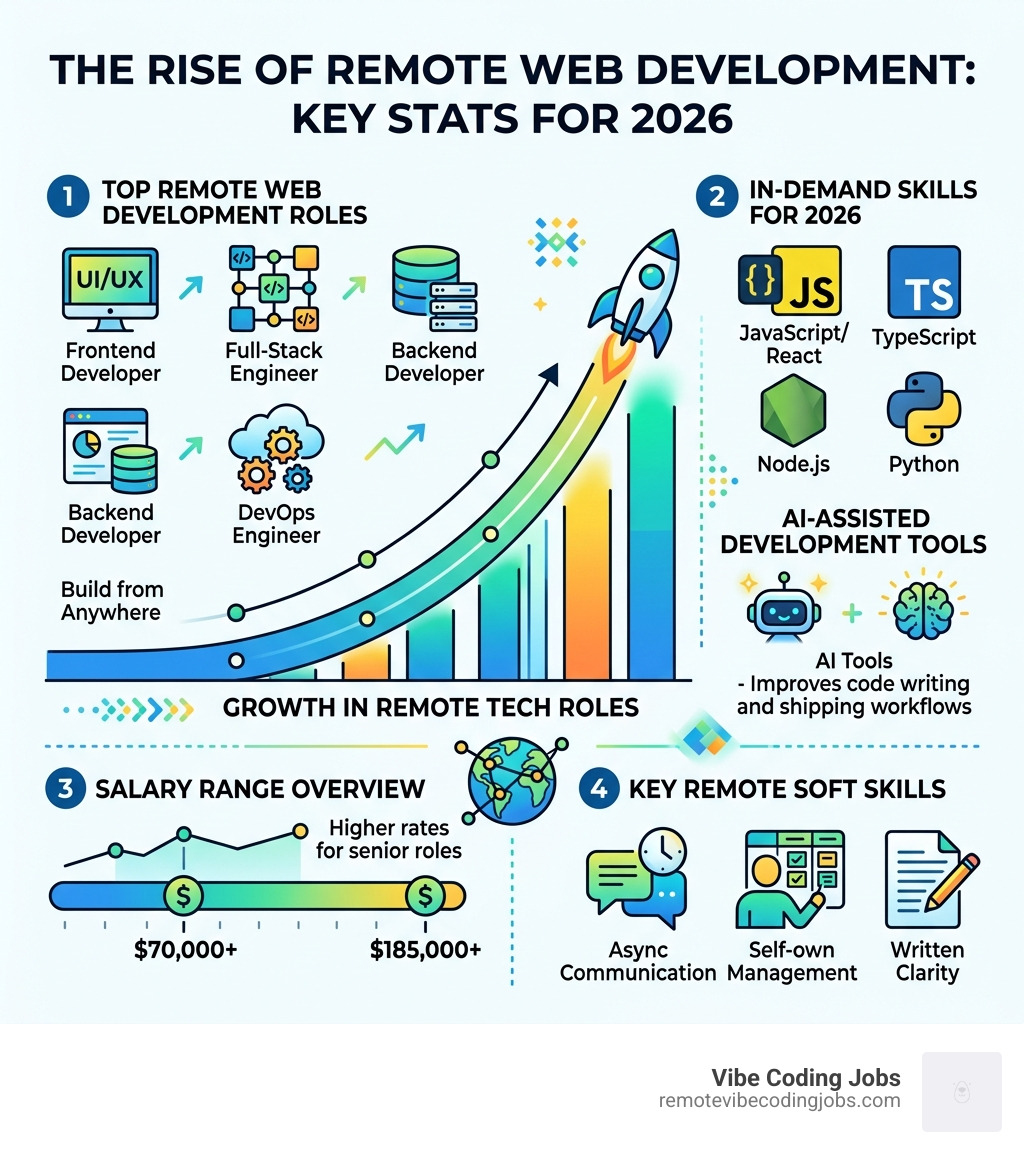
The current job market is diverse, offering something for every specialization. Whether you are a master of the user interface or a wizard of the server-side, there is a remote seat for you. Currently, the most in-demand roles include:
- Frontend Developers: Focusing on the visual and interactive elements of a site.
- Full-Stack Developers: Handling both the client-side and server-side, offering the versatility that modern startups crave.
- Specialized Engineers: Roles focusing on AI integration, cloud infrastructure, and security.

If you are ready to start your journey, you can Explore Remote Web Developer Jobs to see what’s currently available. For those who have already picked a favorite language, check out More info about Python global roles or More info about JavaScript global roles.
Breaking into Remote Web Development as a Junior
Can you land a remote job without a decade of experience? Absolutely. While many companies prefer 2–3 years of experience, the demand for talent has opened doors for entry-level and junior developers. These roles often involve maintaining existing codebases, debugging, and building smaller features under the guidance of senior mentors.
To stand out, we recommend focusing on self-paced learning and building a “proof of work” portfolio. Remote employers look for juniors who can demonstrate they can work independently. Bootcamps, like the 9-week intensive programs that cost around €8,000, are popular paths, but self-taught developers who contribute to open source are equally valued.
If you’re looking for your first big break, browse these Full-Stack Programming Roles. For companies looking to grow their talent from the ground up, you can Hire Fullstack Developer through our curated lists.
Senior Roles and Specialized Engineering
For the veterans, the 2026 remote market is incredibly lucrative. Senior developers are no longer just writing code; they are architects and mentors. We see a high demand for Senior Web Developers who can manage complex migrations and lead distributed teams across time zones.
Specialized roles like DevOps Engineers and Product Engineers are also booming. These professionals ensure that the deployment pipelines are smooth and that the product vision aligns with technical execution. A great example of this high-level remote work can be seen with the Grafana Labs Senior Web Developer role, which emphasizes building scalable monitoring systems. If your company needs top-tier infrastructure talent, you can Hire DevOps Engineer to keep your remote operations running flawlessly.
Essential Tech Stacks and the Rise of Vibe Coding
The tools we use to build the web have evolved. While the core languages remain, the way we interact with them has shifted. In 2026, being a great developer isn’t just about memorizing syntax; it’s about orchestration.
The dominant stacks for remote web development currently include:
- React & Next.js: Still the kings of the frontend.
- TypeScript: Now a non-negotiable requirement for almost all professional remote teams to ensure code reliability.
- Node.js & Python: Powering the backend and AI integrations.
To find roles in these specific stacks, see our Remote Jobs React Developer page or explore Remote Jobs NodeJS Developer.
However, the biggest trend we’ve seen is the rise of “Vibe Coding.” This refers to AI-assisted development where the developer focuses on the high-level logic, architecture, and “vibe” of the product, while AI tools handle the manual typing of boilerplate code.
| Feature | Traditional Coding | Vibe Coding (AI-Assisted) |
|---|---|---|
| Primary Tool | Standard IDE / Text Editor | AI-Native Editors (Cursor, Windsurf) |
| Focus | Manual syntax and debugging | System architecture and prompt logic |
| Velocity | 1x (Baseline) | 3x – 10x faster shipping |
| Entry Barrier | High (Requires deep syntax knowledge) | Lower (Requires architectural thinking) |
| Output | Code files | Functional prototypes and products |
The Future of Remote Web Development: AI and Vibe Coding
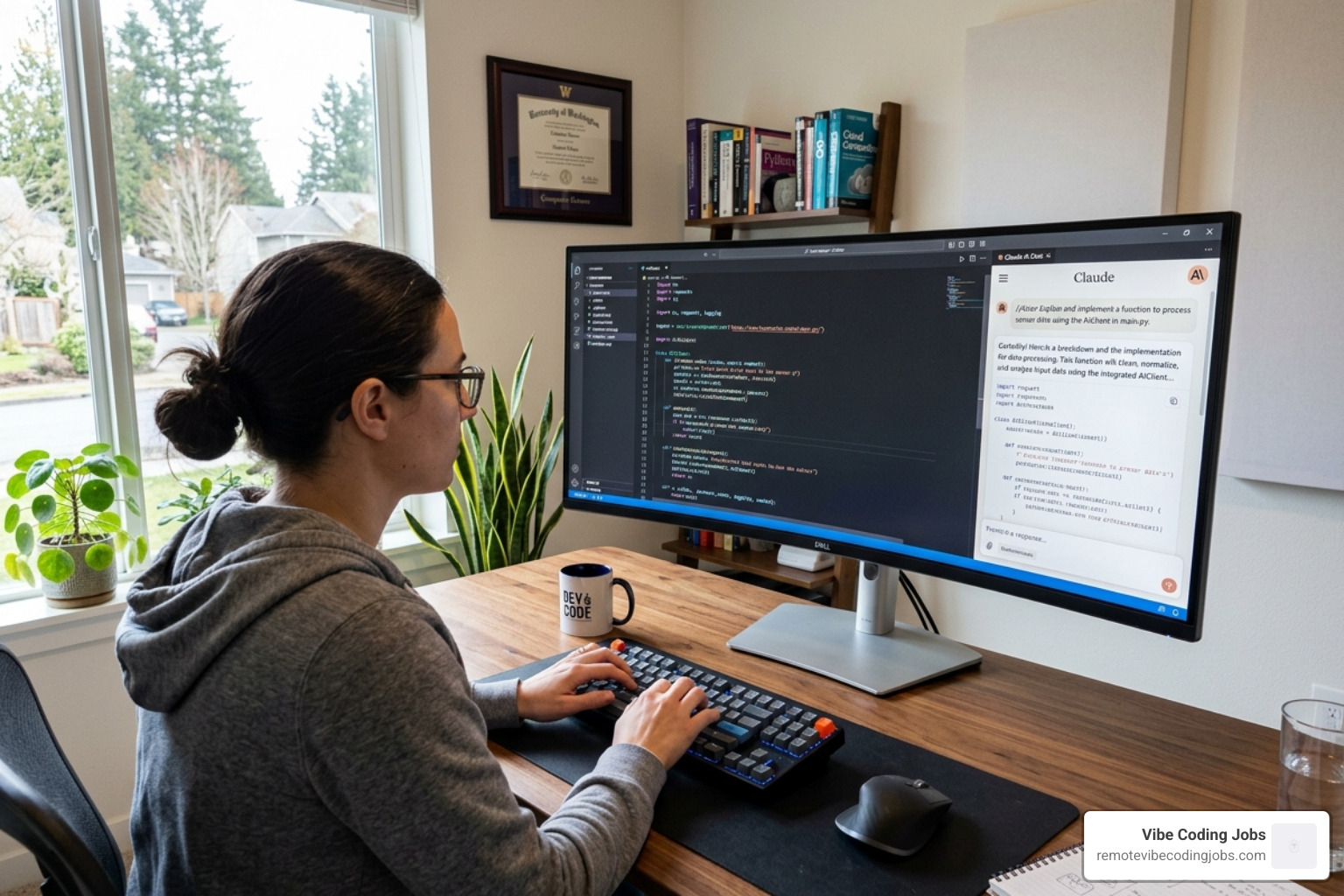
We believe that AI fluency is becoming the only stable advantage in the modern tech career. Tools like Cursor, Claude Code, and GitHub Copilot are no longer optional “extras.” They are integrated into the daily workflow of the most productive remote teams.
Developers are now acting as “AI Pilots,” using natural language to describe features and letting AI agents generate the initial implementation. This allows a single developer to handle tasks that previously required a whole team. For a deeper dive into these tools, check out our guide on Remote Developer Jobs AI Tools. If you want to see how this applies to the world’s most popular language, look at More info about JavaScript Vibe Coding.
Backend and Infrastructure in a Remote World
Even as the frontend becomes more automated, the “plumbing” of the web remains critical. Remote backend developers are increasingly expected to understand containerization and cloud orchestration. Knowing your way around Docker, Kubernetes, and AWS or GCP is essential for ensuring that your applications can scale globally.
Python remains a powerhouse, especially for AI-driven backends. You can find specialized roles here: Remote Jobs Python Developer. For those managing the infrastructure that keeps remote teams connected, check out More info about Docker Global Friendly roles.
Salary Benchmarks and Career Progression
One of the most common questions we get is: “How much can I actually make?” In 2026, the answer depends on your ability to deliver value, often regardless of where your bed is located.
Based on current market data:
- Entry-Level/Junior: $70,000 – $100,000
- Mid-Level: $103,000 – $135,000
- Senior/Staff: $140,000 – $250,000+
- Freelance/Contract: $100 – $300 per hour for AI-proficient experts.
We’ve seen real-world listings for Senior Web Developers in marketing ranging from $100,000 to $185,000, while specialized roles like Staff Product Designers can reach nearly $300,000.
Career progression in remote companies is also becoming more transparent. Companies like WebFX report that 95% of their promotions are internal, with clearly defined paths that don’t require you to move to a physical headquarters to climb the ladder. For more on 2026 trends, read our analysis on Remote React Developer Jobs 2026 and our Remote Typescript Developer Jobs 2026.
Regional Variations and Global Pay
While the “work from anywhere” dream is real, your location can still influence your pay and working hours. Some US-based companies require a 4-hour overlap with the US East Coast. For example, developers in the Philippines might work from 3:30 pm to midnight to stay in sync with their American teammates.
However, many companies are moving toward “Global Friendly” or “Async First” models where your output matters more than your clock-in time. This is especially true in regions like EMEA and LATAM, which have become hubs for high-quality remote talent. Explore these opportunities further via More info about PHP Developer roles or More info about Ruby Global Friendly.
How to Land Your Dream Remote Role
Landing a remote web development job requires a different strategy than a traditional office role. You aren’t just selling your coding skills; you’re selling your ability to work in a distributed environment.
The Application Process usually involves:
- Portfolio Review: Highlighting live, functional products (not just code snippets).
- Vetting/Technical Tests: AI-powered platforms now use seniority assessments and live coding challenges to match you with top firms.
- The “Vibe” Check: Interviews focusing on your communication style and emotional intelligence.
To stand out, we suggest using AI tools to build rapid prototypes for your portfolio. Showing that you can ship a feature in hours rather than days is a massive competitive advantage. For specific tips on the Python market, see our guide on Remote Python Developer Jobs 2026.
Essential Soft Skills for Remote Teams
When we don’t meet at the water cooler, soft skills are actually “hard” skills. We’ve found that the most successful remote developers excel in:
- Written Clarity: Since much of your communication will be via Slack, Notion, or GitHub, being able to explain complex ideas simply is vital.
- Async Discipline: The ability to move a project forward without waiting for a real-time meeting.
- Emotional Intelligence: Building trust and “psychological safety” through a screen.
- Time Management: Being your own manager and avoiding the “always-on” burnout.
Many of our favorite companies are “Async First,” meaning they prioritize documentation over meetings. You can find these roles here: More info about NextJS Async First.
Frequently Asked Questions about Remote Web Development
What are the most in-demand skills for remote web developers in 2026?
The “Holy Trinity” remains React, TypeScript, and Node.js. However, the “plus one” that gets you hired in 2026 is AI Orchestration. Knowing how to use Cursor, Claude, and agentic workflows to multiply your output is what top-tier employers are looking for.
How important is time zone overlap for remote dev roles?
It varies. “Global Friendly” roles might only require a 2–4 hour overlap for stand-ups, while “Async First” companies might require zero overlap. Always check the listing—some US companies strictly require you to be in a specific set of US states for tax reasons, while others hire “Anywhere in the World.”
Can I get a remote web development job without a degree?
Yes. The tech industry is one of the most meritocratic fields. While a Computer Science degree is helpful, employers care more about your GitHub contributions, your portfolio, and your ability to pass a technical vetting test. Many successful remote developers are self-taught or bootcamp graduates.
Conclusion
The dream of building the web without leaving your bed is no longer a fantasy—it’s a career path taken by hundreds of thousands of developers globally. By embracing remote web development, you gain freedom of location, a better work-life balance, and the chance to work with the best minds in the world.
At Remote Vibe Coding Jobs, we are dedicated to helping you navigate this landscape. We curate the best listings from async-first companies that value “vibe coding” and AI-assisted velocity. Whether you are looking to master a new tool or find a company that respects your time zone, we’ve got you covered.
Ready to take the next step in your AI-powered career? Find your next AI Engineer role today and start building the future of the web on your own terms.