Why Screening for Culture Fit Remote Developer Roles Actually Determines Your Team’s Output
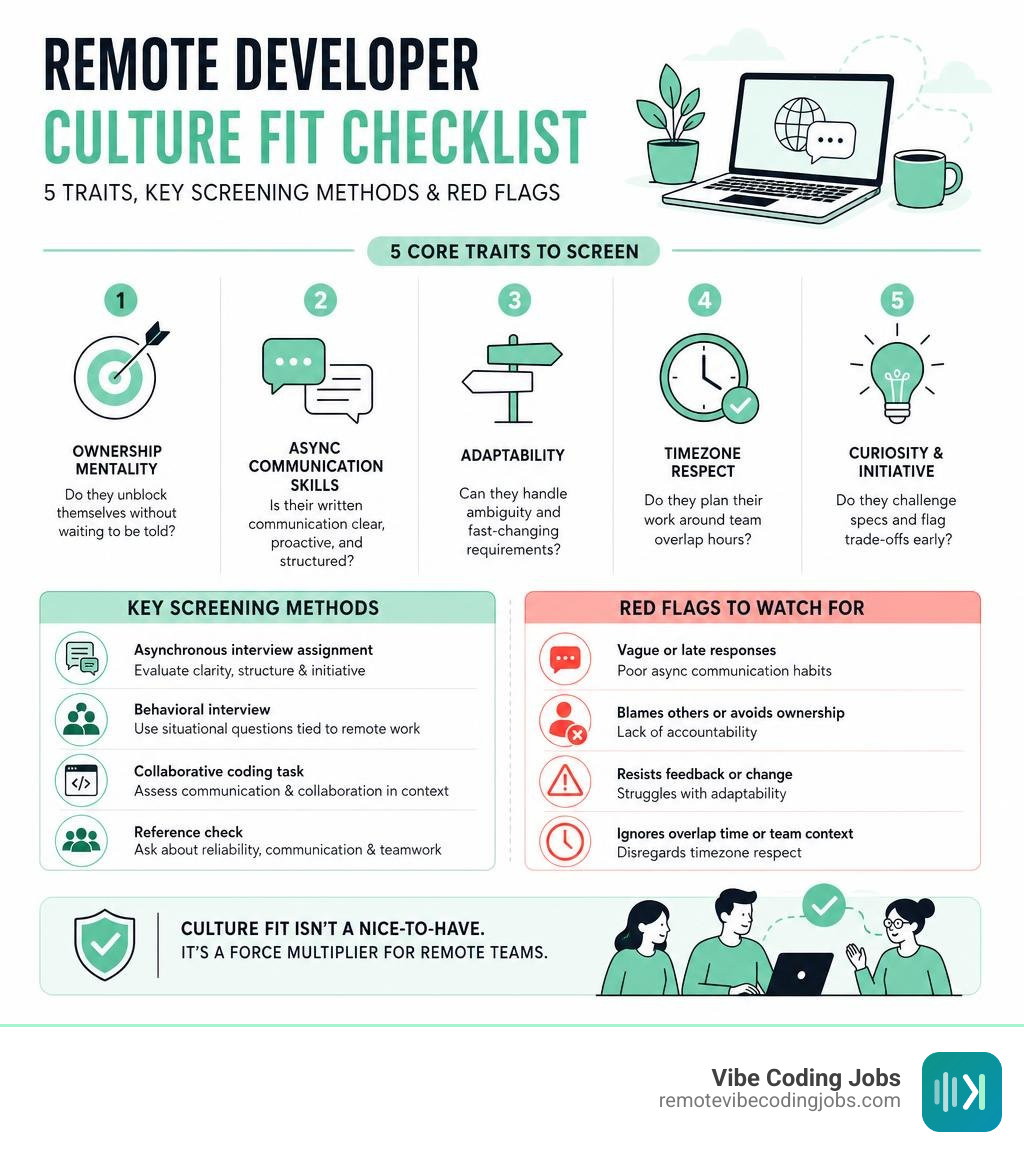
Assessing culture fit for a remote developer comes down to five core traits you can screen for directly:
- Ownership mentality — Do they unblock themselves without waiting to be told?
- Async communication skills — Is their written communication clear, proactive, and structured?
- Adaptability — Can they handle ambiguity and fast-changing requirements?
- Timezone respect — Do they plan their work around team overlap hours?
- Curiosity and initiative — Do they challenge specs and flag trade-offs early?
These traits predict remote developer success more reliably than years of experience or GitHub stars alone.
Here’s the uncomfortable truth: hiring remote developers has never been easier on paper. Global talent marketplaces offer thousands of candidates at the click of a button. Yet startup founders and CTOs still ask the same question — “Why aren’t we shipping faster?”
The answer is almost never the tech stack.
Employees who feel culturally disconnected are 2.6x more likely to be actively disengaged. And toxic team dynamics caused by poor cultural alignment can reduce overall productivity by 40% or more. That’s not an HR problem. That’s a sprint velocity problem.
One fintech team saw 34% faster sprint delivery simply by replacing two misaligned developers with culture-aligned hires — without increasing their budget. No new tools. No process overhaul. Just better fit.
The gap between a team that ships and one that stalls is rarely technical. It’s cultural.
I’m Dominic Zijlstra, co-founder of Adaptify.ai and former data scientist and DevOps engineer, and my experience building and working within distributed technical teams is what shapes my perspective on culture fit for remote developers throughout this guide. Understanding how async-first teams actually function — from the inside — is what separates a useful checklist from a generic HR framework.
Terms related to culture fit remote developer:
Why Culture Fit for a Remote Developer is a Hard Productivity Multiplier
When we talk about a culture fit remote developer, we aren’t talking about finding someone to play ping-pong with or share memes on Slack. In a distributed engineering team, culture fit is a hard productivity multiplier.
In a traditional office, culture can sometimes happen organically through proximity. In a remote setup, building a cohesive team requires intentional, structured efforts. When a remote engineer is a poor cultural fit, the friction doesn’t stay in the HR department—it bleeds directly into your codebase.
Poor cultural alignment acts as a silent tax on your sprint velocity. It leads to:
- Slipped Deadlines: Misaligned communication styles mean requirements are misunderstood, leading to late-stage rewrites.
- Team Burnout: When one developer fails to communicate proactively, other team members must constantly step in to unblock them, causing widespread frustration. To protect your team, you need to know How To Avoid Burnout As A Remote Developer A Comprehensive Guide.
- High Turnover: Replacing a developer means resetting your onboarding clock, costing valuable months of momentum.
Using structured 12 culture fit interview questions you need to ask developers helps weed out these silent productivity killers before they join your Slack workspace.

Defining the Core Traits of a Culture Fit Remote Developer
To screen effectively, we must define what cultural alignment actually looks like in a remote environment. It is built on five pillars:
- Ownership Mentality: In a remote setting, there is no manager walking past a desk to check on progress. An ownership-minded developer doesn’t wait for a Jira ticket to tell them what to do. If they are blocked, they unblock themselves, document their findings, and propose solutions.
- Async Communication Skills: Excellent written communication is the lifeblood of remote work. Because remote teams lack non-verbal cues, minor misalignments in written messages can escalate quickly. Developers must write clearly, structure their pull requests thoughtfully, and document decisions.
- Adaptability to Change: Startups and modern product teams move fast. A great remote developer embraces ambiguity and adapts to shifting priorities without losing focus.
- Respect for Timezones: Distributed teams often operate across vast geographical distances. A culture-fit hire plans their day around core overlapping hours, respects their teammates’ offline status, and ensures handoffs are seamless.
- Curiosity and Initiative: They don’t just write code; they seek to understand the product. They proactively question assumptions, challenge specifications, and communicate trade-offs early.
Cultivating these traits is essential for maintaining Remote Work Deep Focus Productivity across your engineering organization.
Technical Fit vs. Cultural Alignment
It is a common mistake to treat technical skill and cultural fit as a trade-off. In reality, they are two sides of the same coin.
Technical fit is highly domain-specific. For example, hiring a brilliant database generalist to rebuild a SaaS onboarding flow can be a silent bottleneck if they lack experience with SaaS behavioral analytics. Conversely, an engineer with slightly less raw syntax knowledge but a deep understanding of your product domain and a stellar async work ethic will often onboard in days rather than weeks.
| Dimension | Technical Fit | Cultural Alignment |
|---|---|---|
| Focus | Stack mastery, system design, domain-specific experience (e.g., SaaS vs. eCommerce) | Ownership, async habits, collaboration style, timezone respect |
| Onboarding Speed | Drops from weeks to days if domain matches | High autonomy reduces the need for constant hand-holding |
| Long-term Impact | Clean architecture, fewer bugs, appropriate technical trade-offs | High retention, psychological safety, and rapid sprint velocity |
The Proximity Paradox: Deconstructing Local Hiring vs. True Cultural Alignment
Many companies fall into the trap of “proximity bias”—mistaking physical familiarity for competence and cultural alignment. This is known as the Mere Exposure Effect, where managers favor candidates who are physically close or willing to work from a local office.
Often, return-to-office (RTO) mandates and local-only hiring requirements are used as “quiet firing” algorithms to reduce headcount or justify commercial real estate investments. However, this localism comes at a massive cost.
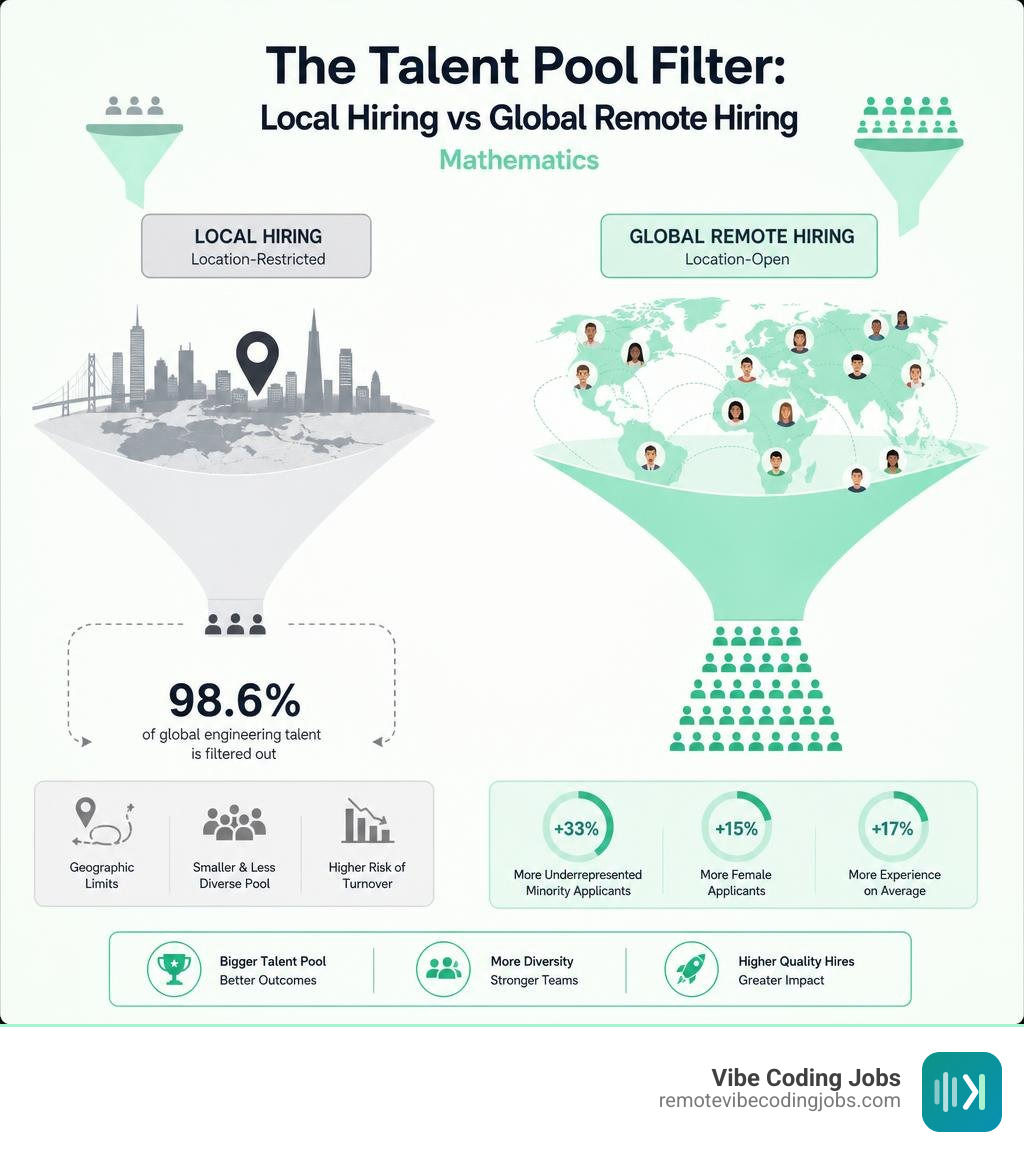
As explored in The Proximity Paradox: Why ‘Culture Fit’ Has Become a Euphemism for Local Hiring | DayZero | Web Development, Programming & Tech Tutorials for Beginners , mandating that a developer live near a major tech hub like San Francisco, Seattle, or New York effectively filters out 98.6% of the world’s engineering talent. It also triggers the “Dead Sea Effect,” where your most talented and marketable remote developers leave first, leaving behind those with fewer options.
The Diversity and Talent Pool Mathematics
When you break free from geographical constraints, your talent pool doesn’t just grow—it becomes significantly more diverse.
According to data from a Wharton diversity study, when a job posting is switched from “On-site” to “Remote,” underrepresented minority applicants increase by 33%, and female applicants increase by 15%. Remote roles also attract candidates with 17% more experience on average.
By focusing on true cultural alignment rather than physical zip codes, companies can build highly experienced, cognitively diverse engineering teams without paying the premium of local tech hub salaries.
The Modern Screening Framework: Beyond the LeetCode Test
Hiring a remote developer based solely on a PDF resume and an abstract LeetCode test is a recipe for failure in 2026. It doesn’t tell you how they write documentation, how they handle being blocked, or how they collaborate with real humans.
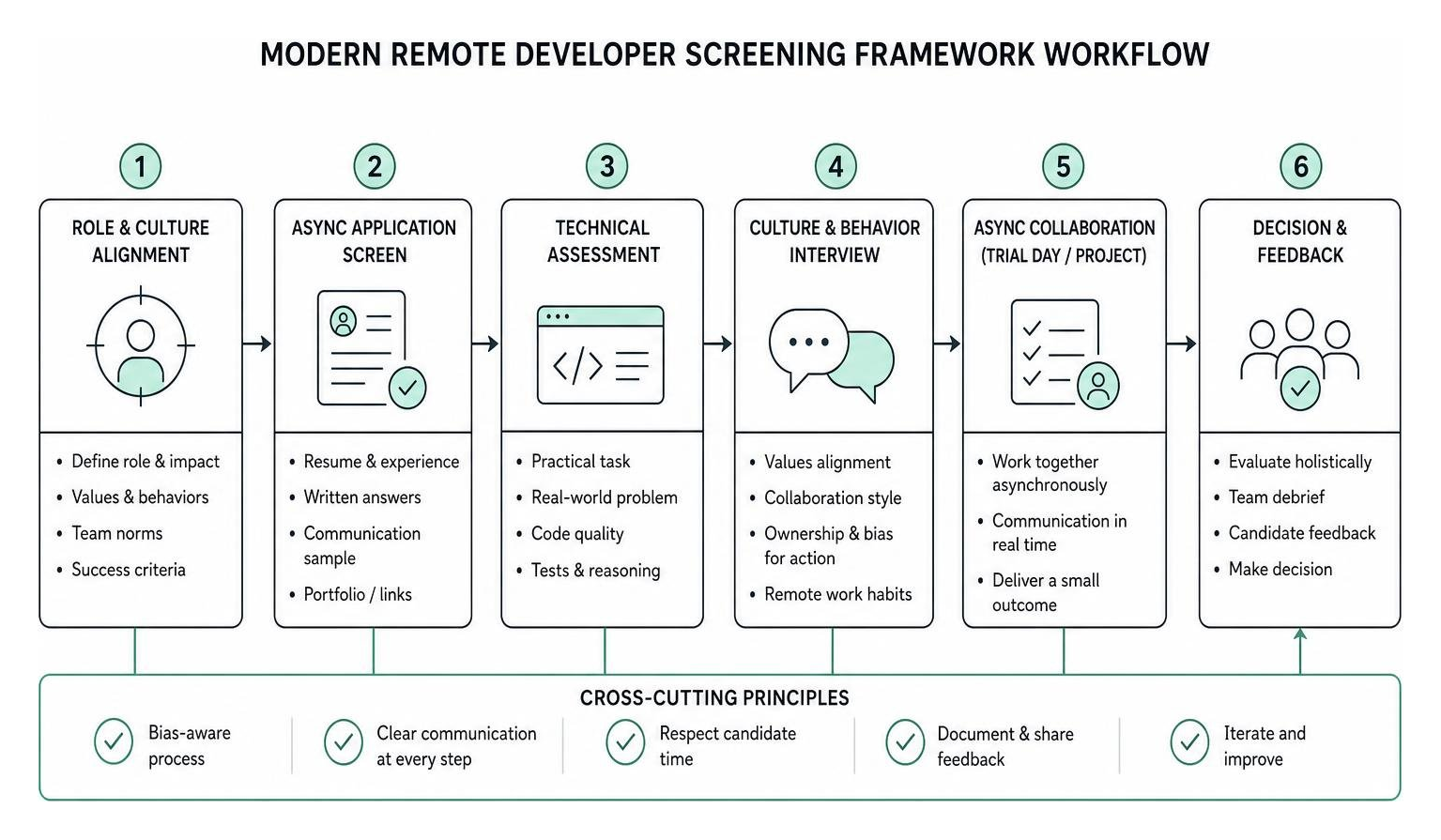
To find a true culture fit remote developer, you need a multi-layered screening framework that prioritizes behavioral alignment, async communication, and practical work scenarios.
Using structured resources like 59 Software Engineer Culture Fit Questions allows you to assess behavioral traits objectively. Furthermore, implementing a “trial day” or a small paid test project where the candidate collaborates asynchronously with your actual engineering team is the single best predictor of long-term retention.
How to Screen for a Culture Fit Remote Developer in the Age of AI
The rise of AI-assisted development tools (like Cursor, Claude, and Copilot) has fundamentally changed what we look for in software engineers. Because LLMs can generate boilerplate code instantly, deep memorization of syntax is no longer the golden ticket.
Instead, modern vetting must focus on:
- AI-Auditing and Code Comprehension: Can the developer review, critique, and secure AI-generated code? Do they understand high-level system architecture?
- Async Communication Tests: Ask candidates to record a short Loom video explaining their technical decisions or write a markdown document outlining their approach to a problem.
- Proactive Problem Solving: Evaluate how they unblock themselves when an API doesn’t work as expected.
To build a team that thrives under this model, check out the resources on Async First Remote Developer Jobs Benefits Communication Teamwork.
12 Essential Behavioral Questions for Engineering Candidates
To assess cultural alignment during live interviews, move away from hypothetical situations and ask for concrete, past examples. Here are twelve highly effective questions:
- Describe a time when you accidentally broke production or made a major technical mistake. How did you handle it, and what did you learn? (Screens for accountability and psychological safety).
- How do you handle a situation where you are completely blocked on a task and the person who has the answer is offline for the next 8 hours? (Screens for autonomy and resourcefulness).
- What are your thoughts on becoming friends with your co-workers in a remote setting? (Helps understand their social expectations; remember that 62% of employees with workplace friends are highly unlikely to leave).
- Tell me about a time you disagreed with a technical decision made by a team lead. How did you resolve it? (Screens for constructive conflict resolution).
- Describe your ideal remote workday. How do you structure your time for deep focus? (Screens for self-discipline and time management).
- Which management style brings out the best in you, and which stifles your productivity? (Ensures alignment with your leadership approach).
- Can you give an example of a decision you made that put the customer’s needs directly ahead of an elegant technical solution? (Screens for customer-first mindset).
- Share an example of how you dealt with an unexpected, last-minute deadline change. (Screens for adaptability and stress management).
- How do you manage documentation for your code so that other remote developers can build on it without calling you? (Screens for async documentation habits).
- What expectations do you have of your senior engineering leaders? (Reveals their alignment with your leadership culture).
- Why do you want to work for our company specifically, rather than just any remote dev shop? (Screens for genuine interest and mission alignment).
- Do you have any questions for us? (A complete lack of questions is often a red flag indicating low engagement).
Building and Maintaining a High-Performance Async Culture
True cultural alignment is a two-way street. Once you hire a culture fit remote developer, you must provide an environment where they can thrive. In a remote-first setup, this means building an async-first culture.
As outlined in How to Hire Remote Developers Who Fit Your Startup Culture | TheAmberPost , successful remote teams do not try to replicate the physical office online. Instead, they optimize for deep work by:
- Writing Things Down: Enforce a strict rule where key decisions, architectural plans, and meeting notes are documented in shared spaces (like Notion or GitHub) rather than lost in Slack threads.
- Establishing Overlap Windows: Define a 3-4 hour daily window where the team is online simultaneously for quick syncs, code reviews, and collaborative problem-solving.
- Creating Psychological Safety: Encourage team members to share mistakes early, ask “dumb” questions, and challenge ideas without fear of retribution.
By protecting your developers’ focus, you lay the foundation for a Deep Work Culture Developer Jobs Finding Focus Flow.
Overcoming Remote Work Fatigue and Isolation
Remote work offers unparalleled freedom, but it can also lead to isolation and burnout if left unmanaged. To maintain team health, remote-first companies must proactively support Remote Work Mental Health Developers.
Some of the best practices we’ve seen include:
- The Onboarding Buddy System: Assign every new hire a peer developer buddy (not an HR rep) to help them navigate the unwritten rules of the team during their first 30 days.
- Virtual Water Coolers: Set up optional, casual Slack channels (e.g.,
#music,#pets, or#vibe-coding) to let developers connect as human beings. - Regular Feedback Loops: Move away from annual reviews in favor of continuous, lightweight feedback to ensure remote developers always know where they stand.
The 2026 Shift: How AI and Vibe Coding Redefine Developer Fit
As we navigate 2026, the tech landscape has experienced a seismic shift. We have entered the era of vibe coding—where developers act more like software architects, orchestrators, and editors, using natural language to direct AI agents that write the bulk of the code.

This shift has redefined what it means to be a “high-performing developer.” Raw typing speed and framework syntax memorization are no longer competitive advantages. Instead, the ultimate differentiators are systems thinking, code comprehension, and cultural alignment.
The Rise of the AI-Augmented Specialist
With AI handling up to 90% of boilerplate code, smaller, highly aligned engineering squads are delivering the output that used to require massive development departments. Junior roles are evolving rapidly into AI-augmented specialist positions, where developers perform at a mid-to-senior level from day one by leveraging tools like Claude Code and Cursor.
In this environment, a developer’s ability to communicate, collaborate, and adapt is the single greatest predictor of their career trajectory. To understand how these changes are opening up new pathways, explore the future of Remote Work Career Growth.
Frequently Asked Questions about Remote Developer Culture Fit
What is the difference between culture fit and culture add in remote teams?
While “culture fit” focuses on aligning with a team’s core operational values (like async communication and ownership), overemphasizing it can accidentally lead to homogeneity, groupthink, and a lack of innovation.
“Culture add,” on the other hand, actively seeks out candidates who bring diverse perspectives, backgrounds, and cognitive approaches to your team while still sharing your core working principles. To find candidates who represent a true balance of both, check out Candidates – Chicagoland Professional Staffing and … .
How do you measure a remote developer’s async communication skills?
You can measure async communication skills during the hiring pipeline by:
- Observing the clarity, tone, and structure of their emails and written responses.
- Asking them to complete a short, written technical review or documentation exercise.
- Having them record a brief Loom video explaining a piece of code they wrote. If they can explain complex technical concepts simply and concisely, they will thrive in an async team.
What are the biggest red flags during a remote developer culture interview?
The most common red flags include:
- Blaming Others: Attributing past project failures or slipped deadlines entirely to “bad management” or “poor specs” without taking personal accountability.
- Timezone Rigidity: An unwillingness to adapt their working hours slightly to ensure a healthy daily collaboration window with the rest of the team.
- Poor Written Communication: Sending sloppy, unstructured, or vague written updates during the application process.
- Lack of Initiative: Showing no curiosity about your product, your customers, or your company’s mission.
Conclusion
At the end of the day, building a high-performing distributed engineering team isn’t about finding the cheapest hourly rate or the longest resume. It is a strategic advantage built on hiring developers who vibe with your team’s core values, respect your communication rhythms, and leverage modern AI tools to ship software at the speed of thought.
If you are a developer looking for an environment that values deep focus, async-first collaboration, and cutting-edge AI workflows, or if you are a team leader looking to hire talent that fits your rhythm, we are here to help.
Explore curated daily listings filtered by culture, tech stack, and modern AI tools like Cursor and Claude at RemoteVibeCodingJobs. Let’s build teams that click, not just code.