
The best remote companies to work for this year
Why Finding the Best Remote Companies Takes More Than a Google Search
The best remote companies aren’t just businesses that let you skip the commute. They’re organizations built from the ground up around distributed work — with async culture, transparent pay, and real career growth for people who never set foot in an office.
Here’s a quick look at the top fully remote companies worth shortlisting in 2026:
| Company | Employees | Open Roles | What Makes Them Stand Out |
|---|---|---|---|
| Deel | 8,800 | 236 | Global hiring infrastructure, fully remote at scale |
| GitLab | 2,500 | 210 | Zero offices since day one, public handbook |
| Zapier | 800 | 23 | Fully remote since 2012, low-meeting async culture |
| Automattic | 1,730+ | 17 | Distributed across 92 countries, remote-first DNA |
| Hugging Face | 600 | 9 | Distributed AI and open-source engineering teams |
| Oyster | 648+ | Open roles | 70 countries, 40 days PTO, people-first benefits |
| Remote | 90+ nationalities | Varies | Async-first, 6 continents, strong inclusion culture |
Across the top 20 fully remote companies ranked by REMOTE Score, there are currently 958 open positions — and over 11,800 remote job listings posted in the past month across all remote employers.
Finding these companies is one thing. Knowing whether they’re actually remote — or just remote-friendly on paper — is harder. A job posting that says “remote” can mean anything from “work anywhere, forever” to “remote until we open our next office.” The difference matters a lot, especially if you’re building an async-first career in AI-assisted development.
This guide cuts through the noise. It covers what separates truly distributed companies from remote-friendly ones, which employers consistently score highest on culture and retention, and how to evaluate a company before you apply.
We are RVCJ Editorial, the team behind Vibe Coding Jobs — we cover remote hiring trends, AI-assisted development, and async-first engineering culture, and have researched and curated best remote companies data across hundreds of distributed employers to help developers find the right fit faster.
Terms related to Best remote companies:
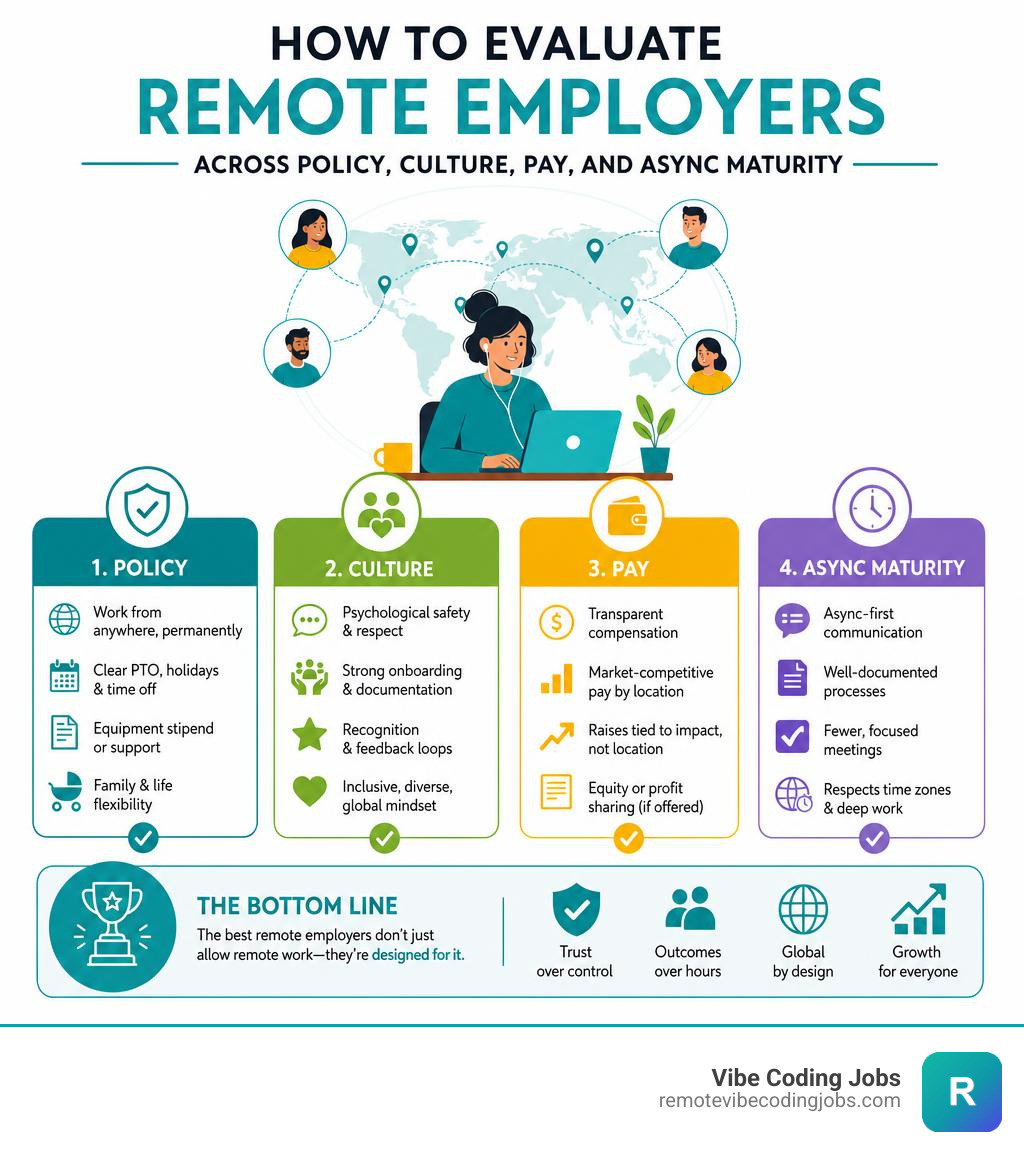
What makes the Best remote companies different from remote-friendly employers
A company can call itself remote and still run like everyone secretly lives within 30 minutes of headquarters. The Best remote companies make distributed work the default, not a perk that depends on your manager, department, or zip code.
Here is the simplest way to compare remote work models:
| Work model | What it usually means | What to check before applying |
|---|---|---|
| Fully remote | No office requirement; distributed work is the operating model | Are all roles remote? Are leaders remote too? |
| Remote-first | Remote is the default, though offices or coworking may exist | Are meetings, promotions, and documentation remote-first? |
| Remote-friendly | Some roles or teams can work remotely | Is remote access equal across departments? |
| Flexible hybrid | Employees split time between home and office | How many office days are required? |
| Structured hybrid | Fixed office days or location-based schedules | Is the role truly remote, or just partially flexible? |
Fully remote means distributed work is the operating model
Fully remote companies do not just tolerate remote work. They design around it.
That usually means:
- No mandatory office attendance
- Leaders and managers working remotely too
- Written documentation instead of hallway decisions
- Async updates as a default
- Global payroll, contractor, or employer-of-record support
- Clear location rules before offer stage
- Benefits that work outside one office city
- Promotion systems based on outcomes, not visibility
GitLab is one of the clearest examples: its careers page describes an all-remote company with zero offices and a strong handbook culture. You can explore its hiring approach on Join GitLab.
Remote is another example of a company built around distributed operations, with employees across 6 continents and more than 90 nationalities represented. Its careers page explains how it supports async work, flexible hours, learning budgets, mental health support, and global belonging. See Remote Careers | Remote .
Remote-friendly and hybrid companies can still be good—but read the fine print
Remote-friendly does not automatically mean bad. Some hybrid companies have excellent remote roles, strong managers, and generous benefits. The catch is consistency.
A remote-friendly company may still have:
- Office hubs where major decisions happen
- Certain teams that are remote while others are in-office
- Location restrictions for tax, compliance, or customer coverage
- Meeting schedules built around headquarters time
- Promotions that favor people who show up in person
- Remote approval that depends on a specific manager
For candidates, the question is not “Does the company offer remote work?” It is “Does the company operate in a way that makes remote employees equally successful?”
Red flags that a “remote” job is not truly remote
A remote job posting deserves a second look if you see phrases like:
- “Remote for now”
- “Must be near our office”
- “Occasional office visits required” without details
- “Hybrid remote”
- “Remote at manager discretion”
- “Must work headquarters hours” with no flexibility
- “Open to remote for exceptional candidates”
- No written remote policy
- No remote onboarding plan
- No clarity on home office support or benefits
If the company cannot explain how remote employees onboard, collaborate, get promoted, and access leadership, treat that as a yellow flag. If they dodge the question entirely, upgrade it to red. Maybe even crimson. Very dramatic, but useful.
Best remote companies to shortlist in 2026

The strongest remote employers tend to perform well across six practical areas: retention, engagement, morale, onboarding, technology, and equity. Some ranking systems call this a REMOTE Score, but the underlying idea is simple: the best remote workplaces are not just flexible; they are durable.
Deel: global hiring infrastructure at fully remote scale
Deel is one of the largest fully remote companies to watch in 2026, with about 8,800 employees and 236 open roles in the research set. Its business focuses on global hiring, payroll, compliance, and distributed workforce operations, which means remote work is not just an internal policy; it is central to the product category.
Candidate signals to look for:
- Clear location and compliance requirements
- International team structure
- Remote-first collaboration norms
- Defined compensation approach
- Mature onboarding for distributed employees
For people interested in global payroll and international hiring infrastructure, Deel is a strong shortlist candidate.
GitLab: handbook-first all-remote culture
GitLab is one of the most referenced all-remote companies because it has operated without physical offices since the beginning. The company has around 2,500 employees in the research set, with 210 open roles, and its public handbook is a major signal of remote maturity.
GitLab stands out for:
- Zero-office operating model
- Documentation-first collaboration
- Async work norms
- Transparent company values
- DevSecOps and AI-powered product focus
- Clear guidance around AI use in interviews
If you want to understand what mature remote operations look like, browsing Join GitLab is worth your time even before you apply.
Zapier: long-running async remote operations
Zapier has been fully remote since 2012, which is basically ancient history in remote-work years. Dog years? Startup years? Either way, it has been at this for a long time.
With about 800 employees and 23 open roles in the research set, Zapier is known for automation, async rituals, documentation, and flexible schedules. Its model is especially relevant for candidates who want autonomy without losing structure.
Strong signals include:
- Low-meeting culture
- Written updates
- Clear ownership
- Distributed team practices
- Automation-heavy workflows
Oyster: work-from-anywhere with people-first benefits
Oyster is a distributed HR technology company founded in 2020, with 648+ employees and representation across 70 countries in the research. Its careers page highlights work-from-anywhere flexibility and a benefits package that includes 40 days PTO inclusive of regional holidays, mental health support, a wellbeing allowance, flexible parental leave, and a $1,500 equipment stipend.
Explore its careers page here: Careers at Oyster® | Mission-driven, Work From Anywhere Jobs .
Oyster is especially interesting for candidates who care about:
- Global employment access
- People-first remote operations
- Wellbeing support
- Generous time off
- Mission-driven work
Automattic: one of the original large-scale distributed teams
Automattic, the company behind WordPress.com, WooCommerce, Tumblr, Jetpack, and other products, has long been one of the best-known distributed companies. Research data shows 1,730+ Automatticians across 92 countries, with 116 languages represented.
You can view the company profile here: Automattic .
Automattic stands out because it has operated with distributed DNA for years, not as a reaction to a temporary trend. For candidates, that usually means more mature written communication habits, global collaboration patterns, and remote-first product workflows.
Hugging Face: distributed AI and open-source collaboration
Hugging Face is a major AI and machine learning company with about 600 employees and 9 open roles in the research set. Its platform hosts more than one million machine learning models used by thousands of organizations, making it one of the most important AI infrastructure companies in the remote hiring conversation.
Why it belongs on the shortlist:
- AI and machine learning focus
- Open-source collaboration culture
- Distributed research and engineering work
- Global community involvement
- High-growth technical environment
For AI developers, ML engineers, and product-minded builders, companies like Hugging Face show where remote work and AI-native collaboration are converging.
Jellyvision and other remote-friendly tech employers to watch
Not every strong employer is fully remote. Some remote-friendly companies still offer excellent roles, especially for product, engineering, data, design, and customer-facing teams.
When we evaluate remote-friendly employers, we look for:
- Clear remote eligibility by role
- Benefits that apply to remote employees
- Remote interview process
- Transparent team expectations
- Documentation and async practices
- Reasonable time zone overlap
- Evidence that remote employees can grow
You can Explore Jellyvision remote opportunities to compare available roles and decide whether the company’s remote setup fits your work style.
How the Best remote companies maintain high employee engagement
High engagement in remote teams does not happen because everyone bought a nice webcam. Though, to be fair, that helps.
The best remote companies usually invest in:
- Clear onboarding and role expectations
- Manager training for distributed leadership
- Async documentation
- Transparent compensation philosophy
- Written promotion criteria
- Mental health and wellness support
- Inclusion across time zones and cultures
- Belonging rituals that do not require an office
- Tools that reduce meeting overload
Remote, for example, emphasizes async work, flexible hours, mental health support, learning budgets, and global belonging across a team spanning more than 90 nationalities. You can learn more from Remote Careers | Remote .
How top remote employers structure pay, benefits, and career growth

The Best remote companies know compensation and career growth need extra clarity when employees are distributed. If pay bands, promotion paths, and benefits are vague, remote workers are left guessing. Guessing is bad for careers and excellent for anxiety. We prefer fewer mysteries.
Compensation: global rates vs location-based salaries
Remote companies usually use one of two compensation models:
| Compensation model | How it works | Candidate impact |
|---|---|---|
| Global rate | Same salary band regardless of location | Easier to understand; often attractive to lower-cost regions |
| Location-based pay | Salary adjusted by country, region, or labor market | More common at scale; can vary widely by location |
Some companies publish salary ranges. Others share ranges during interviews. Some adjust by cost of labor, not cost of living. Others use regional bands or country-specific structures.
Ask:
- Is the role paid on a global band or location-based band?
- Are salary ranges shared before final interviews?
- Does compensation include equity?
- How are raises handled after relocation?
- Are contractors eligible for conversion to full-time roles?
- What payroll or compliance setup is used for my country or state?
Global employment platforms such as Remote — Global Employment Infrastructure | EOR, Payroll & Compliance, Worldwide have grown because hiring internationally involves contracts, taxes, payroll, benefits, and compliance that vary by country.
Benefits and perks remote employees should compare
Top remote companies commonly offer some combination of:
- Flexible or unlimited PTO
- Generous paid parental leave
- Health insurance or regional health benefits
- Mental health support
- Home office stipend
- Laptop and equipment budget
- Coworking stipend
- Wellness allowance
- Learning and development budget
- Stock options or equity
- Sabbaticals
- Company offsites
- Async-friendly flexible schedules
Oyster’s research profile, for example, includes 40 days PTO, mental health support, wellbeing allowance, flexible parental leave, and equipment support. Remote’s careers page highlights flexible PTO, stock options, parental leave, learning budget, and mental health support.
Benefits are not just “nice extras.” In remote work, they determine whether you can build a sustainable setup: good chair, good internet, good boundaries, fewer back problems. Glamorous? No. Important? Extremely.
Career growth without an office
Career growth in remote companies works best when expectations are written down.
Look for:
- 30-60-90 day onboarding plans
- Role scorecards
- Skills matrices
- Promotion rubrics
- Regular manager one-on-ones
- Async feedback channels
- Internal mobility paths
- Mentorship programs
- Clear leadership tracks
- Learning budgets
- Documented performance review cycles
If you are building an AI-assisted development career, compare employers based on both remote culture and technical growth. Our guide to Remote AI developer career paths explains how AI developers can grow across product engineering, platform, automation, and AI systems roles.
You can also compare remote AI employer types in:
- Best Companies Hiring AI Developers Remote Startup Big Tech
- Best Companies Hiring AI Developers Top Employers Innovative
- Companies Hiring AI Developers Vibe Coders
Where fully remote hiring is growing across industries and U.S. cities
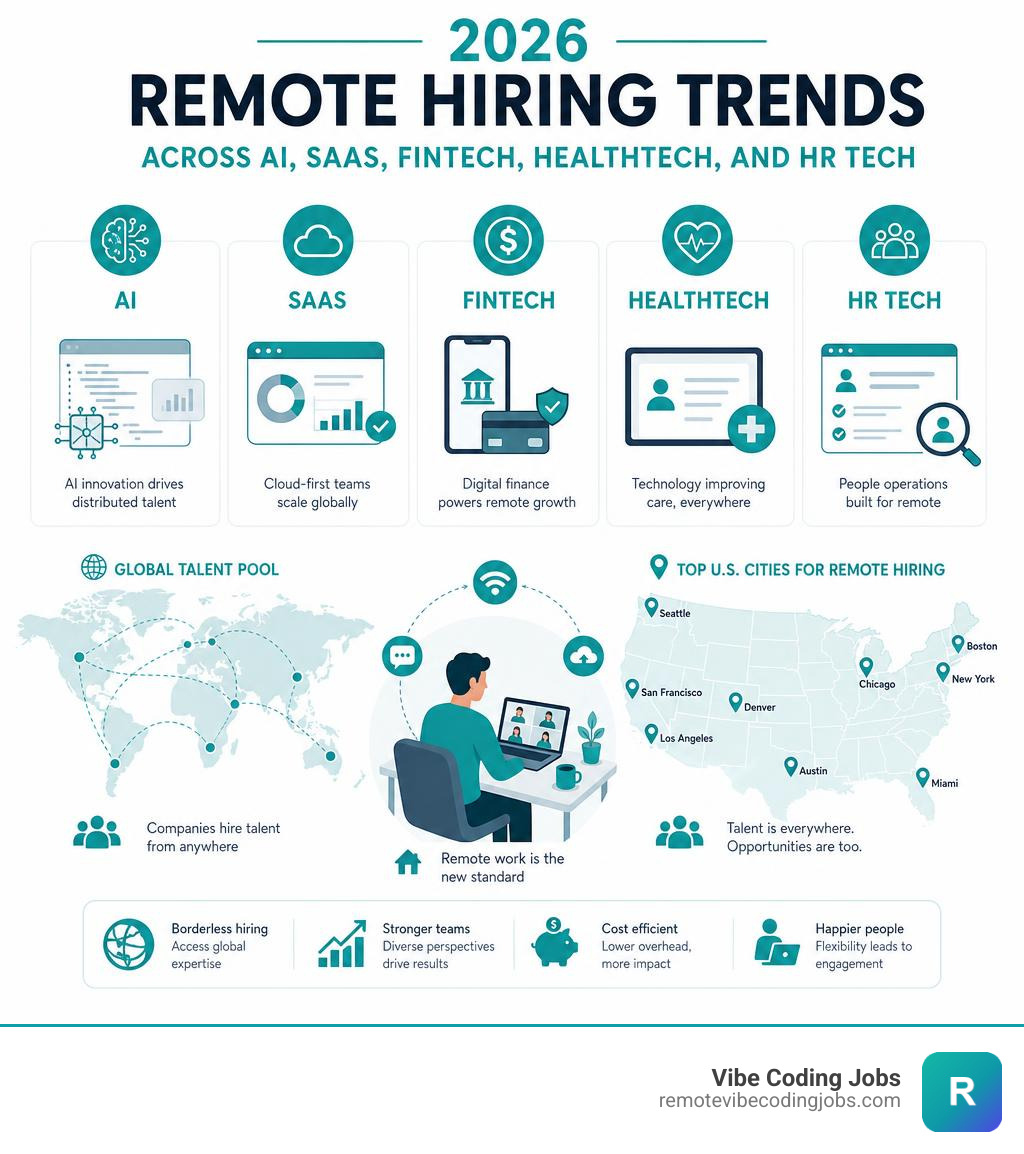
Remote hiring in 2026 is strongest in knowledge-work sectors where teams already rely on cloud tools, written workflows, and measurable outputs.
Industries leading remote hiring in 2026
The biggest remote hiring categories include:
- AI and machine learning
- SaaS
- DevOps and developer tools
- Cybersecurity
- Fintech
- Digital health and healthtech
- HR technology
- Education technology
- Open-source software
- Product design
- Customer success
- Data and analytics
- Creator tools
- Automation platforms
AI companies are especially remote-compatible because much of the work happens in code repositories, notebooks, model evaluation tools, documentation, and async review cycles. That does not make collaboration easy, but it makes distributed collaboration realistic.
Major U.S. cities with strong remote hiring pipelines
Even fully remote companies often use city-based filters because of tax, payroll, compliance, compensation bands, or talent density. Large U.S. hubs with strong remote hiring pipelines include:
- NYC
- Boston
- Chicago
- Seattle
- Austin
- San Francisco
The key point: city filters do not always mean office requirements. Sometimes they reflect legal, payroll, or customer coverage needs. But always confirm before applying.
AI and automation are changing remote job descriptions
Remote job descriptions in 2026 increasingly mention:
- AI agents
- Cursor
- Claude
- GitHub Copilot
- Prompt engineering
- Verification loops
- Automated testing
- Code review with AI assistance
- Product engineering
- Autonomous workflows
Some engineering roles now ask leaders to redesign workflows around AI agents, build reusable automation patterns, or manage teams where AI tools are part of daily development. This is especially relevant for vibe coders and AI-first developers.
If this is your lane, start with our guide to Companies hiring AI developers remotely.
You may also like:
How remote-first companies onboard, collaborate, and measure performance
Remote-first companies are intentional because they have to be. In an office, weak systems can hide behind spontaneous conversations. In remote work, weak systems show up fast.
Onboarding without a physical office
Strong remote onboarding usually includes:
- Preboarding before day one
- Equipment shipping or stipends
- Access to tools before start date
- A buddy or onboarding partner
- 30-60-90 day plan
- Recorded product walkthroughs
- Handbook-first learning
- Async introductions
- Manager check-ins
- Role scorecards
- Clear first-week expectations
The goal is to prevent the classic remote onboarding experience: sitting alone at a laptop wondering if everyone forgot you exist. Good companies do not let that happen.
Collaboration across time zones
Healthy remote collaboration relies on norms, not vibes alone. Common practices include:
- Core overlap hours
- Async standups
- Written project updates
- Decision logs
- Meeting recordings
- Shared docs
- Slack or Teams etiquette
- Clear response-time expectations
- Low-meeting defaults
- Rotating meeting times for global teams
GitLab’s handbook-first approach is a well-known example of documentation-heavy remote collaboration. Remote also emphasizes async work across a global team.
Performance management in distributed teams
The best remote companies measure outcomes, not keyboard theater.
Look for performance systems based on:
- OKRs or written goals
- Clear ownership areas
- Delivery quality
- Customer or product impact
- Peer feedback
- Manager calibration
- Quarterly or semiannual reviews
- Promotion criteria
- Written evidence of impact
Be cautious of companies that rely on surveillance software, always-on status indicators, or meeting attendance as proof of productivity. Remote work runs on trust plus accountability, not digital babysitting.
Equity and inclusion for global teams
Remote equity means employees have fair access to information, opportunity, and recognition no matter where they live.
Strong practices include:
- Meeting rotation across time zones
- Async-first decision-making
- Accessibility support
- Inclusive holiday policies
- Language-aware communication
- Compensation clarity
- Employee resource groups
- Psychological safety
- Written promotion criteria
- Public documentation
- Remote-first leadership access
Remote’s team spans more than 90 nationalities and more than 50 languages, according to its careers page. That kind of scale requires intentional inclusion, not just a nice “we are global” slide in onboarding.
How to evaluate a remote company before applying
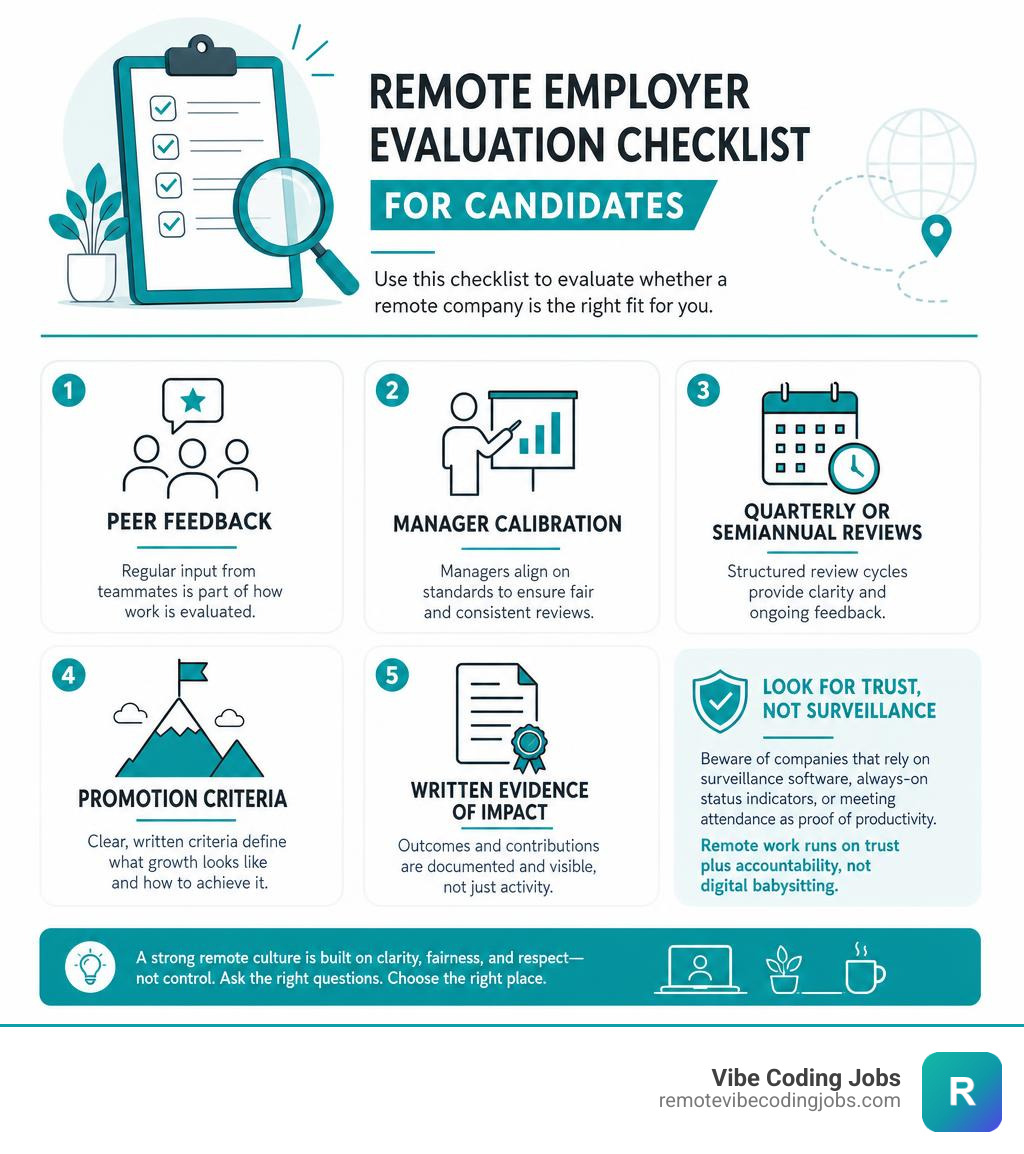
Before you apply, do a quick remote-culture audit. It can save you from joining a company that says “remote” but means “please be online from 7 a.m. to 9 p.m. and smile.”
Questions to ask during the interview process
Ask direct questions like:
- Is this role fully remote, remote-first, remote-friendly, or hybrid?
- Are there any office attendance requirements?
- Are there location or time zone restrictions?
- What hours of overlap are expected?
- How are meetings documented?
- How are decisions made asynchronously?
- What does onboarding look like?
- How are promotions handled for remote employees?
- Are compensation bands global or location-based?
- What benefits apply to remote employees?
- How does the team handle performance reviews?
- What tools does the team use for async collaboration?
- Are leaders distributed too?
A strong company will answer clearly. A weak one will get vague. A very weak one will say, “We are like a family.” Run carefully. Families do not usually have Jira tickets.
Signals of a healthy remote culture
Positive signs include:
- Clear remote policy
- Public or detailed internal handbook
- Transparent hiring process
- Written role expectations
- Remote onboarding plan
- Async documentation
- Manager training
- Fair meeting norms
- Written promotion criteria
- Strong internal mobility
- Benefits designed for distributed employees
- Clear compensation philosophy
- Leaders who model remote work
You can also review employer career pages directly, such as Remote Careers | Remote , Careers at Oyster® | Mission-driven, Work From Anywhere Jobs , and Join GitLab. Always verify each role’s location, payroll, and time zone requirements on the employer’s own careers page before applying.
How Vibe Coding Jobs helps candidates compare remote employers
At Vibe Coding Jobs, we help candidates find remote AI-assisted development roles faster by curating listings around culture, tech stack, and AI tools like Cursor and Claude.
We focus on roles where candidates can compare:
- Remote policy
- Async maturity
- Engineering culture
- AI tool expectations
- Tech stack
- Company type
- Application speed
- Role fit
If you are exploring AI-first development roles, start with Companies hiring vibe coders. You can also review Companies Hiring AI Developers Vibe Coders for more employer research.
Frequently Asked Questions about Best remote companies
What criteria define the Best remote companies in 2026?
The Best remote companies in 2026 usually have:
- Fully remote or remote-first policies
- Strong employee retention
- High engagement and morale
- Clear onboarding
- Mature async documentation
- Good collaboration tools
- Transparent compensation philosophy
- Benefits for distributed workers
- Written career ladders
- Inclusive practices across time zones
- Managers trained for remote leadership
The most important distinction is whether remote work is the operating model or just an employee perk.
Do the Best remote companies pay less than office-based companies?
Not necessarily. The evidence is mixed and depends on the company, role, location, and compensation philosophy.
Some remote companies pay global rates. Others use location-based salary bands. Some offer equity, learning budgets, home office stipends, and strong benefits that increase the total value of the offer.
Before accepting, compare:
- Base salary
- Equity
- Bonus eligibility
- Healthcare or regional benefits
- PTO
- Equipment support
- Coworking stipend
- Retirement benefits
- Learning budget
- Promotion cycle
A lower salary with strong benefits may still be competitive. A high salary with no support, no growth path, and 11 p.m. meetings may not be the dream.
Are fully remote companies better than hybrid companies?
Fully remote companies are often better for candidates who want consistency, location independence, async collaboration, and equal access to leadership without office politics.
Hybrid companies can still be excellent if they have:
- Clear remote rules
- Equal promotion access
- Strong documentation
- Remote-friendly managers
- Fair meeting practices
- Benefits for remote employees
The risk with hybrid is proximity bias. If leadership and key decision-makers are in the office, remote employees may miss informal context. Always ask how the company prevents that.
What resources help job seekers find strong remote employers?
Useful resources include:
- Vibe Coding Jobs company pages and curated remote AI listings
- Employer career pages
- Public company handbooks
- Remote culture pages
- Benefits pages
- Interview guides
- AI developer employer research
Start with curated Vibe Coding Jobs research when you want speed, then verify details on the employer’s own careers page before applying.
Conclusion
The Best remote companies in 2026 are not defined by a single perk or a trendy job posting label. They are defined by how they operate: async-first systems, clear documentation, fair compensation, strong onboarding, inclusive time zone practices, and real career growth for distributed employees.
Before you apply, compare the remote policy, benefits, compensation model, onboarding process, and promotion path. Look for companies where remote work is built into the culture, not bolted on as a temporary perk.
If you are building a remote career in AI-assisted development, we can help you shortlist faster. Use Vibe Coding Jobs to find remote-first developer and AI roles filtered by culture, tech stack, and tools like Cursor and Claude.
And if Jellyvision is on your shortlist, you can Explore Jellyvision remote opportunities.