Navigating the World of Interactive Media and Full Stack Careers
What Interactive Media Developer Jobs Actually Are (And Why They Matter in 2026)
Interactive media developer jobs sit at the crossroads of coding, design, and storytelling — and they’re one of the fastest-growing categories in tech hiring right now.
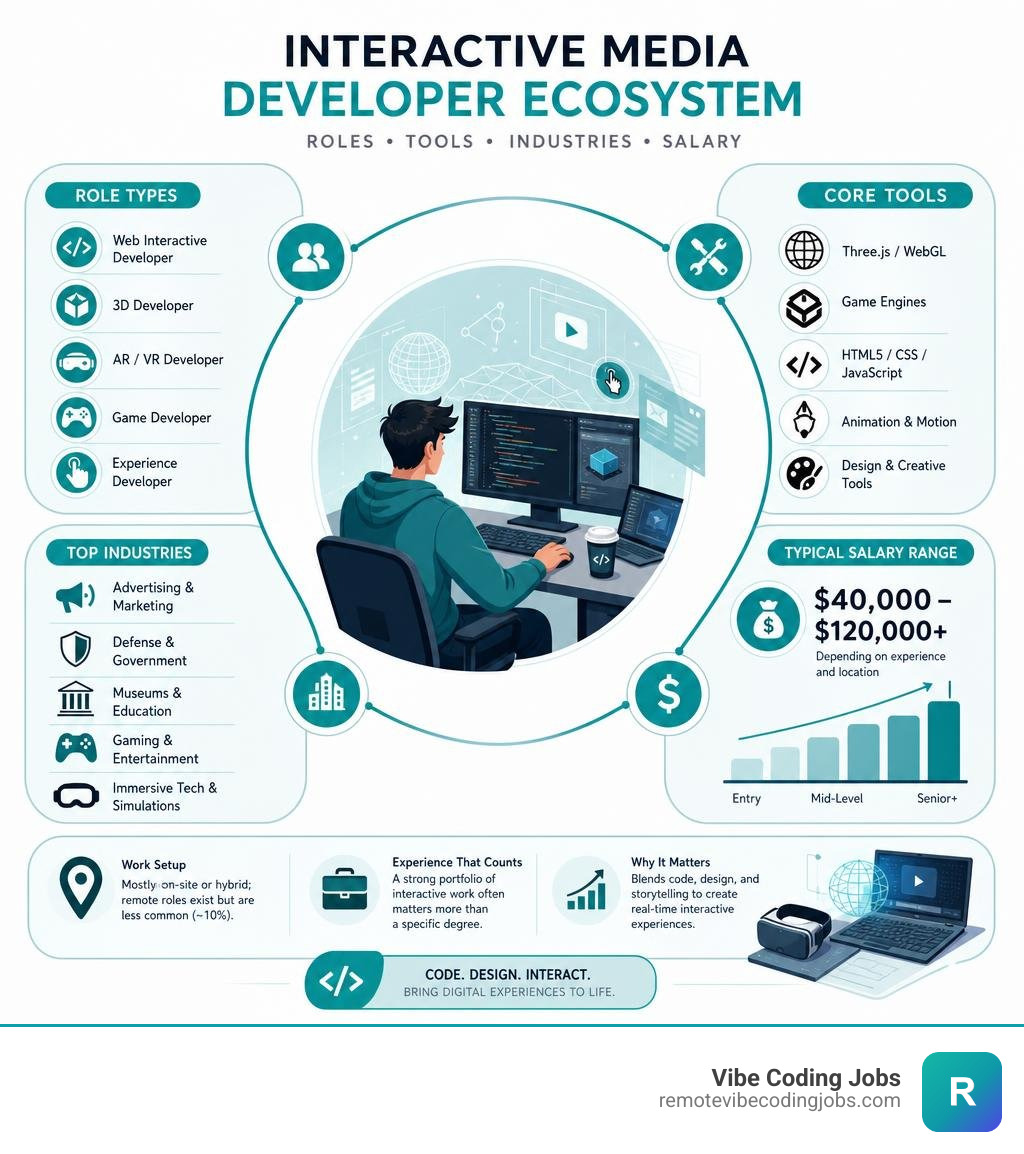
Here’s a quick snapshot of what these roles involve:
| Feature | Details |
|---|---|
| What they do | Build interactive digital experiences — 3D web apps, AR/VR, playable ads, museum exhibits, training simulations |
| Core tools | Three.js, WebGL, Unity, GSAP, Adobe Creative Suite, HTML5/CSS/JavaScript |
| Who hires them | Ad agencies, defense contractors, museums, gaming companies, entertainment brands |
| Typical salary | $40,000–$120,000+ depending on experience and location |
| Work setup | Mostly on-site or hybrid; remote roles exist but are less common (~10%) |
| Experience needed | Portfolio of interactive work often matters more than a specific degree |
Unlike a traditional web developer who focuses on functionality, or a graphic designer who focuses on visuals, an interactive media developer does both — and adds a layer of real-time interactivity that makes digital experiences feel alive.
The field spans a surprisingly wide range of industries. One job posting might ask you to build immersive museum exhibits with touchscreens and AR. Another wants playable ads for mobile games using Phaser.js. A third — from a defense contractor like Lockheed Martin — needs eLearning simulations with Unity and a security clearance.
That variety is part of what makes this career path exciting. It’s also what makes navigating it feel overwhelming at first.
As the Berklee career resource puts it, “because this is an emerging field, and because they do so many different things for so many different employers, it’s difficult to sum up what interactive media specialists do for a living.”
That’s exactly what this guide is here to fix.
I’m RVCJ Editorial, the team behind Remote Vibe Coding Jobs — we cover AI-assisted development, remote hiring trends, and career guidance for developers navigating interactive media developer jobs and beyond, with a focus on modern workflows and async-first roles. Whether you’re eyeing a Three.js contract or a full-time AR role, the sections below break down everything you need to know to find and land the right opportunity.
Key Interactive media developer jobs vocabulary:
Defining the Interactive Media Developer Role
To understand where you fit in the digital landscape, it helps to look at how different roles collaborate. Interactive media development is not just about writing code that works; it is about building software that users can feel, play with, and experience.
The table below breaks down how these creative and technical roles differ:
| Role | Primary Focus | Core Deliverables | Typical Toolset |
|---|---|---|---|
| Interactive Media Developer | Real-time user interaction, motion, and sensory engagement | 3D web experiences, playable ads, simulation modules, AR filters | Three.js, Unity, GSAP, Blender, WebGL, JavaScript |
| Traditional Web Developer | Functional, structured web layouts and data flows | E-commerce platforms, SaaS dashboards, structural databases | React, Next.js, Node.js, SQL, Tailwind CSS |
| Graphic Designer | Visual communication, branding, and static layouts | Brand guidelines, marketing assets, vector illustrations, UI mockups | Figma, Adobe Photoshop, Illustrator, InDesign |
At its heart, this role is about transforming passive viewers into active participants. Whether a user is rotating a 3D product model on an e-commerce site or triggering physics-based animations by scrolling, the interactive media developer is the architect behind those micro-interactions. If you want to see what a professional journey in this field looks like, check out this guide on What is a Career in Interactive Media? to see how specialists bring these environments to life.
What is an Interactive Media Specialist?
An interactive media specialist is a creative technologist who focuses on audience engagement across digital media. They are the bridge between raw creative assets and functional, immersive experiences.
In practice, these specialists take static design concepts and elevate them using motion design, audio integration, and custom interaction logic. You will find them working on virtual classroom interfaces, site-specific augmented reality installations, and interactive kiosks. For a real-time pulse on who is hiring for these specialized, immersive roles, you can explore the Jobs – Interactive & Immersive Jobs board to view the latest industry listings.
Interactive Media Developer vs. Traditional Web Developer
While a traditional web developer focuses on structural front-end layouts and robust back-end data pipelines, an interactive media developer focuses heavily on the presentation and experiential layers.
Traditional web development prioritizes speed, accessibility, and clean data transactions. Interactive media development, on the other hand, is about managing rendering performance, choreographing complex animations, and handling real-time inputs.
Understanding this distinction is vital as you plan your career. If you are deciding which path aligns with your long-term goals, reviewing a Remote Developer Career Path Junior to Senior Guide 2026 can help you map out your trajectory. Additionally, keeping an eye on Remote Developer Skills in Demand 2026 Future Proof Your Career ensures that you are building a skill set that remains highly valuable as the line between traditional web apps and spatial computing continues to blur.
Key Skills and Technologies for Interactive Media Developer Jobs
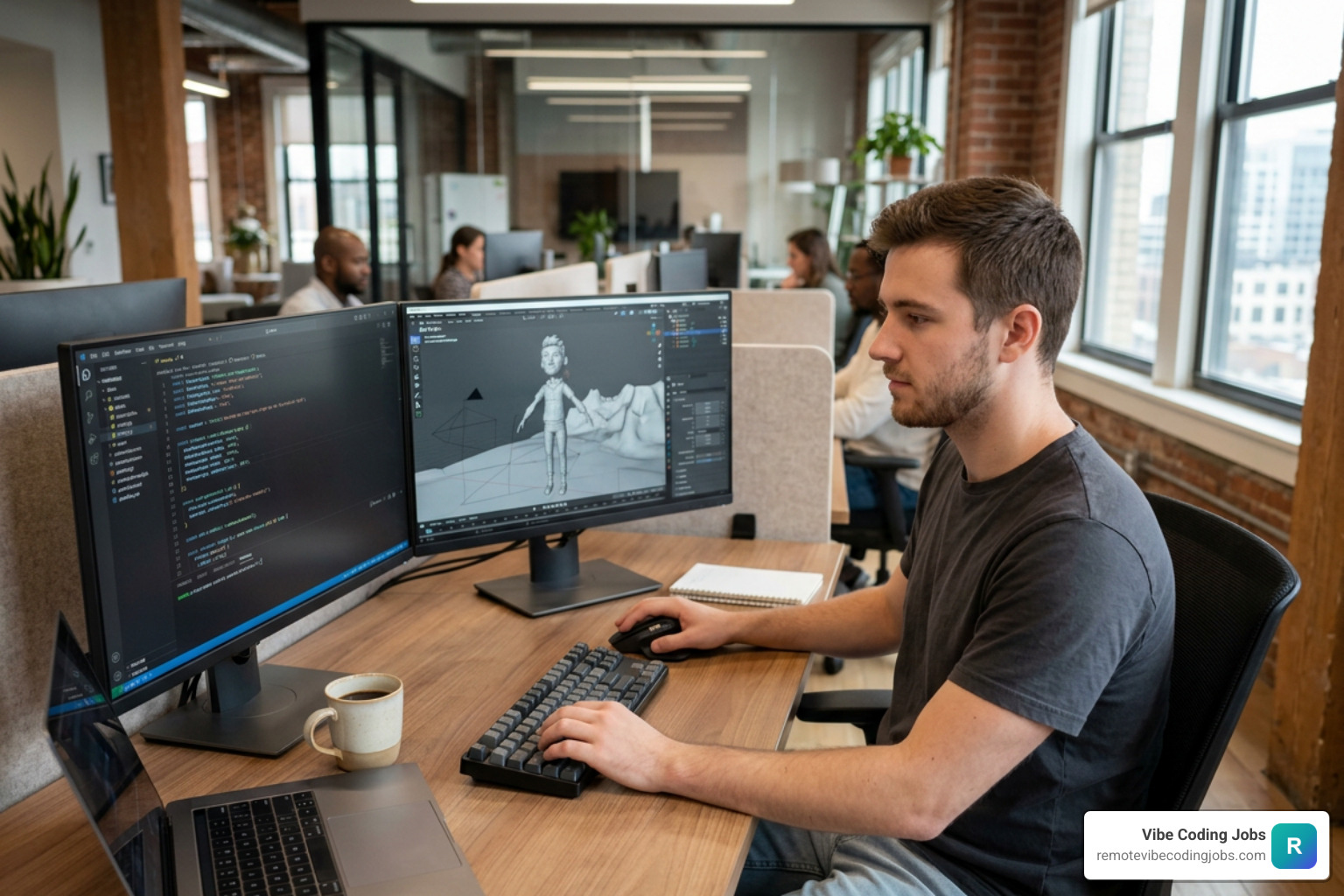
Breaking into interactive media developer jobs requires a unique blend of visual design literacy and rigorous technical engineering. You aren’t just writing logic; you are managing asset pipelines, adjusting virtual lighting, and profiling frame rates to ensure smooth rendering.
For instance, a typical project might require you to take a high-polygon 3D model from a designer, optimize it using Blender to reduce the file size, and load it into a browser using WebGL. From there, you will write custom shaders and use animation libraries like GSAP to make the asset respond to user scrolls or mouse movements. To see how companies structure these requirements in the real world, take a look at the job description for a Creative Developer (Real-Time 3D & Interactive) – Eskimi, which highlights the balance of WebGL development and performance optimization.
Essential Tech for Interactive Media Developer Jobs
If you are looking to secure a role in today’s market, your tech stack needs to be modern and highly performant. The most competitive candidates generally master:
- Three.js & React Three Fiber: The undisputed standards for bringing real-time 3D graphics to the web browser.
- Next.js & React: Modern front-end frameworks that help you structure your interactive applications and handle state efficiently.
- GSAP (GreenSock Animation Platform): The industry standard for high-performance, scroll-triggered web animations.
- Blender: Essential for editing, compressing, and exporting GLB/glTF 3D assets.
For a practical look at how these tools come together in professional contracts, you can review the specifications for an Interactive creative developer (three.js / react three fiber) – Lincoln – Job May 2026 – Jobijoba listing. If you want to focus your efforts specifically on the React ecosystem, exploring Remote React Developer Jobs 2026 Trends Opportunities will give you a clear picture of how React-based interactive roles are evolving.
How AI and Real-Time 3D Shape Interactive Media Developer Jobs
The integration of artificial intelligence is fundamentally changing how we write code and build assets. In 2026, the rise of “vibe coding” — using AI-assisted development tools like Cursor, Claude, v0, and Replit — allows developers to act as creative orchestrators.
Instead of spending hours writing boilerplate code or debugging web GL rendering configurations from scratch, interactive developers can prompt LLMs to scaffold complex scene setups, write custom GLSL shaders, or optimize assets. This shift means that having strong aesthetic taste, creative direction, and system judgment is becoming far more critical than manual syntax memorization.
To stay ahead of these workflow shifts, check out our guide on Remote Developer Jobs AI Tools to learn how to integrate these assistants into your daily routine. You can also review the Remote Developer Tools Stack 2026 to make sure your personal workflow is optimized for speed and creative output.
Career Paths, Salaries, and the 2026 Job Market

The job market for interactive media developers is diverse, offering opportunities across several major industries. To understand the current landscape, let’s look at some real-world data.
For example, a close analysis of current job listings in a major regional tech hub like the Atlanta Metropolitan Area reveals some interesting structural trends:
- There are 58 active Interactive Media Designer and Developer roles listed.
- 74% (43 of 58) are structured as full-time employment.
- 45% (26 of 58) target Mid-Senior level talent, showing that companies are highly eager to find developers who can work independently.
- 69% (40 of 58) are on-site positions, 21% (12) are hybrid, and 10% (6) are fully remote.
While many corporate positions prefer an on-site presence due to hardware testing requirements (such as AR headsets or physical interactive kiosks), there is still a robust market for remote work, especially in digital advertising and web-focused creative agencies. To search for active listings across the country, you can browse through 1000+ Interactive Media jobs in United States to see which companies are actively building out their creative engineering teams.
Salary Benchmarks and Career Progression
Compensation in this field varies based on your specialized technical skills, your portfolio, and your chosen industry.
- Junior Roles: Typically start around $40,000 to $60,000, focusing on asset preparation, basic front-end implementation, and banner production.
- Mid-to-Senior Roles: Range from $75,000 to $120,000+. For instance, interactive producers at specialized design firms like Cortina Productions see salaries ranging from $75,000 to $100,000.
- Specialized Contract Work: Highly skilled freelance creative developers can command premium rates. For example, contract roles in the UK can offer up to £600/day inside IR35 for experienced Three.js developers.
To gain a broader understanding of compensation trends, you can read our Remote Developer Salary Guide 2026. If you are preparing for an upcoming interview or job offer, reviewing Remote Developer Salaries in 2026 What to Expect will help you benchmark your expectations and negotiate confidently.
Freelance Contracts vs. Full-Time Remote Roles
Deciding between a stable full-time position and the flexibility of contract work is a key step in your career journey. Full-time roles offer steady income, benefits, and the chance to see long-term projects evolve. Freelance contracts, on the other hand, allow you to jump from project to project, building a highly diverse portfolio and testing different creative tech stacks.
As you navigate these choices, it is helpful to look at how different work environments impact your day-to-day productivity and long-term growth. Our analysis of Remote Work vs Office Developers breaks down the cultural and practical differences between these paths. Additionally, if you are wondering how working from home affects your promotion schedule, our guide on Remote Work Career Growth offers actionable strategies for staying visible and advancing your career in an async-first world.
Frequently Asked Questions about Interactive Media Developer Jobs
What educational background or portfolio do I need for interactive media developer jobs?
While some enterprise or defense roles — such as an Interactive Media Developer | Lockheed Martin — require a Bachelor’s degree and the ability to obtain security clearance, the vast majority of creative agencies and tech startups care far more about your practical portfolio.
An outstanding interactive portfolio that showcases smooth rendering, creative interaction design, and solid performance optimization is your best asset. If you are looking to land a role without relying on traditional academic credentials or passing stressful, abstract algorithms tests, read our guide on Remote Coding Jobs No Leetcode Practical Portfolio to learn how to build case studies that instantly earn the trust of hiring managers.
What industries are actively hiring interactive media developers?
Interactive developers are needed anywhere that digital audience engagement is a priority. The primary hiring sectors include:
- Museums and Exhibitions: Building immersive, touchscreen-based, and gesture-controlled physical installations.
- Advertising and Marketing: Creating high-impact rich media banner campaigns, brand landing pages, and interactive playable ads. For example, gaming and growth marketing brands rely on specialists like a Playable Ad Developer | Joblume to build lightweight, high-performance HTML5 mini-games that run seamlessly on mobile ad networks.
- Defense and Aerospace: Creating high-fidelity training simulations, interactive manual interfaces, and virtual learning modules.
- Consumer Brands: Developing custom web-based product configurators and virtual try-on experiences. You can find these opportunities on major job boards, such as the Creative Interactive Developer at jobs via dice | JobSearcher platform.
How do interactive media developers contribute to user experience?
Interactive media developers elevate standard UX by making digital interfaces feel more natural and responsive. They write the interaction logic that governs how elements bounce, slide, and transition.
By conducting performance profiling and user testing, they ensure that resource-heavy 3D assets load quickly and run at a stable 60 frames per second, even on lower-end mobile devices. They transform a static, functional layout into an engaging digital journey. If you want to see how modern development teams leverage AI to speed up these UX iterations and maximize project ROI, check out our insights on Remote Developer Jobs AI Tools Benefits.
Conclusion
The world of interactive media development is , highly creative, and constantly evolving. As 3D web technologies mature and AI-assisted “vibe coding” workflows make building software more accessible, the developers who combine solid technical foundations with strong creative judgment will find themselves in high demand.
At Vibe Coding Jobs, we are dedicated to helping you navigate this landscape by curating high-quality, modern roles at forward-thinking companies. If you are ready to take the next step in your career and join an organization that values creative innovation and async-first culture, explore our curated listings and fast-apply opportunities on our Jellyvision page today!