
Pros and Cons of Being a Full Stack Developer
What It Really Means to Be a Full Stack Developer
A full stack developer is a software professional who builds both the front-end (what users see) and the back-end (the logic and data behind the scenes) of web applications.
Quick answer:
| Layer | What it covers | Example tools |
|---|---|---|
| Front-end | User interface, design, interactions | HTML, CSS, JavaScript, React |
| Back-end | Server logic, APIs, business rules | Node.js, Python, Django |
| Database | Data storage and retrieval | PostgreSQL, MongoDB, MySQL |
| Full Stack | All of the above | MERN, Next.js, Supabase |
So a full stack developer doesn’t just own one layer — they can ship an entire product, end to end.
That breadth is exactly what makes this role both exciting and demanding. The median salary in the US sits around $119,000 per year, software development jobs are projected to grow 15% between 2024 and 2034, and demand for developers who can work across the full application stack is only climbing — especially at lean, remote-first teams that can’t afford to hire four specialists.
But the role comes with real trade-offs. Keeping up with fast-moving frameworks, juggling front-end and back-end context simultaneously, and avoiding the “jack of all trades, master of none” trap are challenges every full stack developer faces.
This guide walks through the honest pros and cons so you can decide if the path is right for you.
We’re the RVCJ Editorial team at Remote Vibe Coding Jobs — we cover AI-assisted development, remote hiring trends, and career guidance for developers building with tools like Cursor, Claude, and GitHub Copilot, with a specific focus on what it takes to land and thrive in a full stack developer role at async-first companies. We’ve analyzed hundreds of real job postings and developer portfolios to bring you grounded, practical insight — not hype.
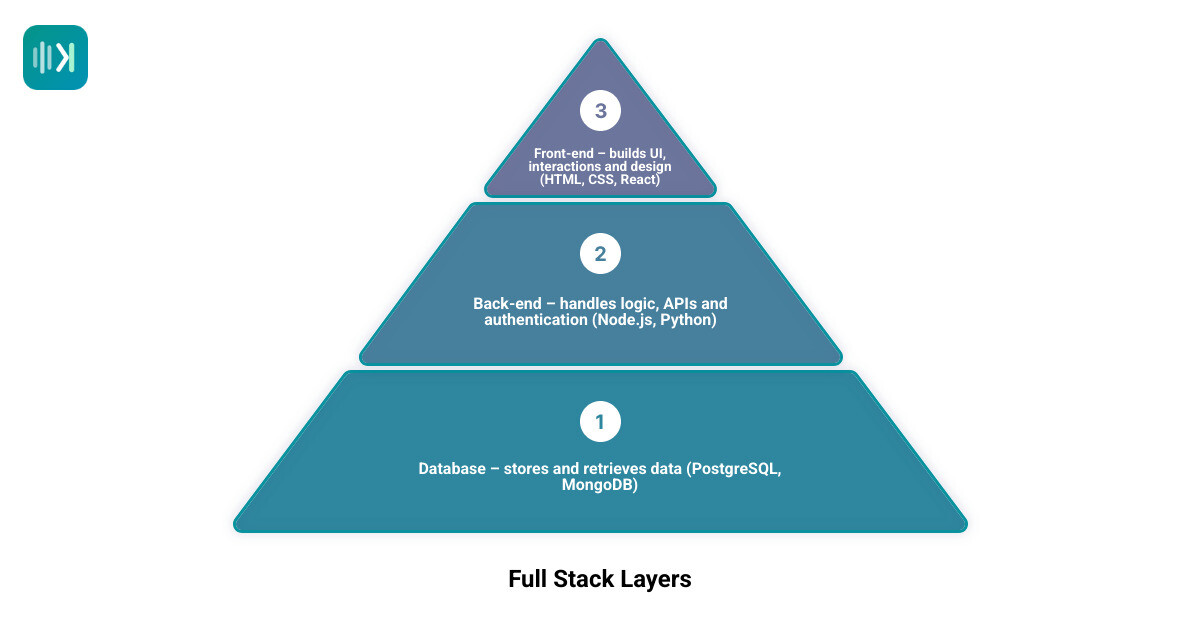
Important Full stack developer terms:
What is a Full Stack Developer?
A Full Stack Developer works across the main layers of a web application:
- Front-end: the interface users click, read, scroll, and occasionally blame
- Back-end: the server-side logic, authentication, background jobs, and APIs
- Database: the storage layer where application data lives
- Integration: connecting services, third-party tools, payment systems, email providers, and analytics
In plain English, they help build the whole machine, not just the dashboard or the engine.
That does not mean every full stack developer is equally deep in every area. In real teams, many are stronger on one side. Some are front-end-leaning full stack developers who use React and Next.js daily but can also wire up APIs and databases. Others are back-end-leaning, comfortable with Python or Node.js and able to ship competent UI work when needed.
A helpful definition from Coursera’s overview of full-stack developers aligns with what we see in the market: this role usually includes building interfaces, server logic, APIs, testing, troubleshooting, and bug fixing across the application.
Here is the simplest comparison:
| Role | Main focus | Typical tasks | Best for |
|---|---|---|---|
| Front-end developer | User-facing experience | UI components, styling, accessibility, state management | Teams needing polished product interfaces |
| Back-end developer | Server and data systems | APIs, auth, business logic, databases, performance | Data-heavy or infrastructure-heavy products |
| Full stack developer | End-to-end delivery | Features across UI, API, database, deployment | Lean teams, startups, fast product cycles |
A modern full stack developer usually also needs working knowledge of:
- Git and collaborative workflows
- Testing basics
- Deployment and hosting
- Security fundamentals
- Performance optimization
- CI/CD pipelines
- Cloud services or serverless platforms
In 2026, “full stack” increasingly means “can move a feature from idea to production,” not just “knows a bit of HTML and SQL.”
Salary and Job Outlook for the Full stack developer
The salary outlook remains strong.
From the research we reviewed:
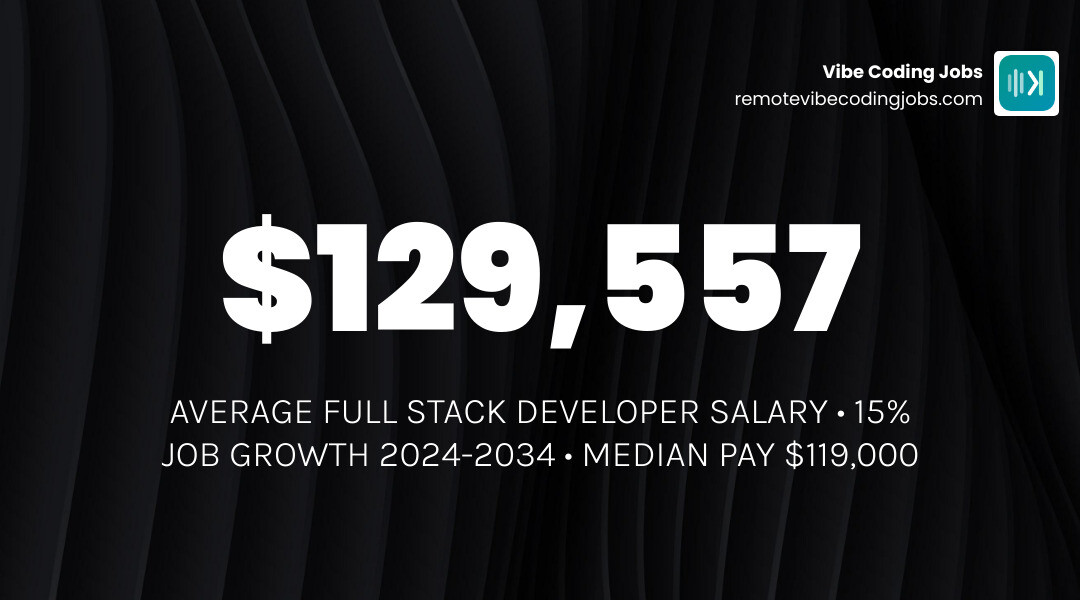
- Median total annual pay in the US is about $119,000
- Average salary for a full stack developer is about $129,557 per year
- Software development jobs are projected to grow 15% from 2024 to 2034
- Employment of web developers and digital designers has also been projected to grow strongly
That combination matters. Good pay is nice. Good pay plus healthy demand is much nicer.
In our view, the 2026 market rewards developers who can do more than code one isolated layer. Hiring managers increasingly want people who can:
- understand product requirements
- build and connect APIs
- work comfortably with TypeScript
- deploy features independently
- use AI tools without turning the codebase into a haunted house
For a broader compensation picture, see our Remote Developer Salary Guide 2026.
Job outlook is especially solid for developers who combine full-stack skills with one or more of these:
- TypeScript
- React or Next.js
- Python
- PostgreSQL
- cloud deployment
- AI-assisted coding workflows
How to Become a Full stack developer in 2026
There is no single path, but there are common patterns.
According to the research, 72% of software developers hold a bachelor’s degree. So yes, a degree is still common. But it is not the only route. We regularly see developers break in through self-study, bootcamps, freelance work, internships, and public portfolios.
A practical path looks like this:
Learn the front-end basics
- HTML
- CSS
- JavaScript
- responsive design
- accessibility basics
Learn one front-end framework
- React remains a safe choice
- Next.js is increasingly valuable for full-stack web apps
Learn one back-end path
- Node.js and Express
- Python and Django or FastAPI
- less commonly, PHP/Laravel, Java/Spring Boot, or Ruby on Rails
Learn databases
- PostgreSQL or MySQL for relational data
- MongoDB or another NoSQL option where relevant
Learn API basics
- REST
- authentication
- CRUD patterns
- validation
- error handling
Learn deployment
- Vercel, Railway, AWS, or similar platforms
- environment variables
- logging
- monitoring basics
Build a portfolio
- one CRUD app
- one auth-based app
- one project with external APIs
- ideally one deployed project with real users
Practice real hiring skills
- reading specs
- debugging
- shipping features
- explaining trade-offs
For structure, the Full Stack Developer Roadmap is a strong reference, and if you prefer video learning, this beginner full-stack tutorial is a useful starting point.
The Pros: Why Pursue a Full stack developer Career in 2026?
The role is demanding, but there is a reason it remains so attractive.

The biggest advantages are:
- versatility across teams and products
- stronger problem-solving range
- good earning potential
- more remote opportunities
- faster progression in lean companies
- better understanding of how software actually works end to end
For current openings, browse Remote Full Stack Developer Jobs. If you are mapping long-term progression, our Remote Developer Career Path Guide can help.
Versatility and “Jack of All Trades” Advantage
This is the classic benefit.
A full stack developer can fill gaps. If a bug starts in the browser, flows through an API, and ends in a database query, they can often trace the whole path without handing the issue to three different specialists.
That broad visibility creates real advantages:
- faster debugging
- better product intuition
- stronger architecture decisions
- fewer handoff delays
- better communication between design, product, and engineering
This is especially valuable in startups and async-first teams where people need to operate with autonomy. A developer who can design a data model, build a route, create the UI, and deploy the feature is incredibly useful.
It also helps with bottlenecks. Research from AWS-style educational material highlights that full-stack developers can spot cross-system issues that siloed developers may miss. We agree. Problems rarely respect org charts.
High Earning Potential and Remote Opportunities
The compensation data is strong, and remote hiring continues to reward breadth.
The average annual figure of $129,557 shows why this role attracts career changers and early-career developers alike. But the money is only part of the story.
A full stack skill set maps well to remote work because remote teams often need people who can own outcomes instead of just tickets. In async environments, a developer who can move a feature through multiple layers creates less coordination overhead.
That is why we see many remote roles asking for combinations like:
- React + TypeScript + Node.js
- Next.js + PostgreSQL + Supabase
- Python + modern front-end framework
- CI/CD + cloud deployment + AI tools
If your goal is remote work, read How to Get a Remote Developer Job. The short version: your portfolio, communication, and ability to ship matter a lot.
The Cons: Challenges of the Full Stack Role
The honest version? Full-stack development can be a lot.

The main downsides include:
- constant learning pressure
- context switching between layers
- risk of shallow knowledge
- higher ownership and responsibility
- burnout potential in understaffed teams
This does not mean the role is bad. It means the role rewards boundaries and intentional learning.
If you want a more practical angle on skill-first hiring, our guide to Remote Coding Jobs No LeetCode is worth reading.
The Never-Ending Learning Curve
Technology changes. Then it changes again because apparently it was not done changing.
A full stack developer has to keep up with:
- front-end frameworks
- back-end frameworks
- database tools
- deployment workflows
- security updates
- browser changes
- AI tooling shifts
A good example from the research: React’s popularity declined from 76.2% in 2022 to 69.9% in 2024. That does not mean React is dead. It means ecosystems evolve, and developers need judgment, not panic.
At the same time, TypeScript adoption keeps climbing, and security basics matter more than ever. In 2026, a strong full stack developer needs to know not only how to build features, but how to avoid creating security risks or performance disasters.
The trap here is framework fatigue. Some developers spend all their time chasing the newest stack and never get strong at the fundamentals. We think the better approach is:
- master HTML, CSS, JavaScript, HTTP, and databases
- learn TypeScript well
- pick one mature front-end path
- pick one strong back-end path
- understand deployment and security basics
- evaluate trends calmly instead of sprinting after each one
Complexity and Responsibility
When you work across the stack, you own more failure modes.
That can mean:
- a broken migration corrupts data
- an insecure API leaks information
- a deployment misconfiguration takes production down
- poor schema design creates long-term technical debt
- a rushed AI-generated patch introduces subtle bugs
In other words, your blast radius gets bigger.
This is one reason some developers eventually specialize. They enjoy depth more than breadth. That is a perfectly valid choice.
But if you stay on the full-stack path, you need systems thinking. Not just coding ability.
Good habits matter:
- write tests for critical flows
- review database changes carefully
- validate input on both client and server
- log errors properly
- monitor production behavior
- document architecture decisions
- do not trust AI output blindly
Popular Tech Stacks and the Rise of AI Tools
A “full stack developer” can mean very different things depending on the stack.
Some of the most common modern stacks include:
- MERN: MongoDB, Express, React, Node.js
- MEAN: MongoDB, Express, Angular, Node.js
- LAMP: Linux, Apache, MySQL, PHP
- Next.js + PostgreSQL + Prisma
- Next.js + Supabase
- Python + FastAPI + React
- Django + PostgreSQL + modern JS front end
We are also seeing AI-assisted tools become part of the stack itself, not just side utilities. For roles centered on this workflow, see Remote Developer Jobs with AI Tools.
Modern Frameworks and Languages
A few patterns stand out in 2025-2026:
- React remains important, even with some decline in popularity
- Next.js is highly visible in full-stack web roles
- Astro is gaining interest for content-heavy sites and marketing experiences
- Python is increasingly valuable because it connects well to AI and automation work
- TypeScript has become close to default for modern web teams
If you are exploring stack-specific roles, these pages are useful:
React Server Components and the Next.js App Router continue to shape the front-end side of full-stack development. On the back end, we see a lot of interest in serverless functions, managed databases, and simpler deployment platforms that reduce infrastructure overhead.
Supabase has also become a popular option for fast-moving teams because it combines hosted PostgreSQL, auth, storage, and APIs in a way that helps smaller teams ship quickly.
AI-Assisted “Vibe Coding” in 2026
This is one of the biggest shifts in the role.
Will AI replace full stack developers? No. But it is already changing how the job gets done.
Across the research, the same theme appears repeatedly: AI tools help with boilerplate, debugging, prototyping, and repetitive tasks, while developers spend more time on architecture, product decisions, and quality control.
The tools most often mentioned include:
- Cursor
- Claude
- GitHub Copilot
These tools can help generate components, draft API handlers, explain unfamiliar code, refactor repetitive sections, and speed up tests or documentation. That is useful. It is not magic.
The best developers use AI as an amplifier, not a substitute for thinking.
We also see more job postings explicitly valuing experience with AI-assisted workflows, especially in TypeScript and Next.js-heavy environments. For related opportunities, explore:
If we had to summarize the 2026 vibe coding version of full-stack work, it would be this:
- prompt clearly
- verify aggressively
- refactor for maintainability
- test what matters
- keep humans responsible for architecture and judgment
Frequently Asked Questions about Full Stack Development
Will AI replace full-stack developers?
No. It is more likely to reshape the role than eliminate it.
AI is good at:
- generating starter code
- summarizing files
- suggesting refactors
- speeding up repetitive tasks
AI is not reliably good at:
- understanding messy product context
- making nuanced trade-offs
- owning system architecture
- protecting code quality without oversight
- handling ambiguity the way experienced developers do
So the role is changing, but not disappearing. Full stack developers who learn to work effectively with AI tools will likely have an advantage.
Can I learn full-stack development in 3 months?
Usually, not from zero to job-ready.
If you already know either front-end or back-end development, three focused months can be enough to add the missing side and build a few portfolio projects. But for complete beginners, full-stack development typically takes longer.
A realistic range is:
- 3 to 6 months to learn basics
- 6 to 12 months to build decent projects
- 12 months or more to become competitive for many jobs
Speed depends on your background, time available, and how much you build.
What is the difference between a full-stack developer and a software engineer?
There is overlap, but they are not always identical.
A full-stack developer usually refers to someone who works across front-end and back-end layers of web applications.
A software engineer is a broader term. It can include:
- full-stack web developers
- back-end engineers
- mobile engineers
- platform engineers
- DevOps engineers
- embedded engineers
So a full stack developer can be a software engineer, but not every software engineer is full stack.
Conclusion
Being a Full Stack Developer in 2026 is a trade-off: more breadth, more ownership, more opportunity, and yes, more complexity.
The pros are compelling:
- strong salary potential
- healthy job outlook
- remote-friendly skill set
- end-to-end product ownership
- flexibility across teams and industries
The cons are real too:
- constant learning
- context switching
- risk of burnout
- broader accountability when things break
Our take is simple: if you enjoy solving problems across the whole application, like seeing how systems fit together, and want strong career flexibility, full-stack development is still one of the best paths in tech.
And if you want to apply that skill set in an async-first environment that values AI-assisted workflows, we built Remote Vibe Coding Jobs for exactly that use case.
For your next role, check out Find your next remote vibe coding role at Jellyvision.