
How to Apply for an OpenAI Careers Internship in 2027
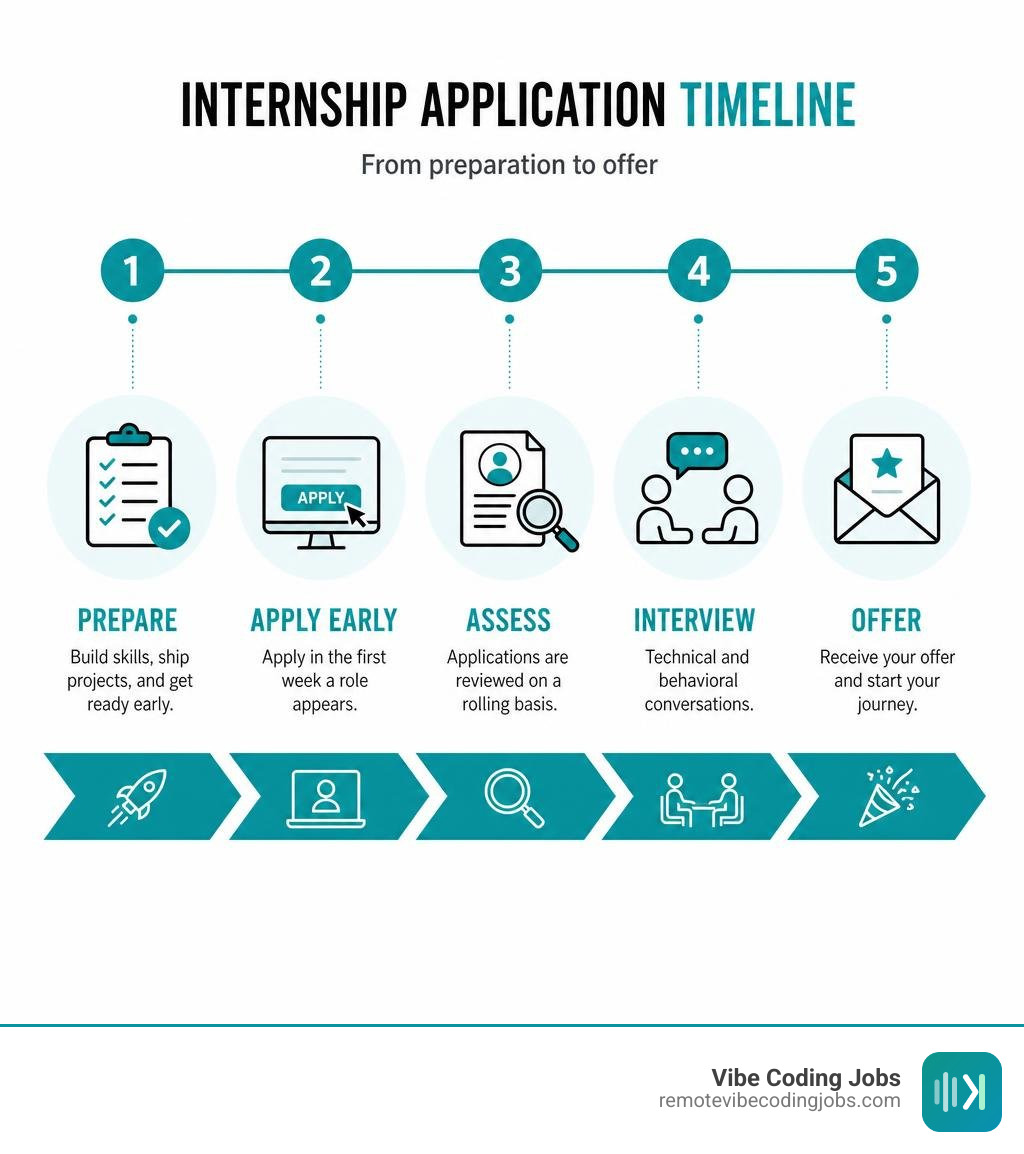
To pursue an OpenAI careers internship for summer 2027, start preparing now, join OpenAI’s Emerging Talent Community, and watch the official careers page from September through November 2026. Applications are expected to be reviewed on a rolling basis, so apply in the first week a role appears rather than waiting for a posted deadline.
Your strongest application will show more than course work:
- Pick the right path: Applied SWE, Systems Research, research and safety, policy, product, or the six-month Residency.
- Build public proof: deployed AI tools, useful open-source work, or well-measured systems projects.
- Practice production coding in Python, including APIs, caching, rate limits, tests, and edge cases.
- Explain why safe, beneficial AI matters to you and how your work supports that goal.
This is a highly selective process, with a community-estimated acceptance rate below 1%. But OpenAI does not publish a minimum GPA requirement, and its early-career programs welcome recent graduates, students, and self-taught builders with strong practical evidence of skill.
I’m Di Su, a software engineer with 10+ years of experience building web products, Python workflows, and high-traffic digital platforms. For this OpenAI careers internship guide, I focus on the proof-of-work, shipping habits, and clear technical story that help developers compete for frontier AI roles.
Openai careers internship terms at a glance:
- The Honest Truth About Anthropic Careers From Glassdoor Reviews
- How to Catch an Anthropic Recruiter: Landing a Claude Code Job
OpenAI Careers Internship Tracks and Program Pathways
OpenAI organizes its early-career opportunities under its OpenAI Emerging Talent programs, designed for builders with 0 to 3 years of experience. Rather than treating interns as coffee-runners, the lab integrates early talent straight into teams operating at high throughput across San Francisco, CA, and Seattle, WA.
Choosing the right track before you submit your application is critical. Here is how the primary tracks compare across scope, audience, and compensation:
| Program Track | Target Candidate | Duration | Base Compensation | Primary Focus Areas |
|---|---|---|---|---|
| SWE Applied | Undergrad / Master’s students | 12 Weeks | $60 / hour (~$10,400/mo) | Full-stack APIs, UI/UX, product features, backend scale |
| Systems Research | PhD students | 13–26 Weeks | $67 / hour (~$11,600/mo) | GPU orchestration, kernel optimization, storage, networking |
| AI Safety & Policy | BS / MS / PhD / Law | 12 Weeks | $36–$60 / hour | Red-teaming, model safeguards, governance, cyber safety |
| OpenAI Residency | Non-enrolled / Career switchers | 6 Months | $18,333 / month | Direct full-time AI conversion, cross-discipline bridging |
Understanding the remote AI developer jobs requirements across high-growth engineering teams will help you benchmark where your existing capabilities fit best within these four pillars.
SWE Applied, Systems Research, and AI Safety Tracks
The SWE Applied track targets undergraduate and master’s students who love turning frontier models into functional, resilient software products. In this role, you build end-to-end user-facing interfaces, developer API primitives, and database pipelines using JavaScript, React, Python, and PostgreSQL or MySQL. The focus here is shipping robust software that serves millions of users with zero friction.
The Systems Research internship caters primarily to PhD researchers exploring the hardware-software boundary. You investigate distributed systems challenges, GPU cluster utilization, high-throughput model inference latency, and data movement bottlenecks. You are expected to design hypothesis-driven benchmarks, instrument live clusters, and contribute findings to technical papers and major industry conferences.
The AI Safety track focuses on red-teaming, alignment calibrations, adversarial testing, and model trust frameworks. Safety engineers work directly alongside research scientists and product managers to ensure deployed models operate safely across real-world environments.
The OpenAI Residency vs. Student Internships
Many applicants confuse student internships with the flagship OpenAI Residency. The key difference lies in enrollment status:
- Student Internships (12–13 Weeks): Exclusively for students currently enrolled in an accredited degree program who have at least one academic term remaining after their placement.
- OpenAI Residency (6 Months): Built specifically for non-enrolled industry professionals, self-taught engineers, and academic researchers from adjacent fields (such as physics, mathematics, or neuroscience) who want to pivot into AI. Residents receive a competitive $18,333 monthly stipend and dedicated mentorship aimed at transitioning into full-time roles.
Eligibility Criteria and Technical Skill Requirements
Landing a technical interview requires matching baseline eligibility criteria while demonstrating hands-on engineering capabilities. Reviewing the expectations for AI coding jobs entry level remote positions provides great context on how top teams evaluate early-career talent today.
Degree Status, GPA Policies, and Visa Sponsorship
OpenAI evaluates real-world problem-solving ability over formal academic pedigree. Key eligibility criteria include:
- Enrollment Status: For traditional summer internships, you must be enrolled in an undergraduate, master’s, or PhD program with at least one semester left to complete post-internship.
- GPA Policy: OpenAI maintains no minimum GPA requirement. Your GitHub repositories, deployed web applications, and systems projects carry far more weight than your university transcript.
- Visa Sponsorship: OpenAI supports international students studying at US institutions via Curricular Practical Training (CPT) and Optional Practical Training (OPT). In select advanced research and Residency roles, visa sponsorships (such as J-1 or O-1 pathways) are evaluated on a case-by-case basis.
- Work Location: All internships are strictly in-person, requiring relocation to OpenAI’s offices in San Francisco or Seattle.
Core Tech Stack: Python, Distributed Systems, and ML Infrastructure
Across all verified technical internship postings, OpenAI expects proficiency in specific languages and core computing paradigms:
- Python: Required across all technical job descriptions. You must write idiomatic, performant Python code with clean abstractions.
- Systems Languages (C++, Rust): Critical for Systems Research and infrastructure roles dealing with low-level GPU acceleration, custom CUDA kernels, and memory-constrained runtimes.
- Frontend & Web Layer (React, TypeScript, SQL): Essential for SWE Applied candidates building user tooling and API endpoints.
- Production Primitives: Deep knowledge of concurrency, in-memory caches (Redis/Memcached), rate limiters, token buckets, and distributed databases.
The OpenAI Hiring Process: From Application to Return Offer
The interview funnel at OpenAI moves fast once your file is pulled from the queue on the official Careers portal.

Understanding evolving AI coding jobs remote market trends helps clarify why frontier labs have overhauled their interview formats.
OpenAI Careers Internship Timeline and Rolling Deadlines
Recruitment for summer cohorts operates on a strict rolling review cycle starting in late summer:
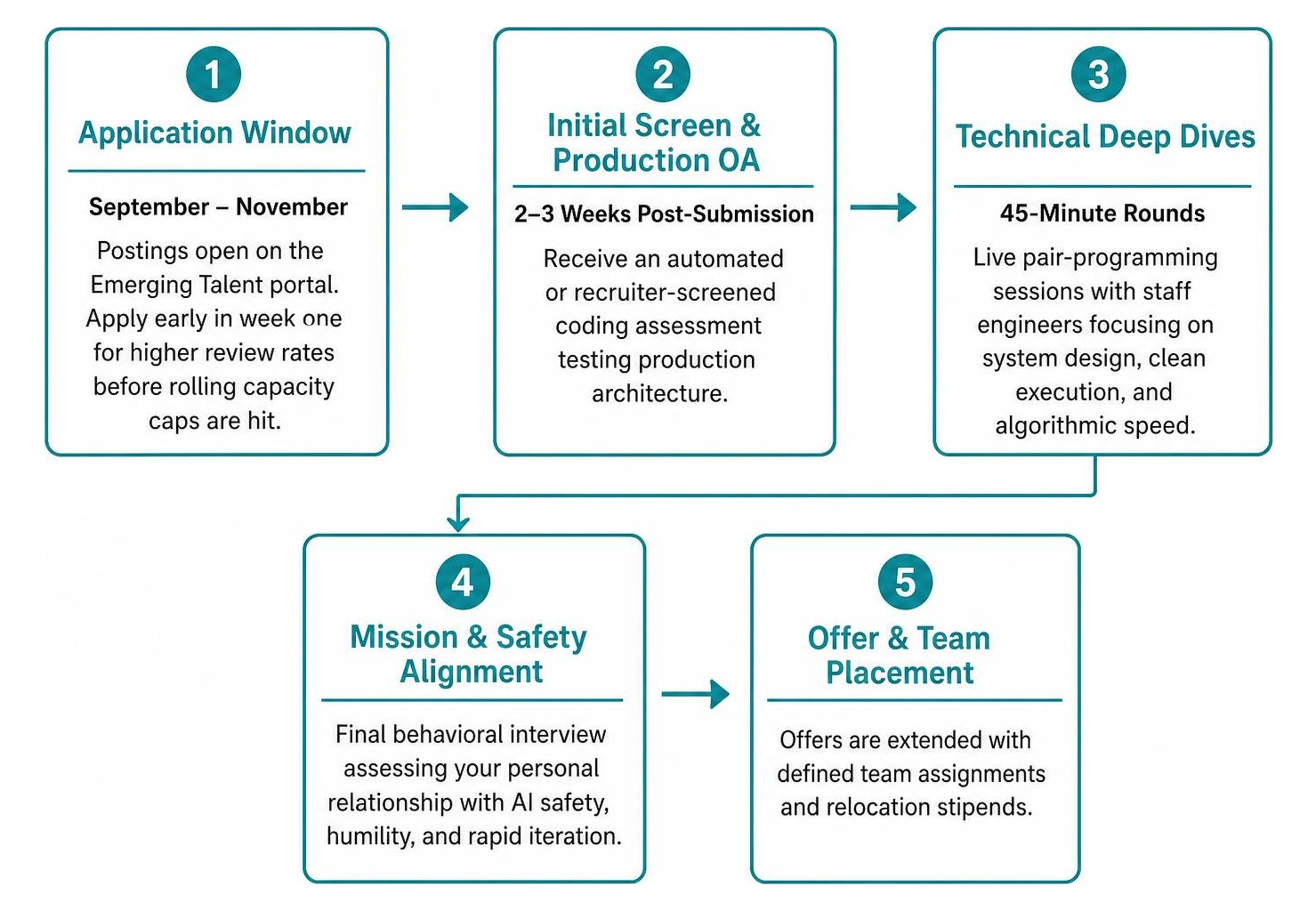
- Application Window (September – November): Postings open on the Emerging Talent portal. Candidates who apply within week one experience significantly higher review rates before rolling capacity caps are hit.
- Initial Screen & Production OA (2–3 Weeks Post-Submission): Candidates receive an automated or recruiter-screened coding assessment testing production architecture.
- Technical Deep Dives (45-Minute Rounds): Live pair-programming sessions with staff engineers focusing on system design, clean execution, and algorithmic speed.
- Mission & Safety Alignment: A final behavioral interview assessing your personal relationship with AI safety, humility, and rapid iteration.
- Offer & Team Placement: Offers are extended with defined team assignments and relocation stipends.
Note: In OpenAI’s rolling admissions, silence exceeding four weeks after any stage typically indicates the cohort pool has reached maximum capacity.
Production-Style Assessments vs. Standard LeetCode Interviews
Unlike traditional FAANG interviews that emphasize abstract mathematical brainteasers, OpenAI uses production-style assessments on platforms like CodeSignal:
- High Code Volume: You are asked to implement functional mini-systems from scratch (such as an in-memory key-value cache with TTL, a token-bucket rate limiter, or an event-driven pub/sub bus).
- Robust Edge-Case Handling: Tests validate how gracefully your code handles network drops, invalid input payloads, high concurrency, and resource constraints.
- Live Verbal Articulation: During technical deep-dive rounds, engineers evaluate how clearly you explain architectural trade-offs while writing clean, modular code under a 45-minute countdown.
Compensation, Return Offers, and Company Culture
Interning at OpenAI provides industry-leading compensation paired with high-impact project ownership:
- SWE Applied Interns: $60 per hour (~$10,400 monthly gross).
- Systems Research PhD Interns: $67 per hour (~$11,600 monthly gross).
- Residency Fellows: $18,333 per month flat stipend.
- Perks: Relocation support, corporate housing stipends, three chef-prepared meals daily, and comprehensive health benefits.
- Return Offer Rate: Community estimates indicate an approximate 85% return offer rate for interns who demonstrate strong technical velocity and cultural alignment.
On internal employee reviews, OpenAI scores 4.1 out of 5.0 overall, with compensation reaching 4.6 / 5.0. However, work-life balance scores 3.2 / 5.0, reflecting the demanding, startup-like pace where interns often push code to production on day one.
Strategic Preparation: Building Proof and Velocity
With an acceptance rate under 1%, general applications rarely get noticed. You need concrete proof of execution to stand out in the candidate pool.

Exploring the long-term AI coding jobs growth potential highlights why mastering AI tooling early builds durable engineering leverage.
How to Stand Out for an OpenAI Careers Internship
To position your profile at the top of the applicant stack:
- Build Autonomous Agent Workflows: Create multi-step AI agents that interface with live APIs, execute data analysis pipelines, and handle real-world operational workflows.
- Contribute to Open-Source ML Repositories: Submit pull requests, fix open bugs, or optimize documentation across major open-source machine learning and inference toolkits.
- Network with Intent: Connect with OpenAI engineers and recruiters during virtual Q&A sessions hosted via the Emerging Talent Community, or participate in local AI research hackathons.
- Lead with Mission Alignment: Demonstrate a deep appreciation for responsible model deployment, red-teaming principles, and long-term AGI safety.
AI-Native Tooling and Real-World Systems Portfolio
Modern engineering at OpenAI relies heavily on AI-native acceleration. Showcase your ability to build and iterate rapidly:
- Demonstrate fluency with AI coding assistants (like Cursor and Claude Code) to build complete, tested prototypes in hours rather than weeks.
- Include benchmark results in your GitHub readmes—such as throughput improvements, p99 latency reductions, and memory profiling graphs.
- Deploy your web services live to cloud platforms with comprehensive automated test suites and public API documentation.
Frequently Asked Questions About OpenAI Internships
Does OpenAI require a minimum GPA for student interns?
No. OpenAI does not enforce a minimum GPA requirement. The recruiting team evaluates practical technical execution, open-source projects, personal side builds, and problem-solving velocity rather than academic test scores.
What is the compensation and return offer rate at OpenAI?
Undergraduate software engineering interns earn $60/hr (~$10,400/month), while Systems Research PhD interns earn $67/hr (~$11,600/month). Residency participants receive $18,333/month. Successful interns experience an estimated full-time return offer rate of approximately 85%.
Can international students apply for OpenAI internships?
Yes. International students currently enrolled at accredited universities in the United States can apply using CPT or OPT work authorization. All interns must work on-site at OpenAI’s offices in San Francisco or Seattle for the duration of the program.
Conclusion
Landing a role at a frontier AI lab requires moving beyond standard textbook exercises. By mastering production-oriented Python, building measured systems projects, and applying during the early rolling window, you give yourself the strongest chance to compete for an early-career spot.
If you are eager to build high-impact AI systems right now, explore curated remote AI engineer positions at async-first companies on RemoteVibeCodingJobs to build real-world production velocity today.