Understanding the Landscape of Claude Code Jobs
To capture the attention of a recruiter hiring for claude code jobs, you must first understand how the market categorizes these positions. The market has matured past simple “prompt engineer” listings into specialized technical tracks.
Essential Roles: Model Performance, Applied AI, and Agentic Builders
The job market for Claude Code expertise broadly splits into three high-demand archetypes:
- Model Performance Software Engineers: Operating at frontier labs like Anthropic, these engineers build evaluation frameworks, reinforcement learning infrastructure, and benchmarking pipelines. They test model coding capabilities, identify failure modes, and turn empirical research questions into scalable systems. These positions require expert-level Python and TypeScript mastery, strong systems architecture design, and 10+ years of deep engineering experience.
- Applied AI Engineers: Found at fast-growing startups and enterprises, Applied AI Engineers leverage Claude Code, LLM APIs, and agentic orchestration frameworks to ship user-facing products. They combine traditional backend architectures with vector databases, Retrieval-Augmented Generation (RAG) pipelines, and low-code platforms like n8n or Make.
- Agentic Builders: This rapidly emerging role focuses on orchestrating AI agents to execute full-stack software development from spec. Agentic Builders write context files, manage sub-agent memory, design custom skills, and maintain strict architectural guardrails while letting AI generate primary application logic.
Anthropic Core Roles vs External Claude Code Jobs
Working directly at Anthropic differs significantly from leveraging Claude Code at external startups or enterprises:
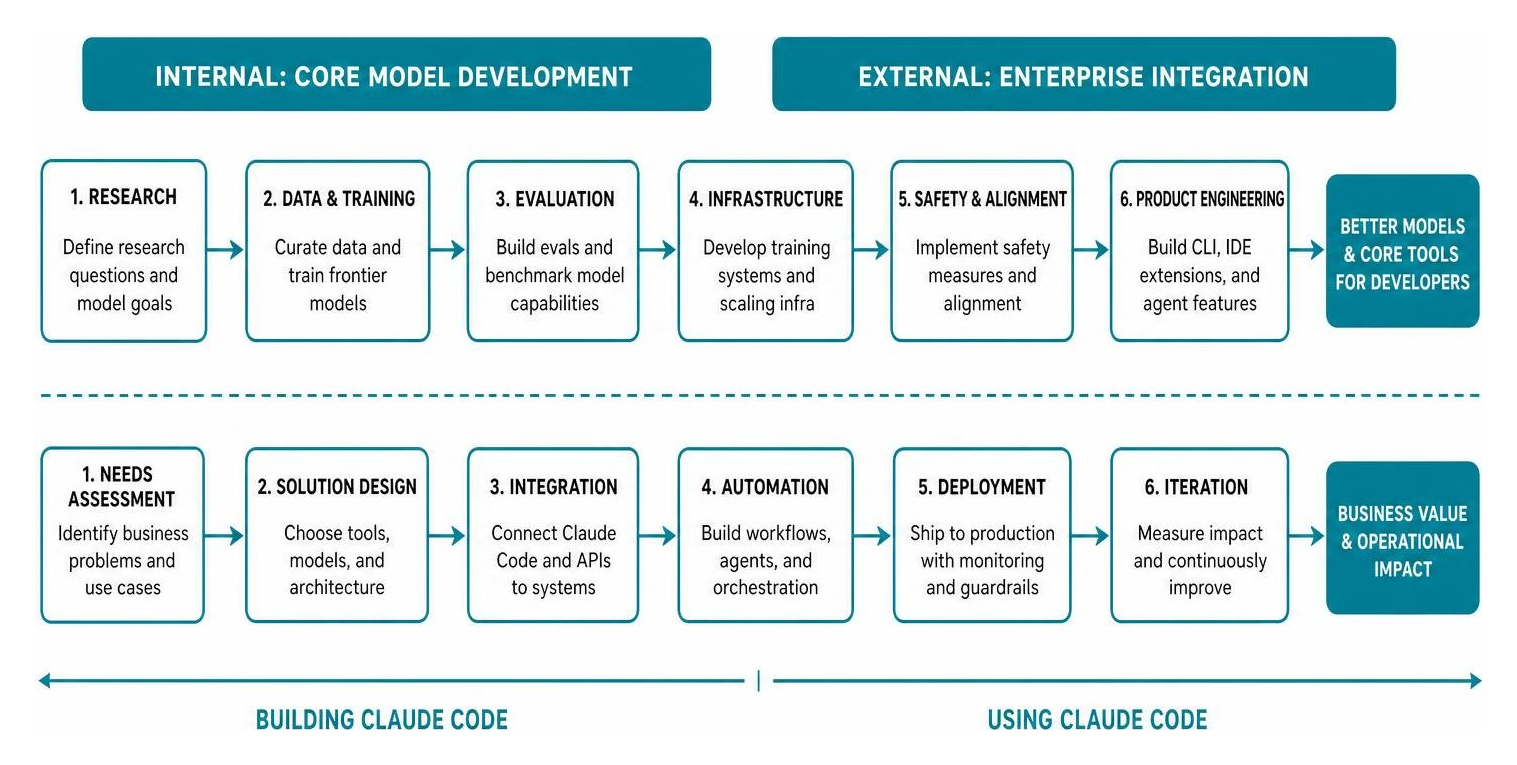
- Inside Anthropic: Roles focus on building Claude Code itself. Engineers develop the underlying command-line interface (CLI) infrastructure, IDE extensions, safety enforcement mechanisms, and agent capabilities used by hundreds of thousands of developers worldwide. Anthropic approaches model development as an empirical science, pairing engineering discipline with cutting-edge research. You can explore open positions directly on the official Careers at Anthropic portal.
- External Companies: Businesses hiring for external claude code jobs focus on speed-to-market, automated workflows, and domain-specific implementation. These positions range from proptech startups modernizing financial analysis tools to public sector agencies executing massive automated code remediation.
Key Skills and Qualifications for Claude Code Engineers

Employers are drawing a firm boundary between superficial “vibe coders” who copy-paste AI prompts and disciplined software engineers who direct AI tools with precision.
Beyond Vibe Coding: TDD, Context Engineering, and Guardrails
To succeed in top-tier claude code jobs, you need to demonstrate mastery over the context and environment that guides AI agents:
- CLAUDE.md Configuration: Designing workspace-level memory files that define coding standards, repository layout, style rules, and testing commands for the agent.
- Model Context Protocol (MCP): Connecting Claude Code to local databases, internal APIs, Git worktrees, and external developer tools.
- Context Engineering & Memory Management: Selecting model tiers (such as switching between lightweight and frontier reasoning models) based on context windows and token economics to keep builds performant and cost-effective.
- Test-Driven Development (TDD) Guardrails: Establishing automated verification loops and pre-commit hooks so agentic coders write, run, and pass integration tests before submitting PRs.
Reviewing modern Vibe Coding Tools can help you understand how agentic interfaces sit on top of foundational software architecture.
Tech Stack Standards: Python, TypeScript, and Agentic Frameworks
While Claude Code handles much of the raw syntax generation, employers still evaluate core programming fundamentals. The standard modern AI tech stack includes:
- Core Languages: Python and TypeScript dominate the landscape for MLOps, M365/CLI tool development, and full-stack backend development. modern JS runtimes like Bun or Deno are also frequently requested.
- Orchestration Frameworks: Hands-on experience with LangChain, LlamaIndex, and custom multi-agent orchestration frameworks.
- Data Layer: Vector databases (Pinecone, Weaviate, Qdrant), PostgreSQL with pgvector, and memory management architectures.
- Developer Workflows: Advanced Git workflows (rebases, worktrees, clean branch hygiene), containerization (Docker), and CI/CD pipelines.
Candidates seeking to stay competitive can check out this break down of the Best AI Tools for Coding to see how various platforms integrate into enterprise environments.
Salaries, Top Employers, and Work Environments
Compensation for professionals skilled in Claude Code ranks among the highest across the software industry, reflecting the high productivity leverage these tools provide.
Compensation Benchmarks Across Startups and Enterprise Labs
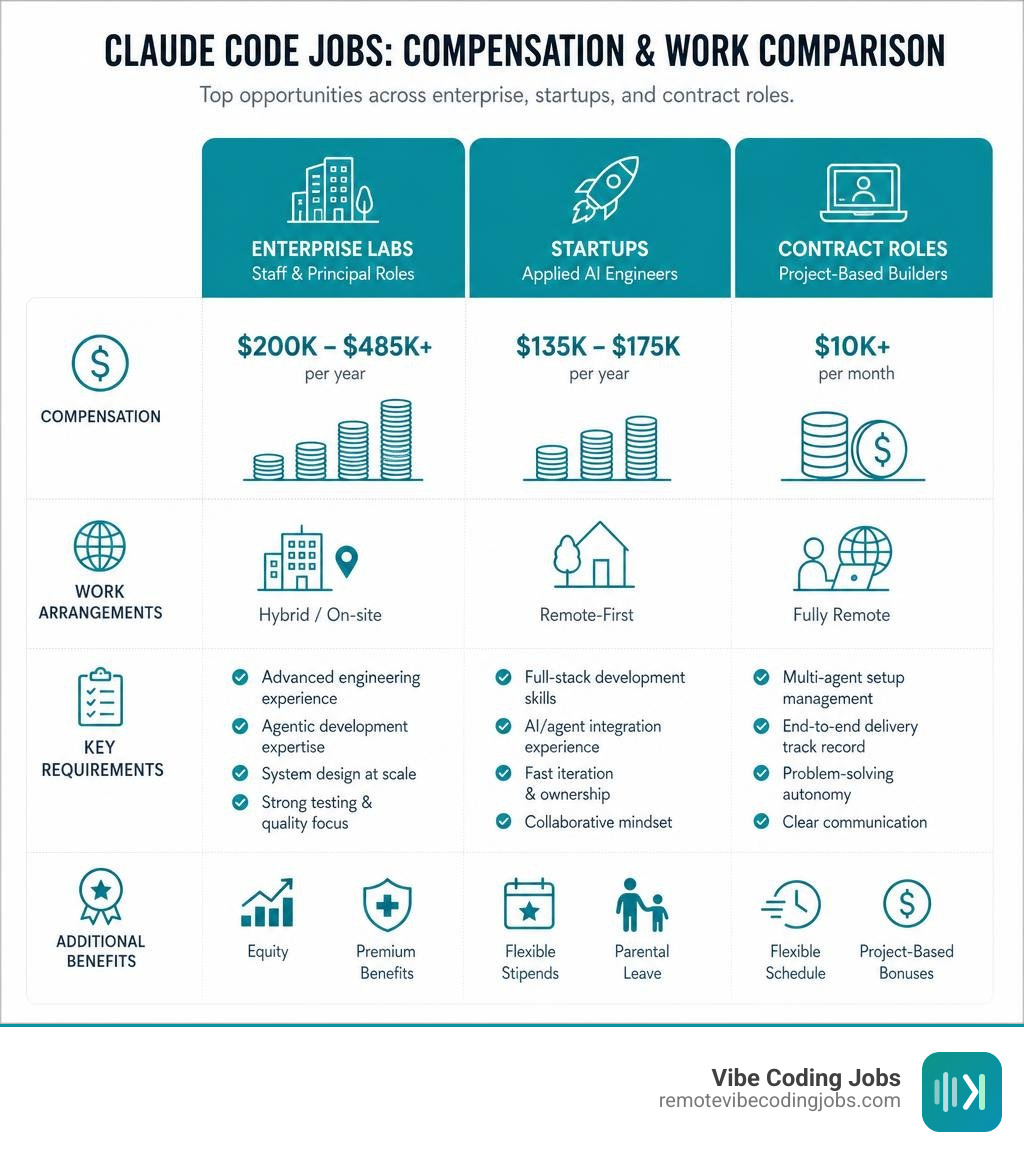
- Anthropic Staff & Principal Roles: Positions like the Model Performance Software Engineer, Claude Code at Anthropic command base salaries between $405,000 and $485,000 annually, with mid-level engineering positions offering base pay ranging from $200,000 to $350,000, plus substantial equity and benefits.
- Startup Applied AI Engineers: Mid-to-senior engineering roles using Claude Code at remote startups offer salary bands typically sitting between $135,000 and $175,000 per year, frequently paired with flexible stipends and parental leave benefits.
- Project-Based Agentic Builders: Autonomous contract builders managing multi-agent setups frequently earn upwards of $10,000+ per month on fixed per-project deployments.
- National Industry Averages: Across broader US listings that mention general Claude AI skills (ranging from entry-level operators to automation specialists), the average yearly pay sits at $88,968, with most positions paying between $57,500 and $122,000.
Where to Find Remote and High-Paying Claude Code Jobs
Finding high-paying claude code jobs requires looking in the right tech hubs and job boards. Many companies embracing agentic development also offer progressive work policies, including 4-day workweeks, asynchronous workflows, and unlimited PTO.
If you are looking for curated listings specifically filtered for AI-assisted engineering and flexible cultures, check out our live feed of curated Claude Code Jobs at remote-first companies.
How to Stand Out and Win Interviews for Claude Code Roles

Because demand is intense, standard resumes often get lost in recruitment filters. To catch a recruiter’s eye, you must show clear evidence of your agentic coding capabilities.
Creating Proof-of-Work Portfolios and Public Repositories
Building a tailored “proof-of-work” pitch is one of the single most effective ways to secure an interview for an AI developer role:
- Publish Open-Source MCP Servers: Build and publish custom Model Context Protocol servers on GitHub that allow Claude Code to interface with niche tools, hardware, or APIs.
- Share Repository Configurations: Publicly share well-documented
CLAUDE.mdworkspace files and agent workflow scripts that demonstrate how you structure context, memory, and automated testing guardrails. - Highlight Benchmark Projects: Document complete applications you built using multi-agent workflows, clearly explaining your architectural trade-offs, token costs, and context window management strategies.
Understanding how different toolsets evaluate code generation will help sharpen your portfolio. Read our comparison on Claude Code vs Copilot for Developers in 2026: A Deep Dive for deeper context.
Mastering Technical Assessments and Live Coding Evaluations
Interview processes at frontier labs and high-growth AI startups differ from traditional LeetCode whiteboarding:
- Practical Agentic Pair Programming: Expect live coding evaluations in environments like CodeSignal or Google Colab where you are explicitly allowed—and expected—to use agentic tools like Claude Code or Cursor. Interviewers evaluate how efficiently you write prompt specs, review generated code, spot security gaps, and guide the model through complex bugs.
- System Architecture & Evaluation Design: You will be asked how to design evaluation frameworks to measure LLM performance on domain-specific codebases. Practice explaining how you would set up unit tests, regression suites, and automated evaluation metrics.
- Empirical Research Mindset: Labs like Anthropic emphasize treating model capabilities as an empirical science. Be prepared to explain how you investigate ambiguous model failures, analyze edge cases, and translate research discoveries into production code.
Frequently Asked Questions About Claude Code Careers
What salary can an engineer specializing in Claude Code expect?
Salary expectations vary depending on the target role and employer type. Mid-to-senior software engineers at frontier AI labs like Anthropic earn base salaries ranging from $200,000 up to $560,000+, with staff-level performance specialists earning $405,000–$485,000. Applied AI Engineers at venture-backed startups typically see salary bands between $135,000 and $175,000, while general AI operators across broader US industries average $88,968 annually.
What is the difference between a vibe coder and an agentic builder?
A vibe coder relies primarily on natural language prompts to quickly generate prototype code without necessarily understanding the underlying software architecture, security implications, or testing requirements. An agentic builder is a disciplined engineer who uses tools like Claude Code as leverage. They design context files (CLAUDE.md), author custom tools via MCP servers, implement strict Test-Driven Development (TDD) guardrails, manage Git branches and worktrees, and optimize context memory while maintaining full architectural ownership.
You can explore more about how developers navigate these tools by reading our breakdown on Cursor & Copilot Developer Jobs in Remote Coding.
Does Anthropic hire remote software engineers for Claude Code?
Anthropic maintains primary office hubs in San Francisco, New York City, London, Seattle, and Zurich. While they offer remote-friendly roles that require periodic travel, many core engineering and product roles on the Claude Code team follow a hybrid model expecting employees to be in an office at least 25% of the time (roughly one week per month or a few days per week depending on team structure). However, hundreds of external startups hiring for Claude Code skills operate on 100% remote-first models.
Conclusion
The shift toward AI-assisted development isn’t replacing engineers—it’s raising the bar for what a single engineer can build. Mastering Claude Code moves you from writing routine syntax to orchestrating complex software architectures, creating custom tools, and shipping features at unprecedented speeds.
Whether you’re targeting a high-compensation research lab position or a flexible remote role at an async startup, building a strong proof-of-work portfolio and mastering context engineering will set you apart from the crowd.
Ready to find your next career move? Explore current opportunities on our Remote AI Engineer Jobs board and apply to top companies hiring for modern AI engineering skills today.