
What a Bolt Customer Success Manager Career Looks Like
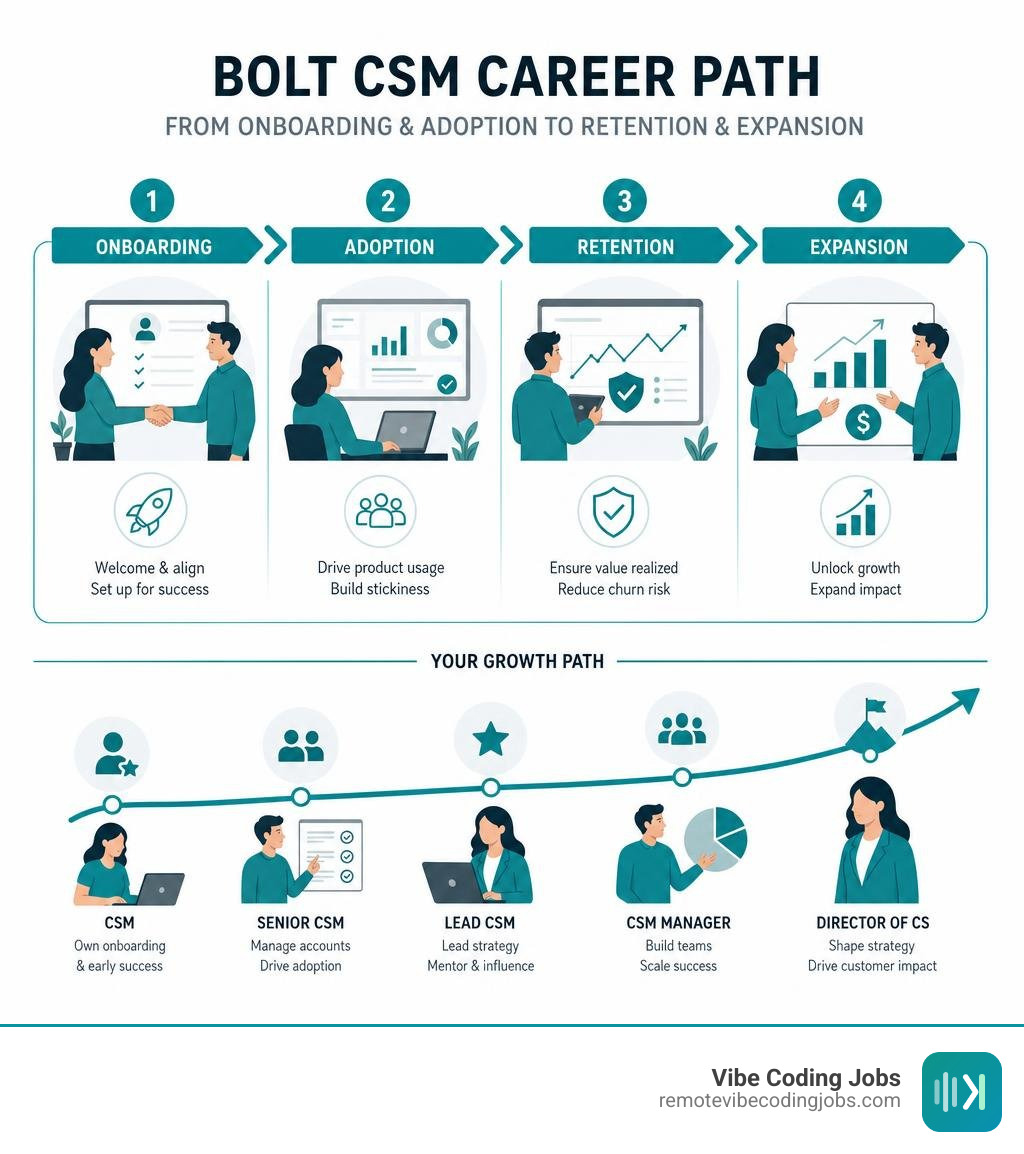
A Bolt Customer Success Manager helps customers or partners get value from Bolt products after launch. The work usually combines onboarding, product adoption, relationship management, renewal risk, and growth planning. For strategic or business-facing roles, candidates commonly need at least three years of account management, customer success, or related tech experience, plus strong data skills and confidence working across product, operations, and sales.
The exact job varies by Bolt business unit. A mobility-focused team may manage fleet or enterprise partners across markets, while Bolt.new customer experience roles lean more technical, with troubleshooting, documentation, developer feedback, and AI-assisted support. Success is typically tied to adoption, retention, customer satisfaction, and expansion revenue – not simply closing tickets.
Salary and work setup also vary by entity, seniority, and location. This guide breaks down the career ladder, hiring signals, AI workflows, and practical expectations so you can judge whether a Bolt CSM role fits your experience.
I am Dominic Zijlstra, a technologist and entrepreneur with experience in data systems, DevOps, and automation. That background helps me assess how a Bolt Customer Success Manager role increasingly connects customer outcomes with AI-enabled operations and technical product feedback.
Bolt customer success manager vocab to learn:
Core Responsibilities of a Bolt Customer Success Manager across Business Units
Managing client success within hyper-growth tech ecosystems requires a delicate balance between high-touch relationship management and high-scale operational automation. Across Bolt’s expanding portfolio—spanning global mobility networks serving over 200 million customers across 50+ countries, B2B corporate travel, enterprise commerce checkout, and developer toolkits—the customer success role takes on distinct operating mandates.
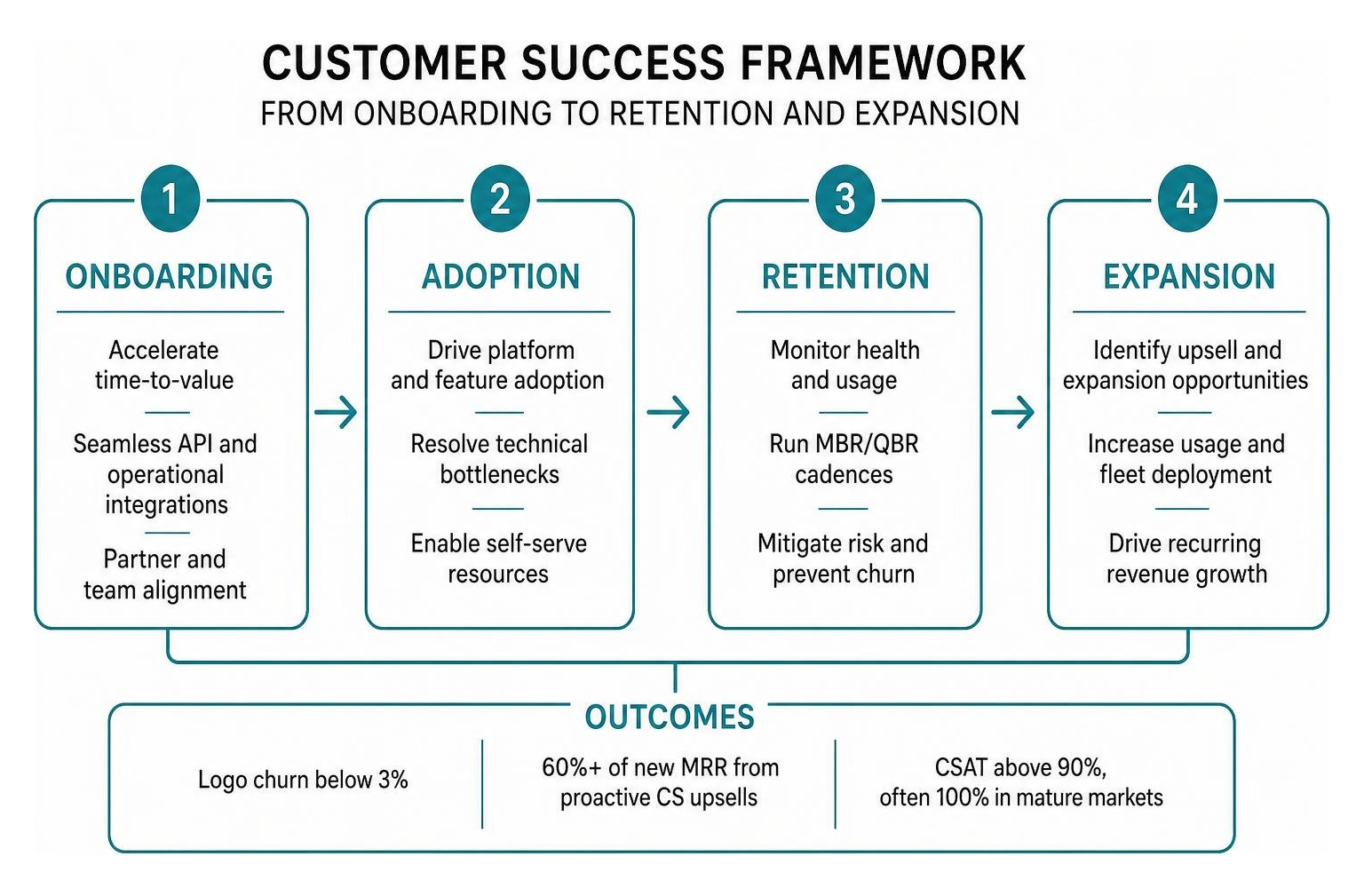
CSMs at Bolt act as the critical bridge between external enterprise clients and internal product, engineering, and commercial teams. You are not simply managing support queues; you own the post-sale customer journey, ensuring rapid time-to-value, seamless API and operational integrations, high platform adoption, and account expansion.

Depending on which entity you join via Bolt Careers – Job openings, your day-to-day work can encompass partner onboarding, running monthly or quarterly business reviews, monitoring automated health signals, resolving technical bottlenecks, and identifying commercial upsell pathways.
Bolt Business and Fleet Key Account Management
Within the core mobility platform—which coordinates more than 4.5 million driver and courier partners—customer success operates primarily through sophisticated Key Account Management (KAM) frameworks. Enterprise accounts range from large logistics suppliers and multi-vehicle fleet operators to multinational corporations using Bolt for Business for employee mobility and expense management.
Global customer success leaders like Charles França demonstrated how marketplace fleet partnerships could be transformed from reactive local firefighting into standardized, data-driven CS operations. By engineering a comprehensive Fleet Health Score framework, Bolt enabled proactive risk detection across 35,000+ fleets in dozens of international markets.
This programmatic approach ensures:
- Logo Churn Mitigation: Maintaining partner logo churn consistently below 3% by tracking operational health metrics before partners disengage.
- Revenue Acceleration: Driving more than 60% of new monthly recurring revenue (MRR) expansion directly via proactive CS upsells and increased fleet vehicle deployment.
- Exceptional Satisfaction: Maintaining consistent Customer Satisfaction (CSAT) scores above 90%, frequently hitting 100% in mature operating markets through structured Monthly Business Review (MBR) cadences.
Bolt.new and Tech Ecosystem Customer Experience Engineering
On the developer tools and AI engineering side of the ecosystem—such as StackBlitz’s Bolt.new in-browser development environment—customer success transforms into Customer Experience Engineering. These roles serve developers building web applications via WebContainers and browser-based full-stack IDEs.
As outlined on Careers at Bolt – Bolt.new, technical success engineers handle everything from troubleshooting front-end build pipelines (Vite, React, Tailwind) to optimizing prompt-crafting workflows for AI-assisted development. They surface critical product bugs, design self-serve technical knowledge bases, and shorten feedback loops directly with core engineering teams, helping users master modern vibe coding workflows.
Essential Skills, AI Workflows, and Performance Metrics for Bolt CSMs
To excel as a customer success manager across these high-velocity platforms, professionals must embody core cultural values: Extreme Ownership and a Bias for Momentum. Bolt values self-starters who identify friction points, construct solutions without waiting for permission, and execute rapidly.
Key competencies include:
- Commercial & Analytical Acumen: Deep familiarity with Salesforce CRM, usage dashboarding, contract negotiation, and net revenue retention (NRR) modeling.
- Technical Fluency: Ability to navigate API integrations, understand webhook behaviors, read technical documentation, and collaborate smoothly with solutions architects.
- AI-Assisted Operations: Utilizing LLM prompts and automated ticketing agents to streamline workflow triage, summarize client meeting notes, and analyze communication sentiment.
Becoming a Data-Driven Bolt Customer Success Manager
Top-tier CS professionals at Bolt treat data as their primary strategic lever. Seasoned leaders like Annie Gault have showcased how data strategy and custom executive dashboards empower CSMs to manage complex portfolios exceeding tens of millions in ARR across distributed global accounts.
Instead of guessing client sentiment, high-performing CSMs evaluate quantitative metrics:
- Platform Utilization Rates: Tracking active seat licenses, trip volume, or API call frequencies against baseline onboarding projections.
- Operational Efficiency: Leveraging custom modeling to evaluate automated workflows, such as calculating operational team productivity across customer touchpoints.
- Expansion Pipeline: Identifying when a corporate account has reached 80% usage capacity and structuring automated outreach for tiered service upgrades.
Navigating Churn Detection and AI Automation in Customer Success
One of the most critical challenges in modern customer success is combating what industry experts call “silent churn.” An unhappy client might lodge a formal complaint, giving your team a chance to intervene. However, a disengaged client simply stops logging in, quietly winding down their usage before renewal conversations even begin.
Strategic leaders such as Eleanore Hodzic emphasize structured Voice of the Customer (VoC) programs, customer segmentation, and standardized account management playbooks to detect these patterns early. By segmenting client tiers based on revenue and strategic value, CSMs can automate low-touch health alerts for smaller accounts while dedicating proactive, consultative time to strategic enterprise relationships.
Bolt actively integrates AI agents and LLM-powered automation into its customer support and operational infrastructure. Dedicated AI Operations Leads oversee end-to-end Automation Resolution Rates, deploying AI agents to handle repetitive inquiries, verify account credentials, and route complex enterprise escalations instantly to specialized human success managers.
Career Progression and Global Compensation Benchmarks
The career trajectory for customer success professionals at Bolt offers rapid vertical velocity and lateral mobility into product management, commercial strategy, operations, and enterprise sales.
| Career Level | Core Responsibilities | Typical Experience Required | Focus Areas & KPIs |
|---|---|---|---|
| Associate CSM / CX Specialist | Ticket triage, basic onboarding, documentation updates, standard account support | 1–2 years in tech or customer support | First Response Time, CSAT, Onboarding Completion |
| Customer Success Manager | Mid-market portfolio ownership, proactive adoption, quarterly reviews, churn mitigation | 3+ years in B2B SaaS or tech account management | Gross Retention, Account Health Score, Logo Churn (<3%) |
| Senior Enterprise CSM / Strategic KAM | Global strategic accounts, complex multi-region rollouts, executive stakeholder alignment | 5–7+ years managing $10M+ ARR portfolios | Net Revenue Retention (NRR), Upsell Revenue (>50% MRR), Executive NPS |
| Head of Customer Success / CS Director | Global strategy, playbook design, AI tooling deployment, team scaling & governance | 8+ years leadership experience | Portfolio ARR, Cost of Operations, Team Velocity, Org Health |
Typical Career Trajectory for a Bolt Customer Success Manager
Starting as an individual contributor handling partner onboarding or enterprise support, CSMs quickly gain cross-functional exposure to product design, pricing, and infrastructure. Within 2 to 4 years, high performers frequently advance to:
- Strategic Key Account Director: Leading multi-million-dollar global mobility or checkout partnerships across dozens of international jurisdictions.
- Customer Success Team Lead / Manager: Mentoring front-line CSMs, refining tiered service playbooks, and optimizing internal tooling.
- Product Operations or Program Manager: Shifting into internal operational leadership to build scalable frameworks, similar to global fleet health score implementations.
Remote Work Models and Global Compensation Overview
Bolt operates a modern, flexible workplace model. Depending on the specific business vertical, roles may be structured as hybrid positions centered around regional headquarters (such as London, Tallinn, Berlin, or Warsaw) or fully remote opportunities operating across European and North American time zones.

Compensation packages are competitive within the broader tech industry, offering base salaries, performance bonuses, equity options, comprehensive health coverage, flexible PTO, and home-office or internet stipends. Candidates evaluating offers can cross-reference standard tech compensation benchmarks to assess regional salary bands, while those pursuing location-independent roles benefit from reviewing organizations that champion an async-first workplace culture.
Frequently Asked Questions About Bolt CSM Roles
What qualifications do I need to become a Customer Success Manager at Bolt?
Most enterprise and strategic partnership postings require at least 3 years of demonstrated experience in B2B account management, consultative client success, or partner operations within a high-growth tech company. Candidates need a strong track record of quota or retention target achievement, advanced data analysis skills (Excel, SQL, or CRM analytics dashboards), and proven ability to lead executive-level business reviews. Technical or developer-facing roles (such as at Bolt.new) often require familiarity with modern front-end web frameworks, APIs, and prompt engineering.
How does Bolt use AI agents in its customer success and operations workflows?
Bolt deploys AI agents and Large Language Models to eliminate manual overhead across customer operations and internal employee support. AI agents handle routine inquiries, parse error logs, summarize support histories for human CSMs, and monitor platform telemetry to identify automated churn risk signals. AI Operations Leads continuously evaluate and optimize Automation Resolution Rates, ensuring that standard customer requests are solved instantly while high-touch commercial issues are seamlessly escalated.
What does the interview and hiring process look like at Bolt?
The hiring process is thorough, transparent, and typically completes within two to three weeks:
- Recruiter Screen (30 mins): Initial conversation covering your background, cultural alignment, and career aspirations.
- Hiring Manager Interview (45–60 mins): In-depth discussion exploring past customer success frameworks, churn mitigation scenarios, and operational methodologies.
- Practical Case Study or Take-Home Exercise: A real-world business scenario assessing how you interpret account health data, design an onboarding plan, or handle an at-risk client renewal.
- Team Panel & Executive Interview (45 mins each): Cross-functional discussions with team peers, product leaders, or executive directors evaluating your problem-solving velocity, data literacy, and cultural fit.
Conclusion
The role of a customer success manager at Bolt places you right at the intersection of hyper-scale platform operations, strategic partner expansion, and next-generation AI workflows. Whether you are optimizing mobility supply for tens of thousands of fleet partners or empowering developers building full-stack web applications in the browser, success at Bolt demands extreme ownership, analytical clarity, and a passion for customer impact.
At RemoteVibeCodingJobs, we track the rapid evolution of modern tech roles, curating premier remote openings that leverage AI tools, data-driven automation, and developer-first workflows. If you are ready to explore your next high-impact career move, explore open roles and developer tools on Bolt to discover how you can shape the future of tech customer success.