
How to Become a Remote Python Data Engineer
Why Remote Python Data Engineer Jobs Are One of the Best Tech Careers Right Now
Remote Python data engineer jobs are in high demand — and the numbers back that up.
Here’s a quick snapshot of what you need to know:
| Topic | Key Facts |
|---|---|
| Job volume | 70,000+ Python data engineer jobs in the US; 13,000+ remote listings |
| Pay range | $50–$100/hr contract; $113K–$215K+ salaried |
| Experience needed | Typically 3–6+ years; some junior roles available |
| Core skills | Python, SQL, Airflow, Spark, cloud platforms (AWS/GCP/Snowflake) |
| AI tools expected | Cursor, Claude Code, GitHub Copilot increasingly required |
| Top hiring industries | Fintech, healthcare, marketing tech |
| Work structure | Fully remote; usually 4-hour overlap with US time zones |
Data engineering is one of the fastest-growing tech roles right now, driven by companies processing more data than ever before. Python is the language powering most of that work — it has been the most loved programming language in the developer community for years. Put those two trends together and you get a career path with real staying power and strong remote flexibility.
The field is also evolving fast. Senior roles at companies like UnitedHealth Group now explicitly require AI coding tools like Cursor and Claude Code as core qualifications — not optional extras.
We are RVCJ Editorial, the team behind Vibe Coding Jobs, covering AI-assisted development, remote hiring trends, and career guidance for engineers navigating remote Python data engineer jobs and beyond. In this guide, we break down exactly what these roles involve, what they pay, and how to land one.
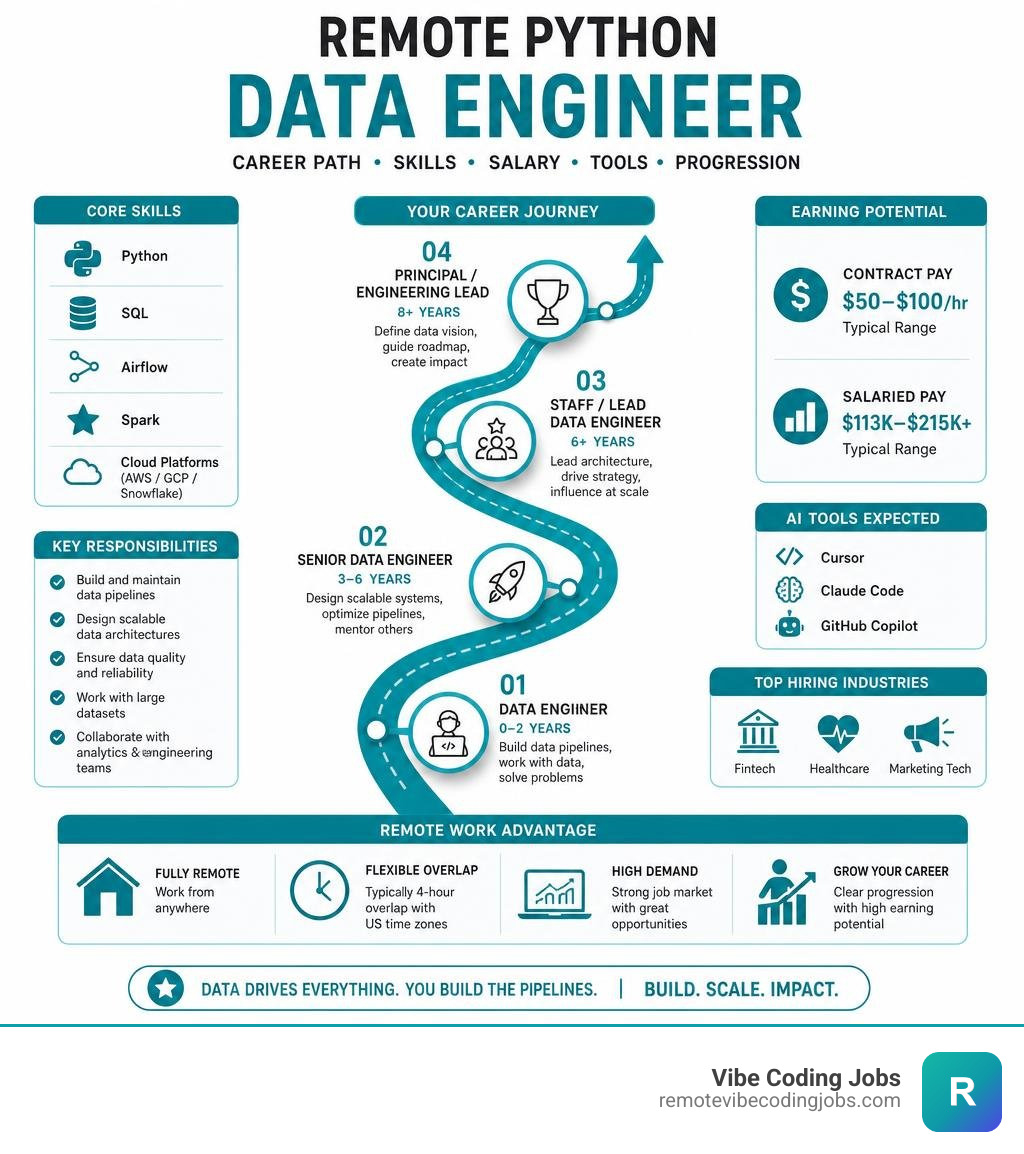
Remote python data engineer jobs vocab explained:
What Does a Remote Python Data Engineer Do?
At its core, a remote Python data engineer is the architect behind a company’s data ecosystem. While data scientists and business analysts spend their time interpreting data to make strategic decisions, data engineers are the ones who build, maintain, and secure the underlying infrastructure that makes those analyses possible.
Without clean, reliable pipelines, even the most advanced machine learning models are useless. As a remote engineer, you design systems that ingest raw data from hundreds of different sources, clean it, transform it into structured formats, and store it safely in cloud data warehouses. Because you are working remotely, you must also be highly skilled at managing these systems asynchronously, ensuring high availability, and automating monitoring so that pipeline failures are caught before they disrupt the business.
Core Responsibilities in Remote Python Data Engineer Jobs
If you step into one of the many Remote Python Developer Jobs specializing in data engineering, your day-to-day responsibilities will generally revolve around several core pillars:
- Designing and Building ETL/ELT Pipelines: You will write Python scripts and utilize modern orchestration tools to Extract data from various APIs, databases, and third-party tools, Transform it to fit business logic, and Load it into central storage systems.
- Data Cleaning and Validation: Raw data is notoriously messy. You will implement validation checks to filter out duplicates, handle missing values, and ensure structural consistency.
- API Integrations: You will frequently write custom Python connectors to link internal systems with external data partners, SaaS platforms, and telemetry sources.
- Data Modeling: You will design database schemas, optimize tables for fast querying, and build tenant-aware storage architectures that keep client data strictly isolated and secure.
Remote Work Structures and Time-Zone Overlap
Working remotely as a data engineer is highly rewarding, but it requires a specific set of operational structures. Most companies hiring for remote Python data engineer jobs do not operate in a complete vacuum. While some offer “work from anywhere” flexibility, the majority require a specific time-zone overlap.
Typically, employers look for at least a 4-hour overlap with US time zones (such as Eastern or Pacific Time) to facilitate team standups, architectural reviews, and incident response sessions. However, the rest of the day is often highly async-first.
In Async-First Python Jobs, asynchronous communication is the default. Instead of constant back-and-forth meetings, engineers write detailed documentation, draft clear Architecture Decision Records (ADRs), and use tools like Slack or Microsoft Teams to update their peers. This structure allows you to focus on deep, uninterrupted work—which is absolutely essential when you are designing complex data systems that handle millions of records.
Essential Technical Skills for Remote Python Data Engineer Jobs
To stand out in the competitive remote job market, you need a balanced blend of traditional software engineering practices, deep database knowledge, and a mastery of modern AI-assisted workflows.
Core Python Libraries and Data Frameworks
Python is the undisputed king of data engineering because of its rich ecosystem of libraries. To succeed, you must be comfortable with the following tools:
- Pandas & NumPy: Essential for local data manipulation, cleaning, and quick exploratory analysis.
- PySpark: The industry standard for distributed computing, allowing you to process massive, multi-gigabyte or terabyte-scale datasets across cloud clusters.
- FastAPI & Django: Often used to build custom internal APIs that serve processed data to web applications or external clients.
- SQL: While Python is your primary language, SQL is still the foundational language of databases. You must write highly optimized queries, manage indexes, and understand execution plans.
Cloud Platforms, Orchestration, and Modern AI Tools
Modern data pipelines do not run on local machines; they live in the cloud. Successful candidates must be proficient in:
- Cloud Platforms: AWS (specifically services like Lambda, S3, Kinesis, and DynamoDB) and Google Cloud Platform (GCP, with tools like BigQuery) are heavily favored by employers.
- Data Warehouses & Lakes: Snowflake and Databricks are the dominant platforms for modern analytical storage.
- Orchestration: Apache Airflow and Prefect are used to schedule, monitor, and manage the execution of complex workflows.
- AI-Assisted Development (Vibe Coding): The landscape is shifting rapidly. Companies are actively seeking engineers who can leverage tools like Cursor, Claude Code, Windsurf, and Aider to ship code faster.
In Vibe Coding Python Jobs, using AI to write boilerplate code, generate unit tests, and draft SQL queries is highly encouraged. The value you bring is no longer in typing out syntax, but in applying human judgment, debugging complex system integrations, and ensuring robust data contracts.
Salary, Experience, and Industry Trends in 2026
As we move through 2026, the job market for data professionals remains incredibly robust. Organizations have realized that AI models are only as good as the data feeding them, leading to a surge in hiring for specialized backend and data roles.
Compensation and Experience Requirements
Salaries for remote Python data engineers are among the highest in the technology sector. Depending on your experience level, you can expect highly competitive compensation packages:
| Experience Level | Years of Experience | Annual Salary Range (US) | Typical Hourly Rate |
|---|---|---|---|
| Junior / Entry-Level | 0–2 years | $80,000 – $110,000 | $40 – $60 / hr |
| Mid-Level | 3–5 years | $110,000 – $150,000 | $60 – $85 / hr |
| Senior | 6–9 years | $150,000 – $215,000 | $85 – $110 / hr |
| Principal / Lead | 10+ years | $215,000 – $280,000+ | $110 – $150+ / hr |
These benchmarks are regularly updated across top-tier platforms. You can view detailed breakdowns of these figures on Python Engineer Salaries.
Top Industries Hiring for Remote Python Data Engineer Jobs
While almost every sector needs data engineering, three main industries are leading the charge in 2026:
- Fintech: Financial technology companies manage massive streams of real-time transactional data. Security, speed, and absolute data integrity are paramount.
- Healthcare: Organizations are modernizing their legacy systems to build scalable, compliant data platforms on GCP and AWS. These roles often require strict adherence to regulatory standards like HIPAA.
- Marketing Intelligence: Marketing tech platforms process vast amounts of telemetry and clickstream data to optimize ad spend and provide real-time attribution analytics.
Whether you are looking to join a fast-growing startup or an established enterprise, you can find tailored postings across all these sectors on our page for Remote Python Developer Jobs.
How to Land Remote Python Data Engineer Jobs
Landing a remote role requires more than just submitting a generic resume. You need a targeted strategy that proves you can build reliable systems autonomously.
Interview Preparation and Technical Assessments
The interview process for remote positions is thorough and usually consists of several distinct stages:
- Initial Recruiter Screen: A brief call to discuss your experience, remote setup, and time-zone availability.
- Technical Assessment: This could be a live coding challenge focused on algorithms and data structures, a SQL optimization test, or a practical take-home assignment where you build a small ETL pipeline using Python.
- System Design Interview: You will be asked to design a scalable data architecture for a hypothetical scenario (e.g., “Design a real-time telemetry processing pipeline for 100,000 connected vehicles”).
- Vibe Coding Evaluation: Increasingly, forward-thinking teams will evaluate how effectively you use AI assistants. They want to see if you can use tools like Cursor or Claude to solve complex problems quickly while maintaining high code quality and writing robust unit tests.

Where to Find the Best Remote Roles
To find high-quality, vetted remote positions, you should look beyond generic job boards. Here are the best places to focus your search:
- Vibe Coding Jobs: If you love working with AI tools and want to join forward-thinking, async-first companies, browse our curated listings at Vibe Coding Jobs.
- Specialized Job Boards: The official Python Job Board is an excellent resource for pure Python and data-focused roles.
- Professional Networks: Platforms like Python Data Engineer jobs in United States – LinkedIn and Flexible Remote Python Data Engineer Jobs – Indeed offer robust filters for fully remote work.
- Direct Applications: Keep an eye on career portals at top firms. For instance, you can find high-impact roles like the Senior Software Engineer, Python (Data Platforms) | Careerport or specialized international contract roles such as the Data Platform Engineer (Python / Golang) – Intellias and Python Engineer with Data Focus (Remote) | Remotepulse .
Career Progression and Overcoming Remote Challenges
A career in data engineering is not static. The skills you build today will open doors to some of the most advanced roles in the tech industry.
Career Paths: From Data Engineering to AI and Architecture
Once you establish yourself as a strong remote Python data engineer, several highly lucrative career paths become available to you:
- Data Architecture: Move away from writing daily pipelines and focus on high-level strategy, designing the overall data structure, governance models, and cloud infrastructure for the entire enterprise.
- Machine Learning (ML) Engineering: Bridge the gap between data engineering and AI. You will build the infrastructure required to train, deploy, and monitor machine learning models in production.
- Management: If you enjoy mentoring and coordinating teams, you can transition into roles like Data Engineering Manager or Director of Data.
If you are interested in transitioning toward predictive modeling and statistical analysis, you can also explore opportunities in Remote Data Scientist Jobs.
Overcoming the Challenges of Remote Data Engineering
While working from home offers incredible freedom, it also comes with unique hurdles:
- Data Security and Compliance: As a remote engineer, you may be accessing sensitive production databases from your home office. Successful remote engineers overcome this by strictly adhering to company VPN protocols, utilizing secure IAM roles, and never downloading production data to local machines.
- Asynchronous Communication: To prevent misunderstandings, make it a habit to over-communicate. Document your pipeline designs, write clear pull request descriptions, and proactively update your team on project blockers.
- Combating Isolation: Working alone can feel isolating. Engage with online developer communities, participate in virtual team socials, and ensure you have a dedicated workspace to maintain a healthy work-life balance.
Frequently Asked Questions about Remote Python Data Engineering
What is the typical salary for a remote Python data engineer?
In the United States, salaried remote Python data engineers typically earn between $113,000 and $215,000 per year, depending on their experience and the size of the company. Contract roles are also highly common, with hourly rates ranging from $50 to $100+ per hour.
Do I need a degree to get a remote Python data engineering job?
While many job listings (such as the Senior Software Engineer, Data Systems – Python at Northbeam – United States Remote ) mention a computer science degree, it is not an absolute requirement. A strong portfolio of real-world projects, contributions to open-source data tools, and a proven track record of building reliable pipelines can easily outweigh a formal degree.
How is AI changing remote Python data engineering?
AI is dramatically accelerating the development cycle. Instead of spending hours writing boilerplate code, parsing JSON files, or writing basic SQL queries, engineers use AI tools like Cursor and Claude to generate code in seconds. This allows data engineers to focus on higher-value tasks like system architecture, data modeling, security compliance, and pipeline reliability.
Conclusion
The market for remote Python data engineer jobs has never been more exciting. As companies continue to amass massive datasets and integrate advanced AI systems, the need for skilled professionals who can build and maintain the underlying data pipelines will only grow.
By mastering core Python frameworks, understanding modern cloud architectures, and embracing AI-assisted “vibe coding” tools, you can position yourself as a highly competitive candidate for these lucrative, flexible roles.
Ready to take the next step in your remote career? Explore our curated, daily-updated listings and Find Remote Python Developer Jobs on Vibe Coding Jobs today!