
The Top Remote Django Developer Jobs for Experts
The 2026 Remote Django Job Market: What Experts Need to Know
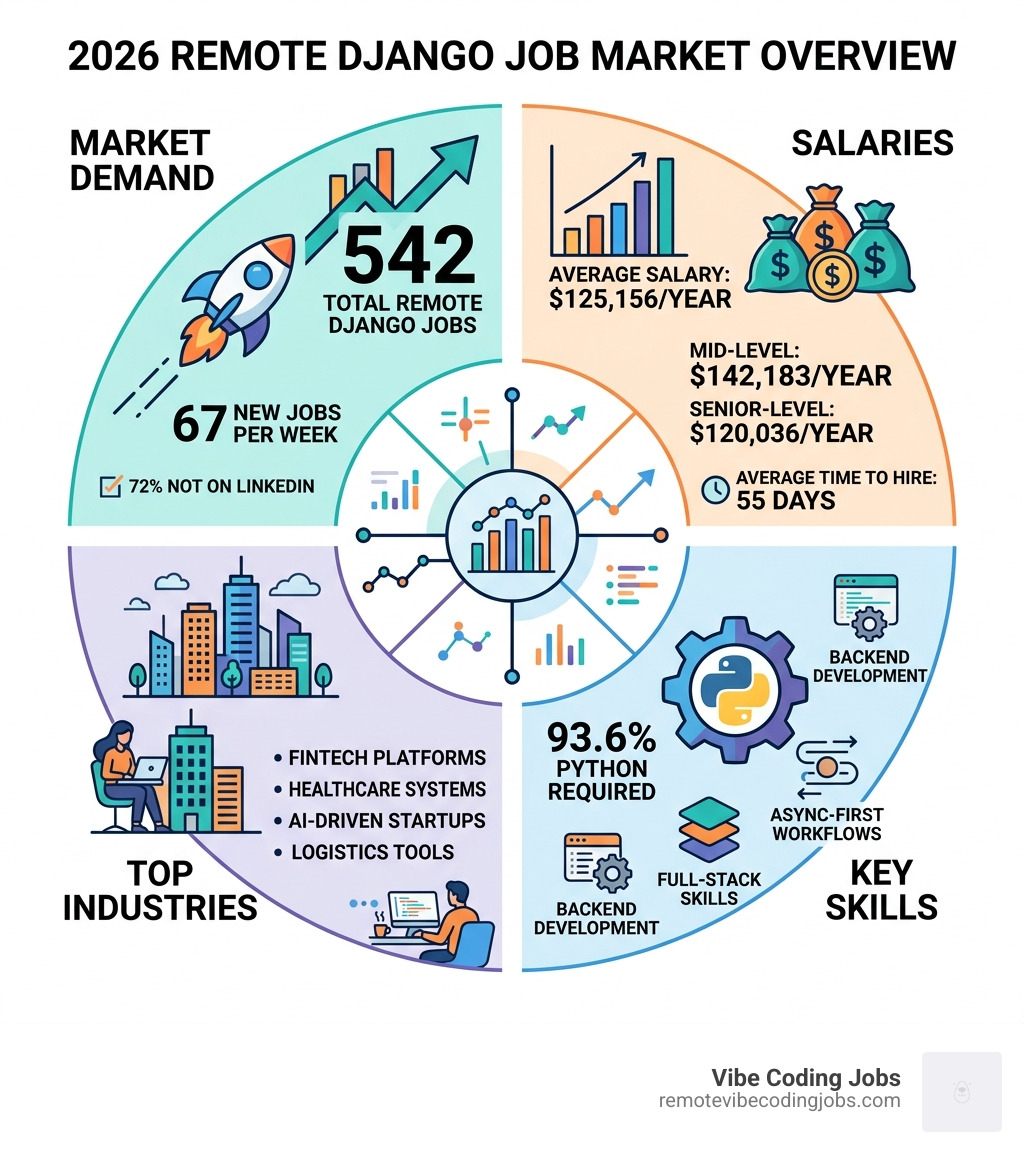
Remote Django developer jobs are in strong demand right now, with over 540 active openings worldwide and dozens of new roles added every week. Here’s a quick snapshot of what the market looks like in May 2026:
| Factor | Current Data |
|---|---|
| Total remote Django jobs | 542 |
| New jobs added per week | 67 |
| Average salary | $125,156/year |
| Mid-level average | $142,183/year |
| Senior-level average | $120,036/year |
| Jobs NOT on LinkedIn | 72% |
| Average time to hire | 55 days |
| Python required in listings | 93.6% |
The biggest takeaway: most of these jobs won’t show up in your LinkedIn feed. Finding the best roles means knowing where to look.
Django remains one of the most in-demand Python frameworks for backend and full-stack remote work. It powers everything from fintech platforms and healthcare systems to AI-driven startups and logistics tools. Whether you’re a mid-level engineer or a seasoned senior developer, there are real opportunities — at real salaries — available fully remote.
We’re the RVCJ Editorial team at Vibe Coding Jobs, covering remote developer hiring trends, AI-assisted workflows, and career guidance for engineers — including the full landscape of remote Django developer jobs across async-first, global teams. In this guide, we break down exactly where the market stands, what it pays, and how to land the right role.
Current Market Demand for Remote Django Developer Jobs
As we move through May 2026, the demand for Python-based web development remains remarkably resilient. Currently, there are 542 remote Django developer jobs available worldwide. What is particularly interesting for job seekers is the velocity of the market; we are seeing approximately 67 new remote Django jobs posted every single week.
However, there is a catch that most developers miss: the “hidden” job market. Our research indicates that 72% of remote Django jobs are NOT posted on LinkedIn. Instead, these companies often hire through specialized developer networks, niche job boards, or internal community referrals. This is why we focus on aggregating these high-quality listings at Vibe Coding Jobs, ensuring you see the roles that others overlook.
The current landscape favors backend engineering and full-stack roles that can handle the complexity of modern data systems. Whether it’s a startup building a new AI platform or an established enterprise migrating legacy SAS logic to Python, the need for clean, scalable Django code is at an all-time high. For those looking to dive into these opportunities, you can explore more about Django developer roles and the specific companies currently scaling their distributed teams.

Salary Benchmarks and Compensation for Django Experts
Compensation for remote Django developer jobs remains highly competitive, though it carries some interesting nuances regarding experience levels. The average salary for a remote Django developer currently sits at $125,156 per year.
Salary Breakdown by Experience
Interestingly, the “mid-level” tier (2-4 years of experience) often sees higher average base salaries than the “senior” tier in recent listings. This is frequently due to high-growth startups aggressively bidding for “doer” engineers who can ship features immediately.
| Experience Level | Average Annual Salary |
|---|---|
| Mid-Level (2-4 years) | $142,183 |
| Senior (5-9 years) | $120,036 |
| Lead / Architect | Up to $200,000 |
Note: Senior roles often include higher equity stakes or performance bonuses that aren’t always captured in base salary averages.
Beyond the base pay, experts in this field can expect a robust benefits package. Common perks in the 2026 market include:
- Equity & Stock Options: Particularly in early-stage startups where you are an early engineering hire.
- Health & Wellness: Comprehensive health insurance and 401k matching (standard for US-based remote roles).
- Flexible Time Off: Many remote-first companies now offer 20-24 “flex days” or paid time off in addition to public holidays.
- Sign-on Bonuses: We’ve seen listings offering bonuses simply for completing the technical assessment stages.
To find your next high-paying role, check out the latest High-paying Remote Django Developer Roles on our platform.
Essential Tech Stacks and Skills for Remote Django Roles
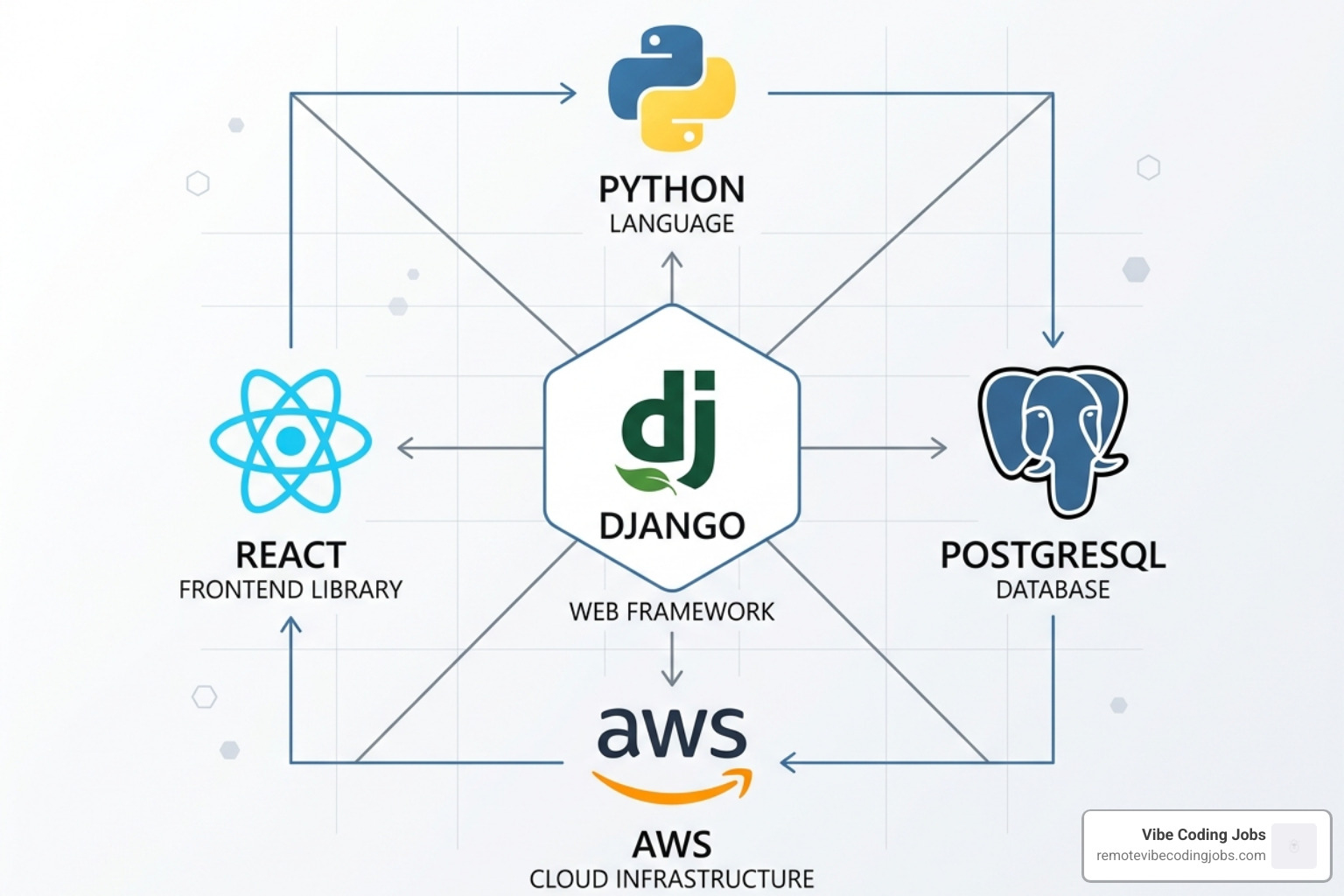
Landing a top-tier remote role requires more than just knowing how to write a view. The 2026 tech stack is increasingly integrated. Python appears in 93.6% of these job postings, while Django itself is explicitly mentioned in 80.8%.
The Most In-Demand Pairings
If you want to be a competitive candidate for remote Django developer jobs, you should be proficient in these complementary technologies:
- Databases: PostgreSQL is the gold standard, appearing in over 25% of specialized listings.
- Frontend: React remains the most popular pairing for full-stack Django roles.
- APIs: Mastery of Django REST Framework (DRF) is essential, though GraphQL is gaining significant traction in logistics and AI startups.
- Cloud & DevOps: AWS, Docker, and Kubernetes are frequently required for senior positions to ensure scalable deployment.
- Alternative Frameworks: Knowledge of Flask (31.9%) and FastAPI (27.7%) is a major plus, as many companies use a microservices architecture where different frameworks live side-by-side.
We recommend developers stay sharp on “vibe coding” practices—using AI-assisted tools like Cursor or Claude to speed up boilerplate generation while focusing their human expertise on architectural design and security. You can Browse Remote Django Developer Jobs on Vibe Coding Jobs to see which specific stacks companies are currently hiring for.
Finding the Best Remote Django Developer Jobs
To find the “hidden” gems, you need to look where the community lives. Many of the best roles are sourced from the Django community itself—distributed via RSS feeds, community job boards, and async-first company career pages. Companies like those in the fintech and healthcare spaces often prefer hiring from specialized pools because they value developers who understand the specific nuances of Django’s ORM and security features.
Career Growth in Remote Django Developer Jobs
The career path for a Django expert doesn’t stop at “Senior Developer.” In a remote environment, growth often looks like moving into a Staff Engineer or Software Architect role. These positions focus less on daily tickets and more on system design, mentoring junior developers across time zones, and contributing to open-source projects. Many companies now actively encourage (and pay for) their engineers to contribute back to the Django Software Foundation or speak at DjangoCon.
Top Industries and Companies Hiring Remote Django Talent
Django’s “batteries-included” philosophy makes it the framework of choice for industries that prioritize security and rapid scaling.
- Fintech & Insurance: Building modern insurance tech and payroll APIs that cover millions of workers. These roles often involve processing massive amounts of data via Celery pipelines.
- Healthcare & Biotech: Django is widely used in medical software that requires HIPAA compliance. We see many roles focusing on connecting families with pediatricians or managing FDA-cleared medical devices.
- AI & Algorithmic Startups: This is the fastest-growing sector. Companies are looking for Django engineers to build the backend infrastructure for Generative AI and RAG (Retrieval-Augmented Generation) systems.
- Logistics & Transport: Real-world problem solving, such as scheduling and tracking for global transport networks, relies heavily on Django’s robust admin and ORM capabilities.
Navigating the Hiring Process for Remote Django Positions
The hiring process for remote Django developer jobs is thorough. On average, it takes about 55 days to fill a position. Here is what a typical journey looks like:
- Initial Screen: A brief conversation about your experience with Python/Django and your remote work setup.
- Technical Assessment: This might be a take-home project or a live coding session. Some startups now offer a $100 bonus just for reaching and completing the second assessment stage to respect your time.
- Deep Dive: A focus on Django internals—ORM optimization, middleware, and security practices.
- Cultural/Vibe Fit: Discussions on async communication and how you use AI tools like Cursor to enhance your workflow.
Timezone and Geographic Constraints
While many roles are “work-from-anywhere,” many companies still require a timezone overlap. Common requirements include:
- CET +/- 3 hours for European and EMEA-based companies.
- US Eastern Time overlap for North American startups.
- US Work Authorization: Some roles are 100% remote but require you to be legally authorized to work in the US without sponsorship.
Frequently Asked Questions about Remote Django Developer Jobs
Are there entry-level remote Django opportunities?
Yes, though they are more competitive. We see remote internships and junior roles that focus on data integration and basic API development. Some offer small stipends (around $200/month for international internships), but many are “no degree required” pathways for those with a strong GitHub portfolio.
How does Django compare to Flask or FastAPI in the remote market?
Django remains the leader for “monolithic” or feature-heavy applications. However, Flask (31.9%) and FastAPI (27.7%) are very common in job descriptions. Usually, a company hiring for a Django role expects you to be comfortable with the others for smaller microservices or high-performance async tasks.
What are the common geographic restrictions for remote roles?
The most common restriction is tax residency and legal employment status. Many global companies hire as “Contractors” to bypass geographic restrictions, allowing you to “live anywhere, work everywhere.” However, always check if the role requires specific regional authorization (like USA or EU).
Conclusion
The market for remote Django developer jobs in 2026 is vibrant and specialized. Companies aren’t just looking for someone who can code; they want experts who can architect systems, leverage AI tools like Claude and Cursor, and thrive in an async-first culture.
By focusing on the “hidden” market and mastering the integrated tech stack of Python, PostgreSQL, and React, you can secure a role that offers both high compensation and the flexibility of remote work.
Ready to find your next challenge? Apply for remote Python developer jobs today and join a community that values deep expertise and modern workflows.