The Real State of Remote iOS Developer Jobs in 2026
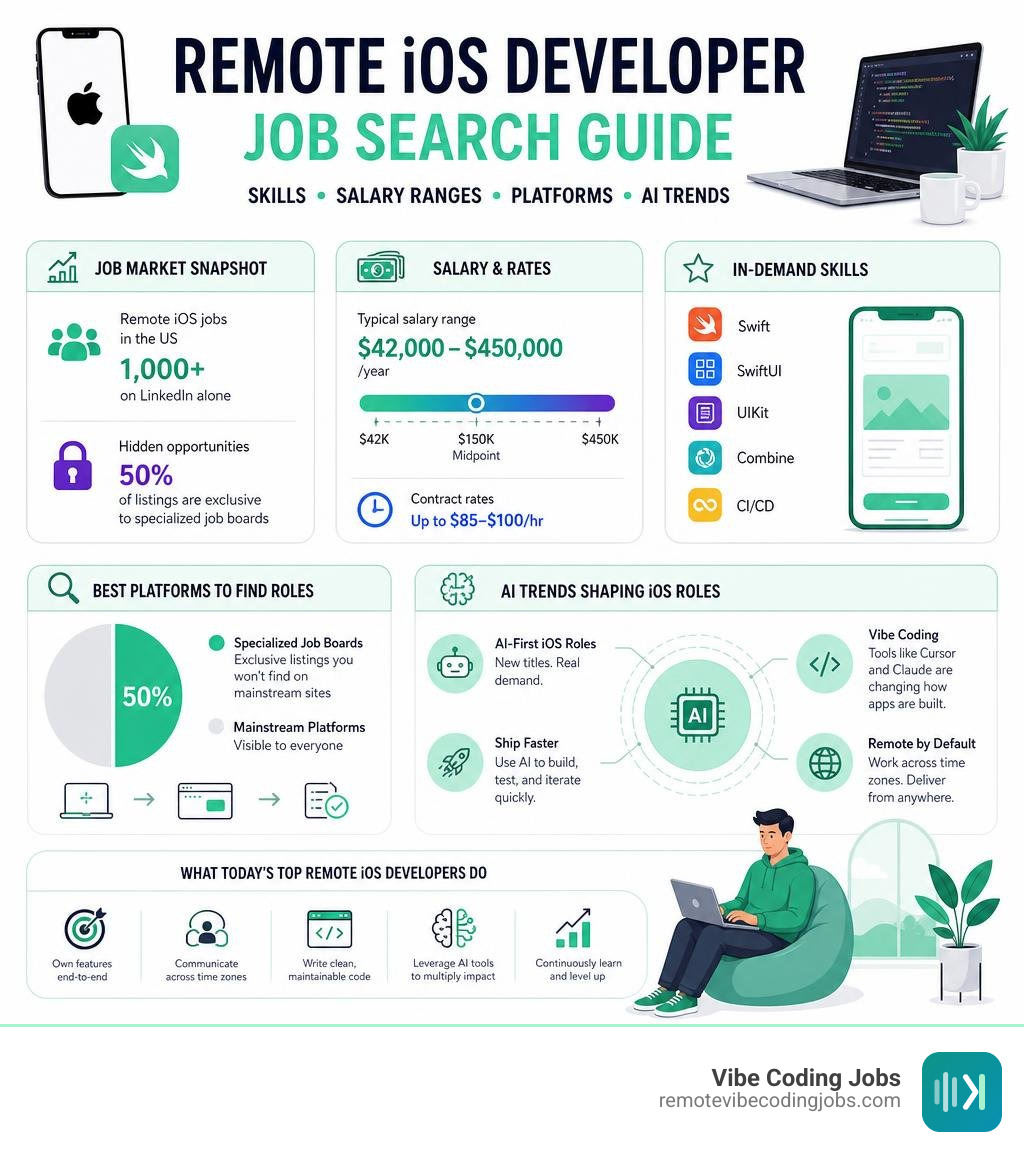
Remote iOS developer jobs are more plentiful — and more competitive — than ever. Here’s a quick snapshot of where things stand right now:
| What You Want to Know | Quick Answer |
|---|---|
| How many remote iOS jobs exist in the US? | 1,000+ on LinkedIn alone |
| Typical salary range | $42,000 to $450,000/year depending on location and seniority |
| Most in-demand skills | Swift, SwiftUI, UIKit, Combine, CI/CD |
| Best platforms to find roles | Specialized job boards, not just LinkedIn (50% of listings are exclusive) |
| New trends to know | AI-First iOS roles, vibe coding with Cursor and Claude |
| Contract rates | Up to $85–$100/hr for remote iOS work |
The iOS job market has quietly become one of the best opportunities in remote tech. Over 1,000 remote iOS roles are actively listed in the US right now. And a significant slice of those — roughly half on some specialized boards — never show up on mainstream platforms like LinkedIn.
That’s a massive hidden job market most developers don’t even know exists.
At the same time, the role itself is changing fast. Companies are no longer just hiring people who can write Swift. They’re looking for engineers who can ship features independently, work across time zones, and increasingly, use AI tools like Cursor and Claude to move faster. Titles like “AI-First iOS Engineer” and “AI Native iOS Developer” are showing up in real job listings right now.
Whether you’re job hunting for the first time or ready to level up to a senior role, knowing where to look and what skills to lead with makes all the difference.
I’m Di Su, a software engineer with 10+ years of experience building scalable, user-focused products — and I’ve applied that same systems thinking to researching the current landscape of remote iOS developer jobs so you can cut through the noise faster. Let’s get into exactly what the market looks like, what pays well, and how to land the role you want.
Important remote ios developer jobs terms:
The Landscape of Remote iOS Developer Jobs in 2026
The market for remote iOS engineers is undergoing a massive shift. If you are only looking at major job aggregators like LinkedIn or Indeed, you are only seeing half the picture.
In fact, market data shows that up to 50% of the remote iOS developer jobs listed on specialized platforms are completely absent from LinkedIn. This hidden job market represents a massive opportunity for developers who know where to look. While there are over 1000+ Remote Ios Developer jobs in United States listed on traditional professional networks, the most forward-thinking, async-first companies prefer to list their openings on specialized platforms.
This shift toward specialized job boards is driven by a change in company cultures. Truly remote companies are moving away from hybrid setups and toward fully asynchronous environments. They want self-starting developers who can manage their own time, write clean code, and communicate effectively in writing. Rather than sorting through thousands of generic applications on mass job boards, these companies target curated communities where they can find specialized, highly productive talent.
The Rise of AI-First and Vibe Coding Workflows
The biggest technological shift in 2026 is the institutionalization of “vibe coding” — the practice of using AI-assisted development tools like Cursor, Claude Code, and GitHub Copilot to accelerate software creation.
Vibe coding is no longer just a hobbyist trend; it is now a legitimate, explicitly stated requirement in job descriptions at major global companies. Startups and enterprises alike are actively seeking “AI-First” and “AI Native” iOS engineers. These companies realize that developers who leverage AI tools as daily force multipliers can build, prototype, and ship features 3x to 10x faster than traditional developers.
In this new era, your value as an iOS developer is less about memorizing syntax and more about your ability to architect solutions, manage system design, and direct AI tools effectively. Product thinking and user interface design instincts are becoming the ultimate multipliers.
Remote vs. Hybrid and Onsite Expectations
Working in a fully remote iOS role is fundamentally different from hybrid or onsite positions. In an onsite role, you might walk over to a QA engineer’s desk with a physical test device. In a remote role, you must manage your testing pipelines and device provisioning asynchronously.
Furthermore, remote roles often come with specific timezone and geographic constraints:
- Timezone Overlaps: Many “fully remote” roles require a minimum timezone overlap. For example, some US-based startups require at least 4 hours of overlap with US Pacific Time, while other global teams coordinate around core hours in Indian Standard Time (IST) or Eastern European Time (EET).
- Geographic Restrictions: Due to tax laws and W-2 employment regulations, many remote jobs require you to reside in specific states or countries.
- Physical Hardware: Some remote hardware-integrated roles (like IoT or connected health apps) require shipping physical testing devices to your home office, occasionally requiring proximity to a central hub for device collection.
Essential Tech Stack and Skills for Remote iOS Engineers
To qualify for high-paying remote iOS developer jobs, you need a robust technical foundation. The modern Apple ecosystem demands mastery of both native frameworks and collaborative remote tools.

The core of your stack should always start with Swift. While Objective-C is still highly relevant for legacy systems, Swift is the language of modern iOS development. You can explore active listings specifically focused on this language on our Remote Swift Developer Jobs page.
Beyond basic Swift proficiency, modern remote roles expect deep knowledge of:
- SwiftUI: This has officially become the standard UI framework for new features and greenfield applications.
- UIKit: Essential for maintaining complex legacy architectures, custom navigation flows, and specialized view layouts where SwiftUI is not yet sufficient.
- Combine and Swift Concurrency: Managing asynchronous data streams using Async/Await, Actors, and Tasks is crucial for building responsive, modern apps.
- CoreData and Realm: Storing local user data securely and building offline-first experiences.
Modern Frameworks and Mobile DevOps
In a distributed team, automation is your best friend. Remote teams rely heavily on robust mobile DevOps pipelines to ensure code quality and seamless deployment without manual intervention.
To stand out to remote employers, you must be comfortable with:
- CI/CD Pipelines: Setting up and maintaining automated build pipelines using Fastlane, GitHub Actions, or Xcode Cloud.
- TestFlight Cadence: Managing weekly beta releases and distributing builds to remote QA teams and stakeholders.
- App Store Connect: Handling the end-to-end App Store submission process, including metadata management, privacy labels, and review guidelines.
- Automated Testing: Writing robust unit and UI tests using XCTest and XCUITest to prevent regressions in highly collaborative codebases.
Hardware Integrations and Compliance
As mobile technology expands into healthtech, fintech, and IoT, specialized technical skills are commanding premium salaries.
Many remote iOS positions involve integrating apps with physical hardware using CoreBluetooth (BLE). For example, in the digital health and clinical trial space, developers build apps that connect to medical sensors, securely syncing local data via Realm or SQLite to cloud databases like MongoDB Atlas. These highly regulated industries require developers to have a strong understanding of compliance standards like HIPAA and GDPR to ensure user data privacy and security.
Salary Expectations and Seniority Levels
Compensation for remote iOS developer jobs is highly lucrative, but it varies significantly based on your experience level, specialization, and geographic location.
Even for fully remote roles, companies often benchmark their compensation packages against major tech hubs. Here is a comparison of typical remote iOS developer salary ranges across key US regions:
| Tech Hub Location | Junior / Mid-Level Range | Senior / Staff Engineer Range |
|---|---|---|
| San Francisco Bay Area | $100,000 – $160,000 | $140,000 – $450,000+ |
| New York City | $48,000 – $192,000 | $100,000 – $440,000+ |
| Seattle | $100,000 – $178,000 | $178,000 – $313,000+ |
For a broader look at how remote engineering salaries scale across different technologies, check out our guide on Remote Developer Salary Expectations by Experience Level.
Entry-Level vs. Mid-Level Remote iOS Developer Jobs
If you are applying for junior or mid-level remote roles, employers want to see that you can work independently without constant hand-holding.
At this level, you should have 3 to 6 years of professional experience, a solid portfolio of published App Store apps, and a strong grasp of fundamental mobile architecture patterns like MVC and MVVM. You will often be tasked with maintaining and modernizing existing codebases. For instance, you might be hired to refactor legacy Swift code, improve app stability, or establish a structured Git workflow (branching, pull requests, code reviews, and release tagging) for an application in production with over 1 million downloads.
Senior and Staff Remote iOS Developer Jobs
Senior and Staff iOS engineers are expected to own the technical roadmap of an entire mobile product. You must be able to design scalable system architectures, lead cross-functional product discussions, and optimize app performance.
These high-level roles often require 5+ to 7+ years of professional experience and a proven track record of shipping complex applications. To see what top-tier senior expectations look like in practice, explore active leadership postings like the Ruby Labs Lead iOS Engineer role or check out the requirements for the Mindd Mobile Engineer position.
How to Find and Apply for Remote iOS Roles
Landing a remote iOS job requires a targeted approach. Because remote work attracts a global pool of applicants, generic resumes sent through giant job boards rarely succeed.
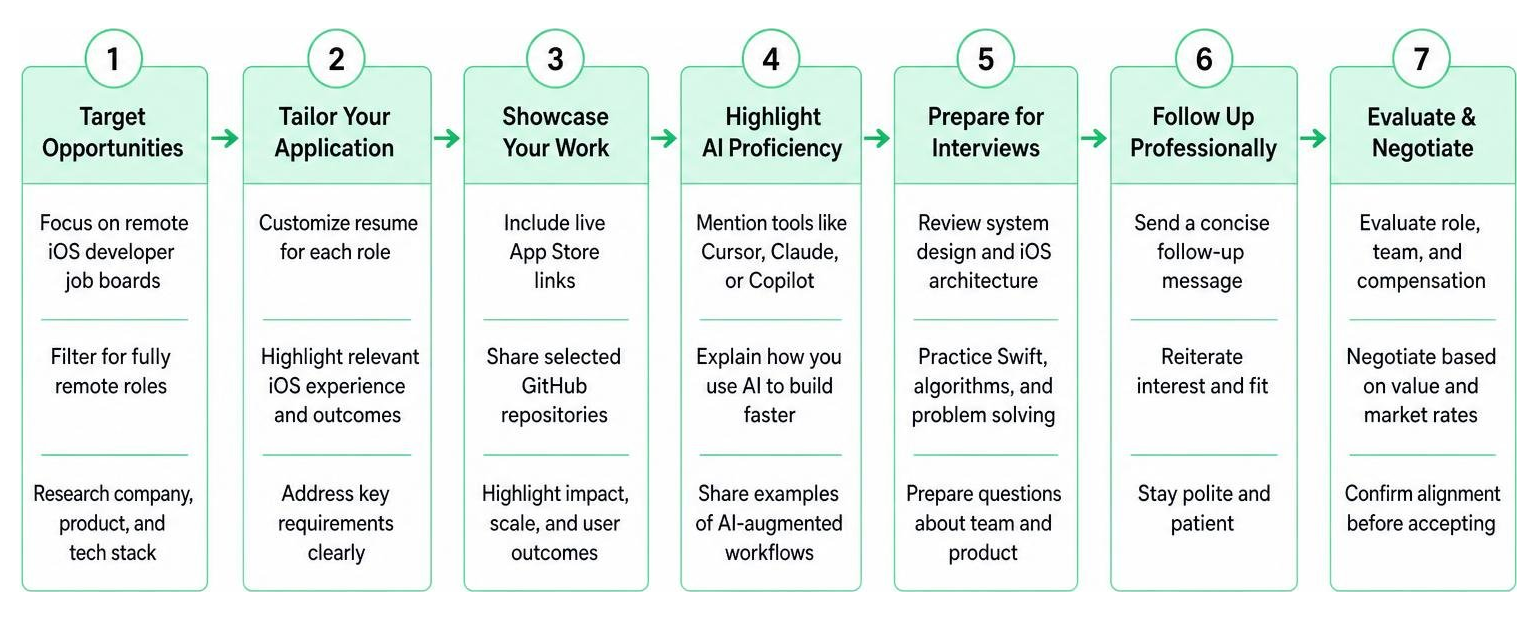
To maximize your chances, we recommend following these proven application strategies:
- Prioritize Specialized Job Boards: Focus on platforms that cater specifically to remote developers and AI-fluent builders.
- Showcase Live App Store Links: A GitHub repository is great, but a live, downloadable app in the Apple App Store is the ultimate proof of your end-to-end development capabilities.
- Highlight AI Tool Proficiency: Explicitly mention your experience using Cursor, Claude, or Copilot to accelerate your development speed.
- Verify Geographic Requirements: Always check the fine print for state or country-specific residency restrictions before applying.
Navigating the Hidden Job Market
To tap into the 50% of remote iOS developer jobs that never make it to LinkedIn, you need to look beyond traditional platforms.
Using specialized niche platforms allows you to bypass the noise of generic job boards. We recommend setting up daily or weekly email alerts on these curated platforms so you can apply within the first 24 hours of a job being posted. Many employers use automated screening or human-verification keywords (like asking you to write a specific phrase in your cover letter) to filter out bot applications, so read every description carefully!
Nailing the Remote Interview Process
The interview process for remote iOS roles is highly technical and designed to evaluate both your coding skills and your remote collaboration habits.
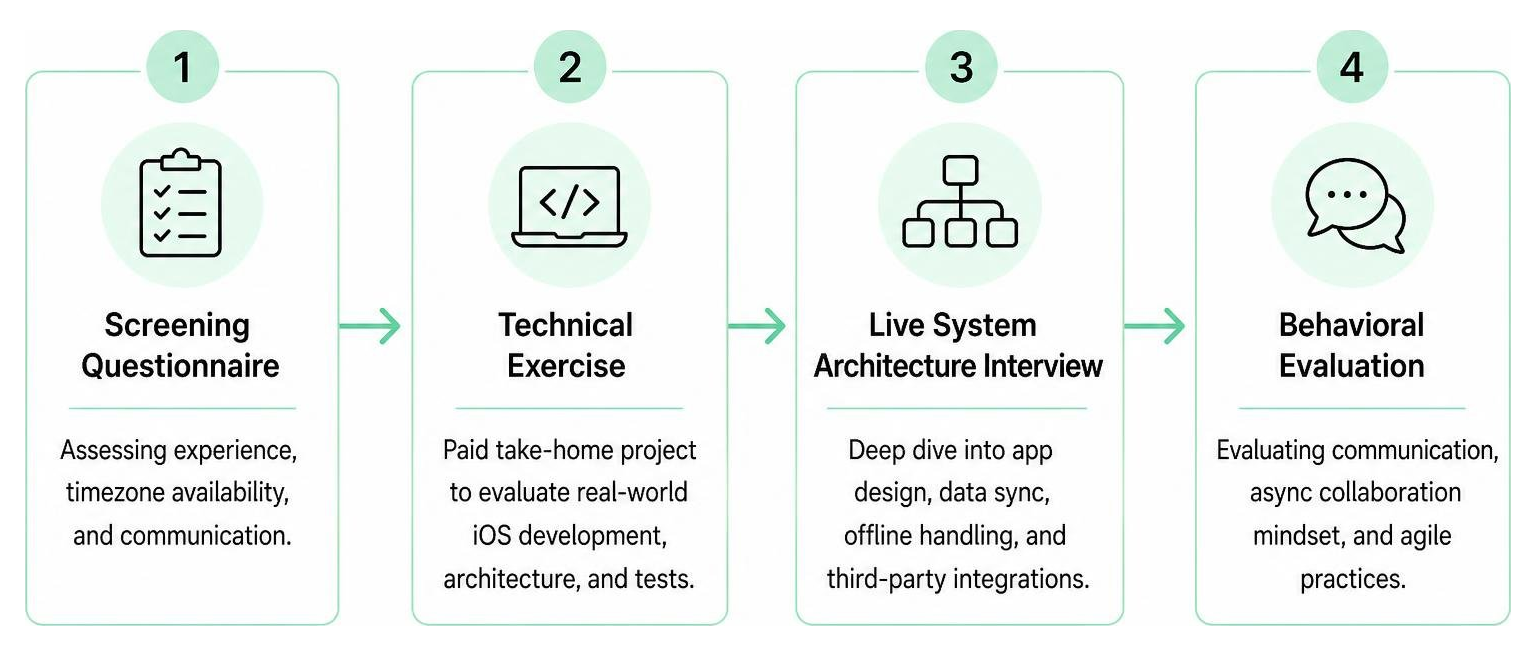
Typically, you can expect:
- Screening Questionnaire: A brief assessment of your experience, timezone availability, and communication style.
- Technical Exercise: Many remote companies prefer a paid take-home technical project over live whiteboarding. They want to see how you structure a real-world iOS app, implement clean architecture, and write tests.
- Live System Architecture Interview: A deep dive into how you design mobile apps, handle offline data synchronization, and integrate third-party APIs.
- Behavioral Evaluation: Assessing your written communication skills, async collaboration mindset, and familiarity with agile development processes.
Frequently Asked Questions about Remote iOS Careers
What is the average salary for a remote iOS developer?
The average salary for a remote iOS developer ranges from $95,000 to $180,000 per year for mid-level roles. However, senior and staff engineers in high-paying markets like San Francisco, New York, and Seattle regularly command salaries between $200,000 and $450,000 per year, depending on the complexity of the app and the company’s industry.
Do remote iOS jobs require legacy Objective-C knowledge?
While modern iOS development is dominated by Swift and SwiftUI, many established companies with massive production apps still require legacy Objective-C knowledge. If you are applying for senior roles at enterprise companies, having the ability to read, refactor, and modernize Objective-C code is a significant competitive advantage.
Can I work as a remote iOS developer training AI models?
Yes! There is a rapidly growing market for remote contract roles focused on AI training. Platforms like DataAnnotation offer flexible, remote roles paying $50 to $100+ per hour for developers to design coding problems, write high-quality Swift code snippets, and evaluate AI-generated code. This is an excellent, highly flexible option for freelancers or developers looking to earn money between full-time roles.
Conclusion

The market for remote iOS developers has evolved. To land the best roles today, you need to combine deep native expertise (Swift, SwiftUI, Combine) with modern, AI-assisted workflows. Companies are looking for proactive, autonomous builders who can leverage tools like Cursor and Claude to ship high-quality features faster than ever before.
If you are ready to bypass the crowded public job boards and find exclusive, curated remote developer roles at async-first companies, we can help.
Explore daily listings filtered by culture, tech stack, and modern AI tools on Vibe Coding Jobs. Let’s find your next remote iOS adventure!