
Remote Backend Claude Jobs Are Booming — Here’s What You Need to Know
Remote backend Claude jobs are one of the fastest-growing categories in tech hiring right now. If you want a quick overview of what’s available, here it is:
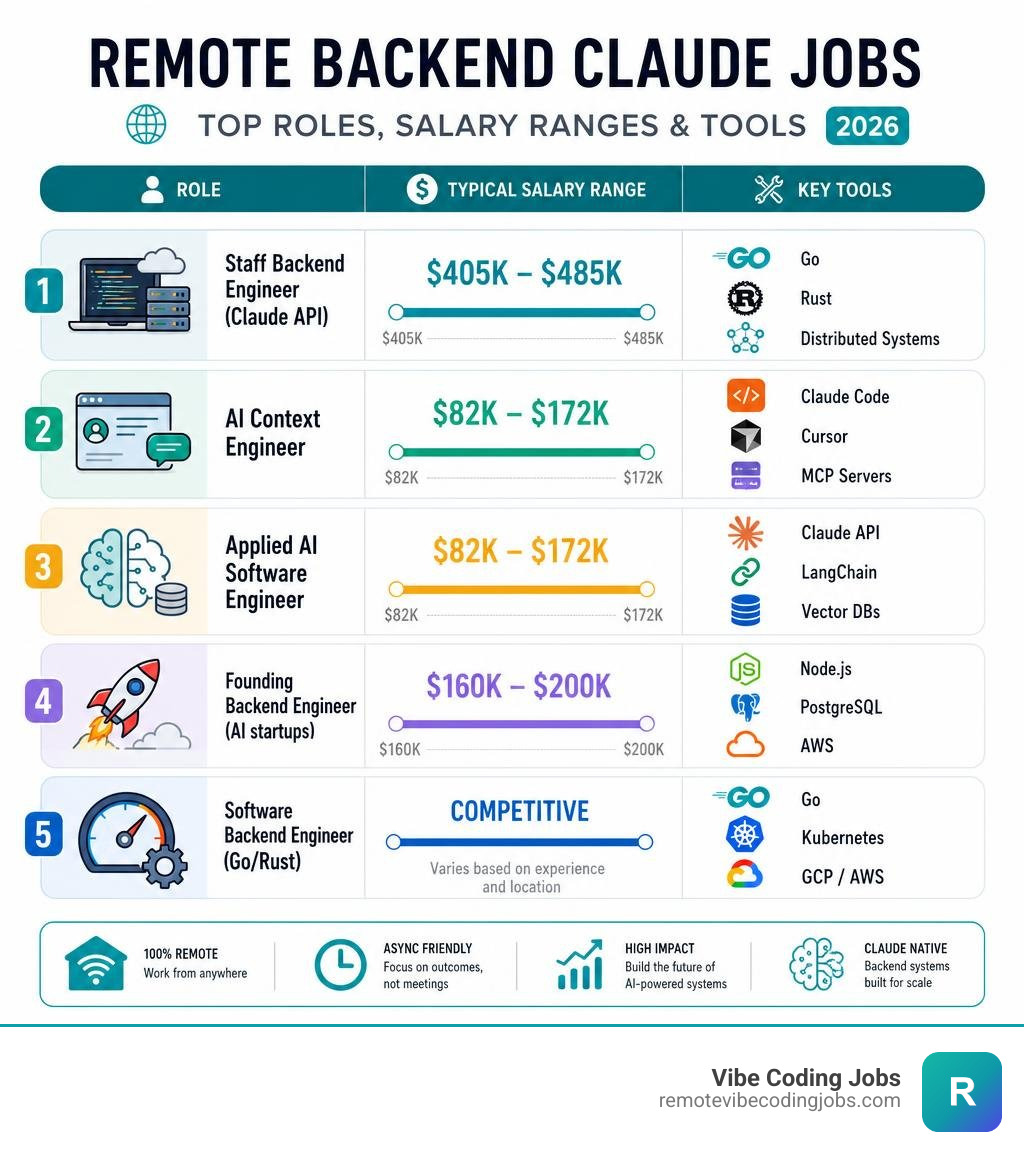
Top remote backend Claude roles in 2026:
| Role | Typical Salary Range | Key Tools |
|---|---|---|
| Staff Backend Engineer (Claude API) | $405K–$485K | Go, Rust, distributed systems |
| AI Context Engineer | $82K–$172K | Claude Code, Cursor, MCP servers |
| Applied AI Software Engineer | $82K–$172K | Claude API, LangChain, vector DBs |
| Founding Backend Engineer (AI startups) | $160K–$200K | Node.js, PostgreSQL, AWS |
| Software Backend Engineer (Go/Rust) | Competitive | Go, Kubernetes, GCP/AWS |
The market has shifted fast. Companies aren’t just experimenting with Claude — they’re building entire backend systems on top of it. Anthropic alone lists over 60 open AI research and engineering roles as of June 2026, and job boards are tracking hundreds more across startups, scale-ups, and enterprise teams. Backend engineers who know how to work with Claude’s API, manage context windows, and ship production-grade agentic systems are in serious demand.
This isn’t a niche anymore. It’s the new baseline for senior backend work.
I’m from the RVCJ Editorial team at Remote Vibe Coding Jobs — we cover AI-assisted development, async hiring trends, and career guidance for engineers building with tools like Claude Code, Cursor, and Copilot, with a specific focus on remote backend Claude jobs and how to land them. With that context in hand, let’s dig into where the best opportunities are and exactly how to get hired.
Remote backend claude jobs word guide:
The Evolving Landscape of AI-Assisted Backend Engineering
The backend engineering landscape in June 2026 looks vastly different than it did even a couple of years ago. Traditional backend work used to involve writing endless boilerplate, manually mapping database schemas, and writing repetitive unit tests. Today, the rise of “vibe coding” and advanced agentic tools has automated much of that routine work.
Instead of writing every single line of code from scratch, modern backend developers act as systems architects and context engineers. We focus on designing robust distributed systems, planning clean API contracts, and orchestrating multi-step agentic workflows.

This evolution is heavily driven by the maturity of specialized developer tooling. If you want to understand how these tools compare and how to leverage them, take a look at our guide on Claude Code vs Copilot for Developers in 2026: A Deep Dive.
For backend developers working remotely, mastering these tools isn’t just about speed; it’s about being able to manage larger codebases independently. To get the most out of your setup, check out the Best Claude Code for Remote Developers in 2026: A Comprehensive Guide. By shifting your focus from syntax to system architecture, you can command higher salaries and work with more autonomy.
Where to Find High-Paying Remote Backend Claude Jobs
Finding high-quality remote backend Claude jobs requires looking in the right places. Since the tech stack and the philosophy behind AI-assisted development are relatively new, traditional job boards often fail to filter for teams that actually embrace these workflows.

If you are looking to transition to an AI-native team, we curate daily opportunities for the modern Remote Backend Developer directly on our platform. You can find active listings from companies that encourage the use of LLMs and agentic tools on Remote Claude AI Jobs on Vibe Coding Jobs.
Top Roles in Remote Backend Claude Jobs
As organizations integrate LLMs deeper into their infrastructure, we are seeing several specialized backend roles emerge:
- AI Context Engineer: This role focuses on designing the development environment itself. Instead of building customer-facing products, context engineers build VS Code tooling, manage Model Context Protocol (MCP) servers, and design structured prompt patterns to ensure that development teams can use Claude safely and efficiently.
- Applied AI Software Engineer: These engineers build the actual applications powered by Claude. They design RAG (Retrieval-Augmented Generation) pipelines, integrate vector databases, and build middleware that structures Claude’s outputs into reliable JSON payloads for frontend consumption.
- Staff Backend Engineer (AI Infrastructure): At larger scale-ups and platforms like the Anthropic Claude Ecosystem, staff-level engineers own the core API architecture. They build high-throughput, low-latency systems that serve millions of model requests while maintaining strict security, permissions, and rate-limiting rules.
How to Prepare for Remote Backend Claude Jobs
To land these roles, you need to demonstrate more than just an ability to write basic prompts. Employers are looking for engineers who understand how to build deterministic systems around non-deterministic models.
- Master Context Architecture: Learn how to manage token usage and context windows. You should be familiar with context compression, semantic caching, and structured document-first context generation.
- Build Agentic Portfolios: Create projects that showcase multi-step reasoning, tool use (function calling), and self-correction loops.
- Keep Your Core Backend Skills Sharp: AI can write code, but it cannot replace your understanding of database indexing, system design, and concurrency. If you are a Python specialist, make sure you know how to build highly optimized asynchronous APIs by exploring Remote Python Developer Jobs to see what modern teams expect.
To find the latest openings specifically tailored to these skills, keep an eye on our curated list of Remote Backend Claude Jobs.
High-Growth Startups and AI Platforms Hiring Now
Several forward-thinking startups and platforms are actively recruiting backend engineers who are fluent in the Claude ecosystem:
- AI-Native Database Startups: Companies like Xata are building database infrastructure specifically designed for agentic workloads. You can check out their open positions, such as the Software Backend Engineer (Go/Rust) – Remote – Xata, which focuses on database branching and isolated environments for AI agents.
- Algorithmic and Creator Platforms: Startups like Spotter AI are hiring engineers to build advanced decision flows, scoring systems, and AI-driven routing engines. Explore their requirements through the Remote Backend Django Engineer – AI & Algorithmic Systems – Spotter listing or via Remote Backend Django Engineer – AI & Algorithmic Systems | Remotepulse.
- Early-Stage AI Startups: If you want to be a founding member of a team building offline-first APIs or physical-world AI training platforms, look at roles like the Founding Backend Engineer – Hurren & Hope.
- Task-Based and Freelance Platforms: If you prefer flexible, task-based work over a traditional full-time role, you can find expert-level backend tasks on platforms like the Backend Software Engineer | Remote Jobs on AiDOOS | Task-Based Work for Experts.
For a broader search of the general market, you can also browse the aggregate results on Claude ai jobs in Remote – Indeed or check out Jobs Requiring Claude Code to see which teams are mandating AI-native coding workflows.
To apply to multiple AI-first startups with a single, streamlined application, check out Task-Based Backend Work on Vibe Coding Jobs.
Core Technical Skills and Best Practices for Claude-Powered Backends
Building a backend that relies on Claude requires a strong foundation in cloud infrastructure and distributed systems. When Claude is called as part of a live API request, your backend must handle network latency, rate limits, and potential service interruptions gracefully.
If you are working with Go, containerization, and orchestration, mastering these patterns is essential. Read our guide on Remote Go Developer Jobs with Kubernetes: Your Ultimate Guide to understand how to deploy and scale AI-native microservices. Additionally, Python remains the dominant language for AI integration; you can stay competitive by reviewing the requirements on Remote Python Developer Jobs.
Overcoming Challenges in AI-Assisted Backend Workflows
One of the biggest hurdles in using Claude for backend systems is managing non-deterministic behavior and token usage. Here are some best practices:
- Strict Schema Validation: Always use libraries like Pydantic (Python) or Zod (TypeScript) to validate the JSON returned by Claude. Never assume the LLM’s output matches your database schema without validation.
- Token Management: Compress your prompts and use semantic caching (e.g., using Redis) to avoid sending repetitive context to the model, which dramatically reduces API costs and latency.
- Hallucination Mitigation: Implement chain-of-thought prompting and provide Claude with clear, structured tools (function calling) so it can verify its own assumptions against your database or third-party APIs.
Using specialized CLI tools like Claude Code can help you automate these testing and integration workflows directly from your terminal. For more ways to optimize your remote setup, read our Remote Developer Productivity Tips & Tools: Boost Your Output and explore the modern Remote Developer Tools Stack 2026.
Collaboration Across Research, Product, and Inference Teams
Backend engineers working with Claude do not operate in a vacuum. You will often act as the bridge between machine learning research teams and the product department.
While researchers focus on model capabilities, backend engineers focus on model serving. This involves setting up streaming APIs, managing fallback queues, and optimizing latency. If you use Node.js or TypeScript for your API layer, you can learn more about modern asynchronous API design in our Remote JavaScript Developer Jobs: Your 2026 Career Guide. To understand how to design clean, developer-friendly interfaces for your AI services, check out our resource on the Remote Developer Jobs API.
Frequently Asked Questions about Claude Backend Engineering
To help you navigate this fast-moving job market, we’ve compiled answers to some of the most common questions we receive from backend developers.
| Feature | Traditional Backend Engineering | AI-Assisted / Claude Backend Engineering |
|---|---|---|
| Primary Task | Writing boilerplate, manual schema mapping, writing raw tests | System architecture, context engineering, agentic orchestration |
| Key Skillset | SQL, REST/gRPC, language syntax mastery | Prompt patterns, token management, vector DBs, system design |
| Workflow | Manual coding in IDE | Vibe coding with Claude Code, Cursor, and MCP servers |
| Core Challenge | Code duplication, manual debugging speed | Non-deterministic outputs, API latency, context limitations |
What is the average salary for remote backend engineers working with Claude?
Salaries for remote backend Claude jobs are highly competitive. For junior to mid-level roles (3–5 years of experience), salaries typically range from $82,000 to $172,000 per year. For senior, staff, or founding engineer roles at high-growth startups, compensation packages often range from $160,000 to $238,000 plus equity. At frontier AI research labs like Anthropic, Staff-level backend infrastructure roles can command base salaries between $405,000 and $485,000.
Do I need a computer science degree to get a remote Claude backend job?
No. While some enterprise companies still list a degree as a preference, the majority of startups and AI-first teams value practical skills and a strong portfolio over formal education. If you can show production-ready applications built with Claude, demonstrate clean system design, and write deterministic validation layers, you can land a high-paying role.
What are the most common tools used alongside Claude in backend workflows?
Backend engineers working with Claude typically use:
- Cursor and Claude Code for rapid prototyping and terminal-based code generation.
- Model Context Protocol (MCP) to connect Claude to local databases, GitHub, and internal APIs.
- Vector Databases (like Pgvector, Pinecone, or Qdrant) for managing long-term memory and RAG pipelines.
- Orchestration Frameworks like LangChain, LlamaIndex, or custom lightweight state machines.
Conclusion
The rise of vibe coding has not made backend engineers obsolete — it has simply raised the bar. By automating repetitive coding tasks, tools like Claude allow us to focus on what really matters: building scalable, resilient, and intelligent systems.
If you are ready to work with an async-first company that values your ability to build with AI, we can help you find your next role. We curate the best daily listings filtered by tech stack, culture, and AI tool integration.
Find your next remote role today on Remote Vibe Coding Jobs.