Get Paid to Prompt: Top AI Coding Assistant Jobs
What Are AI Coding Assistant Jobs (and Where to Find Them)?
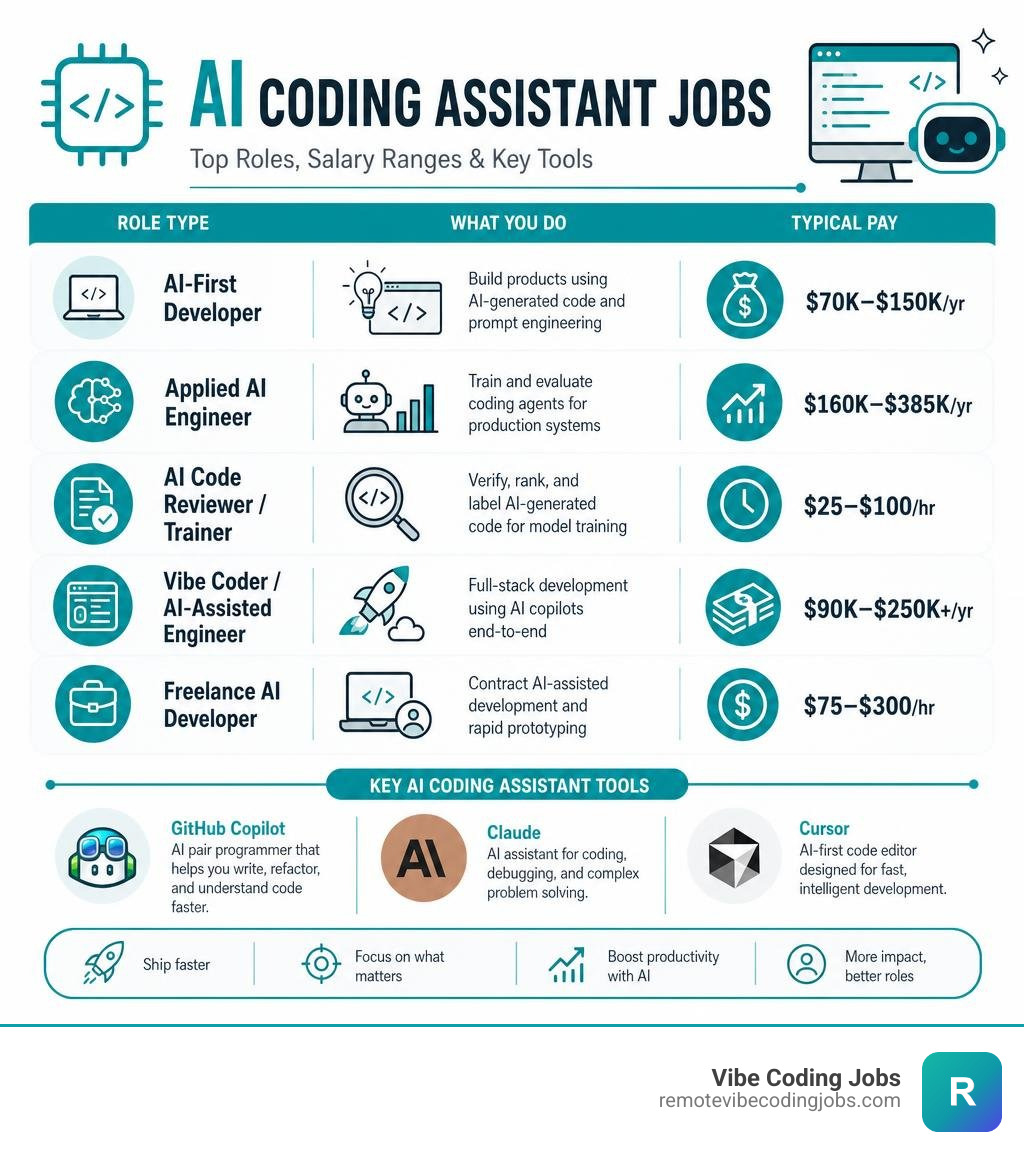
AI coding assistant jobs are roles where developers use AI tools — like GitHub Copilot, Claude Code, or Cursor — to write, review, and ship code faster. Here’s a quick snapshot of what these roles look like:
| Role Type | What You Do | Typical Pay |
|---|---|---|
| AI-First Developer | Build products using AI-generated code and prompt engineering | $70K–$150K/yr |
| Applied AI Engineer | Train and evaluate coding agents for production systems | $160K–$385K/yr |
| AI Code Reviewer / Trainer | Verify, rank, and label AI-generated code for model training | $25–$100/hr |
| Vibe Coder / AI-Assisted Engineer | Full-stack development using AI copilots end-to-end | $90K–$250K+/yr |
| Freelance AI Developer | Contract AI-assisted development and rapid prototyping | $75–$300/hr |
These aren’t niche research positions anymore. Companies like OpenAI, JetBrains, and Google are actively hiring — and the demand is growing fast.
A year ago, “vibe coding” wasn’t even a term most developers had heard. Today, companies are writing it directly into job titles.
The shift is real: developers who know how to work with AI — not just alongside it — are landing roles that didn’t exist 18 months ago. Whether you want to build production coding agents, review AI-generated code for model training, or ship full products using tools like Cursor and Claude, there’s a growing market for your skills.
The AI coding assistant market is projected to hit $10.3 billion by 2028, growing at a 38.4% annual rate. Developers using these tools report a 55% jump in productivity and a 30% drop in time spent on repetitive tasks. That kind of impact is why employers are restructuring entire engineering teams around AI-fluent developers.
I’m part of the RVCJ Editorial team at Remote Vibe Coding Jobs, where we track AI coding assistant jobs across async-first companies and help developers cut through the noise to find roles that match their stack and working style. We’ve watched this market evolve from a handful of experimental roles to hundreds of active listings — and we’re here to help you navigate it.
Essential AI coding assistant jobs terms:
The Rise of AI Coding Assistant Jobs
The landscape of software development is undergoing its most radical transformation since the invention of the high-level programming language. As we move through June 2026, the traditional image of a developer staring at a blank IDE, painstakingly typing out every bracket and semicolon, is quickly becoming a relic of the past. In its place is a highly collaborative, workflow driven by artificial intelligence.

The market for these technologies is expanding at an astronomical pace. With the global AI coding assistant market projected to reach $10.3 billion by 2028, businesses are realizing that integrating AI is no longer optional—it is a baseline requirement for staying competitive. Companies that successfully implement these tools are seeing software development costs drop by up to 40%. This massive economic incentive is driving a hiring boom for professionals who know how to maximize the output of these tools.
To explore the latest remote opportunities in this fast-growing field, check out Remote AI Coding Assistant Jobs.
Defining the AI-Assisted Developer
An AI-assisted developer—often referred to in modern tech circles as a “vibe coder”—is a professional who leverages natural language prompts, agentic workflows, and automated code generation to build applications. Rather than focusing entirely on syntax, these developers operate at a higher level of abstraction.
They use prompt engineering to direct AI agents, orchestrate multi-step code generation tasks, and spend their time reviewing, refining, and integrating the code that the AI produces. This approach is explored in detail in our guide on Vibe Coding Jobs: Remote AI Assistant Careers.
How They Differ from Traditional Software Engineering
Traditional software engineers spend a significant portion of their day writing boilerplate code, debugging syntax errors, and manually searching documentation. They are the “builders” who lay down every single brick.
In contrast, an AI-assisted developer behaves more like an architect or a director. The AI handles the repetitive syntax writing, while the human developer focuses on system architecture, security guidelines, data flow, and product strategy.
According to a detailed breakdown on What are AI Coding Assistants in Software Development? | Sonar, AI coding tools function as highly knowledgeable pair programming partners. This shifts the human’s primary responsibility from typing lines of code to validating logic, analyzing edge cases, and ensuring that the generated code aligns with overall production standards.
Essential Tools and Technologies in the AI Era
To secure one of the top AI coding assistant jobs, you must be deeply familiar with the modern toolkit that powers this new wave of software development. Knowing how to write code is only half the battle; knowing how to orchestrate these tools is what sets high-earning developers apart in June 2026.

The ecosystem has evolved far beyond simple autocomplete plugins. Today’s tools can read entire repositories, plan complex multi-step refactoring tasks, and even spin up their own localized testing environments to debug errors before presenting you with a solution. For a comprehensive comparison of how the market leaders stack up, read our analysis on Cursor vs Copilot vs Claude.
Leading AI Coding Assistants
Several major platforms dominate the industry, and employers frequently look for experience with these specific tools in job descriptions:
- GitHub Copilot: Used by over 1.5 million developers worldwide, Copilot remains a staple in many enterprise environments, offering inline completions and chat-based assistance directly within standard IDEs.
- Gemini Code Assist: Google’s robust offering, known for its deep integration with Google Cloud and its ability to handle massive codebases with large context windows.
- Amazon Q Developer: An AI assistant designed to help developers build, deploy, and operate applications on AWS, making it highly valuable for cloud and DevOps engineers.
You can learn more about how to integrate these platforms into your workflow in our guide on AI Coding Tools for Vibe Coders.
IDE Integrations and Agents
While standard plugins are useful, the real magic happens in AI-native IDEs and agentic workflows. Tools like Cursor and Windsurf have completely reimagined the development environment. Instead of adding AI as an afterthought, these IDEs are built from the ground up to allow AI agents to navigate your codebase, read terminal outputs, and execute terminal commands.
These agentic workflows allow developers to say, “Refactor our authentication system to use OAuth2,” and watch as the AI plans the changes, modifies multiple files, runs the test suite, and presents a clean pull request. To see how companies are hiring for these specific skill sets, browse our listings for Cursor and Copilot Developer Remote Jobs.
Key Skills and How to Transition
If you are looking to transition into this exciting field, you might wonder what skills are actually required. Many believe that AI tools make software engineering “too easy” and eliminate the need for deep technical skills. In reality, the opposite is true: experienced developers benefit the most from AI because their foundational knowledge acts as a force multiplier for the tool’s effectiveness.
If you are ready to make the leap, you can find active listings on AI Programmer Jobs on Vibe Coding Jobs.
Key Skills Required for AI Coding Assistant Jobs
To stand out to employers hiring for these roles, you need a blend of classic engineering fundamentals and cutting-edge AI orchestration skills:
- Strong Programming Fundamentals: Languages like Python, TypeScript, JavaScript, and C++ remain highly sought after. You must understand how code executes to spot subtle logical bugs that AI might introduce.
- Prompt and Context Engineering: Crafting precise, context-rich prompts is an art form. You need to know how to provide the AI with the exact files, documentation, and constraints it needs to generate high-quality code on the first try.
- System Architecture and Design: Because you can generate code rapidly, your main bottleneck will be how different services interact. Understanding design patterns and system architecture is critical.
- Evaluation and Benchmarking: For more advanced roles, such as those building coding agents, you need to know how to set up evaluation suites to measure model performance and catch regressions.
For a deeper dive into what employers are looking for, check out Cursor & Copilot Developer Jobs: Remote Requirements.
Building an AI-Fluent Portfolio
The best way to prove your capabilities to a hiring manager is to show, not just tell. Traditional portfolios that feature simple, hand-coded todo apps are no longer impressive. Instead, build a portfolio that showcases speed, scale, and rapid prototyping:
- Document Your AI Workflow: When building a project, keep a log of how you used tools like Cursor or Claude. Show the initial prompt, the AI’s output, how you identified a bug, and how you guided the AI to fix it.
- Contribute to Open-Source AI Projects: Help build or maintain open-source agents or developer tools. This shows you understand how the underlying technology works.
- Build Complex MVPs Quickly: Use AI to build a fully functional, multi-service application in a weekend. Show off your ability to ship complex products at a pace that traditional developers can’t match.
Day-to-Day Responsibilities and Industry Impact
What does a typical day look like when you work in an AI-assisted role? It is a dynamic mix of high-level planning, continuous code review, and strategic debugging.
| Phase | Traditional Developer Workflow | AI-Assisted Developer Workflow |
|---|---|---|
| Planning | Manual research, writing boilerplate setup | System architecture design, prompt planning |
| Writing Code | Typing line-by-line, looking up syntax | Generating blocks of code using natural language prompts |
| Testing | Writing unit tests manually from scratch | Prompting AI to generate comprehensive test suites |
| Reviewing | Line-by-line manual logic checks | Verifying correctness, security scanning, and RLHF ranking |
This workflow shift is fundamentally changing the way engineering teams operate, a topic we explore extensively in Vibe Coding Jobs: Remote AI Assistant Careers.
Core Tasks of an AI-Assisted Developer
When you step into one of these roles, your daily tasks will likely include:
- Correctness Verification: Reviewing AI-generated code to ensure it actually works, handles edge cases, and adheres to your team’s style guide.
- Preference Ranking and RLHF (Reinforcement Learning from Human Feedback): For specialized AI training roles, you will evaluate multiple code outputs generated by AI and rank them based on quality, security, and efficiency to help train better models.
- Orchestrating Agentic Workflows: Setting up automated loops where AI agents write code, run tests, read error logs, and self-correct until the task is complete.
- Debugging Complex System Issues: Stepping in when the AI gets stuck in a loop or fails to understand a complex architectural conflict.
To see real-world examples of these responsibilities in action, read through our curated Cursor and Copilot Developer Remote Jobs.
Impact on Productivity and Code Quality
The numbers speak for themselves. Developers using AI coding assistants report a 55% increase in productivity and a 30% reduction in time spent on repetitive tasks.
Furthermore, companies that integrate these assistants into their workflows see a 40% reduction in software development costs. This doesn’t mean code quality suffers; when paired with robust static analysis and human oversight, AI helps teams catch security vulnerabilities and edge cases much earlier in the development lifecycle. To learn more about how to maximize these benefits, see our guide on AI Coding Tools for Vibe Coders.
Salary, Career Growth, and Market Demand
The financial rewards for AI-fluent developers are incredibly attractive. Because these professionals can ship products significantly faster than traditional programmers, they command premium rates in the job market.
To explore current salary ranges and find open positions, check out Cursor & Copilot Developer Jobs: Remote Requirements.
Salary and Career Growth in AI Coding Assistant Jobs
Compensation varies based on experience, location, and specialization, but the overall trends are highly promising:
- Entry-Level / Junior AI Developers: Typically earn between $70,000 and $100,000 per year. These roles focus on rapid prototyping and basic code generation tasks.
- Mid-Level AI-Fluent Engineers: Command salaries ranging from $100,000 to $150,000 per year, taking on more architectural and integration responsibilities.
- Senior AI-First Developers / Applied AI Engineers: Can easily earn $150,000 to $250,000+ per year. Highly specialized roles at top-tier companies like OpenAI can offer total compensation packages ranging from $230,000 to $385,000+ plus equity.
- Freelance / Contract Vibe Coders: Charge anywhere from $75 to $300 per hour depending on their speed and ability to deliver complete, high-quality projects independently.
If you are ready to find a role that matches your earning potential, browse our job board at Find Cursor and Copilot Developer Jobs.
To see what major industry players are looking for, you can also review real job listings directly on company career pages, such as the Applied AI Engineer, Codex Core Agent | OpenAI role.
Future Outlook and Market Projections
The demand for AI-fluent developers is not a passing trend. With a projected compound annual growth rate (CAGR) of 38.4% through 2028, this is the fastest-growing segment of the tech job market.
As AI agents become more capable of handling long-horizon workflows—tasks that require planning and executing steps over hours or days—the value of developers who can successfully guide, monitor, and audit these agents will skyrocket.
Frequently Asked Questions about AI Coding Assistant Jobs
What is vibe coding?
Vibe coding is a modern, highly collaborative approach to software development where the developer uses natural language prompts to describe what they want to build, and AI tools generate the actual code. Instead of typing syntax line-by-line, the developer focuses on system architecture, user experience, and overall logic.
To learn more about how this approach is redefining careers, read our article on Vibe Coding Jobs: Remote AI Assistant.
Do I need a computer science degree for AI coding assistant jobs?
No, many employers value practical skills, a strong portfolio of AI-assisted projects, and prompt engineering expertise over formal university degrees. While basic software engineering and programming fundamentals are highly valuable for debugging and system design, you can successfully land a role by demonstrating your ability to build and ship high-quality products quickly using modern AI tools.
What are the main risks of relying on AI coding assistants?
While AI tools are incredibly powerful, they do introduce certain risks that human developers must manage:
- Security Vulnerabilities: AI models can occasionally generate code that contains security flaws or outdated packages. Human review and automated security scanning are essential.
- Over-reliance: Developers may become too trusting of AI outputs, leading to lazy debugging and missed logical errors.
- Code Quality Issues: Without proper constraints and clear prompt instructions, AI can generate bloated or hard-to-maintain code.
Conclusion
The era of manual, line-by-line coding is evolving into a highly strategic, AI-assisted workflow. Whether you are a seasoned software engineer looking to multiply your productivity or an aspiring developer eager to break into the tech industry, mastering AI coding assistants is your golden ticket to a lucrative, future-proof career.
At Remote Vibe Coding Jobs, we make it simple to find your next role. We curate daily listings of remote “vibe coding” and AI-assisted engineering jobs at async-first companies, allowing you to filter by culture, tech stack, and your favorite AI tools like Cursor and Claude.
Don’t get left behind in the traditional coding era. Embrace the future of tech, build your AI-fluent portfolio, and Find Cursor and Copilot Developer Jobs with us today!