
How to build remote teams that vibe with AI
The Vibe Coding Hiring Guide Every Tech Team Needs in 2026
This vibe coding hiring guide gives you a fast, practical path to finding and hiring AI-assisted developers who can ship real products quickly.
Here’s the quick version of how to hire a vibe coder:
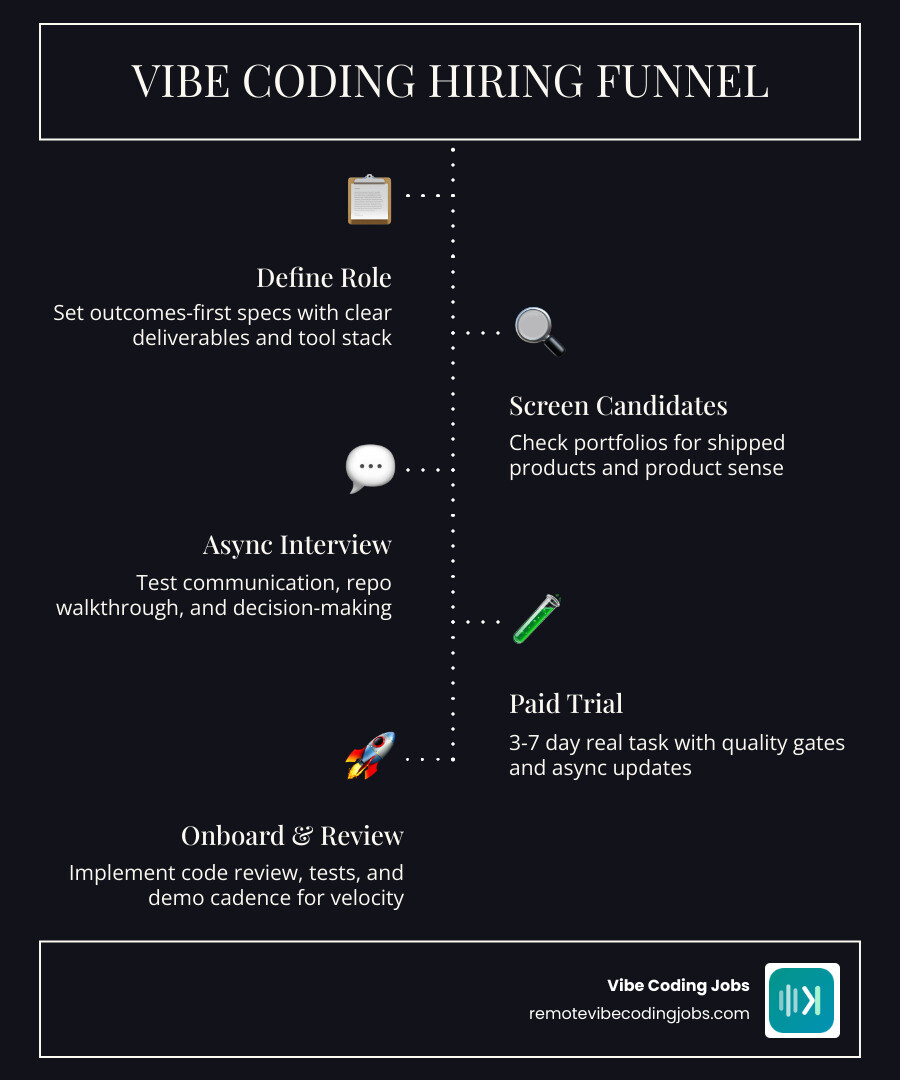
- Define outcomes, not tasks — write job specs around what gets shipped, not how code gets written
- Screen for product sense — great vibe coders think like builders, not just prompters
- Check the portfolio — look for shipped products, not just side projects or demos
- Run a paid trial — give a real, scoped task (3–7 days) before making an offer
- Test async communication — remote vibe coders must document clearly and update without hand-holding
- Set quality gates — require code review, basic tests, and a security check before any merge
- Match the tool stack — confirm they already know your AI IDE, version control, and deployment setup
The way software gets built has fundamentally shifted. In 2026, 73% of tech startups have adopted vibe coding techniques, and teams using AI-assisted development are shipping applications up to 5.8 times faster than those using traditional methods. A quarter of Y Combinator’s Winter 2025 batch had codebases that were 95% AI-generated. This isn’t a fringe experiment anymore — it’s how lean, fast-moving teams stay competitive.
But hiring the wrong vibe coder can be just as costly as hiring no one at all. The role looks new, the title is unfamiliar, and most standard hiring playbooks weren’t built for it.
This guide fixes that.
I’m part of the RVCJ Editorial team at Remote Vibe Coding Jobs — we cover AI-assisted development, remote hiring, and developer career trends, and we’ve helped thousands of teams and candidates navigate the emerging world of vibe coding hiring. Everything in this guide is built from real data, real hiring patterns, and direct experience with the vibe coding hiring guide questions teams ask us every week.
What vibe coding means in 2026 and who should hire for it
Vibe coding in 2026 means building software with AI as a hands-on collaborator, not just an autocomplete tool. The developer still owns the result, but much of the scaffolding, boilerplate, refactoring, debugging assistance, and experimentation happens through prompt-driven workflows.
In practice, vibe coders move fast by combining product judgment, AI tooling, and human review. They are not “letting the bot do everything.” They are directing, testing, editing, and shipping.
That matters because lean teams do not have months to debate architecture for a landing page, internal dashboard, or customer workflow tool. They need progress this week.

What is vibe coding and how is it different from traditional programming?
Traditional programming usually starts with manual implementation. A developer designs the system, writes the code line by line, tests it, and iterates. Vibe coding compresses that cycle.
A strong vibe coder typically:
- frames the problem clearly
- prompts an AI tool to generate a first pass
- reviews the code for correctness and security
- debugs edge cases
- adds tests and documentation
- refines UX and business logic
- ships, measures, and iterates
The difference is not whether humans matter. Humans matter more. The difference is where human effort goes.
With traditional programming, more time goes into manual production. With vibe coding, more time goes into direction, evaluation, and iteration. Speed goes up, but only when the operator is skilled enough to keep control.
Why companies are using this Vibe coding hiring guide now
The demand spike is simple: companies want faster product cycles without bloating headcount.
In 2026, startups, small teams, and async-first companies are under pressure to launch MVPs, test new features, and integrate AI into products without building oversized engineering orgs. The signal is strong:
- 73% of tech startups have adopted vibe coding techniques
- teams embracing AI-assisted development report 5.8x faster application delivery
- 25% of Y Combinator’s Winter 2025 batch reportedly had codebases that were 95% AI-generated
That does not mean every company should replace all developers with vibe coders. It means hiring managers need a clearer playbook for roles that blend coding, prompting, product thinking, and remote execution.
Best-fit companies and projects for vibe coders
The best fit is work that benefits from speed, iteration, and clear business goals.
Ideal projects include:
- MVPs for startups
- internal tools and dashboards
- customer portals
- marketing sites and landing pages
- workflow automations
- feature experiments
- AI-powered wrappers and integrations
- admin panels
- lightweight SaaS products
- no-code replacements that need more flexibility
Best-fit businesses usually include:
- startups validating demand
- SMBs modernizing operations
- agencies delivering prototypes
- product teams running growth experiments
- async-first remote companies that value written communication
If your project needs flawless compliance, deep systems optimization, or high-stakes infrastructure engineering, keep reading before you hand over the keys.
Vibe coding hiring guide: benefits, limits, and role design
The case for hiring vibe coders is not just speed. It is better experimentation economics.
When a team can test ideas faster, the business learns faster. That often means fewer missed opportunities, lower development waste, and better alignment between product and engineering.
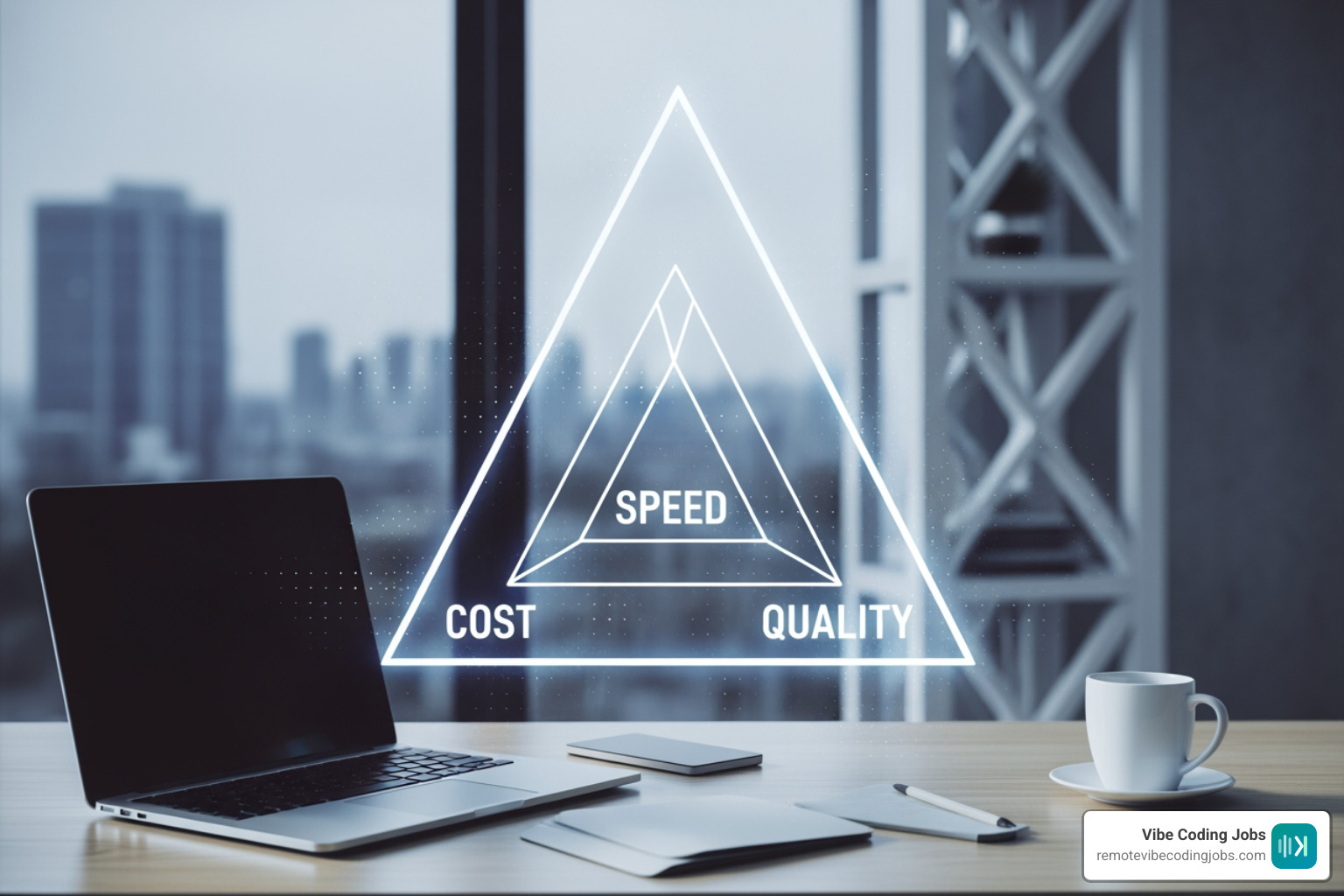
| Factor | Vibe coder advantage | Traditional developer advantage |
|---|---|---|
| Speed | Faster prototyping and iteration | Better for slower, deeply engineered builds |
| Cost | Lower cost per experiment | Better for long-term complex systems |
| Agility | Strong in changing requirements | Strong in stable, defined environments |
| Product feedback loops | Faster shipping and learning | More deliberate but often slower |
| Risk control | Good with strong review process | Better for critical systems by default |
The biggest benefits of hiring vibe coders
The biggest upside is compressed cycle time. Research shows companies using AI-assisted development can build apps 5.8x faster. That changes hiring math dramatically.
Other benefits include:
- faster MVP launches
- lower cost for early experimentation
- fewer people needed to validate ideas
- faster AI integration work
- stronger iteration loops between product and engineering
There are also business outcome signals worth paying attention to. Companies using vibe coding report 47% higher user engagement and 32% better retention rates. Those numbers do not prove that vibe coding magically improves every product. What they do suggest is that faster iteration helps teams respond to user behavior more effectively.
When vibe coders outperform traditional developers
Vibe coders usually win when the challenge is speed with acceptable complexity.
They are especially useful for:
- launching MVPs
- building first versions of new features
- validating pricing or onboarding experiments
- replacing brittle no-code setups
- shipping AI-powered workflows
- supporting async teams that prefer written specs and demos over long meetings
If your company needs a builder who can go from brief to working prototype in days, this is where vibe coders shine.
When to stick with traditional developers instead
Not every project should be AI-assisted first.
Choose traditional developers or a more conventional engineering setup for:
- regulated systems
- security-critical applications
- payment infrastructure
- highly scaled backend architecture
- deep performance tuning
- legacy migrations with hidden complexity
- systems where failure is expensive or dangerous
The smart move for many companies is hybrid hiring: vibe coders for speed and experimentation, traditional engineers for architecture, governance, and mission-critical systems.
Skills, tools, and hiring signals that predict strong performance
A good vibe coder is not just good at prompting. If prompting is the only skill, that is a red flag wearing a trendy hat.
Strong performance usually comes from a mix of technical ability, product sense, and communication.
For a broader tool overview, see Best AI Tools for Coding.
Core skills every hiring manager should look for
Look for these signals first:
- problem framing
- prompt iteration
- code reading and editing
- debugging discipline
- testing mindset
- API fluency
- repo hygiene
- UX judgment
- documentation habits
- async communication
The best candidates can explain why they used AI, where they did not trust it, and how they verified output. That is the sweet spot.
Tools and workflows effective vibe coders should already know
Tool familiarity matters because speed disappears when someone is learning your environment from scratch.
Look for experience with:
- AI IDEs and assistants such as Cursor-style workflows
- agent-based coding loops
- Git and pull requests
- CI/CD basics
- deployment platforms
- API testing tools
- analytics and logging
- design handoff tools
- issue tracking and written specs
If you want a sense of how one of these workflows looks in practice, read Vibe Coding with Cursor: Tutorial & AI Coding Potential.
How to evaluate portfolio quality in a Vibe coding hiring guide
Portfolios matter more than polished resumes in this category.
Ask candidates to show:
- shipped apps, not just screenshots
- before-and-after iterations
- bug fixes they handled
- examples of tests or QA notes
- metrics or user outcomes
- documentation and handoff notes
- Git history or decision logs when available
The strongest portfolios show real tradeoffs. We trust a candidate more when they can say, “Here is what broke, here is how I fixed it, and here is what I would rebuild differently.”
How to hire, interview, and vet vibe coders without wasting time
The fastest way to hire badly is to run a normal software interview for a non-normal role.
Vibe coding roles should be hired around outcomes, judgment, and execution under real constraints.
How to write a role and set deliverables for a Vibe coding hiring guide
Start with outcomes. Do not write a vague ad asking for a “10x AI ninja.” That attracts chaos.
A solid role description should include:
- what the candidate will ship in the first 30 to 90 days
- your stack and AI tools
- level of ownership
- expected documentation standards
- review cadence
- whether the role is product-heavy, frontend-heavy, or automation-heavy
- how quality is measured
Example deliverables:
- launch a customer onboarding flow
- rebuild an internal reporting dashboard
- ship an AI-assisted support workflow
- improve trial-to-paid conversion through two feature experiments
How to identify high-quality candidates during screening
In screening, we want evidence of shipping, not storytelling.
Ask for:
- links to live products
- a short repo walkthrough
- an explanation of one tough bug
- a sample async update
- the tools they use daily
- how they verify AI-generated code
- how they handle changing requirements
Look for candidates who are calm, concrete, and specific. Good vibe coders usually describe process clearly because they work in loops: prompt, inspect, test, refine, ship.
Interview exercises that reveal real vibe coding ability
Forget whiteboard trivia. This role needs practical exercises.
The best interview tasks are:
- a small build brief with acceptance criteria
- a bug-fix task in an existing repo
- a feature extension on top of working code
- a prompt audit where they improve a weak AI prompt
- a test-writing exercise
- a handoff note explaining what they built and what remains risky
Keep the task scoped to 3 to 7 days if paid. That is long enough to show judgment and short enough to avoid free consulting in disguise.
For more on practical hiring over puzzle interviews, see Remote Coding Jobs: No LeetCode, Practical Skills.
Red flags to avoid when hiring vibe coders
Watch for these warning signs:
- they cannot explain their own code
- they rely on AI but do not test outputs
- they overpromise timelines
- they avoid discussing security
- they have vague portfolios with no live work
- they talk only about tools, not outcomes
- they struggle to write clear async updates
- they cannot describe tradeoffs
The biggest red flag of all: speed with no quality process. Fast wrong code is still wrong. It just arrives with more confidence.
Where to find talent, compensation benchmarks, and team management
You can hire vibe coders through freelancers, communities, referrals, and niche remote job boards. But sourcing is only half the job. Compensation, onboarding, and management determine whether the hire actually works.
Best places to source vibe coding talent in 2026
The strongest sourcing channels tend to be:
- niche remote job boards
- async-first communities
- portfolio networks
- founder and operator referrals
- contractor marketplaces
- specialized talent pools focused on AI-assisted work
Because this role is still evolving, generalist job boards often create more noise than signal. We have found that filtered, role-specific sourcing works better, especially when candidates can be screened by culture, stack, and AI tooling familiarity.
For market context, see Companies Hiring Vibe Coders: Remote AI Coding.
Salary ranges and compensation models to expect
Compensation varies by scope, tool fluency, and how independently the person can ship.
Current ranges from the research:
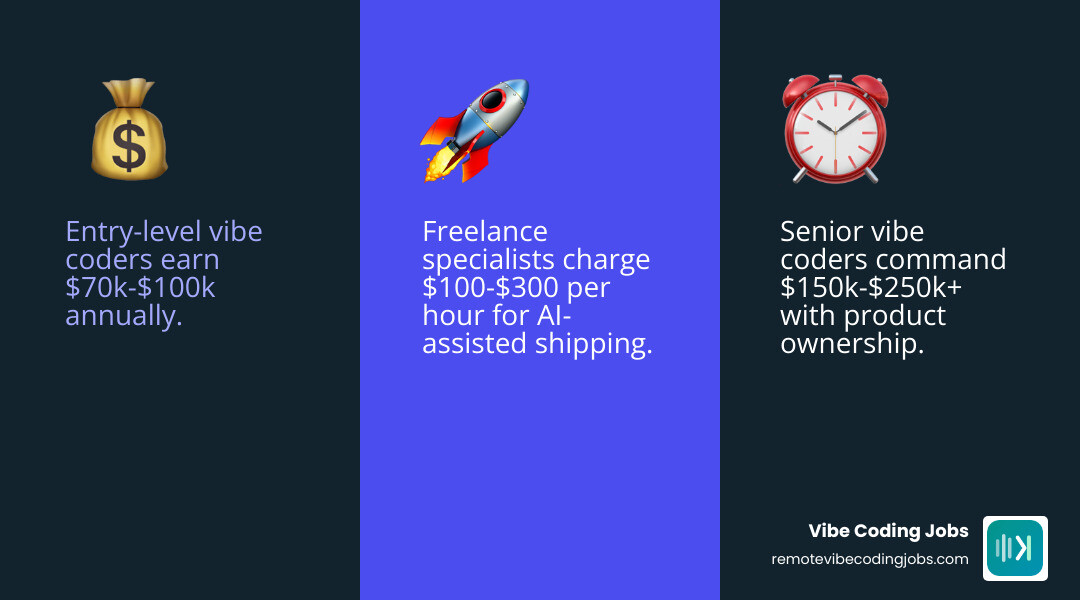
- entry-level vibe coders: $70,000 to $100,000
- mid-level vibe coders: $100,000 to $150,000
- senior vibe coders: $150,000 to $250,000+
- freelance specialists: $100 to $300 per hour
- some in-house vibe coders: $60,000 to $90,000
Why the spread? Because “vibe coder” can mean anything from junior AI-assisted implementer to product-minded senior builder who can own an entire launch.
Common pay models include:
- salary plus equity
- hourly contractor rates
- milestone-based contracts
- paid trial leading to full-time offer
For deeper compensation context, visit Vibe Coding Salary Trends (Remote) and Vibe Coding Salary: Remote vs Onsite Growth.
How to manage vibe coders for quality, speed, and accountability
Management should feel lightweight but structured.
The best systems include:
- specs first
- clear acceptance criteria
- code review before merge
- basic automated tests
- security review for anything user-facing
- daily or frequent async updates
- weekly demos
- rollback plans for risky releases
This is where async culture helps. Developers in async environments report 30% higher job satisfaction, according to the 2025 Stack Overflow survey cited in the research. That matters because vibe coders often work best with uninterrupted build time and strong written communication.
If your team is remote-first, read Async-First Remote Developer Jobs: Culture, Tools, Salary.
The future of vibe coding hiring and how to stay ahead
Vibe coding is not replacing software engineering. It is reshaping which skills companies pay for.
As the AI coding tools market moves toward a projected $27.17 billion by 2032, hiring standards are becoming more specialized. Companies no longer just want “someone who uses AI.” They want builders who can combine AI speed with engineering judgment and product awareness.
Real-world results and data behind the trend
The trend is backed by more than hype:
- 73% of tech startups have adopted vibe coding techniques
- AI-assisted teams report 5.8x faster development times
- companies using vibe coding report 47% higher user engagement
- those same teams report 32% better retention rates
- GitHub Copilot drove more than 40% of GitHub’s revenue growth in 2024, a strong market signal for paid AI coding demand
For more ecosystem context, see State of Vibe Coding 2026.
And if you want to understand how candidates are entering this field, this external guide is useful: How to Become a Vibe Coder: A Career Transition Guide for 2026 .
Hiring trends companies should prepare for next
We expect these shifts to continue:
- more hybrid teams combining vibe coders and traditional engineers
- more portfolio-first hiring
- more outcome-based job descriptions
- more demand for product-minded developers
- more specialization by AI tool stack
- smaller teams shipping more
- stronger governance around AI-generated code
In short: the bar is rising. The easy win of “just hire someone who uses AI” is already fading. The next wave is disciplined, measurable, high-context AI-assisted development.
Frequently Asked Questions about Vibe coding hiring guide
Can one vibe coder replace a full traditional development team?
Usually no. One strong vibe coder can replace a surprising amount of early-stage execution, especially for MVPs, internal tools, and experiments. But they still need product direction, quality standards, and sometimes oversight from senior engineering.
For complex systems, maintenance-heavy platforms, or security-sensitive software, you still want a broader team.
How long should a paid trial project be before making an offer?
The sweet spot is 3 to 7 days.
That gives enough time to evaluate:
- code quality
- judgment
- communication
- follow-through
- testing habits
- documentation
Anything shorter can be too shallow. Anything much longer starts to feel like unpaid strategy theft wearing a fake mustache.
What quality gates should every vibe coding project include?
At minimum:
- code review
- basic automated tests
- security check
- documentation or handoff notes
- deployment checklist
- rollback plan
For customer-facing features, add analytics validation and acceptance criteria review before release.
Conclusion
A good vibe coding hiring guide is really a decision framework. It helps us answer five practical questions:
- Is this project a fit for AI-assisted development?
- What outcomes do we need the hire to own?
- Can the candidate ship, explain, and maintain what they build?
- Do we have quality gates in place?
- Are we managing for speed without sacrificing trust?
If we get those right, vibe coders can unlock major gains in speed, cost efficiency, and experimentation. If we skip them, we get flashy demos and future headaches.
If you are hiring now, start with clear role design, portfolio-first screening, and a paid trial. Then build an async workflow that rewards written updates, clean handoffs, and steady shipping.
For more hiring and career insight, explore Vibe Coding Companies Hiring in 2026: Top Async-First Roles, Vibe Coding Remote Job Guide, and https://remotevibecodingjobs.com/blog/cursor-copilot-developer-jobs.
If you want a faster way to find remote AI-assisted talent or understand how these roles are evolving, we recommend browsing RemoteVibeCodingJobs. We curate daily listings filtered by culture, tech stack, and AI tools, so teams and candidates can spend less time guessing and more time shipping.