
Why Claude Dev Jobs Remote Are One of the Fastest-Growing Opportunities in Tech Right Now
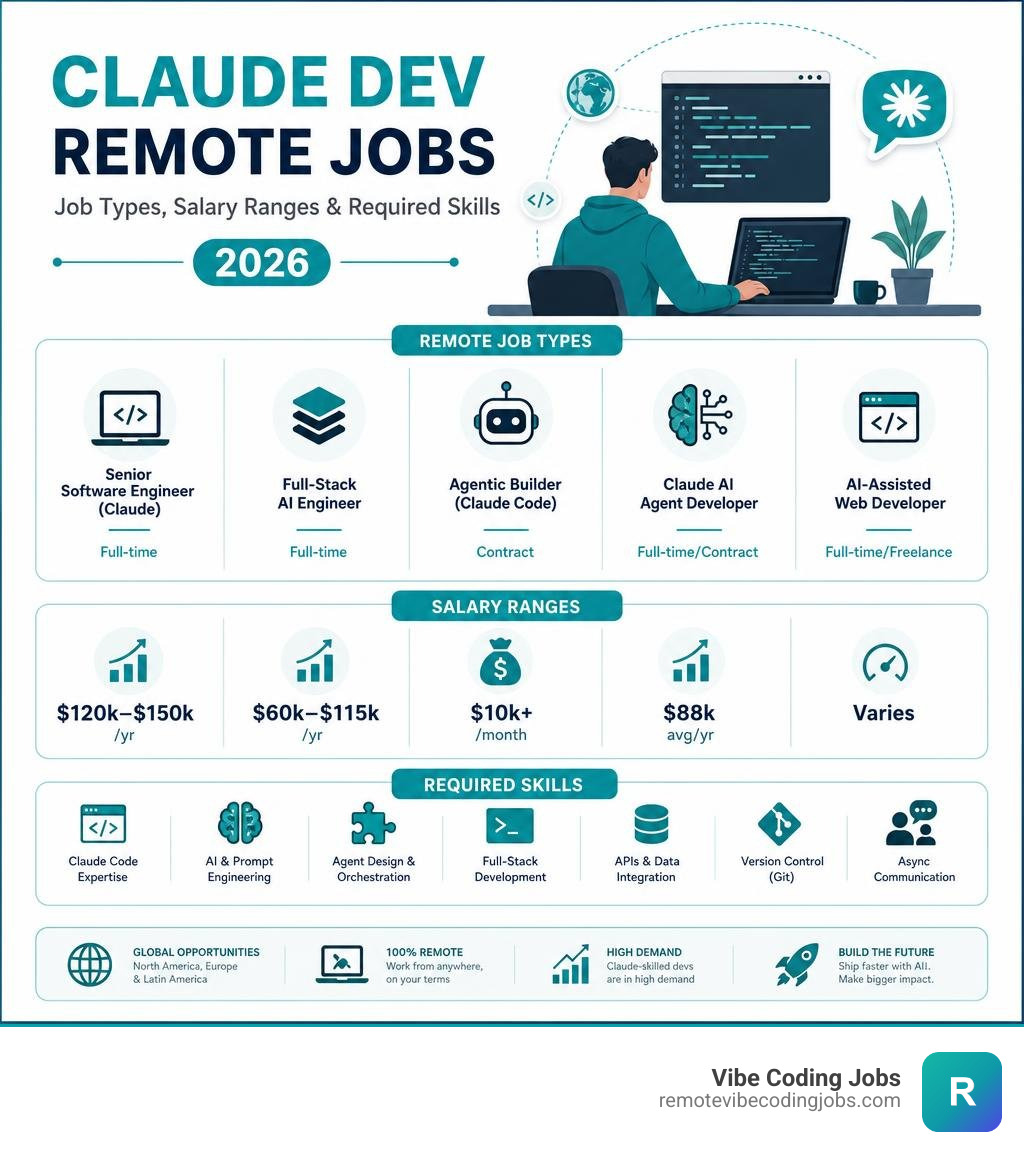
If you’re hunting for Claude dev jobs remote, here’s what you need to know upfront:
Top remote Claude developer roles available in June 2026:
| Role | Typical Salary Range | Type |
|---|---|---|
| Senior Software Engineer (Claude) | $120k–$150k/yr | Full-time |
| Full-Stack AI Engineer | $60k–$115k/yr | Full-time |
| Agentic Builder (Claude Code) | $10k+/month | Contract |
| Claude AI Agent Developer | $88k avg/yr | Full-time/Contract |
| AI-Assisted Web Developer | Varies | Full-time/Freelance |
Remote Claude roles are listed across major job boards, with openings in North America, Europe, and Latin America. Most require hands-on Claude Code experience — not just familiarity with AI tools.
Something important is shifting in software hiring. Companies aren’t just allowing developers to use AI tools anymore — they’re requiring it. Roles now explicitly list Claude Code as a core skill, the same way they’d list Python or React.
The average salary for Claude AI roles in the US sits at $88,968 per year, with a range from around $57,500 up to $122,000. At the high end, contract builders using Claude Code on platforms like Bolder Apps report earning more than $10,000 per month.
This isn’t a niche trend. There are currently 31 remote Claude Code jobs tracked on IT job boards alone — and that number is growing fast as companies migrate entire engineering workflows to AI-first practices.
The developers landing these roles aren’t just using Claude as a shortcut. They’re orchestrating agents, managing context, and shipping production systems at a pace that would’ve been impossible two years ago.
I’m RVCJ Editorial, the team behind Remote Vibe Coding Jobs — we cover AI-assisted development careers, hiring trends, and practical job-search advice for engineers building with tools like Claude, Cursor, and Copilot, with a specific focus on Claude dev jobs remote and the async-first companies hiring for them. In this guide, we break down exactly which roles are hiring, what they pay, and how to stand out when you apply.
Claude dev jobs remote basics:
The Rise of Claude Dev Jobs Remote: Market Overview and Salaries
The hiring landscape has changed dramatically. As we look at the data for mid-2026, the demand for developers who can leverage Anthropic’s Claude suite has moved from experimental teams into core business operations. According to recent industry salary data, the average annual salary for Claude-related positions in the United States is $88,968, with the majority of full-time roles landing between $57,500 and $122,000.
However, compensation structures vary significantly based on contract types and the depth of AI integration required. Senior roles and specialized contract positions command much higher rates. For example, contract builders specializing in advanced agentic workflows can earn more than $10,000 per month on a per-project basis.
Geographically, states like California, Washington, Texas, and New York host the highest concentration of US-based openings. Yet, the true power of this trend lies in its global distribution. Companies are hiring across Europe, Latin America, and North America, leaning heavily into async-first work cultures. To explore how these numbers stack up against other setups, check out our Remote AI Developer Jobs Tools and Salary Guide and our Vibe Coding Salary Remote Guide.
| Experience Level | Primary Tooling | Contract Rate | Full-Time Salary (US) |
|---|---|---|---|
| Junior / Mid-Level | Claude API, Cursor | $50–$75 / hour | $60,000–$90,000 |
| Senior Engineer | Claude Code CLI, MCP | $75–$150 / hour | $120,000–$150,000 |
| Agentic Builder | Multi-Agent Frameworks | $10,000+ / month | $130,000–$180,000+ |
Top 5 Types of Claude AI Developer Roles You Can Land Today
Industry demand is no longer limited to traditional software houses. Agencies, enterprise companies, and fast-growing startups are restructuring their technical teams to prioritize high-velocity builders. Let’s look at the five most prominent roles currently hiring in the remote market.
1. Claude AI Agent Developer
An AI Agent Developer focuses on building systems that don’t just answer questions, but execute complex multi-step workflows. Instead of writing isolated scripts, these developers design autonomous systems that interact with external services, manage memory, and handle unexpected API failures.
In practice, this means designing multi-agent orchestration architectures where different Claude instances take on specialized roles. For example, a marketing automation suite might feature an research agent, a copywriter agent, and a compliance checker agent working in tandem.
Key responsibilities in this role include:
- Designing and versioning a centralized prompt library to ensure consistent model behavior across production environments.
- Integrating Claude APIs with business infrastructure such as HubSpot CRM, PostgreSQL databases, and Slack.
- Implementing robust evaluation frameworks to benchmark different model tiers (Haiku, Sonnet, Opus) to balance speed, cost, and reasoning capability.
- Setting up state management and long-term memory systems so agents can reference historical data across user sessions.
These responsibilities ensure that autonomous agents can operate reliably and efficiently within complex business workflows.
2. Full-Stack AI Engineer Roles with Claude Dev Jobs Remote Workflows
Full-Stack AI Engineers bridge the gap between frontend user experiences and complex backend AI services. Instead of treating the AI as a simple API endpoint, these developers build deep integrations where the UI reacts dynamically to real-time model outputs.
These roles require strong foundations in modern web technologies like TypeScript, Python, React, and Next.js, alongside specialized AI engineering skills. You will spend your time architecting service-oriented REST APIs, designing responsive conversational interfaces, and optimizing application performance to handle streaming responses smoothly.
Additionally, you will work with vector databases and embeddings to build retrieval-augmented generation (RAG) pipelines. This ensures that the application can supply Claude with relevant contextual data from company documents or user databases. For a deeper look at why these positions are so highly sought after, read about the Remote AI Developer Jobs Benefits and explore the Best Companies Hiring AI Developers Remote.
3. Agentic Builder and Claude Code Specialist
The “Agentic Builder” is a relatively new category of developer. In this role, you rarely write raw code by hand from scratch. Instead, your primary responsibility is to direct, orchestrate, and review code generated by Claude Code, the command-line interface (CLI) tool developed by Anthropic.
This workflow requires a unique blend of high-level software architecture knowledge and deep familiarity with agentic tools. Builders are expected to:
- Author and maintain CLAUDE.md files that define project rules, style guidelines, and architectural boundaries for the AI.
- Drive test-driven development (TDD) by instructing the agent to write tests first, and then run verification loops until the tests pass without “cheating.”
- Manage token budgets and context windows over long-running multi-day tasks to keep development cost-efficient.
- Act as the ultimate quality gate, reviewing every line of agent-produced code for security vulnerabilities, edge cases, and architectural alignment.
These roles are highly autonomous and often structured around per-project contract work, requiring a strong self-starting mindset and deep technical expertise.
4. AI-Assisted Web Developer and SEO Engineer
Digital marketing agencies and modern e-commerce brands are hiring web developers who can combine technical SEO with rapid, AI-driven development workflows. In these positions, you use Claude Code to scaffold static sites, automate programmatic SEO campaigns, and set up metadata structures at scale.
Rather than spending weeks writing boilerplate CSS and HTML, you direct Claude to generate lightweight, highly optimized web pages using modern static site generators like Astro SSG, Tailwind CSS, and Netlify.
The day-to-day focus of this role centers on:
- Building programmatic location or category pages that utilize unique, AI-generated local content rather than simple keyword-swapping templates.
- Implementing technical SEO best practices, including schema markup (LocalBusiness, FAQ, and Review schemas) and optimizing Core Web Vitals.
- Resolving crawlability issues, such as ensuring search engines can fully render JavaScript-heavy single-page applications.
5. Senior Software Engineer Positions Requiring Claude Dev Jobs Remote Expertise
Even traditional enterprise environments are seeking senior engineers who can weave Claude into their standard development lifecycles. These roles are typically 80% hands-on building and 20% system architecture and team collaboration.
In an enterprise setting, you will use Claude to navigate large legacy codebases written in C#/.NET, Java, or SQL. You will guide Claude to refactor old components, write unit tests, generate documentation, and plan cloud migrations to platforms like Microsoft Azure or AWS.
Familiarity with building Model Context Protocol (MCP) servers is highly valued here. MCP servers allow Claude to safely connect to internal company databases, file systems, and development tools, turning the AI into a highly contextual assistant. To learn more about how enterprise teams are adopting these tools, check out our article on Remote Developer Jobs AI Tools Trends Salary.
Core Technical Skills and Tools for Claude Developers
To land a high-paying remote role, you must be comfortable with the specific tools and libraries that power the Anthropic ecosystem. While general programming skills are still essential, your efficiency with AI-native workflows is what will set you apart.
The core tools and concepts you should master include:
- Claude Code CLI: Anthropic’s official terminal tool for editing, running, and git-committing code directly through an agentic interface. You can review Anthropic’s own Claude Code documentation to understand its current capabilities and recommended workflows.
- Model Context Protocol (MCP): An open standard that enables developers to build secure servers that feed real-time data and system capabilities directly to Claude. The official Model Context Protocol documentation is a useful starting point for understanding how MCP servers and clients work.
- Context and Token Management: Knowing how to structure system prompts, optimize prompt caching, and select the right model tier (Haiku vs. Sonnet vs. Opus) for specific tasks.
- Modern AI Editors: Understanding how to integrate Claude with environments like Cursor or VS Code to maximize your daily shipping speed. You can read our detailed comparison of these environments in Claude vs Cursor for Remote Developer Jobs and Claude vs Cursor Features and Integration for Remote Jobs.
- Git and CI/CD Pipelines: Standard software development practices remain non-negotiable. You must know how to resolve merge conflicts, manage pull requests, and deploy code to production platforms like Vercel, Fly.io, or AWS.
How to Build a Standout Portfolio and Apply for Claude Roles
When applying for Claude dev jobs remote, standard resumes often fall flat. Because these roles require you to act as an effective “pilot” for AI systems, employers want to see direct proof of your orchestration skills.

Here is how you can build a highly competitive application:
- Record a Loom Walkthrough: Many top-tier AI engineering roles require a 1-to-2-minute Loom video as part of the application process. Use this time to walk through a production-ready application you built using Claude Code, highlighting what the AI generated versus how you directed, debugged, and secured the system.
- Provide a Live URL and Public Repository: Do not just show screenshots. Provide links to live, working web applications (such as an Astro or Next.js app deployed on Vercel) alongside a public GitHub repository.
- Showcase Your Agentic Setup: Include examples of your custom CLAUDE.md files, reusable prompt templates, or custom MCP servers you have written to solve specific integration challenges.
- Demonstrate Test-Driven Development: Show that you know how to configure AI agents to write and run automated test suites before generating production code. This proves you are focused on code quality, not just speed.
For more strategic advice on transitioning your career into this space, take a look at our guide on How to Get a Vibe Coding Job Skills Courses Advice.
Frequently Asked Questions about Claude Developer Jobs
What is the difference between a traditional developer and a Claude developer?
Traditional software engineering focuses heavily on manual syntax writing, debugging syntax errors, and implementing boilerplate structures. A Claude-first developer, on the other hand, operates at a higher level of abstraction.
They spend their time writing system prompts, designing software architecture, managing context windows, and performing rigorous code reviews on AI-generated outputs. The focus shifts from “how to write this loop” to “how to structure this system and verify its correctness.”
Do I need a Computer Science degree to get a remote Claude developer job?
No. While a deep understanding of software design, databases, and APIs is essential, many remote companies prioritize practical building skills over formal credentials. A strong portfolio containing functional, live applications built with AI assistance, backed by a clear explanation of your development process, is often more valuable than a traditional degree.
What are the most common red flags in Claude AI job listings?
When searching for remote roles, watch out for listings that exhibit these red flags:
- Unrealistic Output Expectations: Companies that expect a single developer to ship massive, enterprise-grade systems in days just because they are using AI.
- No Tool Budget: Employers who expect you to build advanced systems but do not provide a budget for Claude API keys, Claude Pro, or modern editor licenses.
- Poorly Defined Scope: Roles that ask you to build “autonomous agents” without specifying the target workflows, security boundaries, or integration endpoints.
To learn more about navigating these team dynamics, check out Remote Developer Jobs AI Tools Efficiency Collaboration Debugging and Remote Developer Jobs AI Tools Career Growth Companies.
Conclusion
The shift toward AI-assisted software engineering is creating a wealth of opportunities for developers who know how to build alongside Claude. Whether you want to work as a full-time AI engineer, a specialized agentic builder, or an AI-assisted web developer, mastering these tools will keep you ahead of the curve.
At Remote Vibe Coding Jobs, we curate daily listings of remote roles at async-first companies that actively encourage and reward AI-assisted development. If you are ready to stop writing boilerplate code by hand and start orchestrating systems at scale, explore our latest open roles and find your next remote position today.