
Get Hired as a Remote Cursor AI Engineer Today
The Remote Cursor AI Engineer Job Market Is Booming in 2026
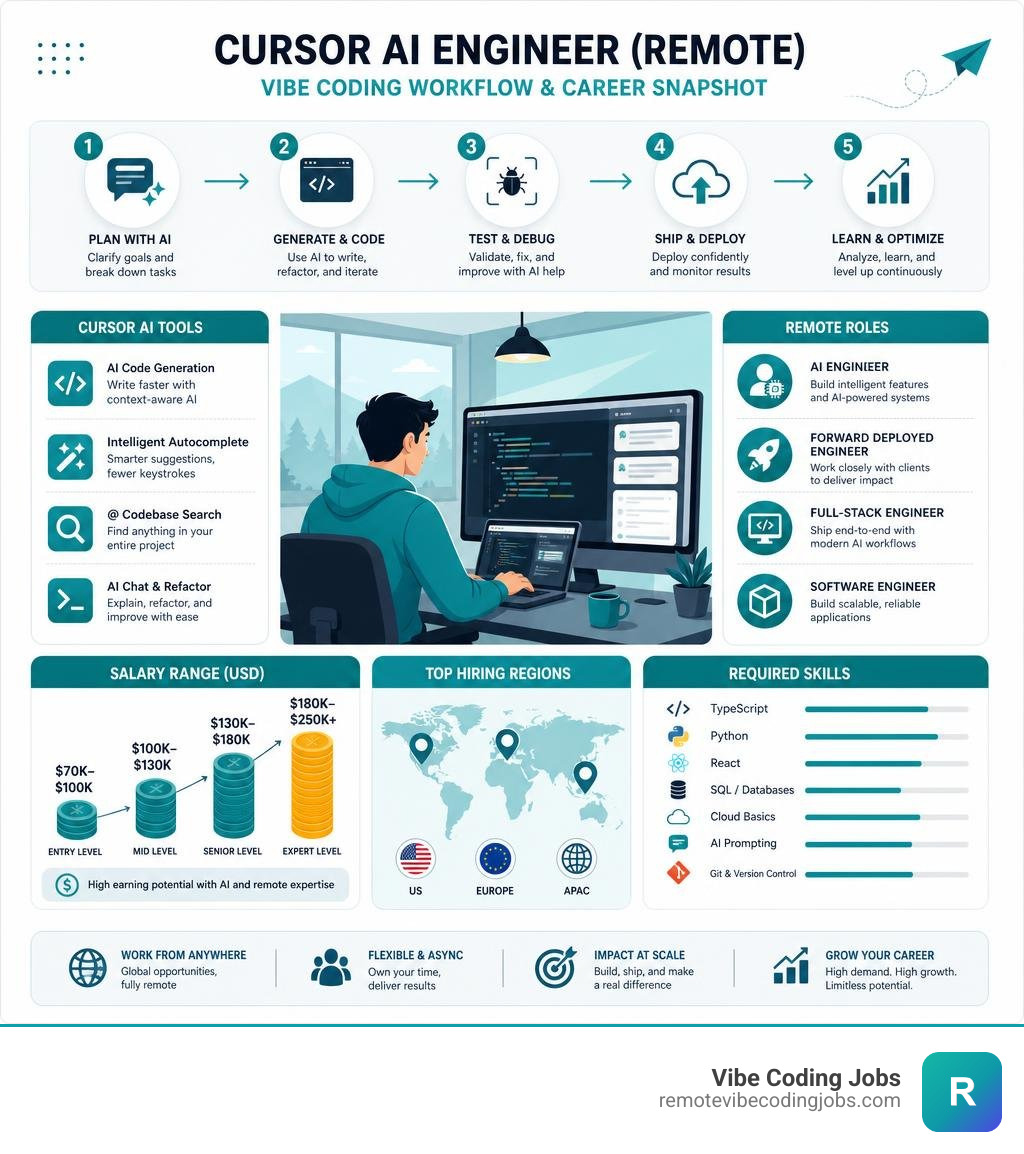
Cursor AI engineer remote roles are among the fastest-growing and highest-paying positions in tech right now. Here’s a quick snapshot of what you need to know:
| What You Want to Know | Quick Answer |
|---|---|
| Jobs available now | 113+ remote Cursor AI roles live |
| Salary range | $70k–$250k+ depending on experience |
| Top hiring regions | US, Europe, APAC |
| Core tools required | Cursor, TypeScript, Python, React |
| How to get experience | Build projects with Cursor’s free plan |
| Top role types | AI Engineer, Forward Deployed Engineer, Full-Stack Engineer |
Companies are no longer treating AI coding tools as a nice-to-have. In 2026, listing Cursor proficiency in a job description signals that a team expects you to ship faster, think in systems, and use AI as your default workflow — not a shortcut.
The numbers back this up. Roles requiring Cursor or similar AI coding tools pay $130k–$250k+ at the senior level. Even entry-level AI-fluent engineers are landing $70k–$100k. And with over 100 remote roles live at any given time, the demand is real and growing.
This isn’t just a niche skill anymore. National Australia Bank standardized 6,000 developers on Cursor and is expanding to over 10,000. The enterprise wave has arrived.
I’m RVCJ Editorial, the team behind Remote Vibe Coding Jobs — we cover AI-assisted development, remote hiring trends, and career guidance for engineers building with tools like Cursor, and we track the cursor ai engineer remote market daily. We’ve curated this guide to cut through the noise and help you land the right role fast.
Essential cursor ai engineer remote terms:
What is a Cursor AI Engineer and How Does the Role Differ?
At its core, a Cursor AI Engineer is a software professional who treats AI-assisted development (often called “vibe coding”) as their default, highly-optimized workflow. While traditional developers spend hours writing boilerplate code, debugging syntax, and manually writing unit tests, Cursor AI Engineers delegate these execution tasks to large language models (LLMs) like Claude 3.5 Sonnet and GPT-4.
This shifts the engineer’s role from a code typist to a software architect, system designer, and code reviewer. Cursor itself is an AI-first code editor built on top of VS Code. Because of this integration, the transition from traditional coding to AI-assisted coding is seamless.
The primary differences in a Cursor AI Engineer’s daily workflow include:
- Codebase-Aware Completions: Instead of predicting the next line of code, the editor scans the entire repository to suggest multi-file code completions that match existing patterns.
- Inline Code Generation and Refactoring: Describing code changes in natural language directly in the file, allowing the editor to edit or refactor lines in real time.
- Chat-Based Problem Solving: Using the built-in chat interface to ask complex architectural questions about the repository, generate full feature mockups, or debug production stack traces.
By mastering these features, developers can build fully functional features in a fraction of the time. To understand how Cursor stacks up against other tools, check out our breakdown of Cursor vs Copilot vs Claude.
Essential Skills and Tools for a Cursor AI Engineer Remote Role

To land a cursor ai engineer remote role, you need a balanced blend of traditional engineering fundamentals and modern AI system design. Simply knowing how to write basic prompts is no longer enough. Employers are looking for developers who understand how to orchestrate AI tools to build complex, reliable software.
Here are the essential technical skills you must develop:
1. Advanced Prompt Engineering and System Design
You must know how to structure prompts to get predictable, high-quality code outputs from LLMs. This includes writing context-rich system prompts, using XML tags to structure instructions, and applying evaluation-driven development to systematically test and refine AI behavior.
2. Modern Web Development Stacks
Most remote vibe coding teams build with fast, flexible technologies. You should have deep practical knowledge in:
- Languages: TypeScript, JavaScript, and Python.
- Frameworks: React, Next.js, and Node.js.
- Databases: PostgreSQL, Redis, and vector databases for AI applications.
3. Agentic Frameworks and RAG Pipelines
Modern AI features rely heavily on multi-agent systems and Retrieval-Augmented Generation (RAG). To stand out, you should understand:
- LangGraph: For building complex, multi-agent state machines.
- Model Context Protocol (MCP): For building custom servers that connect LLMs directly to your databases, APIs, and file systems.
- Advanced RAG: Moving beyond basic vector search to implement hybrid search, knowledge graphs, and agentic memory frameworks.
To see these skills in action, you can look at the work of top industry builders. For instance, shahshrey (Shrey Shah) · GitHub showcases extensive expertise with 2000+ hours of Cursor AI development, RAG systems, and LangGraph pipelines. You can read more about his development methodologies on his portfolio page, Work | Shrey Shah .
For a head-to-head comparison of the leading AI-first editors to see which tool fits your personal workflow, read our guide on Cursor vs Windsurf for Developers in 2026.
Remote Job Titles, Responsibilities, and Hiring Companies
As companies adapt to AI-augmented development, new job titles are emerging that specifically target developers who can leverage Cursor to ship code faster. Here are the most common remote job titles and what they entail:
1. Forward Deployed Engineer
In this role, you embed directly with client teams to design, implement, and optimize custom AI workflows. You’ll be responsible for identifying development bottlenecks, building reusable code patterns, and helping client teams transition to AI-native development. You can check out an active example of this role on the Cursor – Forward Deployed Engineer page.
2. AI-First Developer / Product Engineer
These engineers are responsible for building end-to-end products, from frontend interfaces to backend APIs, using tools like Cursor. They focus heavily on shipping MVPs rapidly, iterating based on user feedback, and maintaining high code quality through AI-assisted review.
3. AI Systems Architect
A high-level role focused on designing the infrastructure that supports AI tools. Responsibilities include managing model inference latency, setting up evaluations, and automating large-scale code migrations (such as moving from a legacy PHP monolith to a modern Node.js microservices architecture).
Many of these cutting-edge remote roles are available at fast-growing startups and AI companies. To explore open roles and apply, check out Cursor – Careers or browse curated listings on our Cursor & Copilot Developer Remote Jobs page.
Salary Ranges and Career Growth for a Cursor AI Engineer Remote
Because Cursor AI Engineers can achieve a 2-5x productivity increase, they command highly competitive compensation packages. Companies are happy to pay a premium for high-output engineers who can design, build, and deploy features in days rather than weeks.
| Experience Level | Estimated Annual Salary | Common Benefits |
|---|---|---|
| Entry-Level (1-2 years) | $70,000 – $100,000 | Health insurance, home office stipend, flexible hours |
| Mid-Level (3-5 years) | $100,000 – $150,000 | 401(k) matching, equity, unlimited PTO |
| Senior / Lead (5+ years) | $150,000 – $250,000+ | Significant equity, performance bonuses, leadership tracks |
| Freelance / Contract | $100 – $300 / hour | Global location freedom, flexible contract lengths |
Entry-Level and Mid-Level Cursor AI Engineer Remote Salaries
For developers early in their careers, being fluent in Cursor is a massive competitive advantage. Instead of spending months mastering complex syntax, you can focus on system design and product architecture. Entry-level salaries generally start around $70,000 to $100,000. Mid-level engineers with a proven track record of shipping production-grade applications using AI-assisted workflows can easily secure $100,000 to $150,000 annually.
Senior and Lead Cursor AI Engineer Remote Compensation
At the senior and staff levels, compensation scales significantly. Senior developers are expected to manage complex system architectures, optimize real-time data pipelines, and improve LLM reliability and editor latency.
For example, look at the profile of Harry White, a Staff Software Engineer at Cursor who focused on reducing editor latency, improving time-to-first-successful-edit by 23%, and optimizing real-time systems. Similarly, Samantha Whitmore, a Software Engineer at Cursor, combines a strong technical background with open-source contributions to LangChain to manage complex, production-ready AI infrastructures. Senior engineers with these capabilities routinely command salaries of $150,000 to $250,000+, often accompanied by substantial equity packages.
Benefits, Challenges, and Interview Evaluation Processes

The Benefits of Remote Vibe Coding
Working remotely as a Cursor AI Engineer comes with massive perks:
- Location Freedom: Work from anywhere in the world for forward-thinking, async-first companies.
- Hyper-Productivity: Shipping features rapidly removes the frustration of repetitive boilerplate coding, keeping you in a creative flow state.
- Rapid Career Growth: Delivering 2-5x more features than traditional developers makes you highly visible and accelerates your path to leadership.
The Challenges to Watch Out For
It’s not all smooth sailing. AI-assisted development brings unique challenges:
- Determinism and Reliability: LLMs can be unpredictable. Managing prompt drift and ensuring consistent code outputs requires rigorous testing.
- Security Risks: Engineers must watch out for prompt injection vulnerabilities and ensure that sensitive API keys or customer data are never exposed to public LLM endpoints.
- Code Quality Maintenance: Moving fast can lead to technical debt if you don’t carefully review AI-generated code.
How Remote Companies Evaluate Candidates
Because anyone can generate basic code with AI, companies have adapted their hiring processes to test for true engineering depth:
- Live Coding in Cursor: Instead of banning AI, forward-thinking companies will ask you to share your screen and build a feature using Cursor. They want to see how you prompt, how you debug errors, and how you review the generated code.
- System Design and Architecture: You’ll be asked to design complex systems (e.g., a real-time collaborative editor or a scalable RAG pipeline). This tests your conceptual understanding, which AI cannot fake.
- Evaluation-Driven Portfolios: Showing a portfolio of projects where you systematically optimized prompt performance using frameworks like DSPy or LLM-as-a-judge is a great way to prove your expertise.
Frequently Asked Questions about Cursor AI Engineering
How do I get practical experience for a cursor ai engineer remote job?
The best way is to start building. Download Cursor, sign up for a free trial, and use it as your primary editor. Build a complex side project from scratch, contribute to open-source libraries, or build custom MCP servers.
For inspiration on what a professional portfolio looks like, browse the GitHub profile of lilingxi01 (Lingxi Li) · GitHub , a software engineer at Cursor who blends full-stack design engineering, React, Next.js, and scalable AI systems. Document your development process, write blog posts about your workflow, and showcase your productivity gains in your resume.
Do companies actually hire specifically for Cursor AI experience?
Yes. In 2026, many remote startups and forward-thinking enterprises explicitly list Cursor or “vibe coding” in their job descriptions. It serves as a filter to find modern developers who know how to use AI tools to ship software at an elite pace.
What are the future trends for AI-native developers in 2026?
We are moving rapidly toward agentic workflows. Rather than just generating code snippets, next-generation tools like Cursor 3 are designed to execute entire development loops—from writing code and running tests to automatically fixing errors and submitting PRs. Additionally, companies are scaling their infrastructure using Blackwell GPUs to achieve faster model inference and lower latency, making real-time AI collaboration smoother than ever before.
Conclusion
The era of manual boilerplate coding is coming to an end. Becoming a remote Cursor AI Engineer allows you to work on cutting-edge projects, enjoy complete location freedom, and command top-tier salaries.
At Remote Vibe Coding Jobs, we curate the best remote AI-assisted developer roles at async-first companies. We filter listings by culture, tech stack, and specific AI tools so you can skip the generic job board spam and find a team that embraces the future of coding.
Ready to take the next step in your career?
- Find Your Next Role: Browse our curated list of Remote AI Engineer Jobs to find open positions today.
- Hire Top Talent: Looking to bring elite, high-output builders onto your team? Hire Remote AI Engineers through our platform.
- Explore Vibe Coding: Dive deeper into AI-assisted development by checking out our Cursor & Copilot Developer Jobs: Remote Coding guide.
Don’t wait for the market to pass you by. Download Cursor, build your portfolio, and Find Remote AI Engineer Jobs on our platform today!