
Coding with Claude 3.5 Sonnet is Basically Magic
Is Claude 3.5 Sonnet Actually Worth It for Coding?
Claude 3.5 Sonnet coding performance has genuinely shifted how developers approach AI-assisted development. Here’s the quick answer:
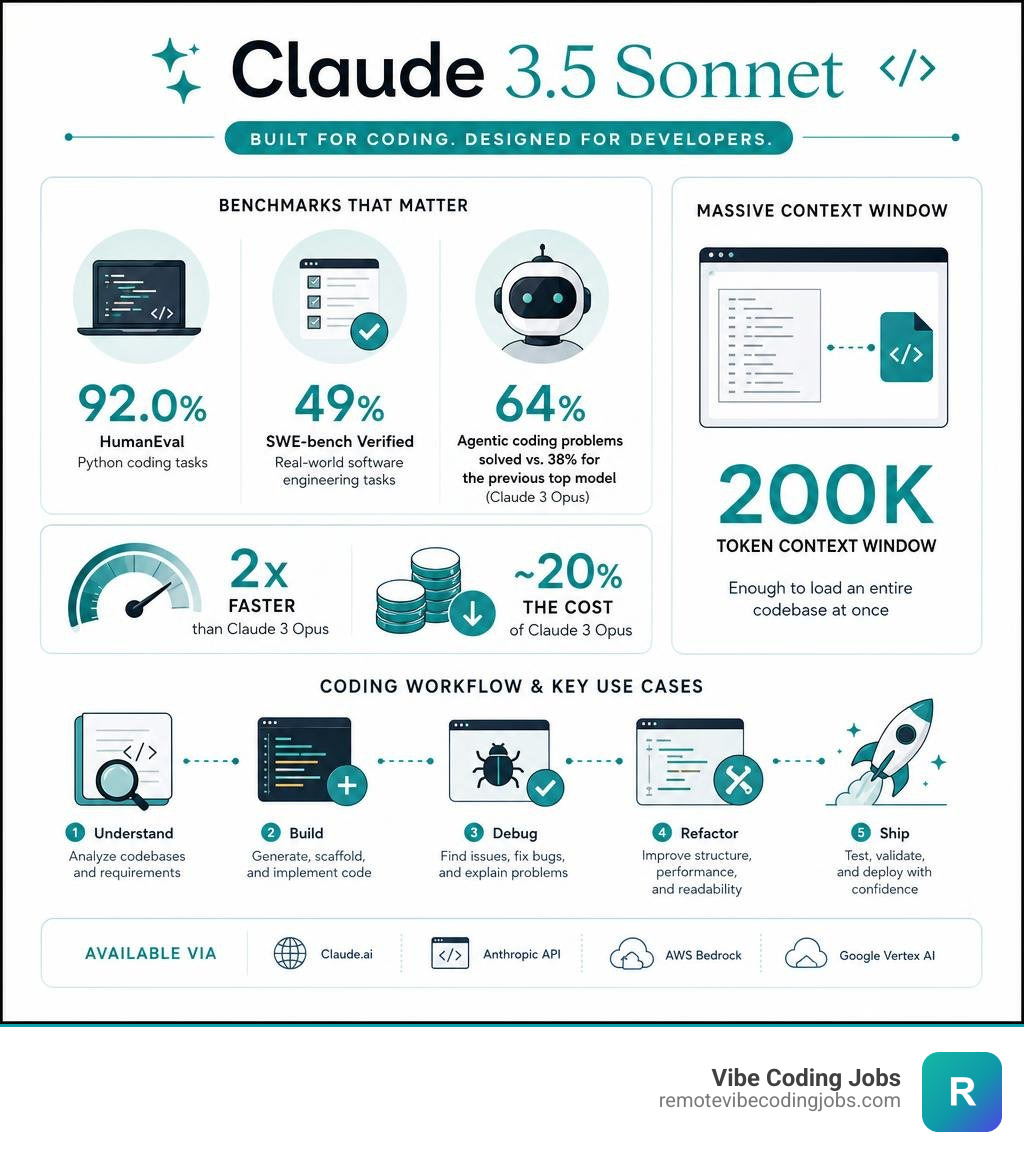
- 92.0% on HumanEval Python coding tasks
- 49% on SWE-bench Verified (real-world software engineering tasks)
- 64% of agentic coding problems solved vs. 38% for the previous top model (Claude 3 Opus)
- 200K token context window — enough to load an entire codebase at once
- 2x faster than Claude 3 Opus at roughly one-fifth the cost
- Available via Claude.ai, Anthropic API, AWS Bedrock, and Google Vertex AI
The short version: if you’re writing production code, debugging complex systems, or building with a vibe coding workflow, Claude 3.5 Sonnet is the model most developers reach for first.
When Claude 3.5 Sonnet launched, developers moved fast. Within weeks of release, agentic coding tools like Cursor, Windsurf, and Aider had made it their default model. One developer on Hacker News described building a fully functioning Django + Twilio SMS app in two hours — without being a professional developer. Another finished a Flask side project in a single day that would have taken weeks before.
That’s not hype. Those are the kinds of results that happen when a model finally crosses the threshold from “useful assistant” to genuine coding partner.
I’m RVCJ Editorial, the content team behind Remote Vibe Coding Jobs, where we cover AI-assisted development workflows, vibe coding tools, and the remote roles being built around them — including deep dives into Claude 3.5 Sonnet coding for real engineering teams. We’ve tracked this model since launch, tested it across Python, TypeScript, React, and full-stack workflows, so everything below is grounded in what actually works in production.
Relevant articles related to Claude 3.5 sonnet coding:
Why Claude 3.5 sonnet coding is the Industry Gold Standard
To understand why Claude 3.5 sonnet coding has become the industry gold standard, we have to look at the numbers. In the AI space, benchmarks are often thrown around like confetti, but when we look at software engineering specific metrics, the story becomes crystal clear.
According to the official Claude 3.5 Sonnet Model Card Addendum , the model achieves an astounding 92.0% accuracy on the HumanEval Python coding benchmark. This means it can generate precise, syntactically correct, and logically sound Python functions from natural language descriptions on the first try almost every single time.
But synthetic benchmarks only tell half the story. The real test of an AI coding model is SWE-bench Verified, a rigorous benchmark that evaluates models on their ability to resolve actual, real-world GitHub issues in complex, multi-file codebases. Claude 3.5 Sonnet scores a groundbreaking 49% on SWE-bench Verified tasks. To put that in perspective, human software engineers resolve roughly 25% to 30% of these issues on their first attempt.
Furthermore, in internal agentic coding evaluations, Claude 3.5 Sonnet solved 64% of problems, demonstrating its immense power in autonomous software engineering workflows. When we read the announcement from the team on Introducing Claude 3.5 Sonnet – Anthropic , it is easy to see how this model has set a new benchmark for the entire industry.
Why Claude 3.5 sonnet coding Outperforms Previous Models
Before the release of Claude 3.5 Sonnet, Anthropic’s most powerful model was Claude 3 Opus. While Opus was highly capable, it was slow and incredibly expensive to run. Claude 3.5 Sonnet achieved what the industry calls “tier compression.” It broke the established tier hierarchy by positioning a mid-tier “Sonnet” model completely above the ultra-premium “Opus” model on developer-critical benchmarks.
How does it compare to its predecessor?
- Speed: Claude 3.5 Sonnet operates at twice the speed of Claude 3 Opus. This rapid response time is critical for maintaining a tight feedback loop during real-time development.
- Cost: It costs roughly one-fifth the price of Opus, making deep, multi-file codebase analysis commercially viable for individual developers and startups alike.
- Problem-Solving: In agentic coding evaluations, Claude 3.5 Sonnet solved 64% of problems compared to Claude 3 Opus’s 38%.
This combination of low latency, high accuracy, and accessible pricing is why so many engineers migrated their workflows. As noted in the analysis on Why Claude 3.5 Sonnet is the New Developer Default | Boby Nugraha , Sonnet has fundamentally changed the developer experience by providing full, executable code by default, rather than lazy, incomplete placeholders. It treats writing and coding as a craft, ensuring that variables are properly initialized and edge cases are handled. You can read more about this generational shift in Claude Powers Up: The Claude 3.5 Sonnet and Haiku Story .
Real-World Performance vs Competitors
How does Claude 3.5 Sonnet stack up against its main competitors, GPT-4o and Gemini 1.5 Pro? While competitors have made strides in speed and multimodal features, developers consistently choose Claude 3.5 Sonnet for pure coding productivity and code quality.
Here is how they compare across key coding and reasoning metrics:
| Metric / Feature | Claude 3.5 Sonnet | GPT-4o | Gemini 1.5 Pro |
|---|---|---|---|
| HumanEval (Python) | 92.0% | 90.2% | 84.1% |
| SWE-bench Verified | 49.0% | 38.8% | 27.0% |
| Context Window | 200,000 tokens | 128,000 tokens | 2,000,000 tokens |
| Retrieval Accuracy | Extremely High (99.7%) | Moderate (Occasional drift) | High |
| Input Cost (per M) | $3.00 | $5.00 | $7.00 |
| Output Cost (per M) | $15.00 | $15.00 | $21.00 |
While Gemini 1.5 Pro boasts a massive context window, its actual code generation accuracy and logical consistency lag behind Sonnet. GPT-4o is fast and performs admirably on quick user interface tasks, but it often suffers from “laziness” in long threads, outputting incomplete code blocks that force developers to copy-paste and stitch things together manually. Claude 3.5 Sonnet, on the other hand, maintains high logic consistency and outputs clean, production-ready code blocks without requiring constant prompt corrections.
Managing Large Codebases with the 200K Context Window
One of the biggest hurdles in AI-assisted development is keeping the AI aligned with your existing codebase architecture. If the model can only see the file you are currently working on, it will inevitably generate code that breaks imports, duplicates existing helper functions, or violates your project’s architectural patterns.
Claude 3.5 Sonnet solves this with its massive 200,000 token context window. This is equivalent to roughly 150,000 words or hundreds of files of source code. More importantly, Anthropic has virtually eliminated the “lost in the middle” problem that plagued early large-context models. In the Needle In A Haystack (NIAH) evaluation, Claude 3.5 Sonnet achieved a 99.7% recall rate at its full 200K context length.

This means you can feed entire directories, complete database schemas, API documentation, and your company’s style guide directly into the prompt. The model acts as an active retrieval system, keeping the file hierarchy in mind and understanding how a change in a database schema impacts a frontend React component. To learn more about how remote developers are leveraging this context in their day-to-day work, check out our Best Claude Code for Remote Developers in 2026: A Comprehensive Guide.
Agentic Coding and Multi-File Refactoring
With a 200K context window and advanced reasoning capabilities, Claude 3.5 Sonnet excels at agentic coding workflows. This is where you delegate an entire, multi-step engineering task to the AI—such as migrating a legacy module, writing a comprehensive test suite, or refactoring an API.
To get the most out of these agentic tasks, developers use specific techniques to guide the model’s internal reasoning:
- System 2 Thinking: Claude 3.5 Sonnet is capable of deliberate, step-by-step reasoning. By asking the model to think through the problem before writing any code, it can identify potential race conditions, edge cases, and typing issues.
- XML Tagging: This is the secret sauce for high-stakes refactoring. By structuring your prompt using custom XML tags like
- Persistent Debugging: When integrated into agentic loops, Sonnet displays an incredible ability to self-correct. If a generated code patch fails a unit test, the model can read the stack trace, locate the bug across multiple files, and iterate until the tests pass.
If you are looking to build full-stack projects using these advanced workflows, check out our Vibe Coding with Cursor Tutorial: Unleash Your AI Coding Potential for a complete, step-by-step walkthrough.
Workflow Evolution: Artifacts, Projects, and IDE Integrations
The launch of Claude 3.5 Sonnet also introduced two workflow features that moved AI coding beyond the traditional, linear chat box: Artifacts and Claude Projects.
Artifacts create a dedicated, side-by-side workspace next to your chat conversation. When you ask Claude to generate a frontend component, an interactive dashboard, or a website mockup, the code is rendered in real-time inside the Artifact window. You can see the visual output instantly, click around the UI, and ask Claude to make edits directly to the code. This completely eliminates the tedious copy-paste-refresh cycle, turning Claude into an interactive prototyping playground.
Claude Projects allow you to build custom, project-specific knowledge bases. You can upload your repository’s core files, internal API documentation, naming conventions, and architectural rules directly into a project. Every prompt you send within that project automatically inherits this rich context. It ensures that Claude always writes code that looks like it was written by a senior engineer on your team who already knows the codebase inside out. You can explore how these tools fit into modern development environments in our guide on AI Coding Tools for Vibe Coding.
Integrating Claude 3.5 sonnet coding into Your IDE
While the Claude.ai web interface is fantastic for prototyping, the real magic happens when you integrate Claude 3.5 sonnet coding directly into your local integrated development environment (IDE).
By bringing Sonnet into tools like Cursor or VS Code, the model gains direct access to your local file system, terminal, and git workflow. This allows you to highlight a block of code, ask Claude to refactor it, and apply the diff with a single click. In terminal-based workflows, developers use CLI tools to let Claude run tests, install dependencies, and even write commit messages.
If you are looking for remote roles where you can put these advanced tools to work, we curate daily opportunities on our Cursor Copilot Developer Jobs Remote Coding page. To see a live demonstration of these setup steps, check out this excellent New Cluade 3.5 Tutorial | Claude 3.5 Sonnet Coding – YouTube .
Strengths, Limitations, and Safety in Production
While Claude 3.5 Sonnet is incredibly powerful, no AI model is perfect. To use it successfully in production, developers must understand both its strengths and its limitations.
Key Strengths:
- Superior Code Quality: It writes clean, well-commented, and highly structured code.
- Visual Reasoning: Sonnet excels at visual tasks. It can analyze UI mockups, charts, and architecture diagrams, and translate them directly into working frontend code.
- Instruction Following: It adheres strictly to complex, multi-layered constraints and system prompts.
Key Limitations:
- Mathematical Reasoning: While highly capable, Sonnet can occasionally struggle with complex, graduate-level mathematical proofs, scoring 71.1% on the MATH benchmark (slightly behind some highly specialized models).
- Knowledge Cutoff: The model’s training data stops in April 2024. If you are working with frameworks or libraries that have updated significantly since then, you will need to paste the new documentation directly into the prompt context.
- Rate Limits: Heavy users on the Claude Pro subscription can hit message limits quickly during intense coding sessions, sometimes restricted to 10-20 requests per day if context windows are fully loaded.
On the safety front, Anthropic has designed Claude 3.5 Sonnet using their Constitutional AI framework. The model has undergone extensive external red-teaming and is classified at the ASL-2 safety level, meaning it does not pose risks of catastrophic harm and is safe for deployment in secure enterprise environments. You can read a comprehensive, independent look at these safety standards and performance metrics in the Anthropic Claude 3.5 Sonnet Review — Computer Use, SWE-bench 49%, and the Model That Redefined the Sonnet Tier — ChatForest .
Pricing, Deployment, and Enterprise Integration
For teams looking to integrate Claude 3.5 Sonnet into their production pipelines, Anthropic offers highly flexible deployment options:
- Anthropic API: Direct access with developer-friendly pricing of $3.00 per million input tokens and $15.00 per million output tokens.
- Prompt Caching: This is a massive cost-saver for developers. By caching frequently used context—such as your entire codebase or large API documentation—you can reduce your API costs by up to 90% and speed up response times significantly.
- Amazon Bedrock: Perfect for enterprises requiring IAM-native controls, regional data routing, and robust security compliance within AWS.
- Google Vertex AI: Seamless integration for teams built on Google Cloud Platform, offering enterprise-grade security and scale.
To explore more about pricing tiers, token limits, and API integrations, visit the official Claude Sonnet – Anthropic documentation.
Frequently Asked Questions about Claude 3.5 Sonnet Coding
How does Claude 3.5 Sonnet compare to Claude 3.7 Sonnet for coding?
Claude 3.7 Sonnet introduces hybrid reasoning, allowing the model to choose between near-instant responses or extended, step-by-step thinking. This “extended thinking mode” significantly improves performance on complex, long-horizon coding tasks, math, and logical planning.
Additionally, Claude 3.7 Sonnet integrates with Claude Code, a terminal-based command-line tool that lets Claude execute commands, run tests, and manage git workflows autonomously. While Claude 3.5 Sonnet remains an incredibly cost-effective and highly reliable option for standard coding tasks, Claude 3.7 Sonnet is the go-to for complex architectural overhauls. You can read more about these advancements in the official announcement on Claude 3.7 Sonnet and Claude Code \ Anthropic .
What are the rate limits for Claude 3.5 Sonnet?
On the $20/month Claude Pro plan, rate limits are dynamic and depend on the size of your conversation history. If you paste a massive codebase into your chat, you may hit the limit in as few as 10 to 20 messages, as the model has to re-read the entire context with every turn.
To avoid this, we recommend keeping your chat threads short, using Claude Projects to store persistent context, or utilizing the Anthropic API where rate limits are based on tokens-per-minute (TPM) and requests-per-minute (RPM) rather than strict message caps.
Can Claude 3.5 Sonnet handle full-stack app development?
Yes, absolutely! Claude 3.5 Sonnet is highly capable of building full-stack applications from scratch. Because of its visual reasoning and strong understanding of backend frameworks, you can ask it to generate a Python Django backend, set up a PostgreSQL database schema, write REST API endpoints, and build a responsive React or Tailwind CSS frontend.
By using interactive workspaces like Artifacts, you can build, test, and refine your user interface in real-time before pushing the code to your local repository. For a complete guide on how to structure your prompts for full-stack projects, take a look at our walkthrough on How to Vibe Code a Full Stack App: A Developer’s Guide.
Conclusion
At the end of the day, coding with Claude 3.5 Sonnet truly does feel like magic. It has bridged the gap between raw technical capability and intuitive developer experience. Whether you are a seasoned senior engineer refactoring a legacy monolith or a “vibe coder” building rapid prototypes, Sonnet gives you the superpower to turn ideas into working software faster than ever before.
At Remote Vibe Coding Jobs, we believe the future of software engineering belongs to developers who know how to leverage these AI tools to their fullest potential. We curate daily listings of remote, async-first developer roles at forward-thinking companies that encourage AI-assisted workflows.
If you’re ready to take your AI-assisted development career to the next level, check out current remote openings like the Jellyvision Careers page, or browse our platform to find your next remote vibe coding role today!