
Find OpenAI Jobs and Apply to the Right Team
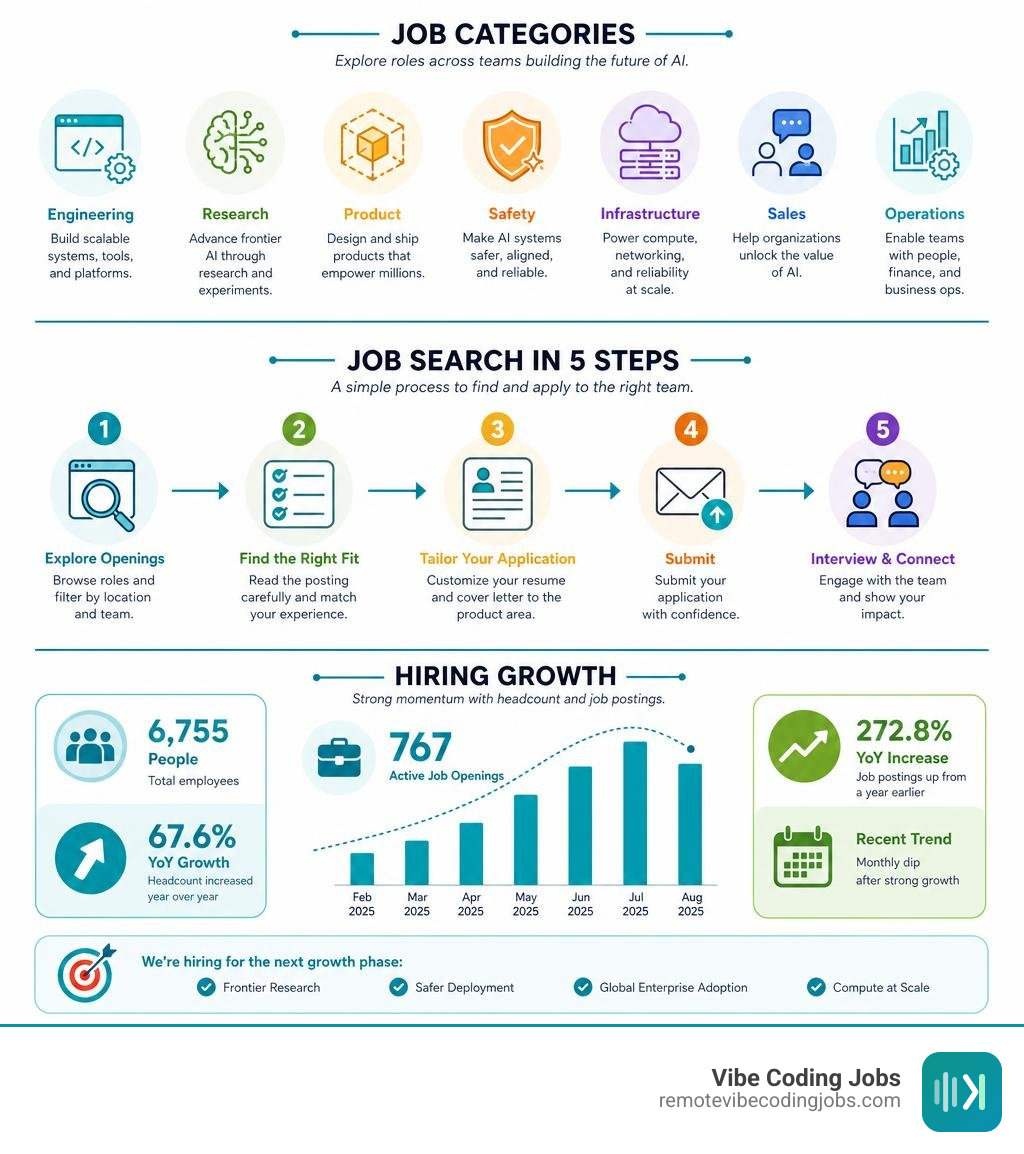
OpenAI has about 767 active job openings across research, engineering, product, safety, infrastructure, sales, and operations. To find relevant OpenAI jobs quickly, start on the OpenAI Careers page, filter by location and team, then tailor your application to the product area named in the posting – such as ChatGPT, Codex, safety systems, or AI infrastructure.
For developers, the strongest current fit is often in:
- Software and infrastructure engineering – distributed systems, inference, cloud, performance, security, and developer tools.
- Research and applied AI – model training, retrieval, agents, evaluations, alignment, and production ML.
- Customer-facing AI engineering – applied AI engineers and forward-deployed engineers helping companies deploy models safely.
The scale explains the breadth. OpenAI reportedly employs 6,755 people, up 67.6% year over year, while job postings have risen 272.8% from a year earlier despite a recent monthly dip. That mix points to a company hiring for the next growth phase: frontier research, safer deployment, global enterprise adoption, and the compute needed to support them.
I am Di Su, a software engineer with more than 10 years of experience in web development, scalable product work, and conversion-focused user experiences. I have also worked across engineering, growth, and e-commerce, so this guide approaches OpenAI jobs from both the technical portfolio and practical application sides.
Key openai jobs vocabulary:
- Anthropic Glassdoor reviews
- Anthropic internship and fellowship guide
- Working at OpenAI insights from Reddit
Current Landscape of OpenAI Jobs: Headcount, Growth, and Key Departments

OpenAI’s organizational structure has evolved from a concentrated research laboratory into an enterprise-scale technology powerhouse. Today, the workforce stands at 6,755 employees worldwide, marking a notable 67.6% year-over-year expansion. The organization balances frontier artificial general intelligence (AGI) exploration with enterprise infrastructure, monetization architectures, and real-world software delivery.
Technical teams form the core backbone of the company’s headcount. Approximately 32% of all staff (2,938 employees) work in technical departments spanning research, systems scaling, product engineering, and security. Regarding organizational seniority, 46% of the workforce (4,275 employees) operate at the Specialist tier, reflecting OpenAI’s deliberate strategy of hiring experienced individual contributors who can operate autonomously within loosely structured problem spaces.
Candidates monitoring hiring trends can explore active listings directly on the OpenAI: Jobs LinkedIn page.
| Department Category | Active Share & Headcount | Primary Focus Areas | Core Technical Domains |
|---|---|---|---|
| Technical & Systems Engineering | 32% (~2,938 employees) | Scaling infrastructure, custom silicon, model runtime, distributed data | C++, Python, CUDA, Rust, Distributed Systems |
| Research & Model Alignment | ~22% of total staff | Personal AGI, reinforcement learning, interpretability, reasoning models | PyTorch, Synthetic RL, Adversarial Evaluation |
| Go-To-Market & Commercial | ~18% of total staff | Enterprise adoption, technical deployment, client success | Forward-deployed engineering, solutions architecture |
| Safety, Risk & Governance | ~14% of total staff | Frontier threat mitigation, red teaming, alignment oversight | Agent security, cyber defense, compliance frameworks |
| Operations, Design & Product | ~14% of total staff | Platform UX, content design, hardware consolidation, finance | Swift, React, design systems, technical accounting |
Talent inflow data reveals that Google is OpenAI’s top talent supplier, contributing 526 hires, followed closely by Meta with 371 hires and Apple with 246 hires. Outflow movements show that departing OpenAI team members most commonly transition to Google (78), Anthropic (74), and Meta (60), underscoring the dynamic talent exchange across top-tier frontier AI labs.
Global Expansion and Remote Hiring Dynamics
While OpenAI maintains four offices situated in San Francisco, California—housing roughly 60% of its personnel (5,546 employees)—the organization’s footprint extends across 88 countries. Global engineering centers and customer-facing hubs have expanded rapidly in London, Tokyo, Singapore, Dublin, and Seoul.
International postings concentrate on Forward Deployed Engineers (FDEs), Regional Solutions Architects, and Applied AI Engineers capable of integrating frontier intelligence into complex regulatory and sovereign enterprise environments. For remote candidates, OpenAI lists numerous distributed positions in regions including US-Remote, India-Remote, and Australia-Remote. These teams operate with an async-first philosophy, relying on clear written specifications, automated CI pipelines, and AI-assisted workflows to coordinate across time zones.
High-Demand Roles, Technical Stack, and Engineering Priorities

Scaling frontier workloads demands unprecedented hardware and software synchronization. OpenAI’s current roadmap emphasizes datacenter architecture, compute optimization, and on-device machine intelligence. Open positions on Careers reflect major investments in compute infrastructure projects such as the Stargate datacenter initiative and internal custom inference silicon, nicknamed the “Jalapeño” chip.
Engineering efforts are divided across three primary priority pillars:
- Foundations and Datacenter Delivery: Data center design engineers, industrial power leads, electrical commissioning specialists, and interconnect reliability engineers work to secure gigawatt-scale infrastructure.
- Compute and Kernel Acceleration: Teams develop custom runtime environments, collective communication protocols, and Triton/CUDA kernels to maximize floating-point operations per second (FLOPs) during distributed training and inference.
- Agent Platforms and Consumer Hardware: Product teams architect full-stack agents, multi-modal audio/visual streaming pipelines, and firmware interfaces for next-generation consumer hardware form factors.
Technical and Research OpenAI Jobs Driving Frontier Models
The frontier research division bridges scientific breakthroughs and dependable platform software. Key positions include the Research Engineer, Retrieval & Search, Applied Engineering | OpenAI role, which scales retrieval-augmented generation (RAG) and dense vector indexing for millions of concurrent ChatGPT queries.
Simultaneously, the Cooperative AI group builds systems that allow autonomous agents to interact safely with human workflows. Software engineers joining this area via the Software Engineer, Cooperative AI | OpenAI posting focus on building reusable primitives, automated operational tooling, and context-retention frameworks with base salaries ranging between $266,000 and $445,000 plus equity.
Other high-priority research tracks encompass Personal AGI (focusing on memory, proactive behaviors, and personality), Synthetic Reinforcement Learning, and Alignment Interpretability—a group dedicated to analyzing chain-of-thought monitorability before models ship to production.
Specialized Product, Performance, and Mobile Engineering
Deploying multi-modal models to consumer devices requires specialized mobile infrastructure and systems performance optimization. Through the iOS Engineer, ChatGPT Mobile Infrastructure | OpenAI opening, OpenAI recruits Swift specialists to unify shared runtime frameworks across ChatGPT, Codex, and video-generation tools. This role offers a base compensation of $185,000 to $385,000 plus equity.
On the backend performance side, teams recruit specialists via the Performance Engineer | OpenAI posting to eliminate latency regressions across GPU memory channels, operating system schedulers, and Python runtimes. Backed by base compensation bands of $325,000 to $405,000, these engineers ensure that inference pipelines handle enterprise spikes without breaking latency budgets.
Compensation Benchmarks, Equity, and Workplace Culture
OpenAI is known for top-of-market compensation packages that pair competitive base salaries with Profit Participation Units (PPUs) or internal equity equivalents. The company practices transparent salary disclosure across job openings, with typical technical base compensation falling between $185,000 and $555,000 per year.
Representative base salary benchmarks across distinct organizational tiers include:
- Research Scientists & Specialized Systems Engineers: $293,000 – $585,000 base + equity
- Senior Platform & Performance Software Engineers: $266,000 – $445,000 base + equity
- Applied AI Engineers & Forward Deployed Specialists: $200,000 – $385,000 base + equity
- Technical Program Managers (TPMs): $160,462 average base ($160,000 – $240,000 typical range)
- User Operations Specialists & Risk Analysts: $90,481 average base ($80,000 – $130,000 range)
- Technical Recruiters & Talent Sourcers: $77,089 average base ($75,000 – $150,000 range)
Employee sentiment reviews yield an overall company rating of 4.1 out of 5.0 stars across verified platforms. Compensation and benefits earn the highest marks at 4.6/5.0, supported by perks such as 24 weeks of paid birth-parent leave, 20 weeks of paid parental leave, comprehensive healthcare, annual learning stipends, and provided meals.
Conversely, work-life balance receives a rating of 3.2/5.0. The rapid pace of model releases, constant competitive pressure, and intensive product cycles require a resilient mindset. As stated in OpenAI’s operating philosophy, the culture prioritizes “intense focus,” “updating quickly,” and choosing “creativity over control.”
Non-Technical and Interdisciplinary Career Paths
Scaling an AI lab into a global institution demands extensive non-engineering expertise. Open roles across legal, design, marketing, and safety policy shape how products operate in society.
For example, the Content Designer | OpenAI position offers $207,000 to $295,000 base pay for specialists who craft product vocabularies, system prompts, and language frameworks for experimental agent surfaces. Interested applicants can also browse operational, legal, and program management positions on the OpenAI job board.
Cross-functional categories actively hiring include:
- Government Partnerships & Sovereign Policy: Managing compliance, export controls, and sovereign AI compute programs with international entities.
- Trust, Safety & Risk Operations: Investigating critical threats, red-teaming multimodal models, and building anti-abuse filters.
- Technical Accounting & Compute Procurement: Handling capital deployments, power contracts, and infrastructure supplier negotiations.
Navigating the Application Process and Candidate Requirements
Securing a role at OpenAI requires a mix of fundamental engineering depth, rapid problem solving, and practical familiarity with modern AI tools. Across research, platform, and product teams, interviewers evaluate a candidate’s ability to navigate ambiguity, design scalable distributed systems, and implement robust safety guardrails.
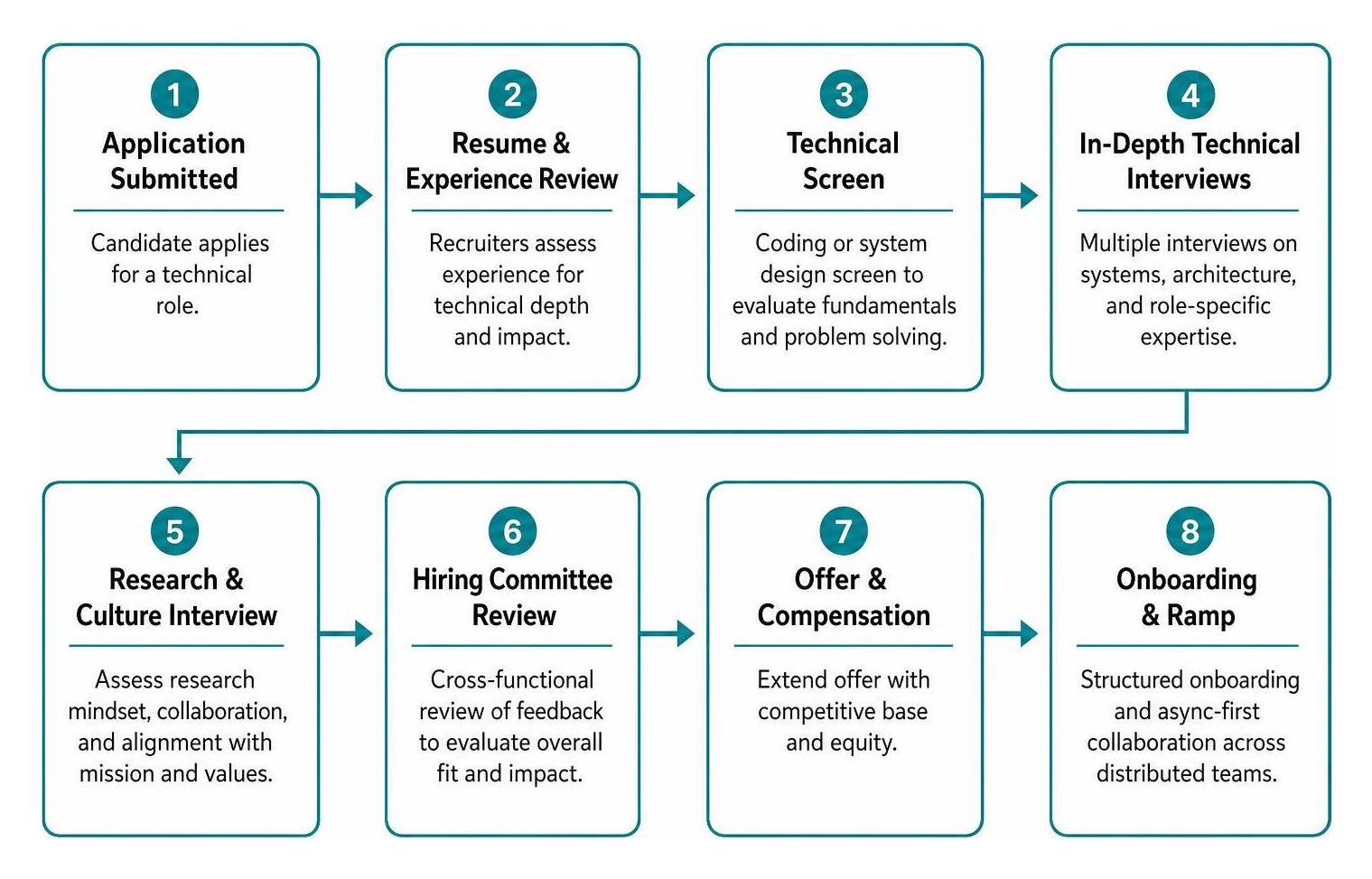
The hiring pipeline typically moves through five main stages:
- Application & Portfolio Screening: Recruiters and engineering leads assess your past technical contributions, open-source repositories, and hands-on experience with modern AI development environments.
- Technical Screen (1-2 Rounds): Live coding sessions focusing on algorithmic efficiency, system architecture, or ML fundamentals (e.g., PyTorch, CUDA, concurrency, or Swift internals).
- Deep-Dive Work Sample / Practical Assignment: A real-world systems or research problem where you analyze bottlenecks, write unit tests, and document your architectural decisions.
- Onsite Interview Loop (4-5 Sessions):
- System Design & Scalability (profiling, caching, multi-GPU orchestration).
- Domain-Specific Depth (e.g., RAG pipelines, RL training, memory management).
- Cross-Functional Collaboration & Product Intuition.
- Values & Safety Alignment (evaluating humility, adaptability, and mission alignment).
- Offer & Executive Calibration: Final compensation structuring spanning base pay, profit units, and comprehensive benefits.
Early-career researchers and engineers transitioning into artificial intelligence can also leverage the OpenAI Residency program—a six-month full-time pathway designed to transition STEM talent into permanent research and engineering roles.
How to Stand Out When Applying for OpenAI Jobs
To stand out in the applicant pool, candidates should demonstrate modern development workflows and a clear focus on shipping user value:
- Leverage AI-Assisted Workflows: Show experience building alongside AI coding agents such as Codex, Claude Code, or Cursor. Demonstrate how you use prompt scaffolding, repository-level instructions, and automated test loops to accelerate delivery.
- Emphasize Measurable Systems Impact: Highlight concrete performance milestones from your past work—such as reducing P99 latency, optimizing GPU memory footprints, or preventing model regressions.
- Showcase End-to-End Ownership: OpenAI values self-directed specialists. Frame your past projects around how you took ambiguous problems from early concept to production deployment.
- Demonstrate Safety & Alignment Awareness: Familiarize yourself with OpenAI’s published research on safety evaluations, alignment guardrails, and model policy to speak thoughtfully to ethical deployment during interviews.
Frequently Asked Questions About Careers at OpenAI
What salary and equity packages can candidates expect at OpenAI?
OpenAI provides top-of-market compensation packages that combine transparent base salaries with equity-like profit participation units (PPUs). Base salaries for engineering and research roles typically range from $185,000 to over $555,000 per year, depending on specialization and track record. Non-technical roles, including recruiting and operational support, generally offer base salaries between $75,000 and $160,000, complemented by full health coverage, retirement programs, and annual education stipends.
Does OpenAI offer remote and international opportunities?
Yes. While OpenAI’s primary headquarters is in San Francisco, the company employs staff across 88 countries and lists fully remote positions in designated regions (such as US-Remote, India-Remote, and Australia-Remote). The company also maintains growing international offices in London, Dublin, Tokyo, Singapore, and Seoul, with a strong focus on Forward Deployed Engineering, regional enterprise partnerships, and localized safety policy.
Which technical skills are most valued during OpenAI hiring?
The most sought-after competencies include distributed systems engineering, GPU kernel optimization (CUDA, Triton), low-level performance profiling, and machine learning frameworks like PyTorch. For application and platform positions, teams look for deep experience in Python, Rust, Go, Swift, modern vector databases, and agent orchestration frameworks. Candidates who integrate AI-assisted development tools into their daily workflow are especially well-aligned with the company’s builder culture.
Conclusion
OpenAI’s hiring trajectory reflects its evolution from a dedicated research lab into a global AI platform. With hundreds of open positions across infrastructure, model safety, consumer hardware, and developer tooling, the company offers high-impact career paths for engineers and operators shaping the future of intelligence.
Whether your expertise lies in low-level systems tuning, product design, or enterprise deployment, working on frontier systems requires continuous learning and practical AI fluency. If you are looking to build modern, AI-assisted development skills, explore high-impact remote ai engineer opportunities and start applying your engineering talents to the frontier ecosystem today.