What Is an Anthropic Internship — and How Do You Actually Get One?
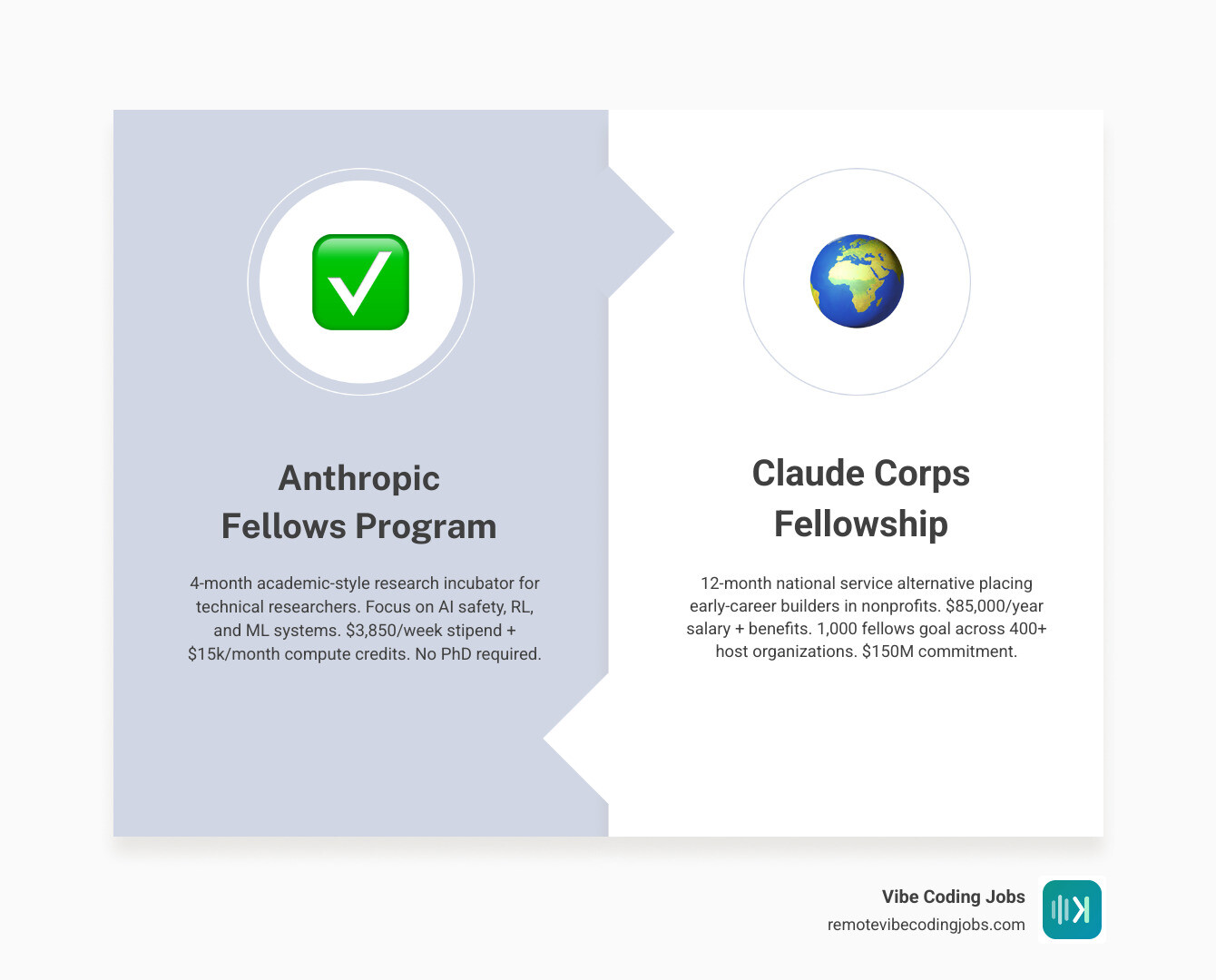
The Anthropic internship doesn’t exist in the traditional sense — and that surprises most applicants. Instead of a standard summer program, Anthropic runs two distinct early-career fellowships:
| Program | Duration | Pay | Who It’s For |
|---|---|---|---|
| Anthropic Fellows Program | 4 months | $3,850/week + $15k/month compute | Technical researchers (AI safety, RL, ML systems) |
| Claude Corps Fellowship | 12 months | $85,000/year salary + benefits | Early-career builders placing AI in nonprofits |
Anthropic is valued at $965 billion after its Series H in May 2026, with over $47 billion in annual recurring revenue and 2,300+ employees — making it the most valuable pure-play AI safety company on Earth. Yet despite its scale, it has only around 22 active interns in its workforce at any given time.
The path in is narrow, but it’s real — and it’s open to people without PhDs.
I’m Di Su, a software engineer with over 10 years of experience in web development and scalable systems, and I’ve researched the Anthropic internship landscape in depth to give you the clearest, most actionable guide available. Read on for everything you need to apply with confidence for the 2027–2028 cohorts.
Demystifying the Anthropic Internship: Fellows Program vs. Traditional Roles
When most university students search for an anthropic internship, they expect to find a standard 10-to-12-week summer posting where they write unit tests and shadow senior engineers. However, Anthropic’s approach to early-career talent is fundamentally different.
Instead of viewing interns as temporary support staff, we see that Anthropic treats early-career positions as rigorous research incubators and high-impact deployment vehicles. The company approaches AI development as an empirical science—similar to physics or molecular biology—where breakthroughs require deep commitment, massive compute resources, and highly focused execution.
Why There is No Standard Anthropic Internship
With a workforce that has scaled rapidly, Anthropic still maintains an incredibly lean footprint of formal, short-term interns. Out of their thousands of employees, only about 22 active interns are typically listed in workforce data.
Rather than standard corporate pipelines, the company occasionally posts specialized, forward-looking roles such as the Anthropic hiring for 2026 Intern, Gen AI/LLM Research. This remote-friendly research internship requires zero years of minimum experience, targeting fresh, highly motivated minds who can immediately collaborate with leading AI researchers on natural language processing and multi-agent interactions.
However, because these traditional openings are exceedingly rare and highly competitive, the primary gateways into Anthropic for early-career developers are its structured fellowship programs.
The Anthropic Fellows Program Explained
The Anthropic Fellows Program is a 4-month, full-time research initiative designed to foster technical talent in AI safety. Rather than a side project, fellows are paired directly with world-class mentors to work on high-priority empirical research questions.
To manage the logistics, workspace allocations, and initial application vetting, Anthropic partners with an external recruiting organization called Constellation. This program operates with the intellectual freedom of an academic lab but is supercharged by the resources of a leading commercial AI firm. You can learn more about how university career centers track this unique opportunity via the Anthropic Fellows Program – Career & Internship Center | University of Washington.
Claude Corps Fellowship: The $150M National Service Alternative
For those more interested in practical deployment than pure academic research, Anthropic committed an initial $150 million to launch the Claude Corps Fellowship. This 12-month program is designed to bridge the AI adoption gap in the nonprofit sector while training the next generation of AI builders.
Through a collaborative partnership with CodePath and Social Finance, Claude Corps bypasses traditional tech hiring filters. It requires no formal computer science degree, focusing instead on comfort with Claude and under two years of full-time work experience.
Fellows are technically employed by CodePath during their tenure but are fully funded by Anthropic. Over the next 12 months, at least 400 nonprofits will host these fellows, allowing early-career builders to embed directly within mission-driven teams to build real-world AI tools.
Program Details: Compensation, Workstreams, and Eligibility for 2027–2028
If you are aiming to secure a spot in either of these prestigious programs, understanding the exact logistics, financial compensation, and available workstreams is crucial for positioning your application.
| Feature | Anthropic Fellows Program | Claude Corps Fellowship |
|---|---|---|
| Duration | 4 Months (Full-Time) | 12 Months (Full-Time) |
| Compensation | $3,850 USD / week | $85,000 USD / year + benefits |
| Compute Budget | ~$15,000 USD / month | Standard Claude Team access |
| Primary Focus | Empirical AI safety & ML systems research | AI tool deployment in non-profit sectors |
| Locations | San Francisco, CA; London, UK; Ontario, CAN; Remote-friendly (US) | Various nonprofit host sites across the US |
| Visa Sponsorship | None (Must have independent work auth) | US work authorization required |
Compensation, Duration, and Locations
The financial backing for these programs is exceptionally generous. Anthropic Fellows receive a weekly stipend of $3,850 USD (or £2,310 GBP / $4,300 CAD depending on location), which totals approximately $61,600 over the 4-month program.
On top of this personal compensation, fellows receive an unprecedented compute allocation of approximately $15,000 per month. This means you have a $60,000 compute budget to run massive training pipelines and stress-test frontier models.
The Fellows Program operates out of Anthropic’s physical offices in San Francisco, California and London, UK, as well as Ontario, Canada. While there are remote-friendly options for US-based fellows, on-site collaboration is highly encouraged to maximize mentorship.
The Five Core Research Workstreams
When applying for the Fellows Program, you must specify your target workstream. Each represents a critical pillar of Anthropic’s safety and alignment mission:
- AI Safety: Focused on scalable oversight, adversarial robustness, and model welfare. Fellows investigate how models behave under stress or in simulated environments. To see what past cohorts worked on, check out the Anthropic Fellows Program, AI Safety at Anthropic — California, United States | Intern Insider.
- AI Security: Red-teaming models, detecting vulnerabilities, and analyzing the offense-defense balance of scaling AI models in cybersecurity and biosecurity.
- Reinforcement Learning: Building model-based tools, designing RL environments, and optimizing RLHF (Reinforcement Learning from Human Feedback) pipelines. Explore this track further via the Anthropic Fellows Program, Reinforcement Learning at Anthropic — San Francisco, California, United States | Intern Insider.
- ML Systems & Performance: Engineering highly optimized infrastructure, maximizing hardware utilization, and scaling training runs.
- Economics & Policy (The Anthropic Institute): Researching the societal impacts of AI, labor transitions, and global governance frameworks. You can view the formal posting details at the Job Application for Anthropic Fellows Program, The Anthropic Institute (Economics & Policy) at Anthropic.
Eligibility Requirements and Deadlines
The eligibility criteria for the anthropic internship alternatives are refreshingly non-traditional:
- No PhD Required: You do not need an advanced academic degree or prior machine learning publications to apply.
- Python Fluency is Mandatory: Python is the non-negotiable language of choice across all technical streams. Your coding skills must be production-grade.
- Work Authorization: Candidates must possess independent, full-time work authorization in the US, UK, or Canada. Anthropic does not sponsor visas for these temporary fellowship roles.
Applications are reviewed on a rolling basis, meaning spots fill up quickly. If you are targeting the 2027–2028 cohorts, you should prepare your materials months in advance. To keep track of active application windows, bookmark the Anthropic Internship 2027–2028: Deadlines & How to Apply | Extern.
The Application and Interview Process
Getting an offer from Anthropic is notoriously difficult, but the timeline is surprisingly fast. The entire application-to-offer pipeline typically takes between 3 to 6 weeks. Because admissions operate on a rolling basis, applying early—ideally the week the job board listing appears—is paramount.
One unique aspect of Anthropic’s process is that references are contacted incredibly early—often during the initial application review stage rather than at the end of the hiring loop. You must brief your three references in advance so they are ready to respond immediately.
How to Ace the Anthropic Internship Interview Loop
The technical interview process is structured to evaluate practical system-building and empirical thinking rather than academic credentialing.
1. The CodeSignal Assessment
This initial screen eliminates 60% to 70% of all applicants before they ever speak to a human. While the official passing score is 480 out of 1,000, a competitive score that guarantees review is typically 600+.
Unlike standard algorithmic puzzles, this test is highly systems-focused. You might be asked to build a fully functional in-memory database with TTL (Time-To-Live) expiration from scratch in Python. Understanding the Vibe Coding vs Traditional Software Engineering Key Differences is useful here: Anthropic expects you to write pristine, manual Python code without relying on AI shortcuts during this specific test.
2. The Live Coding Screen
If you clear CodeSignal, you will enter a live coding screen. A great tip here is to spend the first 10 to 15 minutes of the interview purely clarifying requirements and outlining your architecture before writing a single line of code. Narrate your thought process continuously to show how you navigate ambiguity.
3. The Final Loop
The final round consists of an LLM engineering challenge and a research brainstorming session. You will work with Anthropic researchers to design an empirical experiment or propose a solution to a novel safety problem, testing your ability to think like an empirical scientist.
Key Skills and How to Stand Out in Rolling Admissions
To stand out in a sea of highly qualified applicants, you must demonstrate strong quantitative skills (such as a background in physics, mathematics, computer science, or cybersecurity) alongside a deep, authentic motivation for AI safety.
We highly recommend showcasing independent research, thoughtful blog posts, or open-source contributions at the top of your resume. Interestingly, Anthropic actively invites candidates to use Claude or other AI tools to refine and enhance their application materials.
If you are looking to build a standout portfolio that showcases your ability to build alongside AI, check out our guide on How to Get a Vibe Coding Job Skills Portfolio to learn how to structure your GitHub projects for maximum impact.
Frequently Asked Questions about Anthropic Early-Career Roles
What is the conversion rate from the fellowship to full-time roles?
The transition rate from the Fellows Program to full-time engineering and research roles at Anthropic is remarkably high, ranging between 25% and 50% across cohorts. In the very first cohort, over 40% of the fellows successfully joined Anthropic full-time.
Additionally, the program is incredibly productive: over 80% of the fellows in the first cohort successfully produced and published peer-reviewed research papers during their 4-month tenure. This makes it an unparalleled launchpad for AI Assisted Development Career Growth.
Do I need a PhD or prior ML experience to apply?
No! This is one of the most common misconceptions about Anthropic. Approximately 50% of Anthropic’s technical staff had absolutely no prior machine learning experience before joining. Furthermore, roughly half of the technical staff do not hold a PhD.
We know that Anthropic prioritizes clean Python execution, quantitative reasoning, and a passion for alignment over academic credentials. If you are a beginner looking to break into the industry, explore our resource on AI Coding Jobs Entry Level Beginners to start building your foundation.
What other programs or alternatives should I consider?
If you are passionate about AI safety and development, you should not limit your search to a single firm. Other frontier AI labs offer dedicated safety research-intern roles. These specialized positions command a significant premium, advertising a mean salary of about $70,000, compared to approximately $54,800 for general software engineering internships.
Additionally, we see a massive rise in “vibe coding” and AI builder roles at fast-scaling, remote-first startups. To find companies that encourage prompt-driven development and modern workflows, check out our curated list of Companies Hiring Vibe Coders Remote AI Coding.
Conclusion
Breaking into Anthropic through the Fellows Program or the Claude Corps Fellowship is an extraordinary opportunity to shape the future of safe, beneficial artificial intelligence. While the selection process is highly rigorous, the lack of rigid academic requirements means that raw talent, Python fluency, and practical execution are what truly matter.
As you prepare your application for the 2027–2028 cohorts, focus on building robust, functional systems, mastering Python, and understanding the core mechanics of LLM alignment.
If you want to accelerate your development speed and learn to build production-grade applications using state-of-the-art AI tools, we are here to help. Explore our beginner’s guide to Vibe Coding with AI A Beginner’s Practical Guide 2026 and check out our Vibe Coding Remote Job Guide to kickstart your career.
Ready to take the next step in your AI journey? Apply for AI Engineer Roles on RemoteVibeCodingJobs today and find curated, remote-first positions that match your skills!