
Start Your Search for Bolt Payments Careers With the Right Company
Bolt payments careers can mean two very different employers. If you want to build one-click checkout, payment routing, merchant tools, fraud systems, or financial ledgers, look for roles at Bolt Financial / Bolt.com, the commerce and payments company. If you want to support rider charges, driver or courier payouts, and a global mobility platform, look for Bolt Technology / Bolt.eu roles.
Before applying, check the company domain, product description, location rules, and job title. Payment-focused openings commonly include:
- Backend engineers building reliable acquisition, settlement, reconciliation, and ledger services
- Frontend engineers creating secure checkout flows, payment SDKs, and merchant-facing tools
- Product operations specialists using SQL to investigate failed transactions, escalations, and rollout issues
These jobs sit at the hard edge of fintech: systems must be fast, secure, compliant, and dependable when money moves. For developers, the strongest applications show real experience with distributed systems, APIs, payment integrations, data analysis, and secure handling of card or tokenized payment data.
I am Dominic Zijlstra, a technologist, data scientist, and DevOps engineer who has worked on data infrastructure and automated systems. In this guide to bolt payments careers, I will help you separate the similarly named companies and focus your search on the roles that fit your technical background.
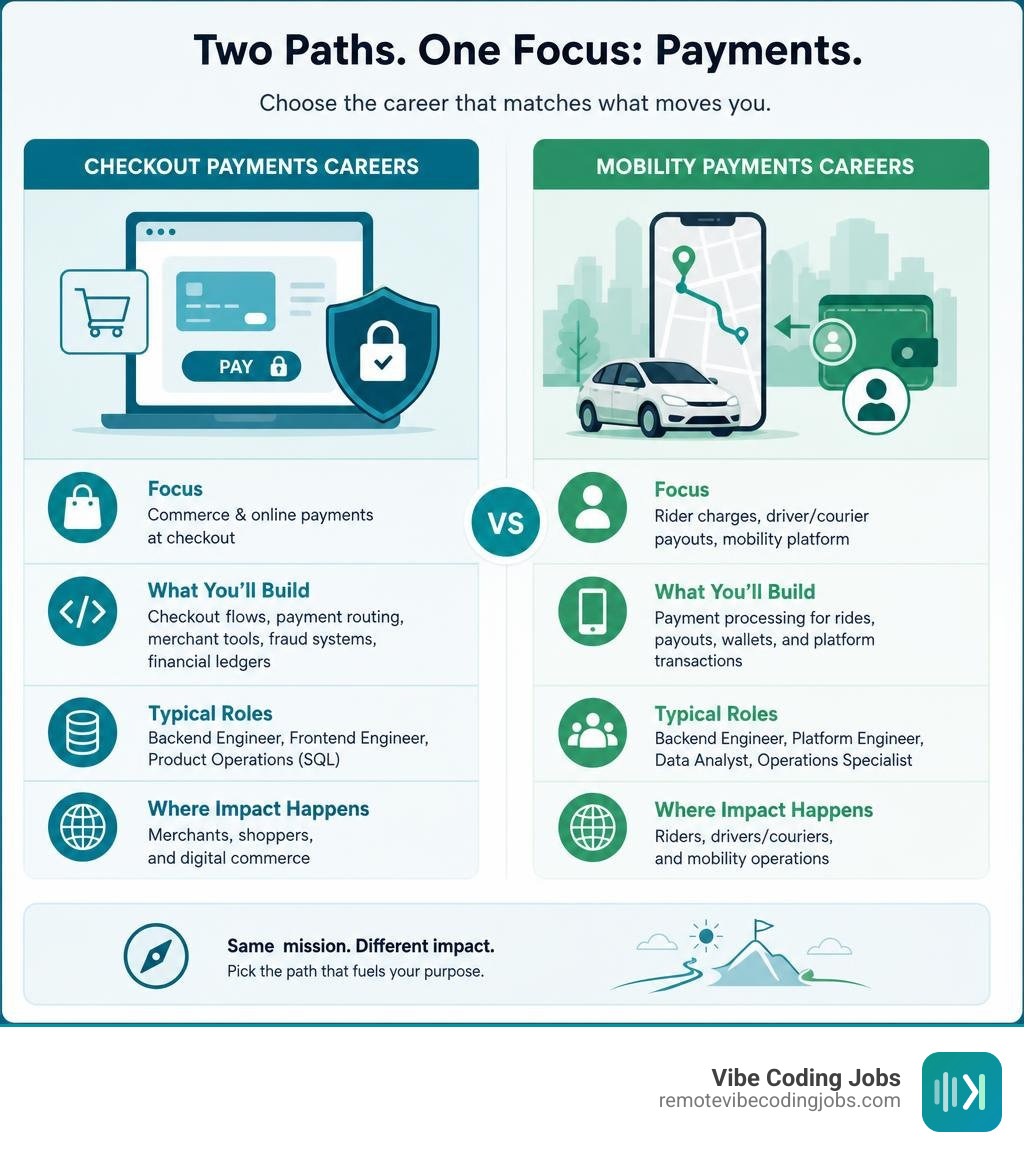
Bolt payments careers glossary:
Navigating Bolt Payments Careers: Fintech vs Mobility Super-App
When exploring job boards and tech listings, the single biggest point of confusion is that two entirely different tech scale-ups share the name “Bolt.” Both operate massive transaction platforms, but their core product architectures, business models, and engineering challenges differ significantly.
| Feature / Metric | Bolt Financial (Bolt.com) | Bolt Technology OÜ (Bolt.eu) |
|---|---|---|
| Core Product | One-Click Checkout, CheckoutOS, Universal Shopper Network | Urban Mobility, Ride-Hailing, Micromobility, Food Delivery |
| Industry Sector | E-commerce Fintech & Embedded Payments | Transportation & On-Demand Delivery Super-App |
| Primary Headquarters | San Francisco, CA (Remote-First) | Tallinn, Estonia (Hybrid Hubs) |
| Total Funding | Over $980M across multiple rounds | $2.3B across 18 rounds |
| Audience / Scale | 80M+ shoppers in network; thousands of retail merchants | 200M+ customers in 50+ countries and 600+ cities |
| Primary Payment Flow | Inbound merchant checkout conversion, tokenization, anti-fraud | Bi-directional: rider debit charging & courier/driver payouts |
| Core Tech Stack | Go, Java, Kotlin, React, TypeScript, GraphQL, Docker | Kotlin, TypeScript, Python, Kubernetes, Spark, Databricks |
Checkout Infrastructure vs Urban Mobility
Bolt Financial focuses entirely on democratizing commerce by enabling frictionless, one-click checkout across thousands of independent retailers. Its core product line—including CheckoutOS and Bolt Ignite—connects over 80 million shoppers across a decentralized, universal network. Engineering here centers on payment service provider (PSP) routing, anti-fraud transaction scoring, ledgering, and merchant settlement.
In contrast, Bolt Technology OÜ is a European mobility super-app. Their internal payments infrastructure handles complex, high-velocity bi-directional flows across 50+ countries. Inbound systems charge millions of passengers and grocery delivery customers in real-time, while outbound payout engines disburse funds to over 4.5 million driver and courier partners across fragmented international banking rails.
Where to Find Open Positions
To ensure you are applying to the right team and tech stack, bookmark the verified careers portals for both organizations:
- Explore checkout, commerce, and US/Canada remote-friendly engineering roles at Bolt | View Open Roles.
- Review international mobility platform, data analytics, and operations roles at Bolt Careers – Job openings.
- Access developer-focused AI tool ecosystems and modern building platforms via Careers — Build the thing everyone else builds with | Bolt.
- Discover specialized operational openings like Product Operation Specialist positions in payments and merchant operations.
- Review technical architecture openings such as Staff Software Engineer roles across backend and frontend payments teams.
In-Demand Roles Across the Payments Ecosystem

Payment engineering teams operate at the intersection of high throughput, zero-tolerance data accuracy, and strict security constraints.
Engineering: Backend and Frontend Architecture
Backend engineers building payment systems work primarily with Go, Java, Kotlin, and Rust. A typical backend payment engine must maintain five-nines (99.999%) availability while processing thousands of transactions per second. Engineers build event-driven microservices for:
- Payment Acquisition & Routing: Intelligently directing card transactions through diverse PSPs to minimize decline rates and lower processing fees.
- Ledgering & Double-Entry Accounting: Creating immutable, auditable financial records to track every cent from authorization to settlement.
- Card Network Tokenization: Managing secure handshakes with Visa, Mastercard, and American Express using ISO 8583 standards.
On the frontend, engineers leverage React, TypeScript, and GraphQL to design ultra-fast checkout interfaces. Every millisecond of latency in an e-commerce checkout flow directly impacts merchant conversion rates. Frontend teams build embeddable SDKs, manage secure tokenized web components to keep card data isolated from merchant servers, and maintain accessible design systems.
Product Operations and Payment Escalations
Engineering cannot run without operational domain experts. Product Operations Specialists act as the connective tissue between technical platform systems, customer support escalations, and global banking partners.
Day-to-day responsibilities in payment product operations include:
- Running complex SQL queries across relational and distributed data warehouses to pinpoint why transactions fail in specific markets.
- Monitoring gateway uptime and latency spikes across international currencies.
- Coordinating payment flow adaptations for new market launches and international merchant rollouts.
- Collaborating with fraud prevention teams to tune risk thresholds without blocking legitimate shoppers.
Skills and Qualifications Required for Success

Landing a payment-focused position requires specialized domain knowledge and a demonstrated capability to ship reliable software.
Essential Technical Skills for Bolt Payments Careers
When interviewing for technical payment positions, hiring managers look for candidates with direct experience in financial infrastructure:
- Security & Compliance: Practical understanding of PCI-DSS Level 1 compliance, tokenization, and encryption standards.
- Payment Protocols & Gateways: Hands-on integration work with payment rails, ISO 8583 message formats, and gateway webhooks.
- Distributed Systems: Designing idempotent APIs to ensure network timeouts never trigger accidental double charges.
- Data Querying & Analytics: Strong SQL proficiency for real-time transaction debugging and system observability.
Core Cultural Competencies
Technical acumen must be paired with clear operational values. Teams building financial infrastructure rely on core operational principles:
- Extreme Ownership: Treating payment integrity as an absolute personal responsibility. When a ledger discrepancy occurs, top engineers diagnose the root cause across the entire stack.
- Bias for Momentum: Shipping code in tight iteration cycles, validating with real transaction metrics, and avoiding paralysis from over-engineering.
- Win Together: Fostering cross-functional collaboration where backend developers, product designers, and compliance officers resolve customer blockers collectively.
- Build for Impact: Focusing engineering effort on the highest-leverage workflows—such as reducing checkout abandonment or cutting payment processing costs.
The Hiring Process, Benefits, and Compensation
The interview loops for modern payment teams are designed to evaluate real-world problem solving rather than purely theoretical trivia.
The 5-Stage Interview Pipeline
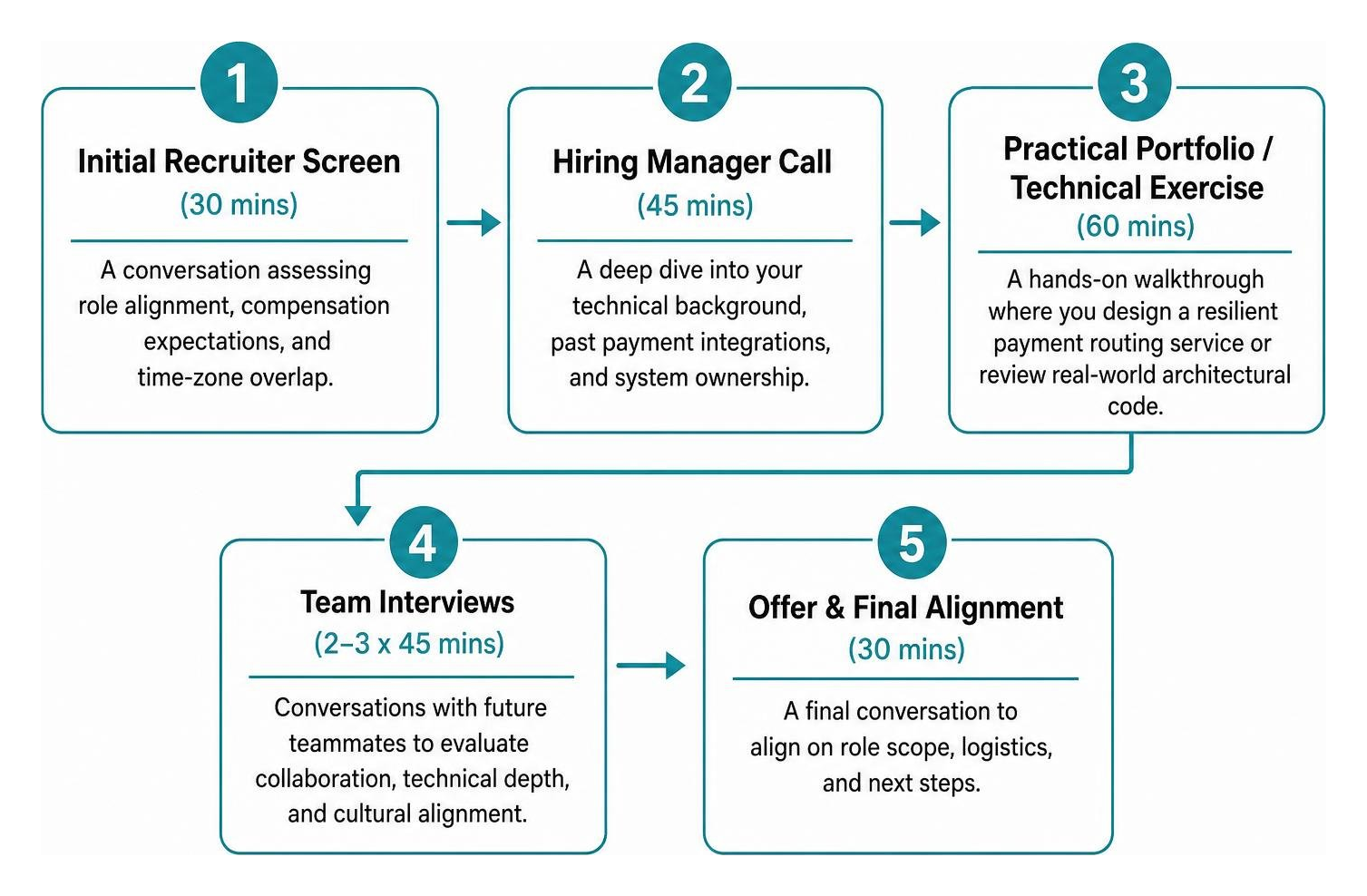
The typical hiring pipeline wraps up within two to three weeks and consists of five structured stages:
- Initial Recruiter Screen (30 mins): A conversation assessing role alignment, compensation expectations, and time-zone overlap.
- Hiring Manager Call (45 mins): A deep dive into your technical background, past payment integrations, and system ownership.
- Practical Portfolio / Technical Exercise (60 mins): A hands-on walkthrough where you design a resilient payment routing service or review real-world architectural code.
- Team Skill Evaluations (2-4 sessions, 45-60 mins each): Collaborative discussions covering backend architecture, distributed systems reliability, and cross-functional problem solving.
- Executive Conversation (30 mins): A final alignment chat with leadership (such as the CTO or VP of Engineering) focused on vision and engineering culture.
Compensation and Benefits in Bolt Payments Careers
Compensation in payments engineering reflects the specialized nature of the domain. In the US market, average software engineer base salaries hover around $187,119 per year, with senior software engineers earning approximately $199,481 annually. In European tech hubs like Tallinn or Warsaw, senior technical and analytical salaries scale competitively alongside relocation assistance packages.
Standard benefits packages typically provide:
- Comprehensive health, dental, and vision insurance with day-one eligibility.
- 401(k) retirement plans without extensive waiting periods.
- Flexible paid time off (PTO), with minimum guarantees of 20+ days plus floating holidays.
- Monthly wellness stipends and home-office internet reimbursements.
- Structured paid parental leave policies with gradual return-to-work ramp-backs.
Frequently Asked Questions About Bolt Careers
What is the difference between Bolt Financial and Bolt Technology OÜ?
Bolt Financial (Bolt.com) is a US-headquartered fintech company specializing in one-click e-commerce checkout software and merchant payment processing. Bolt Technology OÜ (Bolt.eu) is an Estonian-headquartered mobility super-app offering ride-hailing, micromobility, and delivery services across 50+ countries.
How long does the hiring loop take for payment engineering roles?
Most recruitment loops finish within two to three weeks from the initial recruiter screen to the final executive offer call, with individual rounds lasting between 30 and 60 minutes.
Does Bolt support remote work for payments and engineering positions?
Yes, fintech engineering roles at Bolt Financial are primarily remote-first across the US and Canada with specific time-zone overlap requirements. European roles at Bolt Technology frequently operate under a hybrid model supported by centralized office hubs in cities like Tallinn, Berlin, and Warsaw.
Conclusion
Whether you are designing low-latency payment acquisition engines for global e-commerce checkouts or building bi-directional payout rails for millions of drivers, careers in payment infrastructure offer unparalleled technical scale and high business impact. Success in this domain comes down to mastering distributed ledger reliability, maintaining security standards like PCI-DSS, and demonstrating extreme ownership over every transaction.
If you are a software developer looking to work with modern developer tools and AI-accelerated workflows, explore curated remote vibe coding jobs for Bolt on our platform to find your next career opportunity today.