
What Life as a Bolt Data Scientist Really Looks Like
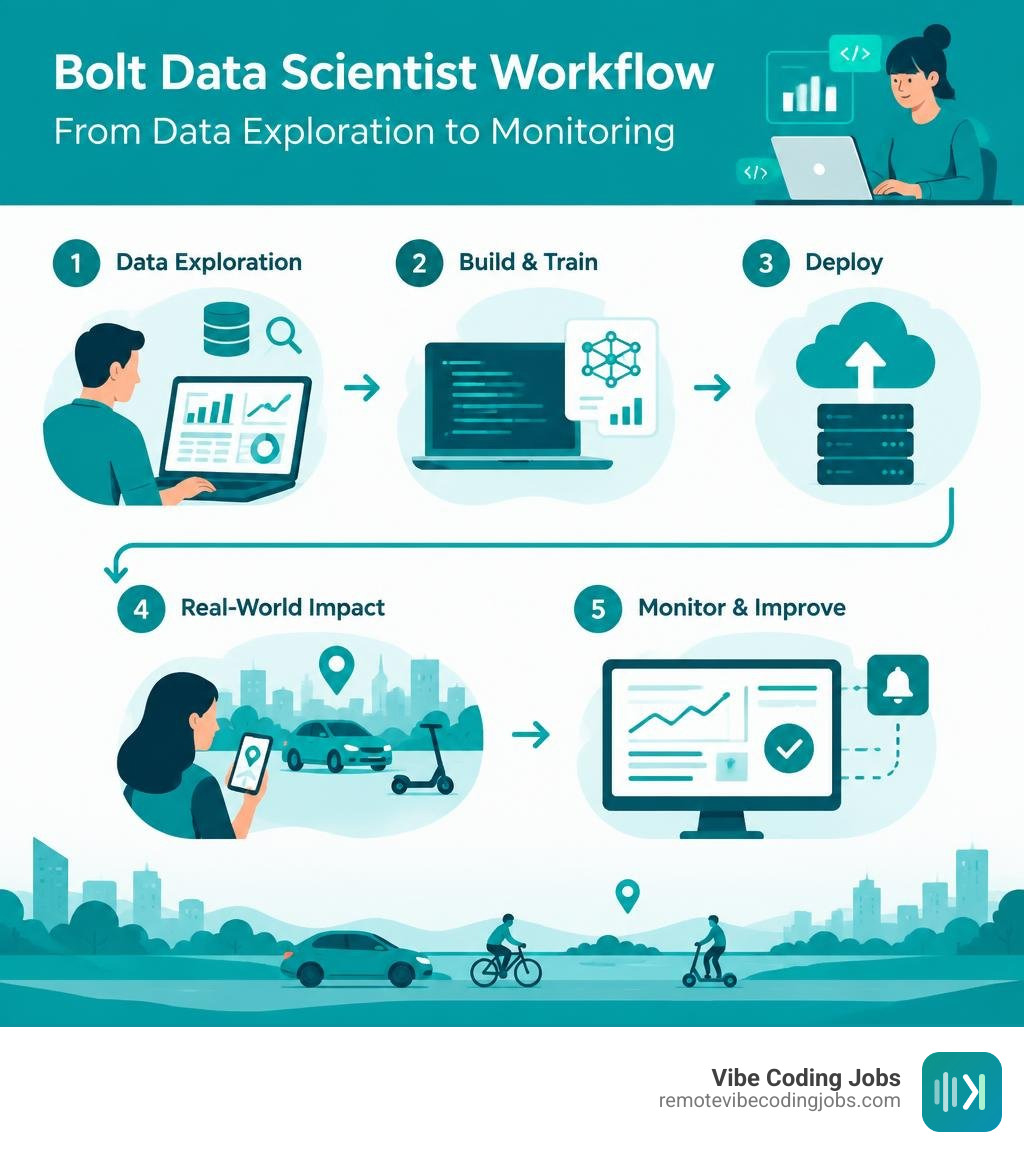
A Bolt data scientist builds and runs machine learning systems that affect real rides, deliveries, rentals, and platform safety. The role sits within Engineering, not apart from it: expect to explore data, test an idea, train a model, deploy it as a production service, and monitor results after launch.
In practice, that can mean improving ETA predictions, balancing driver and rider demand through pricing, detecting payment fraud in real time, or verifying that a scooter was parked correctly. Bolt operates at large scale, with more than 100 million customers across 500+ cities, so even small model changes can have visible product and business effects.
This is a strong fit for developers who want more than dashboard work. You will need solid Python, SQL, statistics, machine learning, and MLOps habits – plus the ability to explain trade-offs to product managers and engineers. Bolt’s published data science work includes gradient-boosted trees, deep learning, forecasting, causal inference, reinforcement learning, and constrained optimization.
I am Dominic Zijlstra, a technologist, entrepreneur, former data scientist, and DevOps engineer. My experience building data systems and production workflows helps me assess what a Bolt data scientist role demands beyond the job title.
Essential bolt data scientist terms:
Engineering Integration and Team Structure at Bolt
At Bolt, data science is embedded directly inside the Engineering division. Rather than functioning as a centralized consulting arm that hands off Jupyter notebooks to someone else, data scientists operate within cross-functional product squads. Each squad brings together product managers, backend engineers, frontend developers, and data specialists to solve domain-specific business problems.

Because data scientists write production-grade services, they maintain full architectural accountability for what they build. As detailed in the engineering blog on How we do data science at Bolt, practitioners rely on internal platforms managed by dedicated Model Lifecycle engineering teams. This structure allows developers to turn exploratory prototypes into live Python microservices running in production clusters within days. Squads operate with high autonomy, relying heavily on async-first workflow communication to coordinate across international tech hubs.
Product Verticals: Rides, Micromobility, Delivery, and Platform Services
Bolt organizes its technical teams across key customer-facing verticals and shared horizontal platforms:
- Marketplace (Rides): Optimizes ride-hailing dispatch systems, automated matching, and dynamic surge pricing to balance real-time passenger demand with driver supply.
- Micromobility (Rentals): Manages scooter and e-bike fleets across hundreds of European cities, predicting battery depletion, optimizing rebalancing routes, and scoring parking accuracy.
- Delivery: Powers food delivery logistics and grocery dispatch routing, balancing complex multi-stop delivery times against courier availability.
- Platform Services (Geo, Identity & Fraud): Builds shared infrastructure including custom routing engines, map correction pipelines, rider identity verification, and anti-fraud engines.
Day-to-Day Responsibilities of a Bolt Data Scientist
Working as a data scientist at Bolt means balancing theoretical modeling with backend engineering. A typical development sprint moves through distinct phases:
- Problem Scoping & EDA: Translating business goals into measurable machine learning targets and querying distributed data stores.
- Offline Experimentation: Training algorithms, testing feature subsets, and validating model performance on historical logs.
- Containerization & Deployment: Packaging inference code into standardized Docker containers exposed via low-latency internal APIs.
- Online Telemetry: Continuously monitoring operational health, inference latency, and data drift via live dashboards.
Those exploring the engineering challenges can view open technical tracks on the Data Science at Bolt Careers portal.
Data Science vs Data Engineering: Cross-Functional Collaboration
Data scientists at Bolt work side by side with data engineers and analytics engineers to maintain high data reliability across the company.
Data engineers build the backbone: they construct high-throughput Kafka streaming pipelines, maintain distributed Spark processing clusters, and structure unified data lakes. Data scientists consume these clean data streams to engineer features, run experiments, and deploy inference microservices.
To prevent data drift and bad inputs from breaking production systems, teams use validation frameworks like Great Expectations alongside standard remote Python engineering practices to enforce rigorous data contracts.
What It Takes to Excel as a Bolt Data Scientist: Tech Stack and Modeling Challenges
Working at hyper-growth scale requires a broad mathematical toolset and deep engineering discipline. Bolt’s multi-sided marketplaces operate under strict latency limits, requiring algorithms to deliver predictions in milliseconds.

Industry professionals like Friedrich Vogt have highlighted how modern mobility challenges require combining statistical machine learning with explainable AI (XAI) and econometric modeling to ensure algorithmic decisions remain interpretable to operations teams.
Core Machine Learning, Causal Inference, and Optimization Workflows
Bolt relies on distinct modeling methodologies across different product domains:
- Ensemble Learning (XGBoost, LightGBM): Serves as the primary workhorse for tabular prediction tasks, including churn prediction, ETA adjustments, and conversion scoring.
- Causal Inference & Uplift Modeling: Essential for evaluating driver and rider incentive campaigns, isolating true incremental lift using synthetic controls and quasi-experiments.
- Constrained Optimization & Graph Algorithms: Applied to dispatch matching, courier routing, and fleet rebalancing, framing operations as variants of the Vehicle Routing Problem (VRP).
- Deep Learning & Computer Vision: Powers automated safety checks, document validation, and spatial image processing.
Engineers such as Karl Nurmeots have focused on these large-scale routing architectures, ensuring that real-time graph engines and predictive models run seamlessly alongside high-throughput cloud infrastructure.
Production MLOps Stack: SageMaker, Docker, Airflow, and Grafana
The data science toolchain at Bolt emphasizes reliability, reproducible environments, and automated continuous delivery:
Automated retraining pipelines triggered by Airflow ensure models update as urban mobility conditions shift. Grafana dashboards provide real-time visibility into inference latency and prediction distributions, alerting on-call engineers the moment model drift occurs. Staying sharp on these tools aligns closely with benchmarking remote developer salary trends across top-tier European tech companies.
Real-World Impact: Production ML Use Cases Across 500+ Cities
With over 3 million drivers and couriers operating across diverse geographical regions, models running in production directly shape urban transportation efficiency every minute.

Dynamic Pricing, Dispatch, and ETA Prediction
Bolt’s ride-hailing marketplace uses real-time pricing algorithms that adjust for local supply and demand fluctuations. Dynamic pricing models estimate short-term price elasticity, helping balance fleet availability while maintaining competitive fares.
Dispatch systems run constrained optimization algorithms to pair riders with nearby drivers, minimizing pickup times and unassigned requests. ETA models combine spatial graph routing engines with gradient boosted residuals, adjusting base travel times for local traffic, weather, and historical bottleneck patterns.
Computer Vision for Micromobility and Real-Time Fraud Detection
In micromobility, Bolt uses computer vision to keep city streets safe and orderly. When a user ends an e-scooter ride, they submit a parking photograph through the mobile app. Convolutional neural networks analyze the image on the fly to confirm the scooter is parked safely and not blocking footpaths or doorways.
For platform trust and security, real-time anti-fraud engines evaluate incoming payment transactions, ride requests, and user registrations within milliseconds. Applied researchers such as Rabeez Riaz have demonstrated how applying advanced deep learning and anomaly detection flags stolen payment methods, account takeovers, and fraudulent incentive claims before transactions settle.
Career Progression, Compensation, and Growth Pathways
Bolt provides structured growth tracks for individual contributors and engineering managers, ensuring data scientists can advance technically without being forced into people management.
| Career Level | Base Salary Range (Estonia) | Total Comp Median | Equity Vesting Schedule | Technical & Organizational Scope |
|---|---|---|---|---|
| L3 (Mid Data Scientist) | €55,000 – €62,000 | €76,500 | 4-Year (25% per year) | Owns feature pipelines and microservices within a single squad |
| L4 (Senior Data Scientist) | €70,000 – €78,000 | €80,200 | 4-Year (25% per year) | Leads vertical ML initiatives, system design, and mentoring |
| L5 (Staff Data Scientist) | €88,000 – €98,000 | €99,700 – €124,300 | 4-Year (25% per year) | Sets cross-vertical ML architecture and algorithmic strategy |
Data reflects verified European compensation reports.
Career Levels from Associate to Staff and Leadership
Technical contributors can progress from Associate Data Scientist to Senior, Staff, and Principal levels:
- Individual Contributor Track: Staff and Principal Data Scientists guide cross-team machine learning architecture, establish tooling best practices, and tackle high-ambiguity modeling initiatives.
- Management Track: Senior Data Analytics Managers and Heads of Data Analytics direct hiring, align quarterly OKRs with executive leadership, and manage team resources.
- Continuous Learning: Bolt hosts internal learning clubs, paper reading groups, and cross-team code reviews to help engineers explore modern techniques in causal modeling and reinforcement learning.
Understanding how these compensation bands map to the broader European and remote ecosystem is critical when evaluating data science compensation.
Compensation Benchmarks, Equity Vesting, and Relocation Packages
In Estonia, median total compensation for data scientists sits around €80,200, with top-tier L5 compensation reaching up to €124,376 annually. Bolt uses a standard 4-year equity vesting schedule with equal 25% distribution each year.
To attract international talent to its engineering hubs in Tallinn and Warsaw, Bolt offers relocation packages covering travel costs, one month of temporary accommodation, initial rent and broker fees, government visa processing, and personal shipping allowances.
The Hiring Pipeline and Preparation Strategy
The interview process at Bolt tests practical problem-solving, clean coding standards, statistical intuition, and system design ability.
According to resources like the Bolt Data Scientist Interview Guide, candidates should prepare for a practical hiring funnel designed to reflect everyday engineering tasks.
Navigating the Bolt Data Scientist Interview and Assessment Stages
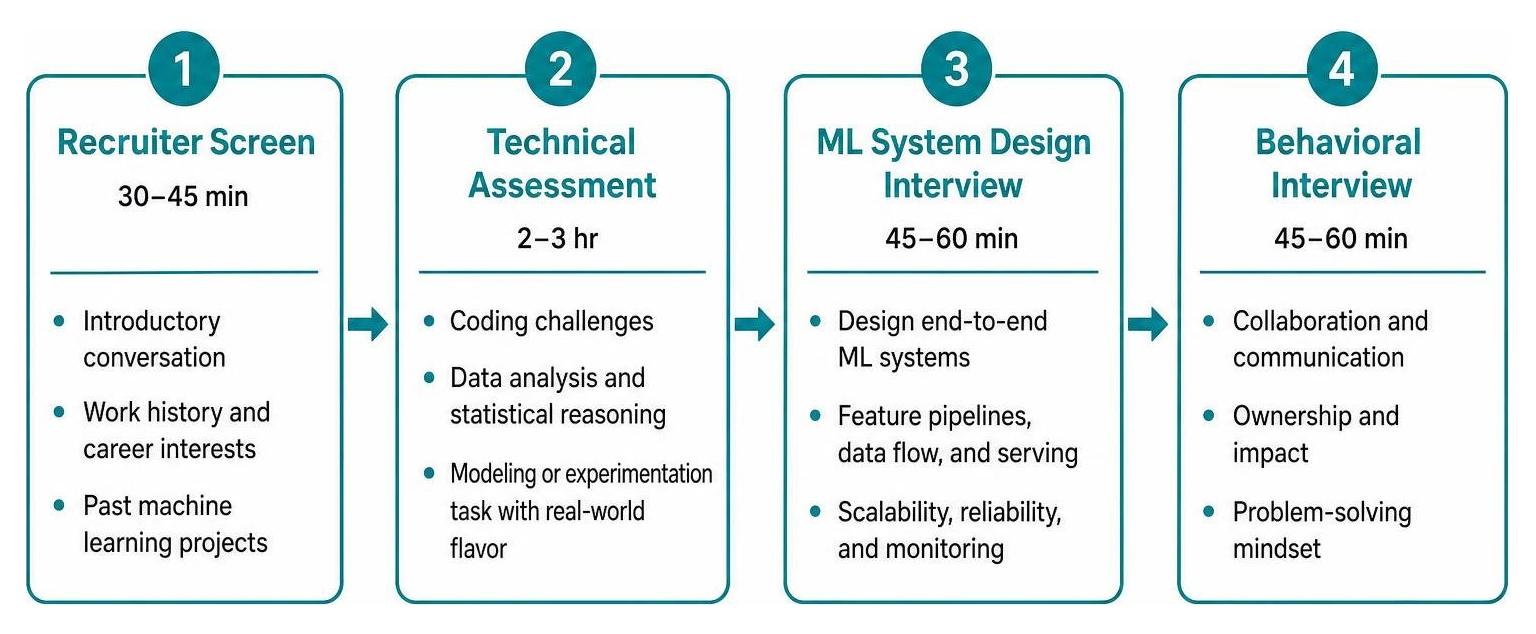
The selection process moves through four primary stages:
- Recruiter Screen (30–45 min): An introductory conversation covering your work history, career interests, and past machine learning projects.
- Technical Assessment (HackerRank, 1–2.5 hrs): Practical coding challenges assessing data structures, SQL window functions, string manipulation, and statistical programming in Python.
- Analytics Home Assignment & Defense: A take-home project using realistic tabular or spatial datasets. Candidates perform exploratory analysis, train baseline models, and defend their design decisions during a live technical round.
- Onsite & System Design Rounds: Deep-dive sessions covering machine learning system design, causal inference principles, and product trade-offs.
Sharpening your fundamentals using practical coding interview strategies will help you write clean, modular scripts under timed conditions.
System Design, Analytics Case Studies, and Cultural Alignment
System design interviews at Bolt focus on building scalable services for high-throughput mobile environments. Be ready to discuss:
- Architecting low-latency feature lookup stores for real-time inference.
- Designing marketplace experiments where localized network interference can bias standard A/B test splits.
- Handling spatial autocorrelation and class imbalance in fraud or safety datasets.
- Structuring behavioral answers using the STAR method (Situation, Task, Action, Result) to demonstrate ownership and resilience.
Frequently Asked Questions About Becoming a Bolt Data Scientist
How much does a Bolt data scientist earn in Europe?
In Estonia, base salaries for mid-level (L3) data scientists start around €55,000 to €62,000 per year, yielding total compensation packages averaging €76,500 including stock grants. Senior (L4) and Staff (L5) levels range from €80,200 to over €124,300 in total annual compensation. Packages include standard 4-year equal 25% annual equity vesting schedules.
What is the difference between Data Science and Data Analytics at Bolt?
Data scientists are embedded in Engineering squads, focusing on writing and maintaining production machine learning algorithms, building Docker microservices, and implementing real-time APIs. Data analysts and analytics engineers operate closer to commercial strategy and operations, designing executive BI dashboards, evaluating marketing spend, and informing product roadmaps.
What machine learning techniques are most valued at Bolt?
Bolt relies heavily on gradient boosted tree ensembles (XGBoost, LightGBM) for tabular prediction, constrained linear optimization and graph algorithms for dispatch and routing, causal inference for uplift modeling and incentive spend, and computer vision models for micromobility safety.
Conclusion
Working as a data scientist at Bolt means building machine learning systems that directly influence physical operations across hundreds of cities. Because data scientists own their models end-to-end—from initial exploratory analysis to production microservice deployment and ongoing telemetry—the role demands strong engineering discipline alongside deep statistical expertise. For engineers who thrive on autonomy, scale, and algorithmic ownership, it offers an environment where technical work translates into immediate, visible impact.
Explore our curated platform to find open data science and AI engineering roles at Bolt and discover opportunities across top async-first engineering teams.