
Why Remote Developers Need an Engineering Playbook
A playbook for developers is a practical guide to how a team builds, reviews, ships, and supports software. To make one useful, document the steps a developer needs on day one: set up the environment, find the right code, run tests, open a pull request, and get help when something breaks.
That matters even more on a remote team. Clear, current instructions let people move forward without waiting for someone in another time zone. Unlike general coding advice, a playbook captures your team’s tools, decisions, and ways of working.
I’m Dominic Zijlstra, a former data scientist and DevOps engineer who has built automated systems and data infrastructure. In this guide, I’ll draw on that experience to show how a playbook for developers can support both better teamwork and career growth.
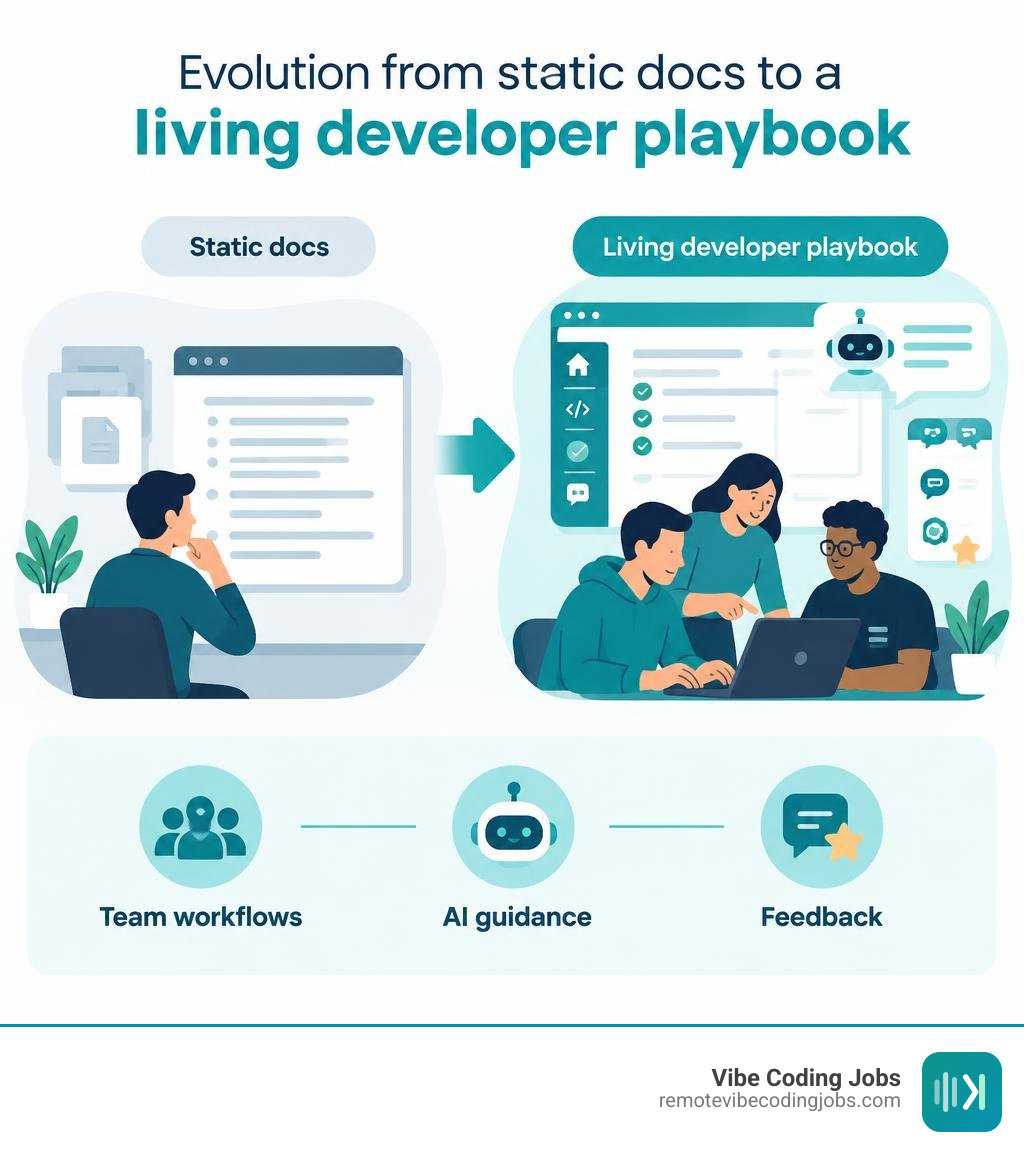
Common playbook for developers vocab:
Core Components of an Engineering Playbook for Developers
A modern developer playbook serves as an operational operating system. When engineers operate across distributed time zones, ambiguous tribal knowledge leads to stalled pull requests, broken build pipelines, and onboarding fatigue. A comprehensive engineering playbook replaces informal chat queries with documented, repeatable standards.
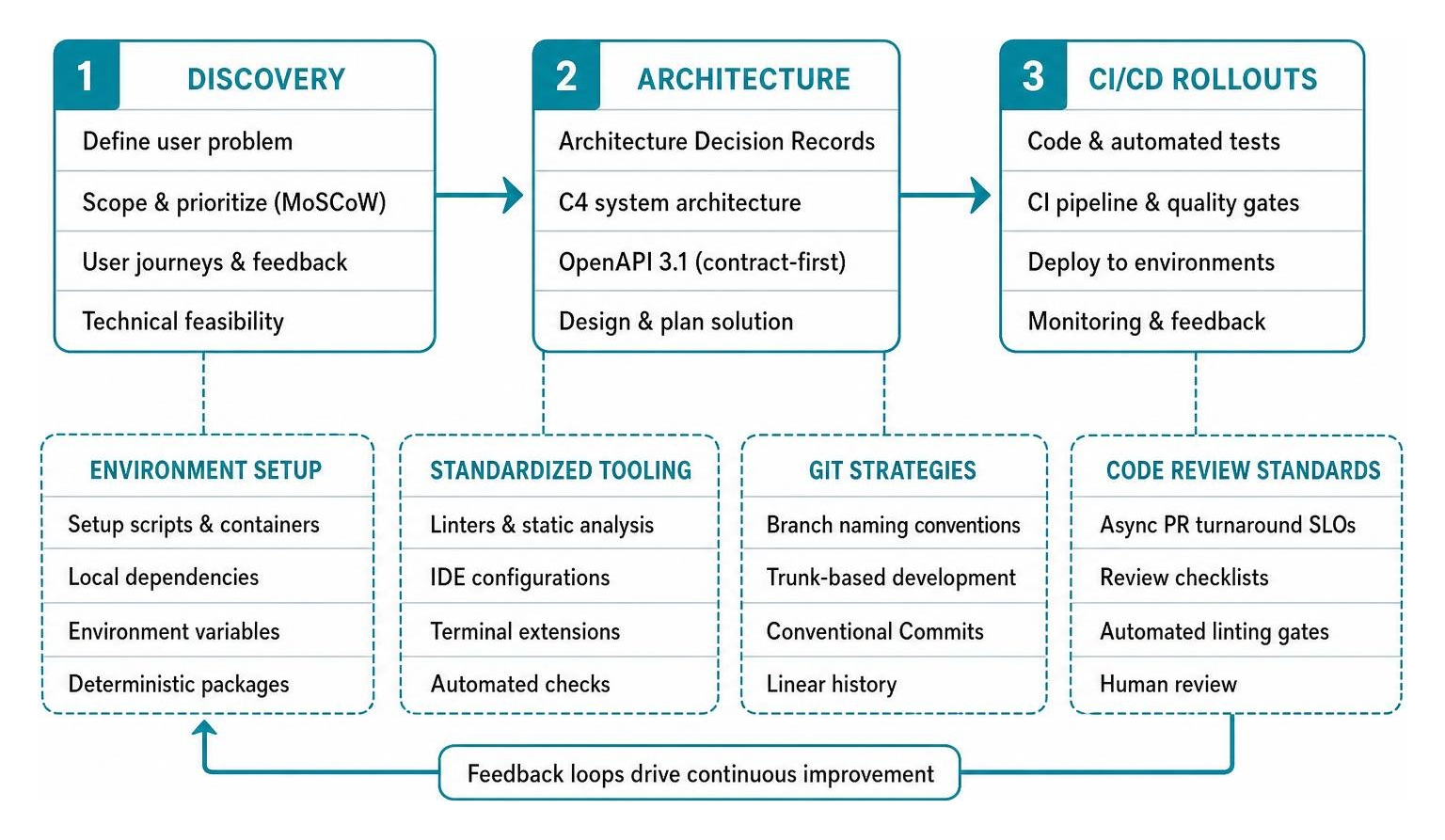
The core architecture of an engineering playbook includes four essential operational layers:
- Environment Configuration: Automated setup scripts, containerized local dependencies, pre-configured environment variables, and deterministic package configurations.
- Standardized Tooling: Linters, static code analysis rules, terminal shell extensions, and integrated development environment (IDE) configurations.
- Git Branching Strategies: Branch naming conventions, trunk-based development protocols, and linear history management using Conventional Commits.
- Code Review Standards: Clear Service Level Objectives (SLOs) for asynchronous pull request turnaround times, review checklists, and automated linting gates that must pass prior to human evaluation.
Navigating these workflows is critical when transitioning to remote software engineering, where self-reliance and clear communication replace hallway conversations.
To avoid reinventing foundational patterns, many engineering teams leverage established open-source engineering frameworks, adapting standard operational phases to their specific architecture.
| Dimension | Technical Playbook (Engineers) | Product Playbook (PMs & Designers) |
|---|---|---|
| Primary Scope | Code structure, testing frameworks, CI/CD pipelines, runtime reliability, and automated rollbacks | User problem definition, wireframing, feature scoping (MoSCoW), user journeys, and customer feedback |
| Target Audience | Software engineers, tech leads, DevOps specialists, site reliability engineers | Product managers, UX/UI designers, product marketing managers, executive stakeholders |
| Core Deliverables | Architecture Decision Records (ADRs), OpenAPI specs, Dockerfiles, runbooks, linting rules | Product briefs, PRDs, clickable prototypes, release schedules, sprint backlog maps |
| Success Metrics | DORA metrics (lead time, deployment frequency), code coverage, p90 TTFV, error budgets | Feature adoption rate, churn reduction, customer satisfaction, active user growth |
Architecture Decision Records and Standards Enforcement
Building scalable systems requires an explicit mechanism for documenting architectural trade-offs. Rather than letting system architecture evolve through fragmented discussions, our teams use Architecture Decision Records (ADRs). ADRs track the context, trade-offs, and consequences of major structural choices.
We combine ADRs with the C4 system architecture model (Context, Containers, Components, and Code) to provide visual system maps at varying levels of abstraction. Before writing backend business logic, teams adopt contract-first API design using OpenAPI 3.1 specifications. This contract serves as the single source of truth for frontend client generation, backend routing, and end-to-end integration testing.
To ensure quality without micromanagement, every task must satisfy an unambiguous Definition of Done (DoD). This includes passing automated tests, updating documentation, validating API contracts, and passing security scans. Proposed changes to shared engineering standards undergo a mandatory one-week consensus waiting period. This window allows distributed engineers across all time zones to review proposals, suggest edge-case revisions, and achieve consensus before new rules are merged.
Security Protocols, OWASP Baselines, and Incident Runbooks
Security is not an isolated milestone checked off before release; it is an active baseline woven into the daily development lifecycle. A developer playbook must map every layer of code implementation directly against the OWASP Top 10 vulnerabilities and NIST SP 800-63B digital identity guidelines.
Key security baselines include:
- Role-Based Access Control (RBAC): Defining access control matrices in code, managing token lifecycles with short-lived tokens, and enforcing least-privilege principles across services.
- Static and Dynamic Scans: Running automated software composition analysis (SCA) and secrets detection in pre-commit hooks to block sensitive keys from entering version control.
- Automated Incident Runbooks: Distinguishing between open-ended investigation playbooks and deterministic execution runbooks. When alerts fire, runbooks provide exact diagnostic sequences (DNS resolution, host reachability, service health) to isolate faults rapidly.
Modernizing Development Workflows: Async Protocols and AI Integration

Engineering execution has evolved from synchronous meetings to distributed, autonomous pipelines. In modern remote teams, maintaining async communication workflows protects deep work blocks—consecutive hours of uninterrupted focus dedicated to complex problem solving.
Instead of interrupting colleagues for ad-hoc reviews, engineers rely on structured verification gates, terminal hooks, and automated GitHub Actions. When engineers leverage systematic AI agent frameworks, these tools enforce consistent naming conventions, unit test generation, and pull request summary drafting automatically.
State-First AI Orchestration and Context Preservation
In the era of AI-assisted engineering, developers frequently leverage tools like Cursor vs Windsurf in 2026 to accelerate code generation. However, naive prompting often results in context degradation after long sessions.
Our developer playbooks implement a state-first development methodology. Instead of relying on the ephemeral conversational memory of an LLM, long-term project state is offloaded to standardized local files (such as tests.json and progress logs).
Key implementation steps include:
- Orientation Protocol: Before initiating changes, the AI tool executes a 10-second inspection protocol, analyzing recent git logs, roadmap files, and the current test suite.
- LSP Integration: Integrating Language Server Protocols (LSP) into terminal and AI workflows delivers symbol navigation up to 900x faster (50ms vs 45s) compared to raw file scanning.
- Red-Green-Refactor Cycles: AI agents break feature requests into atomic test cases, generating failing tests first, writing implementation code to pass, and refactoring for clean architecture.
Continuous Integration, Testing Gates, and Automated Rollbacks
A developer playbook must explicitly define continuous integration (CI) constraints. Automated test matrices run unit, integration, and end-to-end suites against isolated staging environments before any branch merges.
Pre-git safety hooks block accidental force pushes to protected branches, verify Semantic Versioning tags, and run linters locally. If a production defect passes testing barriers, automated rollback execution scripts allow on-call engineers to revert changes with a single command, mitigating downtime while ephemeral cloud demo environments allow rapid reproduction of edge-case bugs.
Career Progression and Team Scaling Frameworks

A high-performing remote team requires transparent criteria for developer growth. Traditional tenure-based ladders are obsolete; modern engineering organizations evaluate engineers on output velocity, architectural clarity, and async leverage.
Understanding compensation dynamics and market value is simplified by tracking remote developer salary trends in 2026, allowing teams to align compensation with transparent performance expectations.
Structuring a Multi-Tier Playbook for Developers by Career Stage
A playbook must provide distinct operational expectations for every engineering level:
- Junior Developers: Focus on core execution baselines, adhering to standardized linters, mastering terminal workflows, and submitting clean, atomic pull requests.
- Intermediate Developers: Expected to demonstrate independent execution, manage end-to-end feature implementations, contribute to ADR discussions, and mentor newer teammates.
- Staff and Principal Engineers: Drive cross-team system architecture, author high-impact operational playbooks, establish security protocols, and set technical direction.
Engineers aiming to demonstrate mastery across these tiers benefit from building a killer remote developer portfolio that showcases real-world pull requests, open-source contributions, and verified system designs.
Eliminating Tribal Knowledge and Reducing Onboarding Churn
Onboarding friction is one of the highest hidden costs in remote software teams. When a new hire must ask ten questions a day just to configure their local database, time-to-productivity plummets.
Our playbooks eliminate tribal knowledge through:
- Self-Serve Checklists: Providing sequential, copy-pasteable setup steps that get code running locally on day one.
- Sandboxed Starter Repositories: Pre-configured template repositories with mock datasets and running test suites.
- Ticket Writing Hygiene: Mandating clear user stories, acceptance criteria, reproducible steps, and expected outcomes on every project ticket.
- Blameless Post-Mortems: Treating system outages as learning opportunities to refine runbooks and eliminate fragile single points of failure.
Developer Experience Telemetry and GTM Execution
Whether building internal tools for your engineering team or shipping external developer-facing platforms (such as APIs, SDKs, and developer infrastructure), optimizing developer experience (DX) directly drives product success. Research from CB Insights shows that 42% of startup failures stem from building products without validated market demand. For developer platforms, poor onboarding documentation creates an immediate activation cliff.
A study by Heap revealed that every 10 minutes spent beyond a 5-minute Time-to-First-Value (TTFV) benchmark results in an approximate 9% drop in user activation. Top developer-centric platforms set rigorous internal standards:
- Vercel: < 2 minutes from repository import to live URL
- Clerk: < 4 minutes to working login UI
- Supabase: < 3 minutes to first database row created
- Stripe: < 5 minutes to first successful API call
- PostHog: < 5 minutes to first event captured
Adopting the principles in the Developer Onboarding Playbook guidelines enables teams to conduct friction inventory audits and systematically eliminate activation barriers.
Go-to-Market and Onboarding Playbook for Developers and DevTools
Developers distrust traditional marketing collateral and sales decks. They evaluate tools by testing documentation, inspecting APIs, and evaluating sample code.
A high-converting developer onboarding flow uses a 9-element quickstart structure:
- One-Line Prerequisite Declaration: Explicitly stating supported runtimes and package managers.
- Single Install Command: Minimal, copy-pasteable CLI installation.
- Environment Setup: Clear
.envconfiguration instructions. - Auto-Injected API Keys: Injecting the logged-in user’s live test API keys directly into documentation code blocks.
- Single Execution Command: A working
curlor SDK call that executes immediately. - Expected Response Output: Showing exact JSON return payloads so developers can visually confirm success.
- Live Verification Widget: Real-time in-docs status indicators confirming the backend received the event.
- Success State Confirmation: Clear visual acknowledgment that setup is complete.
- Three Next Action CTAs: Offering exactly three clear next steps (e.g., Read Core Concepts, Deploy Demo App, View SDK Reference) to avoid choice overload.
Every additional step in a quickstart reduces completion by roughly 10%, while adding a visual progress indicator reduces onboarding abandonment by ~20%. In lifecycle communications, sending a Day 0 onboarding email with a functional subject line (e.g., “Your API key and quickstart endpoints”) yields an open rate above 50%, compared to ~22% for generic welcome emails.
Telemetry Schemas, DORA Metrics, and Continuous Refinement
To evaluate both internal developer velocity and external platform health, engineering teams track DORA (DevOps Research and Assessment) metrics alongside product activation funnels:
- Deployment Frequency: How often code is successfully deployed to production.
- Lead Time for Changes: The time elapsed from first commit to production deployment.
- Change Failure Rate: The percentage of production deployments requiring hotfixes or rollbacks.
- Failed Deployment Recovery Time: Time required to restore service following an outage.
Teams capture telemetry using structured in-product feedback. Micro-surveys triggered 30 seconds after a developer’s first successful API call yield response rates between 12% and 18%, providing real-time feedback on onboarding hurdles. Documentation audits should run monthly for high-friction pages and quarterly across top-100 reference documents.
Frequently Asked Questions About Developer Playbooks
What is the primary difference between a developer playbook and general programming best practices?
General programming best practices provide abstract, universal principles (like DRY code, SOLID design, or general test-driven development). A developer playbook provides concrete, localized operating procedures tailored to a specific organization. It specifies the exact frameworks, repository structures, linters, deployment pipelines, branch naming rules, and incident runbooks your team uses every day. It shifts focus from theoretical design patterns to actionable execution recipes.
How does a developer playbook reduce onboarding time-to-first-value?
A developer playbook eliminates guesswork by providing deterministic environment scripts, pre-seeded local databases, and step-by-step setup checklists. Instead of waiting for senior engineers across time zones to explain tribal knowledge or debug environment variables, a new engineer can clone the repository, run a unified setup script, pass local test suites, and deploy their first code change to staging on day one.
How often should engineering teams review and update their playbook?
A developer playbook is a living system maintained through continuous pull requests. Minor workflow adjustments, script updates, and documentation fixes should be merged immediately alongside feature releases. Substantial architectural changes or standard updates should undergo a one-week team review window to ensure broad consensus. Additionally, teams should conduct blameless post-mortem reviews after operational incidents to update runbooks and prevent recurring failures.
Conclusion
A well-architected engineering playbook transforms distributed remote teams from collections of siloed contributors into coordinated, high-velocity engineering organizations. By establishing clear architectural standards, automating security and CI/CD gates, integrating state-first AI workflows, and tracking developer experience telemetry, your team builds durable systems while maintaining a high quality of life.
At RemoteVibeCodingJobs, we believe the future of software engineering belongs to developers and teams that combine deep async focus with modern AI workflows. If you are looking to take your remote engineering career to the next level, explore our curated listings for remote Swift developer jobs and find high-impact roles at async-first companies today.