
Why Remote NYC Recruitment Is the Competitive Edge Tech Companies Can’t Ignore
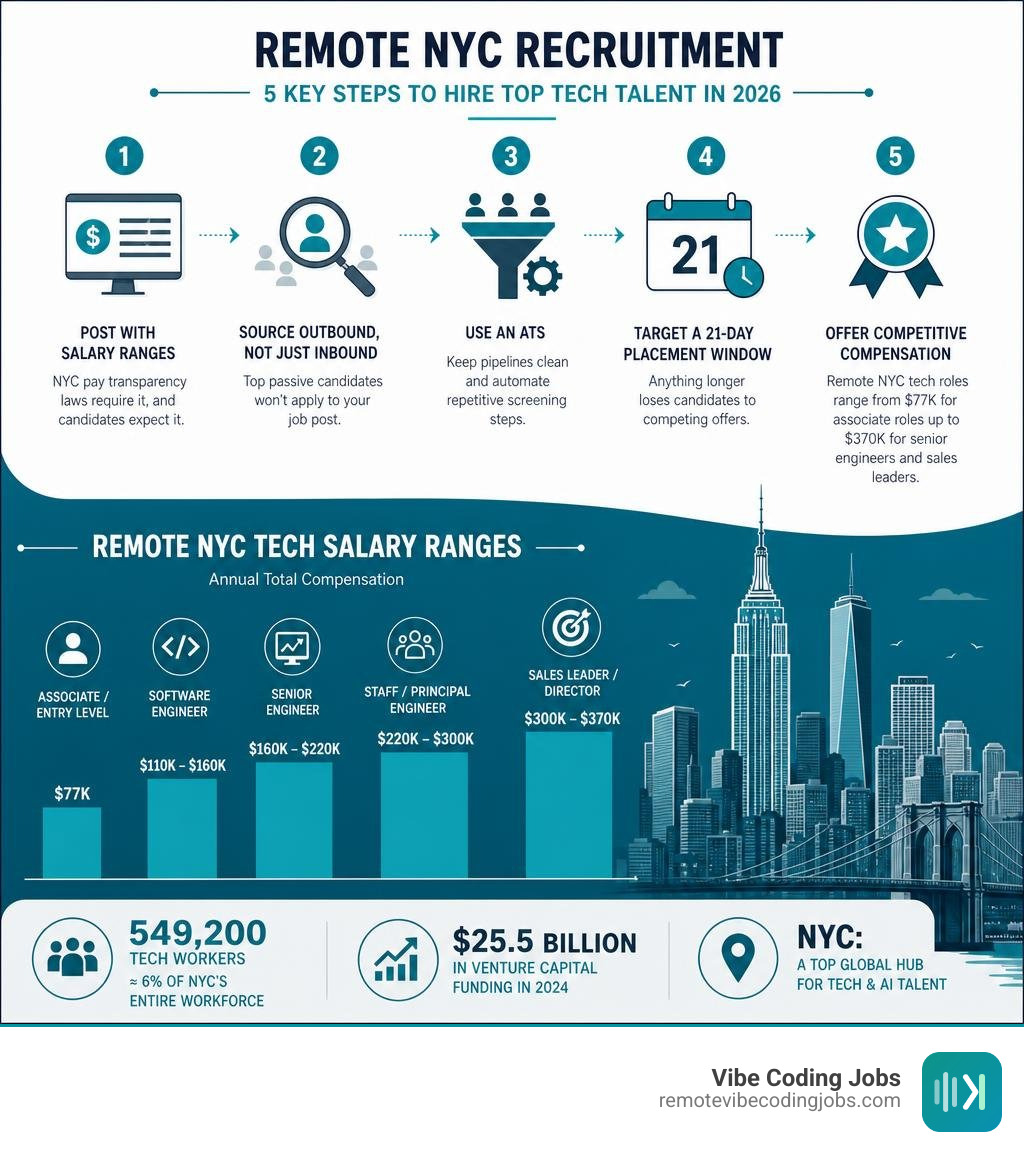
Remote NYC recruitment is one of the fastest-moving hiring markets in the world right now. If you need a quick answer on how to hire remote tech talent in or around New York City, here’s what actually works in 2026:
How to hire remote tech talent in NYC — fast:
- Post with salary ranges — NYC pay transparency laws require it, and candidates expect it
- Source outbound, not just inbound — top passive candidates won’t apply to your job post
- Use an ATS like Ashby — keep pipelines clean and automate repetitive screening steps
- Target a 21-day placement window — anything longer loses candidates to competing offers
- Offer competitive comp — remote NYC tech roles range from $77K for associate roles up to $370K for senior engineers and sales leaders
NYC is a uniquely dense talent market. The city has 549,200 tech workers — roughly 6% of its entire workforce — and attracted $25.5 billion in venture capital funding in 2024 alone. That means both the competition for talent and the quality of candidates available are exceptional.
But remote hiring in this market is not simple. Employers face NYC-specific pay transparency rules, multi-state compliance headaches, and a candidate pool that has very high expectations around compensation, async culture, and tech stack.
The stakes are high. Get it right and you tap into one of the richest engineering and AI talent pools on the planet. Get it wrong and top candidates ghost you before the second interview.
I’m Di Su, a software engineer and growth specialist with over a decade of experience building scalable digital systems — experience I’ve applied directly to understanding how remote NYC recruitment pipelines are built and optimized at the technical and operational level. In the sections below, I’ll break down exactly how to sharpen your remote hiring strategy for the NYC tech market in 2026.
Remote nyc recruitment terms to know:
Mastering Remote NYC Recruitment in the Modern Tech Landscape

New York City has cemented its position as one of the premier technology hubs globally. The city’s tech workforce of over half a million professionals spans software engineering, artificial intelligence, product design, and revenue operations. When venture-backed startups and scale-ups look to accelerate product development, the talent density in the NYC metropolitan area is second to none.
However, the dynamics of hiring in NYC have shifted dramatically over recent years. While some high-bar early-stage startups continue to push for in-office density in Manhattan, the overwhelming market demand from engineers and product operators is for remote and hybrid flexibility. Recruiters and hiring managers must navigate a landscape where high-performing candidates prioritize asynchronous workflows, flexible work arrangements, and modern tech stacks alongside premier compensation.
The Core Drivers of Remote NYC Recruitment Growth
Several distinct catalysts drive the rapid expansion of remote nyc recruitment:
- Extreme Talent Density: With over 549,000 tech workers representing 6% of the local workforce, NYC offers an unmatched concentration of specialized skills, particularly across FinTech, enterprise AI, healthtech, and trade software.
- Venture Capital Influx: Massive capital injection — such as the $25.5 billion raised in 2024 — forces tech companies to scale quickly. Companies must recruit outside traditional geographic barriers to fill critical engineering and go-to-market (GTM) seats.
- Asynchronous Work Expansion: Modern scale-ups prioritize shipping output and code velocity over physical presence. By adopting distributed hiring practices, founders can tap into top talent across the US Eastern timezone while retaining NYC as their strategic home base.
- Cost Efficiency & Strategic Retention: Distributed teams allow startups to balance high-tier leadership hiring with flexible distributed individual contributor roles, optimizing operational burn while maintaining high standards.
Key Benefits and Challenges for Employers
Recruiting remote talent connected to the NYC market offers massive strategic upside, but it also comes with real operational friction that every hiring team must manage.
Benefits
- Access to Premier Talent: Employers tap into candidates who have built scalable software at top-tier NYC enterprises and VC-backed scale-ups.
- East Coast Timezone Synergy: Teams operating across the US East Coast benefit from seamless real-time communication during core business hours, avoiding the extreme time-zone shifts associated with overseas offshoring.
- Higher Candidate Conversion: Remote job descriptions draw significantly higher application volumes compared to strict 5-day in-office listings, giving talent partners a broader pool to evaluate.
Challenges
- Fierce Competition: NYC candidates frequently hold multiple offers simultaneously. According to active market listings, there are over 1,300 talent acquisition and recruiter openings in the NYC metro area alone, highlighting how companies are competing for talent.
- Rapid Compensation Escalation: High cost of living expectations in the New York region push compensation bands upward across engineering, sales, and product roles.
- Passive Candidate Sourcing Friction: Relying solely on inbound applications yields mixed results. The top 0.01% of engineering and GTM talent must be targeted via personalized, outbound sourcing.
Sourcing, Compensation, and Legal Compliance for NYC Talent
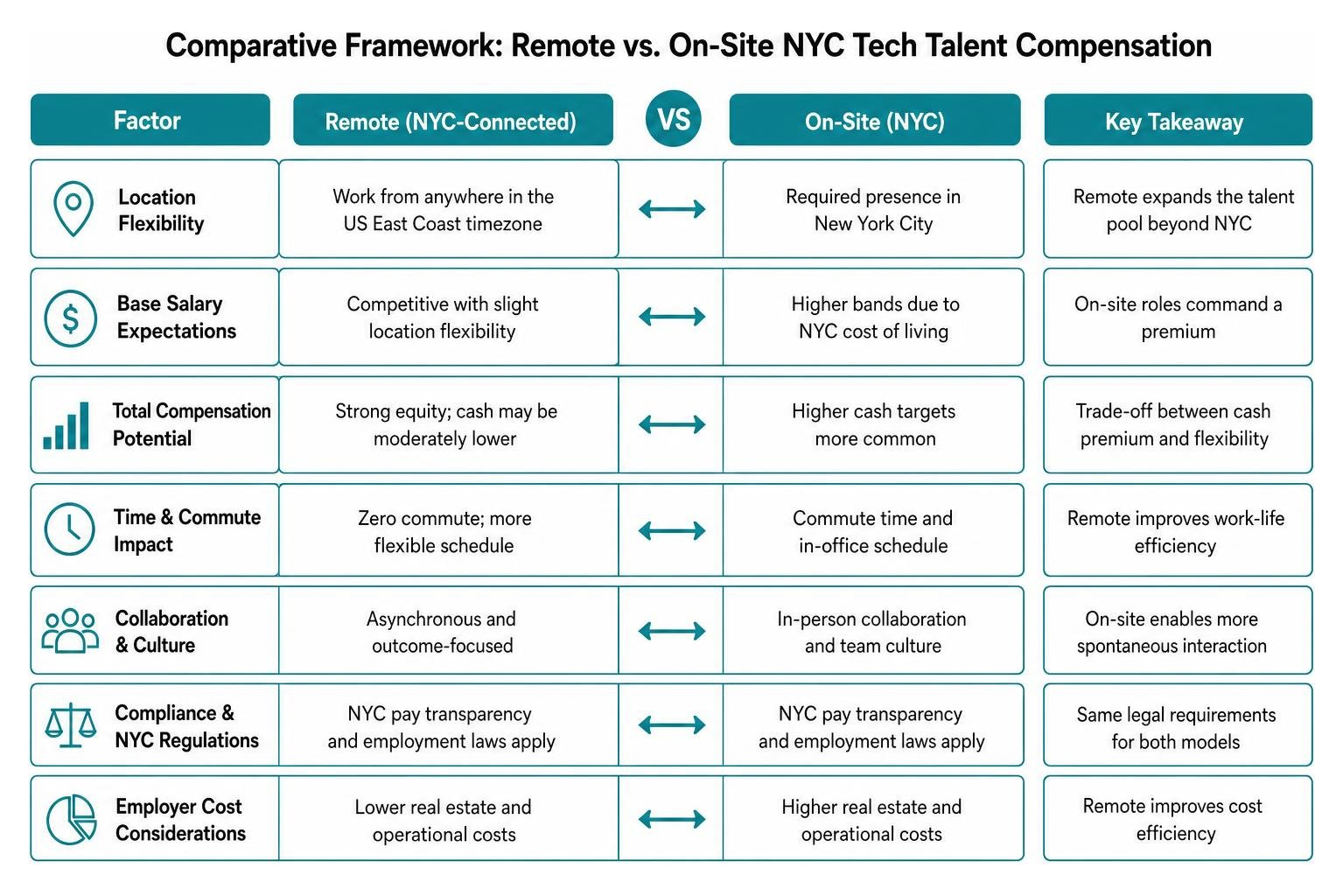
Successfully executing remote nyc recruitment requires complete clarity on local employment legislation, salary disclosures, and candidate sourcing channels. Employers who fail to align with local regulations or market-rate compensation bands quickly lose candidates during the offer phase.
Strategic Compensation Bands and NYC Transparency Laws
New York City was an early pioneer in pay transparency legislation, requiring employers to list accurate, good-faith base salary ranges on every job advertisement. In the current job market, candidates actively filter out postings that omit explicit compensation bands.
Data from recent NYC tech job listings highlights the current baseline market ranges across remote and hybrid positions:
- Founding GTM / Technical Recruiters: $160,000 – $220,000 annually (or $60–$80/hour on contract-to-hire arrangements).
- NetSuite / Enterprise Solution Consultants: $77,000 – $202,000.
- Quality Engineering Leads & GTM Engineers: $161,000 – $303,000.
- Staff Software Engineers: $234,000 – $300,000+.
- Senior Machine Learning & AI Engineers: $195,000 – $343,000.
- Senior Enterprise Account Executives: $232,000 – $370,000.
To maintain equity and competitiveness, companies often structure remote compensation packages according to work setup:
| Role Level | On-Site NYC Comp Band | Remote US/NYC Metro Band | Key Perks & Stipends |
|---|---|---|---|
| Junior / Associate | $75,000 – $110,000 | $70,000 – $100,000 | Home office setup, learning stipend |
| Mid-Level Engineer / GTM | $130,000 – $180,000 | $120,000 – $170,000 | $500/mo wellness & remote stipend |
| Senior / Lead / Staff | $190,000 – $280,000 | $180,000 – $260,000 | Equity grants, 100% healthcare coverage |
| Principal / Executive | $250,000 – $370,000+ | $240,000 – $350,000+ | Travel reimbursement for quarterly syncs |
Legal Considerations and Multi-State Compliance
When extending remote offers to candidates living in New York State or hiring from NYC to other regions, talent operations teams must adhere to explicit legal frameworks:
- W-2 vs. 1099 Classification: Early-stage startups frequently use 3-month contract-to-hire arrangements to evaluate talent. However, misclassifying full-time core employees as independent 1099 contractors can lead to heavy state tax penalties.
- State and City Tax Registrations: Hiring a remote W-2 employee living in New York requires payroll registration with the NY State Department of Taxation and Finance and compliance with local tax withholding rules.
- Mandatory Employer Disclosures: Under NYC labor laws, candidates must receive formal notification of benefits, paid time off policy details, and sexual harassment prevention training requirements upon onboarding.
- Travel Expense Reimbursement Policies: For remote-first companies requiring occasional NYC office visits or hybrid syncs (e.g., two pre-scheduled office visits per month), travel expenses must be formally covered or reimbursed to comply with candidate agreements and local standards.
For candidate sourcing across major platforms, teams rely on active directory tools like LinkedIn NYC recruiter jobs to gauge candidate availability and set benchmark salaries.
Building Culture and Streamlining Onboarding for Remote Teams
Hiring top remote talent is only half the battle; retaining candidates and bringing them to peak productivity rapidly is what determines long-term startup performance. Streamlined onboarding processes directly impact early candidate retention and code output velocity.
Effective Onboarding and Integration Practices
High-performing distributed teams target a 21-day placement window from initial outreach to offer acceptance, followed immediately by a structured, automated onboarding sequence.
To ensure seamless integration for remote hires:
- Hardware & Systems Pre-Provisioning: Ensure developer machines, security credentials, and access permissions (GitHub, Slack, ATS platforms) are fully configured prior to day one.
- 30-60-90 Day Success Roadmaps: Provide explicit performance criteria and measurable milestones for early-stage roles, especially critical for founding engineers and GTM specialists.
- 1-on-1 Mentorship Pairing: Pair new hires with an experienced peer to guide them through team communication norms, codebase architecture, and cross-functional processes.
- Comprehensive Documentation Portals: Establish centralized repositories in Notion or Slite outlining team SOPs, async expectations, and technical workflow documentation.
Sustaining Startup Culture Across Distributed Teams
Maintaining team alignment without a physical office requires deliberate communication protocols. Scale-ups that excel at remote culture emphasize output and clarity over arbitrary online presence.
- Default to Asynchronous Communication: Minimize unnecessary live meetings by encouraging detailed write-ups, video walkthroughs, and Slack project channels.
- Quarterly Strategic Offsites: Bring distributed team members together once per quarter for deep strategic planning, team bonding, and alignment.
- Transparent Founder Updates: Host bi-weekly all-hands calls to share company metrics, fundraising updates, customer wins, and product roadmaps openly.
Founders and hiring partners who want to audit active NYC remote roles can explore transparent salary benchmarks and market analysis to observe how market leaders structure their team culture and job postings.
Leveraging AI Tools and Automation in Modern Hiring
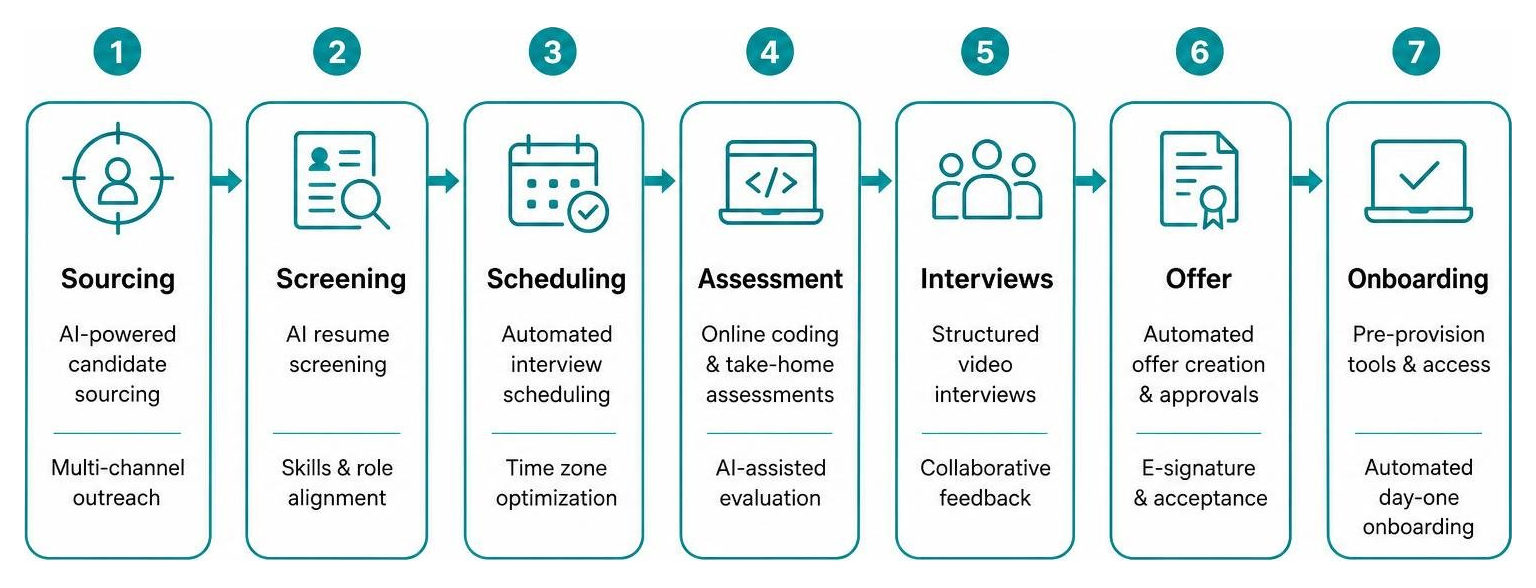
The landscape of remote nyc recruitment has evolved dramatically with the integration of artificial intelligence and recruitment workflow automation. Forward-thinking companies no longer rely on manual resume screening or static spreadsheets. Instead, talent operations leads leverage modern tech stacks to handle sourcing, pipeline management, and candidate evaluation.
Integrating AI Tools into Remote NYC Recruitment Workflows
Modern talent acquisition relies heavily on specialized platforms like Ashby to maintain pipeline hygiene and eliminate scheduling bottlenecks. Beyond standard ATS platforms, the emergence of vibe coding — utilizing AI-assisted development tools like Cursor, Claude, and Codex — is revolutionizing both technical candidate evaluation and recruitment operations.
Here is how modern tech startups utilize AI and automation across the hiring lifecycle:
- Automated Candidate Sourcing & Pipeline Hygiene: Recruiter operations use AI workflows to scan tech ecosystems, map passive talent pools, and personalize outbound emails based on specific candidate experience and GitHub contributions.
- AI-Assisted Candidate Screening: Non-technical recruiters leverage AI prompts to review candidate code repositories, verify technical skill alignment, and generate tailored screening questions.
- Predictive Hiring Metrics & Calibration: Teams track cost-per-hire, offer acceptance ratios, and interviewer scoring calibration using automated dashboards, ensuring objective and fast hiring decisions.
- Vibe Coding in Technical Assessment: Modern engineering teams actively test candidate proficiency in using AI coding tools (e.g., Cursor, Claude, or GitHub Copilot). Candidates are evaluated on their ability to prompt AI models, review generated code, and ship features rapidly rather than writing syntax from scratch under artificial constraints.
Companies seeking dedicated recruitment capability frequently establish dedicated in-house talent acquisition workflows or leverage specialized AI-driven tools to analyze how top NYC startups structure their talent acquisition infrastructure.
Frequently Asked Questions about Remote NYC Hiring
How does NYC pay transparency impact remote recruitment?
NYC pay transparency laws require all job advertisements covering roles that can be performed in NYC (including remote roles open to NYC residents) to clearly state the minimum and maximum base salary range. This law prevents compensation ambiguity, speeds up candidate trust during initial outreach, and ensures applicants align with employer budget expectations before entering the interview pipeline.
What is the average timeline for making a remote tech hire in NYC?
High-velocity hiring teams aim for a 21-day placement window from initial candidate contact to final offer acceptance. In competitive markets like NYC, drag-out interview processes exceeding 30 days result in high candidate drop-off rates as senior engineers and GTM professionals receive competing offers.
What tools are essential for managing remote hiring operations?
Modern remote recruiting infrastructure typically includes:
- ATS & Pipeline Management: Ashby or Greenhouse for tracking candidates and automating stage movements.
- Outbound Sourcing & Data: LinkedIn Recruiter, GitHub, and specialized talent platforms.
- Async Interviewing & Assessment: Loom for asynchronous presentations and AI-assisted pair programming environments like Cursor.
Conclusion
Building a high-performing distributed team connected to the New York technology ecosystem offers an unparalleled advantage in 2026. By understanding local pay transparency standards, maintaining competitive compensation bands, default-asynchronous communication, and leveraging AI tools like Ashby and Cursor to streamline talent pipelines, employers can consistently land top-tier talent.
At RemoteVibeCodingJobs, we specialize in connecting ambitious companies with developers and technical talent who leverage AI-assisted tools to ship product faster.
If you are ready to scale your engineering team with elite, remote-first talent, explore our curated platform and find top remote NYC tech roles on RemoteVibeCodingJobs NYC Listings today.