
Find and Win Remote Oracle PL/SQL Developer Jobs
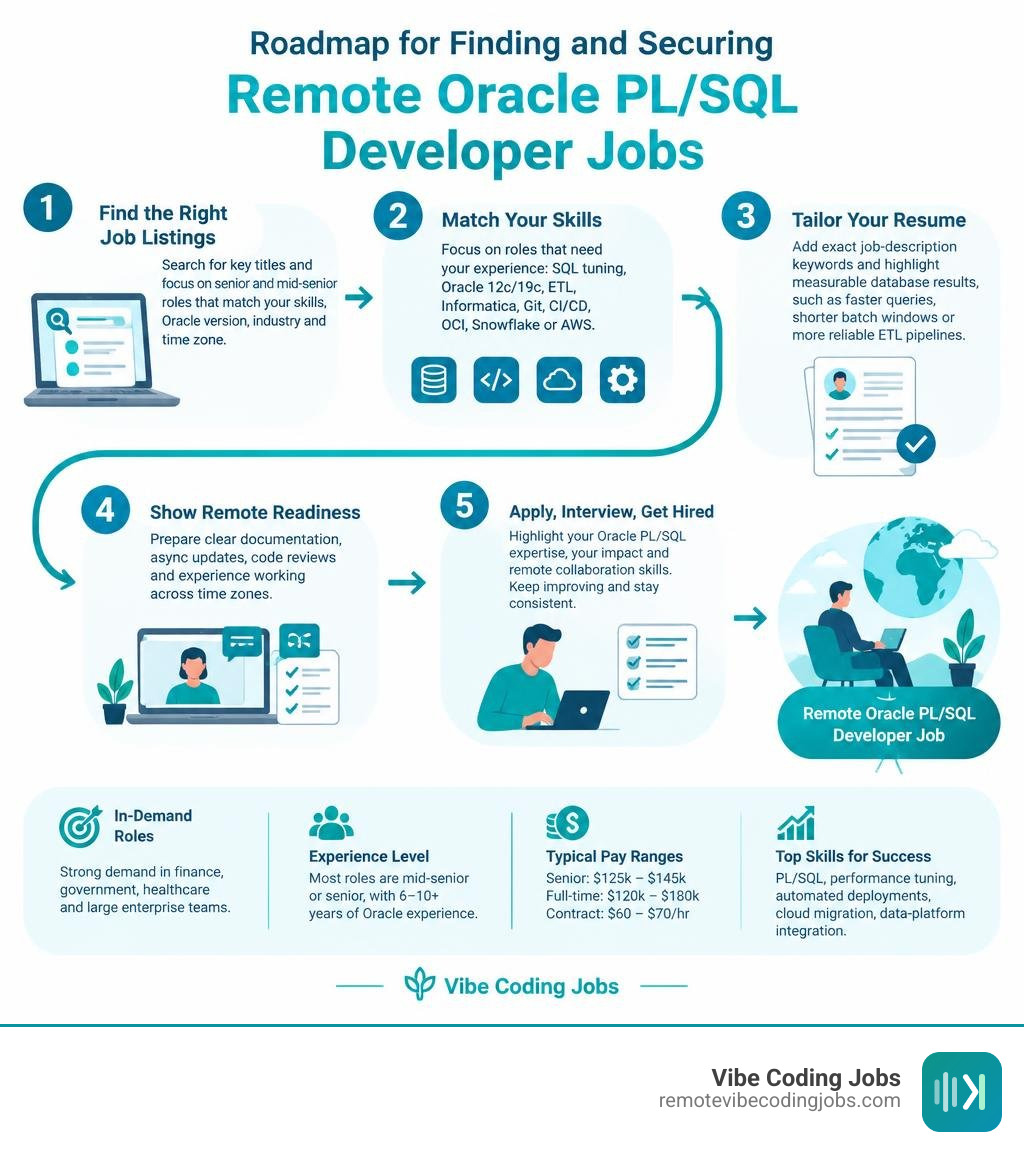
To find remote Oracle PL/SQL developer jobs, focus on senior and mid-senior listings that match your Oracle version, industry background, and time zone. Then tailor every application around measurable database results, such as faster queries, shorter batch windows, or more reliable ETL pipelines.
A practical starting plan:
- Search for titles such as Oracle PL/SQL Developer, Oracle SQL/PLSQL Software Engineer, Database Developer, and Oracle Data Warehouse Developer.
- Prioritize roles asking for skills you already use: SQL performance tuning, Oracle 12c or 19c, ETL, Informatica, Git, CI/CD, OCI, Snowflake, or AWS.
- Add exact job-description keywords to a clean, ATS-friendly resume.
- Prepare proof of remote readiness: clear documentation, async updates, code reviews, and experience working across time zones.
There are more than 1,000 U.S. remote PL/SQL listings visible across enterprise talent analytics, but most target experienced candidates. More than 78% of postings are mid-senior or senior level, and many ask for 6 to 10+ years of hands-on Oracle work. Financial services, government, healthcare, and large enterprise data teams remain strong sources of demand.
The upside can be substantial. Remote senior positions commonly advertise salaries around $125,000 to $145,000, while some full-time roles list ranges from $120,000 to $180,000. Contract work often falls near $60 to $70 per hour. The strongest candidates combine deep PL/SQL skills with modern delivery practices, including performance tuning, automated database deployments, cloud migration, and data-platform integration.
I’m Dominic Zijlstra, a technologist, data infrastructure practitioner, and DevOps engineer who has built automated systems and worked with complex technical platforms. In this guide to remote oracle pl sql developer jobs, I’ll help you turn enterprise database experience into a focused remote-job search and application plan.
Remote oracle pl sql developer jobs glossary:
Market Landscape for Remote Oracle PL/SQL Developer Jobs in 2026
The enterprise market for database engineers has shifted fundamentally. Organizations handling massive transactional volumes—such as investment banking firms, clinical healthcare providers, and federal contractors—continue to rely on Oracle Database architectures to power mission-critical operations. Rather than phasing out relational database engines, enterprises are modernizing their stored procedures, packages, and database backends to integrate with modern cloud data systems.
Hiring trends indicate sustained demand for engineers who possess deep architectural familiarity with Oracle 19c and the newer database releases. Companies actively recruit talent capable of maintaining legacy packages while migrating heavy analytical workloads into modern cloud ecosystems. As companies streamline hiring, experienced database engineers frequently review backend engineer compensation trends to understand how database specialization compares to traditional software engineering roles.
Compensation structures for remote database talent remain competitive across both direct full-time employment and contract engagements. Senior engineers can evaluate market standards by analyzing remote developer salary expectations in 2026 across various engineering tracks.
| Role Type | Experience Level | Typical Compensation Range | Common Focus Areas |
|---|---|---|---|
| Full-Time Enterprise Engineer | Mid-Senior (5–8 Years) | $120,000 – $145,000 / year | Schema Design, Package Optimization, CI/CD Integration |
| Senior Lead Database Architect | Senior (8+ Years) | $145,000 – $180,000 / year | Cloud Migration (OCI/AWS), Exadata Tuning, System Architecture |
| Remote W2 / C2C Contractor | Senior (6+ Years) | $55 – $70 / hour ($60–$65 avg) | Batch Window Reduction, High-Volume ETL, Regulatory Reporting |
| Specialized Migration Consultant | Lead / Specialist (10+ Years) | $75 – $95+ / hour | Snowflake Pipelines, Informatica Modernization, DevSecOps |
Sourcing Verified Remote Oracle PL/SQL Developer Jobs Across Relevant Job Sources
Finding high-paying database openings requires targeting direct enterprise channels where data teams post mission-critical positions. Enterprise employers look for specific database versions, security clearances, and time-zone coverage.
Candidates exploring opportunities can target verified channels:
- Direct corporate career channels of enterprise institutions publishing remote PL/SQL developer roles.
- Cloud modernization initiatives in banking and healthcare requiring Oracle Cloud Infrastructure, data warehousing, and Oracle SQL Developer expertise.
- Specialized financial institution engineering programs for Oracle PL/SQL Developer placements.
- Technical consulting engagements seeking senior Oracle SQL/PLSQL software engineers.
- Direct contract roles requiring EST or CST coverage for mission-critical database engineering.
Core Technical Stack and Modern Skills for Remote Database Engineers

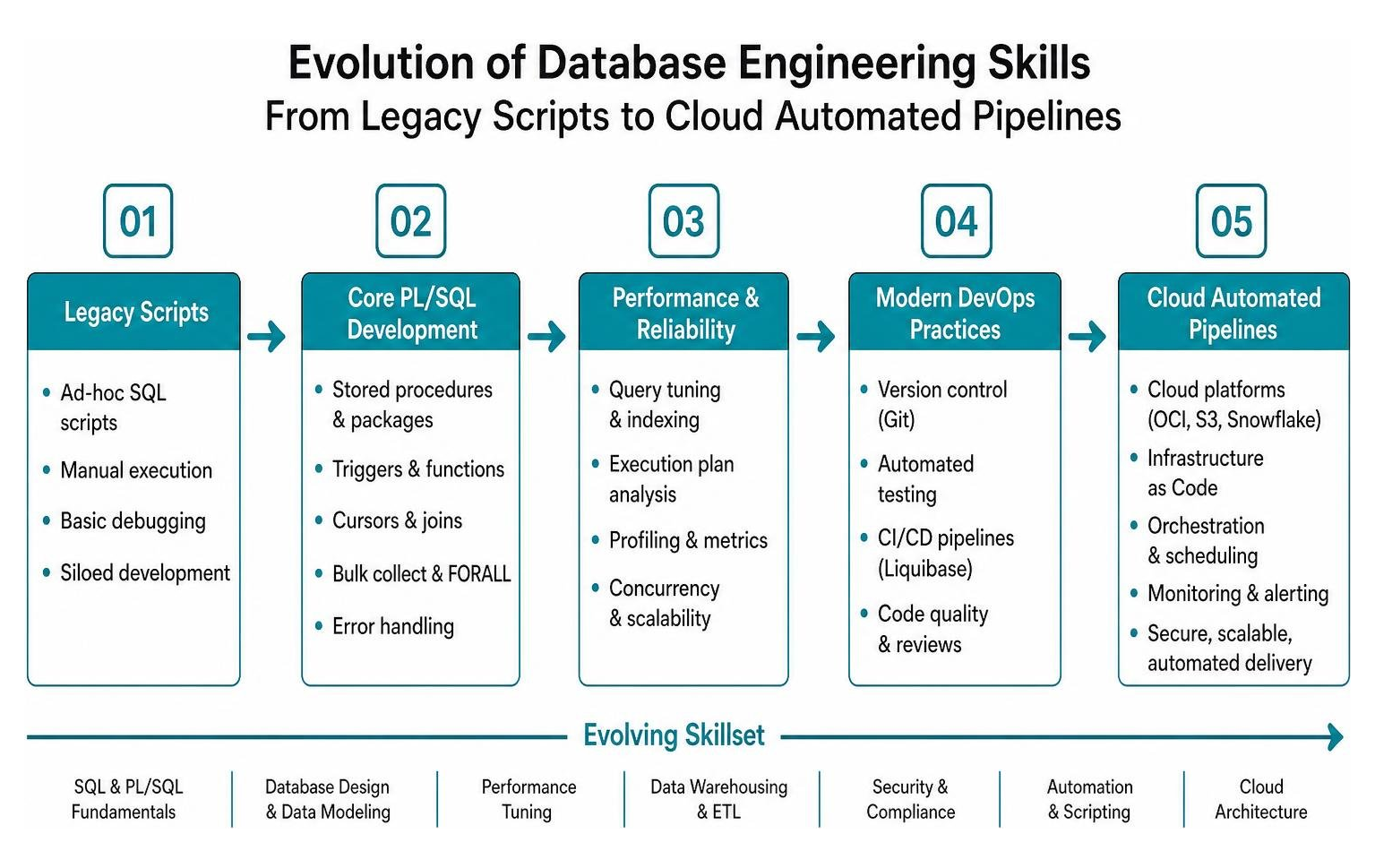
Securing a modern remote database role requires moving beyond basic scripting in PL/SQL. Employers evaluate candidates on their ability to build secure, scalable backend architectures while navigating the modern remote developer tools stack.
Database Performance Tuning and Data Warehousing
Performance optimization is the single most valuable technical differentiator for remote database developers. Enterprise teams expect engineers to pinpoint bottlenecks independently without needing handholding from a database administrator.
Key competencies include:
- Execution Plan Analysis: Interpreting cost-based optimizer decisions, evaluating index scans versus full table scans, and resolving cardinality mismatches.
- Diagnostics Tools: Reading Automatic Workload Repository (AWR) and Active Session History (ASH) reports to detect locking issues, latch contention, and I/O wait events.
- Advanced Optimization Techniques: Implementing bulk processing with
BULK COLLECTandFORALLconstructs to minimize context switching between the SQL and PL/SQL engines. - Data Warehousing Patterns: Managing partition exchange operations, designing star schemas, and architecting data staging areas for integration with cloud data warehouses like Snowflake.
Modern DevOps, Automation, and Testing for PL/SQL
The days of manually copying SQL scripts into production environments during weekend maintenance windows are over. Remote engineering teams rely on automated testing and deployment pipelines to ship reliable database migrations.
Top candidates incorporate the following workflows:
- Database Change Management: Version controlling schema modifications and package definitions using tools like Liquibase and Flyway integrated into Git workflows.
- Automated Testing & ATDD: Implementing Acceptance Test-Driven Development (ATDD) frameworks, utilizing utPLSQL to run automated unit tests across database routines before merge approval.
- AI-Assisted Development: Leveraging automated agents and testing utilities, comparing workflows like cursor vs windsurf for developers in 2026 to accelerate query generation, refactor legacy packages, and generate test assertions.
Step-by-Step Execution Plan to Land Remote Roles
Securing interviews in a competitive market requires a systematic search and application process. Because many remote applications are processed through applicant tracking systems before reaching engineering managers, your strategy must demonstrate both technical depth and remote readiness from the initial touchpoint.

Optimizing Your Resume for Remote Oracle PL/SQL Developer Jobs
Automated filters scan resumes for specific database technologies, tools, and business outcomes. To ensure your resume passes ATS algorithms and impresses hiring leads:
- Highlight Quantifiable Performance Metrics: Replace vague descriptions with precise performance results. Instead of writing “Optimized stored procedures for billing,” write “Refactored legacy billing PL/SQL package using table partitioning and parallel execution, reducing night batch processing window from 4.5 hours to 48 minutes.”
- Feature Relevant Enterprise Keywords: Ensure your profile clearly lists Oracle 12c/19c/23ai, AWR, ASH, DBMS_PROFILER, Liquibase, Git, Informatica, Autosys, and cloud data platforms.
- Showcase a Concrete Portfolio: When working under enterprise NDAs, developers can still present sanitized schemas, tuning scripts, and architectural templates by maintaining a practical technical portfolio on GitHub.
Navigating Remote Technical Interviews and Assessments
Technical interviews for database engineers differ from standard frontend or full-stack software interviews. Rather than testing abstract dynamic programming puzzles, database hiring teams focus on practical troubleshooting and schema design. Many candidates specifically target remote coding jobs with no LeetCode tests because enterprise database assessments prioritize domain-specific problem-solving.
During the interview process, expect evaluations covering:
- Live Query Optimization: Reviewing a slow-running SQL statement with suboptimal join orders, diagnosing the execution plan, and proposing indexing or hint strategies to resolve the bottleneck.
- Schema & Data Architecture Scenarios: Designing a multi-tenant relational schema capable of handling high-volume concurrent financial transactions while preventing row locking and deadlocks.
- Take-Home Schema Challenges: Refactoring an existing PL/SQL package to implement exception handling, autonomous transactions, and bulk processing routines.
Demonstrating Asynchronous Collaboration and Remote Readiness
Because remote teams operate across multiple time zones, your ability to communicate clearly in writing is just as critical as your technical acumen. Hiring managers evaluate whether you can advance projects independently without synchronous supervision.
To prove your remote capability:
- Document technical specifications clearly in Jira and Confluence, including comprehensive schema diagrams and input/output parameters.
- Conduct thorough peer code reviews on pull requests, explaining architectural suggestions with clear technical reasoning.
- Adopt established async-first communication workflows to provide proactive project updates and log changes systematically.
Frequently Asked Questions About Remote Oracle PL/SQL Careers
What are the typical salary ranges and hourly rates for remote Oracle PL/SQL positions?
Full-time remote Oracle PL/SQL developer roles typically offer base salaries ranging between $120,000 and $180,000 annually, depending on cloud modernization expertise, performance tuning skills, and industry domain background. Senior engineers and enterprise architects with deep experience in banking or healthcare systems land near the top end of this bracket. Contract engagements commonly pay between $55 and $70 per hour, with the majority of long-term enterprise contracts settling in the $60 to $66 per hour range.
Can I land a remote Oracle PL/SQL developer job without LeetCode style interviews?
Yes. The majority of enterprise database developer hiring processes do not utilize algorithmic LeetCode puzzles. Instead, interviews focus on practical database challenges: analyzing real execution plans, diagnosing lock contention in AWR reports, optimizing complex joins across multi-million-row tables, and demonstrating clean PL/SQL package design. Demonstrating solid knowledge of relational integrity, indexing strategies, and automated testing frameworks is far more effective than memorizing algorithmic trivia.
Which cloud technologies pair best with PL/SQL for remote database roles?
Oracle Cloud Infrastructure (OCI), Snowflake, and Amazon Web Services (AWS) are the most valuable cloud platforms to pair with PL/SQL. Many enterprises are actively building hybrid pipelines where on-premises or OCI-hosted Oracle databases feed analytical data warehouses in Snowflake. Expertise with AWS services (such as RDS, Lambda, EC2, and S3) alongside ETL tools like Informatica PowerCenter significantly enhances your candidacy for modernization initiatives.
Conclusion
The market for remote Oracle PL/SQL talent remains resilient and lucrative for engineers who combine core relational database mastery with modern engineering practices. By treating performance optimization, automated CI/CD deployments, and cloud data platform integrations as primary competencies, you position yourself at the forefront of enterprise hiring.
Tailor your resume around measurable execution speedups, demonstrate proactive asynchronous communication, and continuously expand your cloud data capabilities. To find your next career opportunity and connect with companies embracing modern distributed engineering cultures, explore curated listings on RemoteVibeCodingJobs today.