
Get Reliable Workers When Demand Changes Fast
Swift labour hire helps businesses add qualified workers without carrying the cost and delay of a permanent hire. For RemoteVibeCodingJobs readers, the same operational idea matters in tech recruitment: teams need a faster way to find trusted people when product demand, engineering roadmaps, or client deadlines change quickly.
RemoteVibeCodingJobs does not provide construction or industrial labour hire. It aggregates remote vibe coding and AI-assisted software development roles at async-first companies. This guide explains what businesses usually mean by swift labour hire, then translates the same principles – speed, screening, compliance, role fit, and clear onboarding – into practical lessons for hiring remote technical talent.
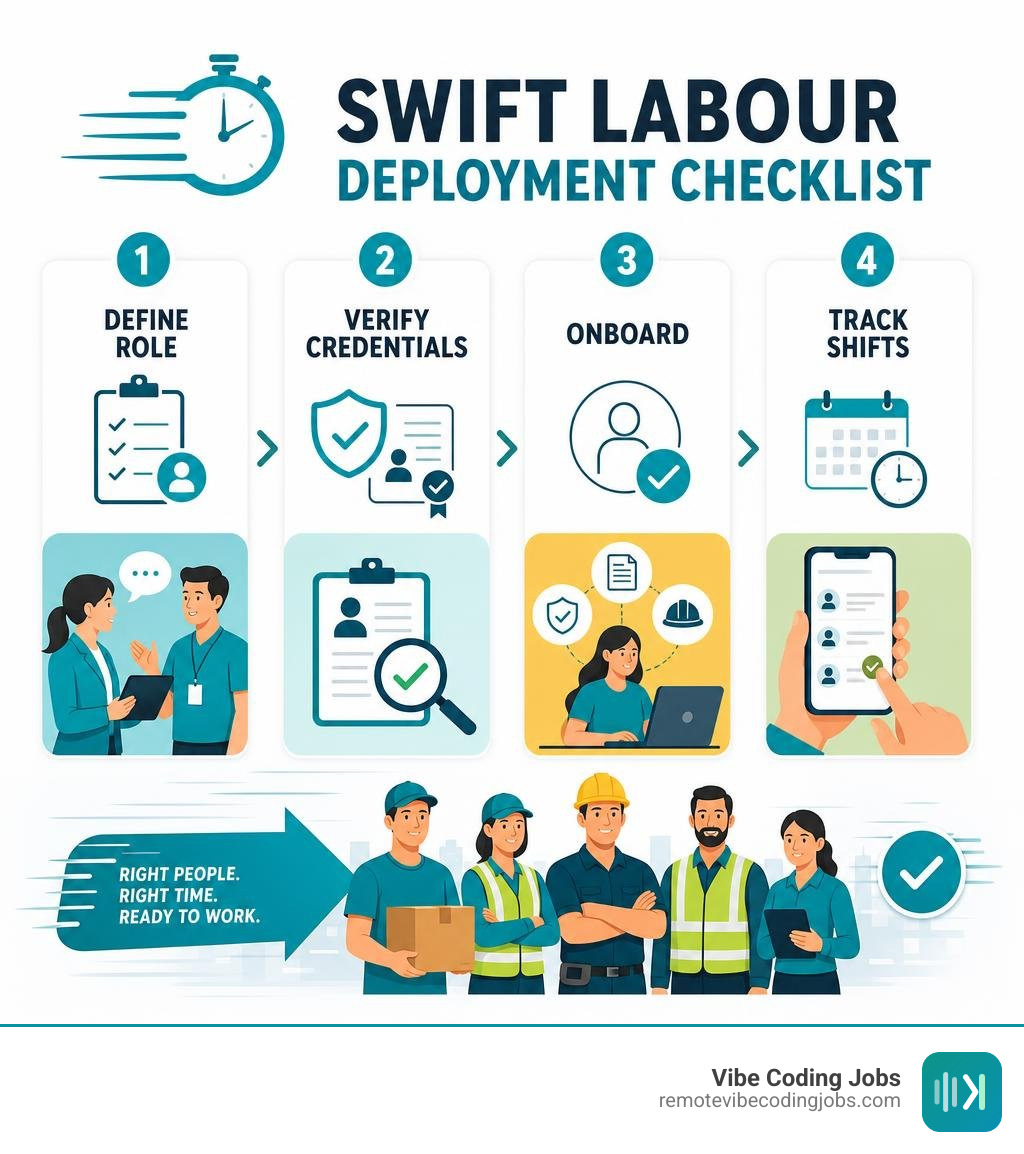
To get the best result from any fast staffing channel, give the provider or hiring platform clear details upfront:
- Define the role, shift or async working expectations, location requirements, and start date.
- List required tickets, licences, tools, security requirements, PPE, or safety inductions where relevant.
- Confirm whether you need temporary, contract, freelance, or permanent staff.
- Ask how candidates are screened, paid, insured, supported, and replaced if the fit is wrong.
A strong labour-hire partner can supply general labourers, skilled trades, operators, drivers, warehouse staff, and specialist workers. In the digital workforce, a strong jobs platform helps developers and employers reduce search friction by filtering opportunities by role type, culture, tech stack, remote expectations, and AI tools such as Cursor or Claude. In both cases, fast matching only works when the process behind it is transparent and reliable.
Swift Labour Hire is not one single global brand. The name is used by several separate recruitment and labour businesses in Australia, the UK, and elsewhere, each with its own locations, sectors, processes, and workforce pool. This guide explains how to assess any provider using the Swift name – or any on-demand staffing partner – based on speed, safety, fit, and transparency, while also showing how those standards apply to remote software hiring.
I am Di Su, a software engineer and growth professional with more than 10 years of experience building user-focused systems, scalable workflows, and high-converting digital services. My work in recruitment-adjacent technology and operations shapes this practical view of swift labour hire: fast matching only works when the underlying process is clear, compliant, and easy for people to use.
Swift labour hire word guide:
The Strategic Value of Swift Labour Hire in Modern Operations
In high-velocity business environments, the friction of traditional recruitment can stall capital projects, delay freight, slow software delivery, and lead to lost revenue. Modern project managers, operations directors, and engineering leaders increasingly treat workforce provisioning not as a fixed balance-sheet burden, but as an on-demand operational capability.
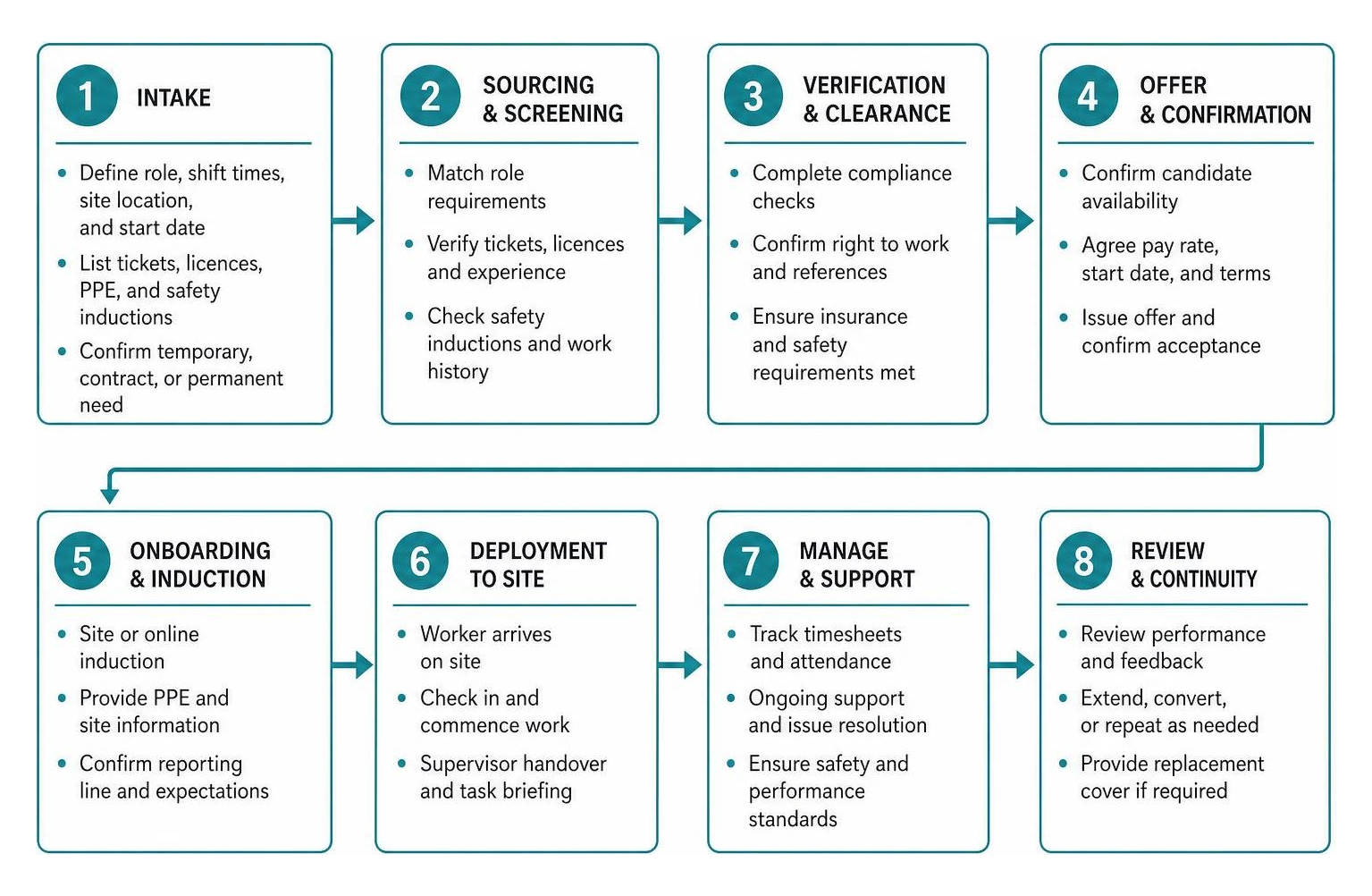
Understanding the Swift Labour Hire Model
Staffing agility relies on bridging the gap between immediate operational demands and qualified human capital. The modern labour hire model spans the operational spectrum, from blue-collar trade execution and logistics support to white-collar project support and digital delivery roles.
Rather than running lengthy internal recruitment cycles for seasonal peaks, sudden backfills, product launches, or urgent engineering milestones, organizations engage flexible staffing services and curated hiring platforms to access pre-screened talent faster. This dynamic framework covers casual day labour, multi-month infrastructure contracts, contract software roles, and temp-to-perm transitions, ensuring businesses remain fully staffed without inflating long-term structural overheads.
For Vibe Coding Jobs, this idea is especially relevant to remote development teams. Async-first companies often need AI-assisted developers who can contribute quickly, document decisions clearly, and work across distributed workflows without slowing the rest of the team down.
Core Industries Powered by Swift Labour Hire Solutions

Flexible staffing frameworks support several core industrial and knowledge-work sectors:
- Civil Infrastructure and Major Projects: Transport corridors, rail expansions, and hospital developments require massive surges of civil labourers, carpenters, and plant operators during specific build stages.
- Logistics and Warehousing: High-throughput distribution centres rely on certified forklift operators, pick-packers, and freight handlers to manage seasonal spikes and volatile inventory flows.
- FMCG and Food Manufacturing: Regulated production facilities require staff trained in critical safety protocols, including HACCP and GMP environments, to maintain uninterrupted processing lines.
- Commercial and Residential Construction: From initial site preparation to internal fit-outs, builders deploy skilled trades such as hydraulic plumbers, mechanical fitters, sheet metal workers, and ticketed carpenters on demand.
- Traffic Management and Site Support: Projects often require bundled ancillary support, such as accredited traffic controllers managing lane closures and pedestrian access, high-pressure washing, and post-construction cleanup crews.
- Remote Software and Product Teams: Digital companies need flexible access to mobile developers, full-stack engineers, AI-assisted coders, QA specialists, and technical product support when roadmaps accelerate or permanent hiring takes too long.
Flexible Staffing Models for High-Demand Work Environments
The core advantage of modern contingent recruitment lies in its responsiveness. Operations managers and technical hiring teams need reliable channels capable of handling both scheduled project growth and immediate workforce emergencies.
Rapid Contingent and Emergency Staffing
When sudden project changes occur – such as unexpected equipment breakdowns, emergency repair shifts, unannounced staff absences, urgent product deadlines, or a critical developer leaving mid-sprint – companies cannot wait weeks to find replacements. Top-tier labour providers operate around the clock, utilizing automated pre-shift matching systems and vast pools of active talent to facilitate same-day dispatches. In logistics and transport networks, vetted commercial drivers and warehouse handlers are often placed on site in under 24 hours to keep distribution chains moving.
Remote technical hiring follows the same logic, although the workflow is different. Instead of dispatching a worker to a physical site, a company needs fast visibility into candidates who match the role, stack, timezone expectations, async culture, and AI-assisted development workflow. Curated job aggregation helps reduce the search time for both candidates and hiring teams.
High-Demand Trades and Ticketed Plant Operators
Industrial projects require verified technical competence. Staffing platforms maintain specialized rosters of ticketed professionals ready for immediate mobilisation:
- Elevating Work Platform (EWP) Operators: Certified operators trained for safe high-altitude civil and maintenance work.
- Heavy Vehicle and Dump Truck Drivers: Licensed heavy-rigid and articulated dump truck operators for civil excavation and quarry transport.
- Material Handling Specialists: Forklift drivers with verified high-reach, counterbalance, and order-picker endorsements.
- Specialized Riggers and Crane Crews: Ticketed personnel capable of orchestrating complex industrial lifts and structural steel assembly.
- Mechanical Fitters and Welders: Certified pipe welders and fitters experienced in high-pressure industrial environments.
In software teams, the equivalent is not a physical licence, but proven competency: shipped projects, relevant frameworks, code review habits, security awareness, communication quality, and practical experience with AI coding tools. A fast hire is only useful if the person can contribute safely and productively inside the existing workflow.
Comparing Flexible Labour Hire with Direct Hiring
Evaluating temporary staffing versus internal recruitment requires balancing speed, risk, and long-term costs:
| Evaluation Factor | Flexible Labour Hire Model | Traditional Direct Hiring |
|---|---|---|
| Ramp-Up Speed | Deployment within 24-48 hours from pre-vetted candidate pools | 4 to 8 weeks for sourcing, interviews, and notice periods |
| Administrative Burden | Provider manages payroll, statutory taxes, superannuation, and compliance | Internal HR handles advertising, onboarding, contracts, and administration |
| Payroll Flexibility | Variable operational expense tied directly to productive project hours | Fixed structural overhead regardless of project volume or seasonal lulls |
| Regulatory & Safety Risk | Shared risk; provider verifies tickets, right-to-work, and initial safety briefings | Complete employer liability for all worker compliance and safety onboarding |
| Workforce Scalability | Scale up or down instantly based on milestones without severance liabilities | Downsizing requires complex redundancy procedures and potential severance payouts |
For remote engineering teams, the comparison is similar. A curated jobs marketplace can shorten discovery and application time, while the employer still remains responsible for final assessment, contracting, data-security checks, and onboarding.
Rigorous Vetting, Safety Standards, and Statutory Compliance
Fast deployment is counterproductive if it introduces site safety incidents, regulatory non-compliance, security risk, or poor team fit. Leading labour hire frameworks place risk mitigation and candidate vetting at the center of their operations, and the same mindset applies to remote technical recruitment.

Multi-Stage Screening and Site-Ready Inductions
To support day-one productivity, candidates may undergo a comprehensive screening process before arriving at a work site or joining a distributed team:
- Identity and Right-to-Work Verification: Rigorous confirmation of national work entitlements, visa statuses, and background checks where legally permitted and role-appropriate.
- Licence and Ticket Authentication: Cross-referencing trade certifications, High-Risk Work (HRW) licences, driver accreditations, and industry safety cards (such as White Cards) directly with issuing authorities.
- Competency and Experience Assessments: Detailed reference checks with previous site supervisors, managers, or technical leads to verify technical skills, reliability, communication, and punctuality.
- Site-Specific or Team-Specific Inductions: Delivery of digital or face-to-face safety inductions for physical sites, or structured remote onboarding for software teams covering code repositories, documentation, security practices, communication norms, and delivery expectations.
Workplace Health, Safety, and Legal Protections
Adherence to occupational safety and health standards is non-negotiable across construction, industrial, and logistics operations. Robust labour providers maintain dedicated safety teams who work closely with client sites to review risk assessments, conduct regular site safety audits, and reinforce proactive safety cultures.
Furthermore, reputable providers carry comprehensive Public Liability and Workers’ Compensation insurance policies, shielding clients from legal exposure. Transparent operations ensure all contracts, pay structures, and employment practices strictly comply with regional labour standards and equal-opportunity employment guidelines.
For remote technology roles, compliance looks different but is just as important. Employers should verify work authorization, clarify contractor or employee status, protect confidential data, define acceptable AI-tool usage, and ensure hiring processes are fair, transparent, and non-discriminatory.
Best Practices for Managing and Scaling an On-Demand Workforce
Securing quality labour is only the first step; maximizing productivity requires streamlined administrative workflows, clear expectations, and high contractor engagement. This is true on a warehouse floor, a construction site, and a remote software team.
Integrated Payroll, Timesheets, and Workforce Tracking
Outdated paper timesheets create billing disputes and payroll bottlenecks. Modern labour hire providers leverage cloud-based mobile apps and automated workforce management systems. Contractors log hours directly through their devices, allowing site supervisors to review and approve shifts with a single tap. This transparency eliminates payroll errors, provides clients with transparent, itemized invoices, and ensures workers receive their guaranteed weekly pay without administrative friction.
Remote engineering teams need the same operational clarity, even when work is asynchronous. Instead of physical shift tracking, they often rely on documented scope, issue trackers, pull requests, async updates, code review records, and milestone-based reporting. The goal is not surveillance; it is reducing ambiguity so the business can understand progress and the worker can deliver without constant interruption.
Contractor Support, Upskilling, and High Retention
Workforce quality depends on worker retention. The most reliable labour agencies invest heavily in their people:
- Continuous Up-skilling: Providing access to subsidized ticket upgrades, safety modules, and continuous professional development.
- Reliable Weekly Pay: Consistent, on-time weekly payments to foster loyalty and reduce roster turnover.
- Dedicated Consultant Support: 24/7 on-call operational support to address site concerns, shift adjustments, or logistical issues immediately.
- Clear Career Pathways: Structured pathways that allow high-performing contingent workers to transition into long-term commercial contracts or permanent positions.
The same retention principle applies to vibe coding and AI-assisted development roles. Developers are more likely to stay engaged when employers communicate clearly, respect async focus time, define how AI tools should be used, review work constructively, and offer meaningful growth paths rather than treating flexible talent as disposable capacity.
Frequently Asked Questions About On-Demand Staffing
How quickly can skilled labourers be deployed to a project site?
For standard roles such as general labourers, warehouse pickers, or certified forklift drivers, top providers can place personnel on shift within 24 hours. In urgent situations, emergency dispatch systems can deliver pre-vetted local talent on the same day. Highly specialized technical trades or ticketed plant operators typically deploy within 48 to 72 hours, depending on site induction requirements.
For remote software roles, timing depends on role seniority, stack specificity, timezone needs, interview depth, and security requirements. Curated listings and fast applications can reduce discovery time, but employers should still protect quality by validating skills and onboarding carefully.
What compliance checks and certifications are verified prior to placement?
Before entering a site, candidates undergo structured vetting, including:
- National identity and right-to-work verification.
- Mandatory general safety inductions (such as construction White Cards).
- Physical High-Risk Work licences for cranes, EWPs, and forklifts.
- Commercial driving licences, digital tachograph cards, and hazardous goods accreditations where applicable.
- Direct reference checks with former employers to confirm technical competency and safety history.
For remote development positions, employers commonly verify identity, work authorization, portfolio or GitHub evidence, prior employment or client references, communication standards, security awareness, and practical competency with the required stack and AI-assisted workflow.
How does temporary labour hire reduce overhead costs for growing businesses?
Engaging contingent labour converts fixed employee overhead into a flexible variable expense. Businesses save on recruitment advertising, HR administrative costs, payroll processing overhead, and statutory leave liabilities. More importantly, it eliminates the expensive idle time that occurs when full-time staff remain on the payroll between project phases or during seasonal lulls.
Digital teams use the same principle when they hire contractors, fractional specialists, or remote developers for defined product phases. They can increase capacity during launches, migrations, or AI tooling rollouts, then return to a leaner core team once the workload stabilizes.
Conclusion
Building an agile, resilient operation requires immediate access to dependable talent. Whether you are navigating seasonal supply chain spikes, scaling up for critical civil infrastructure milestones, filling unexpected roster gaps, or accelerating a software roadmap, a structured workforce strategy delivers the qualified people you need to stay on schedule and within budget.
For physical worksites, that may mean choosing a licensed labour-hire provider with strong safety systems, verified tickets, transparent payroll, and replacement cover. For digital teams, it means finding remote technical talent quickly without compromising culture fit, communication quality, security, or delivery standards.
Just as physical operations benefit from agile, on-demand staffing, modern digital teams require flexible technical talent to drive product roadmaps forward. If your business is expanding its software engineering capabilities with elite, AI-augmented developers, explore curated mobile developer positions to connect with top-tier remote specialists who can accelerate your technical delivery today.