
Find Paid Vibe Coding Work Without Wading Through Noise
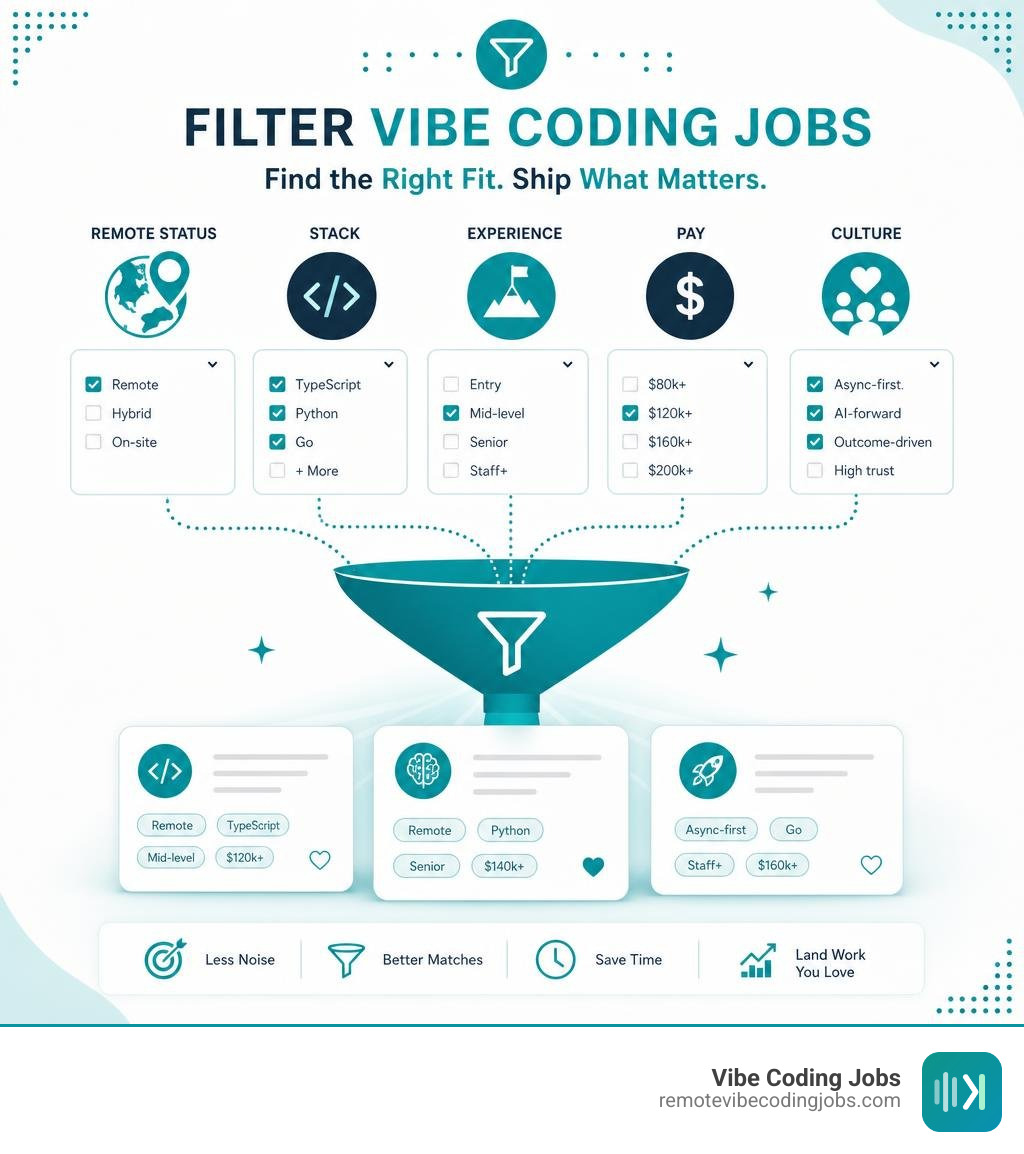
The fastest way to find paid work is to use a vibe coding job list that lets you filter for remote roles, your core stack, seniority, and async-first culture. Prioritize listings that name the AI tools used, explain the delivery expectations, and show a salary range. Then apply with links to live projects, a clean GitHub repository, and a short build log that proves you can use AI agents and review their output.
In 2026, this is a real and growing job market. Vibe coding roles rose 340% year over year, with 1,842 active listings tracked across 22 sources as of April 2026. Most are remote, but the title is not always “Vibe Coder.” Look for related roles such as:
- AI Engineer or AI Product Engineer
- Agentic Engineer
- Full-Stack AI Developer
- Product Engineer
- LLM Engineer
- Creative Technologist
- AI-assisted Software Engineer
The strongest marketplaces do more than collect job posts. They help you spot the signals that matter: whether a team is truly AI-forward, whether it works asynchronously, whether the role fits your experience, and whether “ship fast” still includes testing, security, and code review.
I am Dominic Zijlstra, a technologist and entrepreneur with experience in data systems, DevOps, automation, and AI-enabled products. I bring that practical lens to this vibe coding job list: finding roles where fast AI-assisted building is paired with real engineering standards.
Terms related to vibe coding job list:
- remote vibe coding what modern tech teams actually expect in 2026
- async first developer jobs
- cursor developer remote jobs
The Shift to AI-Assisted Engineering and Why Vibe Coding Roles Are Surging
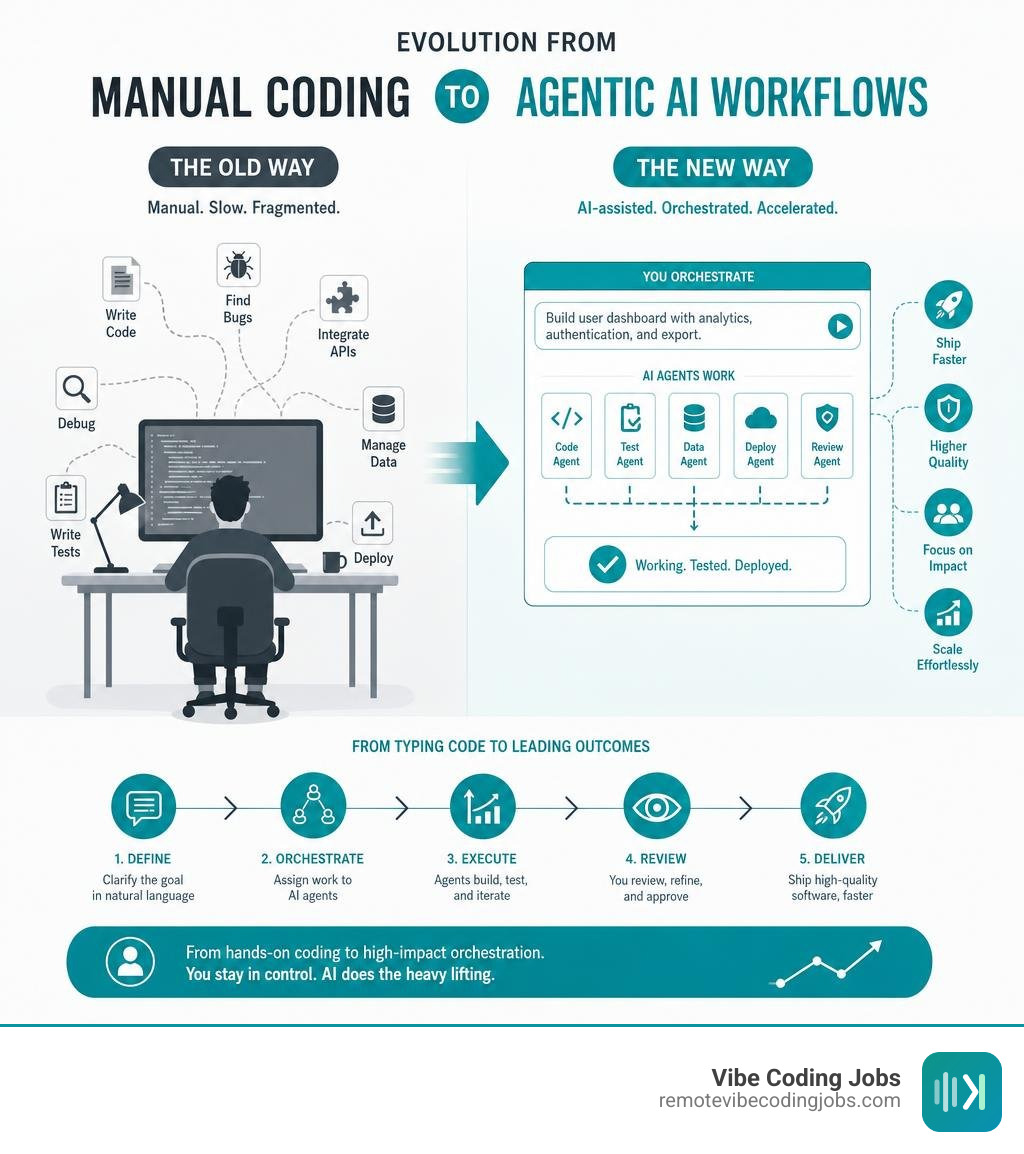
The software engineering landscape has undergone a profound transformation. What began as an experimental way of generating code has solidified into an established paradigm known as agentic engineering. Today, engineering teams care less about your manual typing cadence and far more about your velocity in moving systems from concept to production. The contrast between vibe coding vs traditional development is no longer a theoretical debate—it is visible across modern team structures where single builders now deliver the output once expected from entire engineering squads.
This momentum is reflected in active developer forums and community inquiries regarding vibe coding opportunities. Platforms tracking developer trends show a staggering +340% year-over-year posting increase for vibe coding and AI-assisted engineering positions. The total volume has surpassed 4,772 all-time listings, establishing vibe coding as the fastest-growing developer specialization of 2026.
This evolution is heavily supported by broader startup ecosystems. By early 2025, Y Combinator reported that a quarter of its startup batch maintained codebases where 95% of the code was generated by AI models. As these startups mature in 2026, they require engineers who can orchestrate these models fluently without sacrificing uptime or architecture.
How Daily Workflows Differ from Traditional Software Engineering
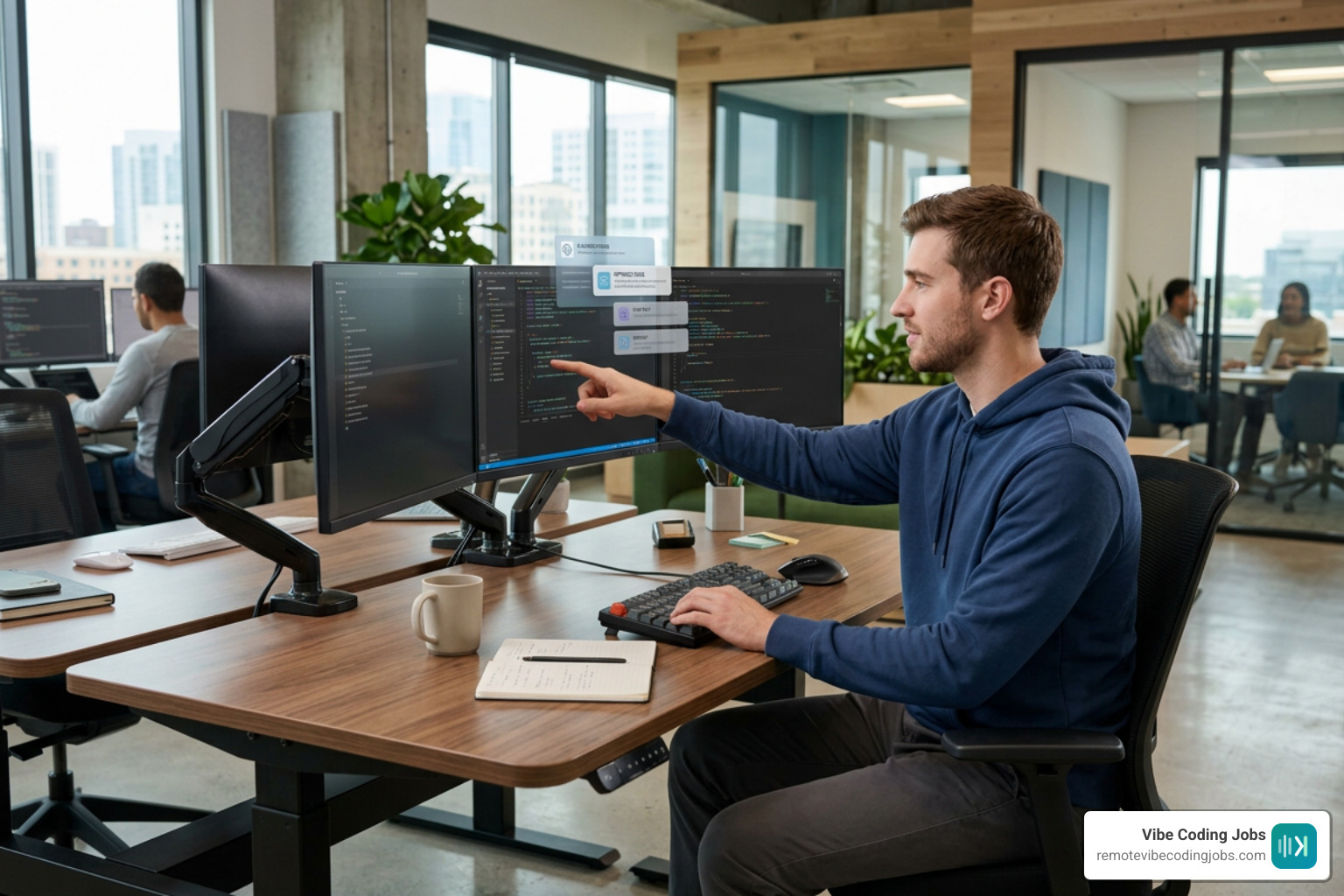
A vibe coder’s day-to-day workflow looks distinctly different from legacy development cycles. Instead of manually writing boilerplate syntax and spending hours wrestling with repetitive utility functions, practitioners manage AI coding agents using precise, natural-language instructions and structured reasoning.
Key responsibilities in this workflow include:
- Prompt Orchestration & Architecture Definition: Translating product requirements into modular system specifications that AI agents can execute accurately without circular regressions.
- Planner-Executor Agent Frameworks: Leveraging dual-agent workflows where frontier reasoning models act as high-level planners while specialized, low-latency models handle implementation tasks.
- Verification and Code Hardening: Systematically reviewing AI outputs, validating edge cases, detecting security vulnerabilities, and ensuring generated modules integrate smoothly with backend APIs.
- End-to-End Ownership: Handling everything from the initial prompt to the live, deployed production environment within hours rather than multi-week sprint cycles.
Because this workflow removes the bottleneck of manual syntax generation, the modern AI developer operates best in environments optimized for deep, uninterrupted execution. This is why the overwhelming majority of these listings are found among async first remote developer jobs, where continuous status meetings are replaced by transparent documentation and rapid shipping.
High-Demand Stacks: Python, Kubernetes, and Agentic Frameworks
While developers interact with systems through high-level AI interfaces, underlying technical stacks remain critical for system resilience, scalability, and agent integration. The top technologies appearing across active vibe coding job listings in 2026 include:
- Python (373 listings): The undisputed foundational language for AI orchestration, backend data pipelines, model interfacing, and agentic workflows.
- Kubernetes (318 listings): Essential for container orchestration, microservice scaling, and managing infrastructure for AI-assisted deployments.
- Go (310 listings): Highly demanded for high-performance cloud backends, API gateways, and distributed services requiring minimal runtime overhead.
- AWS & Cloud Infrastructure (285+ listings): Serverless compute, cloud storage, vector databases, and container management.
- TypeScript & React (199+ listings): The premier front-end and full-stack runtime for building reactive web applications, interactive canvases, and AI-driven user interfaces.
Mastering these technologies alongside daily tools like Cursor, Claude Code, and GitHub Copilot ensures developers can direct models effectively and inspect the generated code for runtime performance and security.
Navigating the Curated Vibe Coding Job List by Experience and Compensation
Compensation across the AI-assisted developer ecosystem reflects a massive productivity multiplier. The overall median annual salary for vibe coding positions stands at $160,000, spanning an overall range up to $350,000. According to comprehensive industry data from our vibe coding salary guide remote and external market research on where vibe coding jobs are emerging, the category pays approximately 20% higher than the broader software engineer median of $132,000 recorded by the US Bureau of Labor Statistics.

Freelancers and contract engineers working in the vibe coding space clear roughly $100 per hour on average, with elite practitioners possessing hardened portfolios commanding between $150 and $200 per hour.
| Experience Level | Median Salary | Base Range | Core Expectations |
|---|---|---|---|
| Junior / Entry-Level | $75,000 | $50,000 – $100,000 | Core CS mechanics, git hygiene, basic AI tooling, unit test generation |
| Mid-Level | $135,000 | $110,000 – $160,000 | Autonomous feature builds, agentic debugging, API integrations, production hardening |
| Senior | $150,000 | $120,000 – $320,000 | Rapid prototype-to-production lifecycle, prompt architecture, security reviews |
| Staff+ | $200,000 | $100,000 – $300,000 | Distributed systems design, AI agent integration standards, engineering governance |
| Lead / Principal | $210,000 | $120,000 – $350,000 | Full organizational workflow transformation, high-throughput delivery management |
Filtering Entry-Level Roles on a Vibe Coding Job List
A persistent question among new developers is whether junior positions exist within AI-assisted development. While explicitly tagged “Junior Vibe Coder” roles represent a smaller fraction of listings (around 89 explicitly indexed roles across entry programs and internships), hundreds of accessible opportunities exist in practice.
Early-career engineers can find high-growth positions by targeting AI coding jobs entry level remote opportunities. Companies like Fannie Mae, PlanetArt, and SSOE offer starting salaries ranging from $52,000 to $100,000+ for candidates who showcase strong software fundamentals combined with AI fluency. Instead of relying purely on a traditional computer science diploma, junior applicants land these roles by submitting verified portfolios featuring live URLs, functional full-stack apps, and clear documentation showing how they used AI agents to accelerate development.
Evaluating Senior and Lead Roles on a Vibe Coding Job List
Senior, Staff, and Lead listings make up the largest share of active hiring demand, with over 650 positions categorized at the Lead and Staff+ tiers. In over 40% of Senior+ listings, the expectation to take “ideas to production in hours” is an explicit requirement.
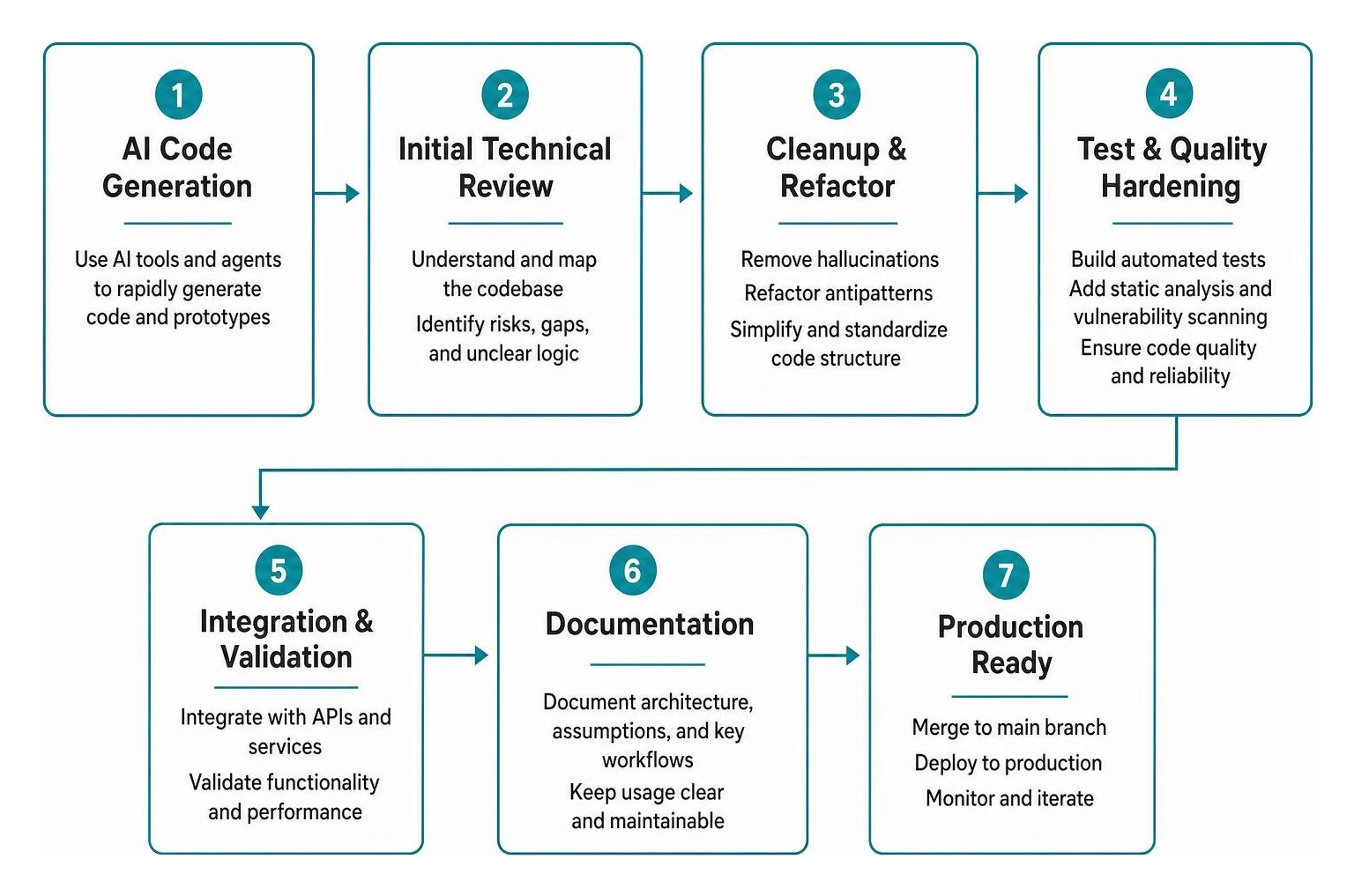
At these senior levels, companies also recruit for specialized functions like the Vibe Code Cleanup Specialist. As engineering teams leverage AI tools to rapidly produce large volumes of code, organizations require senior developers who excel at:
- Reverse-engineering complex AI-generated codebases
- Refactoring architectural antipatterns and removing hallucinations
- Establishing automated test suites and vulnerability scanning pipelines
- Managing technical debt before rapid prototypes move into enterprise production
Top Marketplaces and Companies Hiring Vibe Coders in 2026
The vibe coding job market is heavily decentralized. 73% of all listings are fully remote, allowing developers to collaborate globally without geographic restrictions. The remaining 27% cluster around key technical hubs including San Francisco, New York, Stockholm, and Amsterdam.
A wide array of companies are actively recruiting developers who specialize in AI-accelerated workflows. To review active postings, candidates regularly consult our directory of companies hiring vibe coding experts to find forward-thinking engineering organizations.
Async-First Startups and Scale-Ups Leading the Market
Key employers driving the demand for vibe coders include:
- Grafana Labs (359 active listings): Leading the tech sector in hiring AI-assisted systems engineers, backend developers, and SREs who incorporate generative tools into observability and monitoring workflows.
- GitLab (17 listings): Championing asynchronous development practices, continuous delivery, and integrated AI capabilities across their developer platform.
- Replit (12 listings): Expanding cloud development environments and automated agent systems tailored for AI builders.
- Spotify (11 listings): Deploying AI-forward engineers to build dynamic, interactive media features and data platforms.
- Lovable: Establishing dedicated programs such as their Vibe Coder in Residence, turning AI-first product builders into a recognized full-time profession.
Technical Vetting: No-Leetcode Live Builds and Agentic Code Reviews
Hiring processes for vibe coders have diverged significantly from legacy algorithmic interviews. Rather than asking candidates to invert binary trees on a whiteboard, modern interview funnels focus on practical builder evaluations:
- The Live Build Challenge: Candidates are given a problem statement and access to their preferred AI tools (Cursor, Claude, Copilot). They are evaluated on how fast they can generate a functional prototype, deploy it to a live staging environment, and refine the UX.
- Prompt Reasoning and Agent Selection: Interviewers assess how well the candidate structures prompts, handles context windows, and uses planner-executor patterns to avoid runtime errors.
- Code Review and Reverse Engineering: Candidates are handed an intentionally buggy, AI-generated codebase and asked to identify hallucinations, fix performance bottlenecks, and implement unit tests.
- Security & Threat Modeling: Testing the applicant’s ability to spot common AI-induced vulnerabilities, such as insecure direct object references, missing authentication checks, and prompt injection vectors.
How to Build a Standout Portfolio for Vibe Coding Work
In an agentic hiring market, a standard PDF resume is rarely enough. Shipped software is the ultimate credential. A competitive portfolio provides concrete proof that you can take an idea, direct AI agents to build it, review the output, and deploy it to real users.
When putting together your showcase, following established strategies for building portfolio with AI tools ensures your applications stand out from candidates who simply claim prompt engineering expertise on their resumes.
Essential Portfolio Projects: Browser Apps, SaaS Tools, and Public Build Logs
To land mid-to-senior vibe coding roles, your portfolio should include three core assets:
- A Functional Browser Application: An interactive tool or game (e.g., using TypeScript, Three.js, or React) demonstrating state management, fluid UX, and zero runtime console errors.
- A Micro-SaaS Prototype: A full-stack web application featuring user authentication, database integration (PostgreSQL or Supabase), payment processing (Stripe), and external API connections. The accompanying GitHub repository must display structured commit messages demonstrating code reviews and test coverage.
- A Transparent Public Build Log: A written case study, Loom walkthrough, or prompt transcript documenting your development process. Detail the initial architecture prompts, how you handled hallucinations, where you optimized token usage, and how you secured the final production endpoints.
Frequently Asked Questions about Finding Vibe Coding Work
What is the median salary expected from a vibe coding job list in 2026?
The median annual salary across all vibe coding jobs is $160,000. Salaries span from $50,000 to $100,000 for junior and entry-level developers up to $350,000 for senior, lead, and staff-level architects. Freelance vibe coders typically bill between $100 and $200 per hour depending on project complexity and proof of delivery. Overall, compensation sits approximately 20% above the wider software development industry average.
Can junior developers land paid vibe coding roles without a CS degree?
Yes. While traditional tech roles often filter candidates using computer science degree requirements, vibe coding teams prioritize live prototypes, shipped apps, and verifiable git histories. A candidate who demonstrates solid knowledge of web fundamentals (HTTP, APIs, basic databases) and shares a working portfolio of AI-built applications is frequently hired over a degree-holder with no shipped projects.
How do hiring teams address AI code quality and technical debt?
Companies protect their codebases by establishing strict automated testing, CI/CD validation pipelines, and dedicated review roles such as Vibe Code Cleanup Specialists. Hiring teams vet developers on their ability to inspect AI output, write comprehensive unit tests, and maintain modular architecture so technical debt is resolved before code hits production.
Conclusion
The shift toward AI-assisted software engineering has created massive leverage for developers who know how to build with modern agents. By leveraging a comprehensive vibe coding job list, identifying companies with strong async-first cultures, and highlighting your shipped applications, you can secure high-paying, remote engineering roles at the forefront of tech.
Whether you are building full-stack platforms, optimizing agentic workflows, or looking for specialized language roles, explore our curated listings for remote Swift vibe coding jobs and find your next high-impact engineering position today.