
Find Remote Flutter Jobs That Match Your Skills
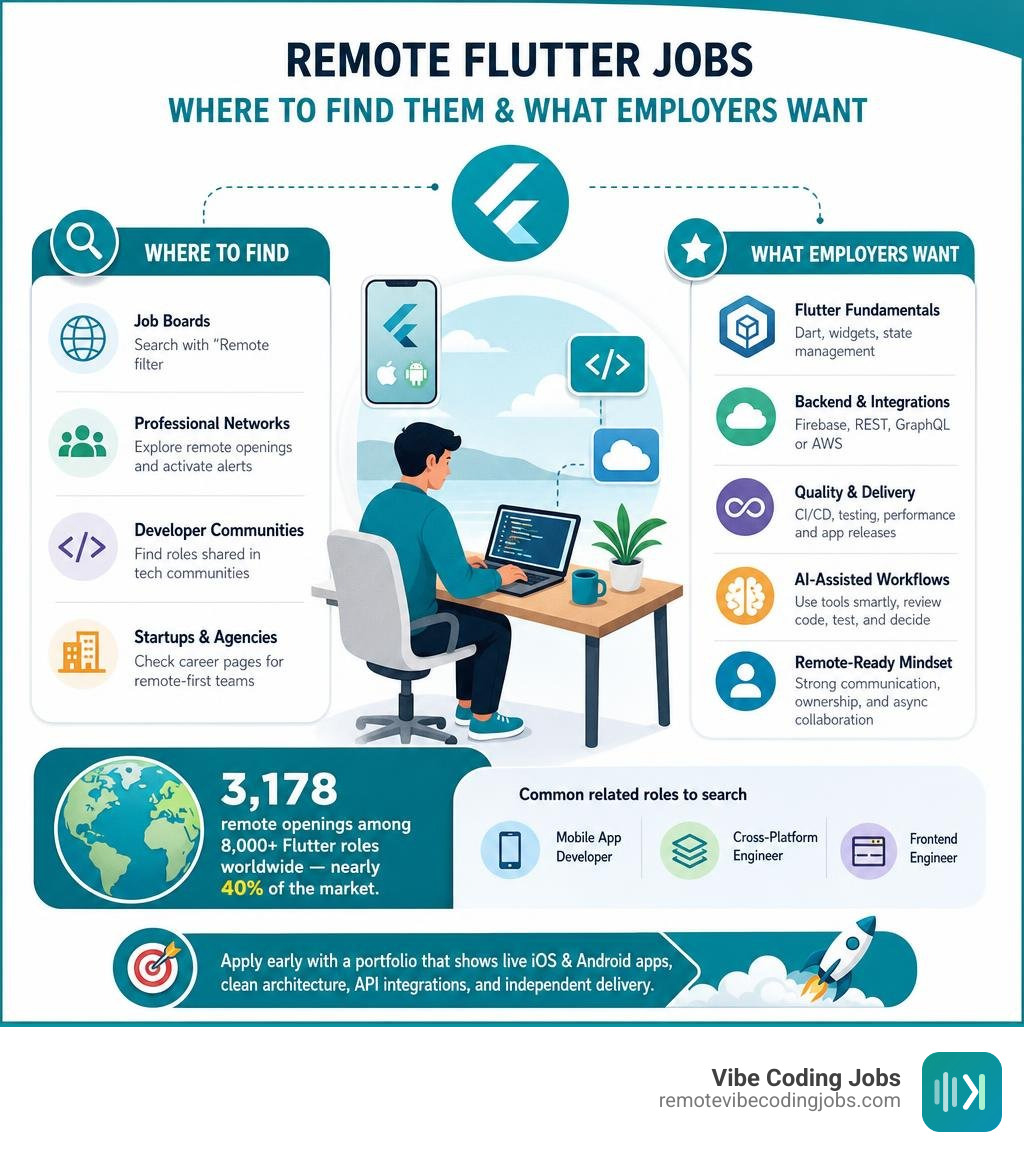
The fastest way to find remote Flutter developer jobs is to search beyond the exact title. Use filters for Remote and try related roles such as Mobile App Developer, Cross-Platform Engineer, and Frontend Engineer. Then apply early with a portfolio that shows live iOS and Android apps, clear Dart) architecture, API integrations, and your ability to work independently.
There is real global demand: Industry data shows 3,178 remote openings among more than 8,000 Flutter roles worldwide, or nearly 40% of the market. Most openings favor mid-to-senior engineers, but startups, agencies, and product teams also hire developers with 1-3 years of Flutter experience.
In 2026, the strongest candidates pair Flutter fundamentals with practical delivery skills: Riverpod, BLoC, or Provider; Firebase, REST, GraphQL, or AWS; CI/CD; and App Store and Google Play releases. AI-assisted workflows matter, too. Listings increasingly mention tools like Cursor, Claude Code, and GitHub Copilot, but employers still expect you to review generated code, test it, and make sound technical choices.
This guide breaks down where the jobs are, what they pay, and how to stand out in an async-first hiring process.
I’m Di Su, a software engineer with more than 10 years of experience building web products, improving user journeys, and helping teams ship scalable software. I use that product and growth perspective to help developers position themselves for remote Flutter developer jobs and show employers the impact behind their code.
Related content about remote flutter developer jobs:
The Global Landscape for Remote Flutter Developer Jobs
The mobile development hiring landscape has shifted toward cross-platform agility. Global listings indicate that over 3,100 of the 7,800+ active Flutter positions indexed worldwide offer fully remote arrangements. Companies no longer want to build separate codebases for iOS, Android, web, and desktop when a single unified team can deliver production-ready apps across all platforms.

Mid-to-senior level engineers represent more than 60% of open listings (around 4,800 jobs globally), but demand spans from seed-stage startup builders to enterprise systems architects. Whether companies are seeking high-throughput white-label marketing apps or complex internal tools, remote-first hiring has unlocked access to distributed engineering talent.
High-Hiring Industries and Company Types
Flutter adoption extends across diverse industry sectors:
- Health Tech and Clinical Research: Platforms such as digital intervention tools, smoking cessation trackers, and patient care portals use Flutter to deploy secure, cross-platform apps connected to cloud data backends.
- IoT Hardware & Connected Devices: Companies building smart wearables, audio hardware, and cold-chain logistics platforms pair Flutter with custom Bluetooth Low Energy (BLE) integrations.
- SaaS and Micro-Marketplaces: B2B sales automation suites, POS systems, and rental platforms rely on Flutter for unified web and mobile client interfaces.
- Fintech & Banking: Enterprise financial service providers use Flutter to modernize multi-tenant client apps while adhering to strict compliance and accessibility standards.
Geographic Hubs and Time Zone Dynamics
Remote Flutter positions span North America, the European Union, South Asia, and Latin America. Many distributed teams operate asynchronously, using 2 to 4 hours of daily overlap for collaborative system design while running code reviews, ticket planning, and sprint retrospectives via written documentation.
Teams based in Central Europe frequently coordinate schedules with US-based product managers, offering flexibility for engineers who can structure their focus time and communicate progress independently.
Technical Stack and AI-Assisted Vibe Coding Requirements
Hiring managers look for candidates who can take a feature from a Figma design through backend integration and deployment to both app stores. If you need to validate framework details while preparing, the official Flutter documentation is the most reliable reference for widgets, navigation, testing, and platform integration.

Core Dart Architecture and State Management
Modern Flutter listings emphasize solid architectural choices and predictable data flow. The most common technical requirements include:
- State Management: Advanced hands-on experience with BLoC (Business Logic Component), Riverpod, Provider, or MobX, paired with code generators like Freezed.
- Networking and Serialization: RESTful APIs, gRPC with Protocol Buffers (Protobuf), WebSockets, and GraphQL for high-throughput mobile communications.
- Backend and Cloud Integrations: Cloud architectures spanning Firebase, Google Cloud Platform (GCP), AWS (AppSync, Lambda, API Gateway, S3 pre-signed URLs), and backend frameworks like Laravel or GoLang.
- Hardware Integration: Communicating with physical devices via libraries like
flutter_blue_plus, alongside native Swift and Kotlin method channels to resolve low-level device quirks.
Essential AI Tooling and Prompt Engineering in Remote Flutter Developer Jobs
AI-assisted engineering – often called vibe coding – is transforming mobile development. Rather than writing repetitive boilerplate by hand, modern Flutter developers use tools like Cursor, Claude Code, GitHub Copilot, and v0 to scaffold widget trees, write unit tests, and refactor code.
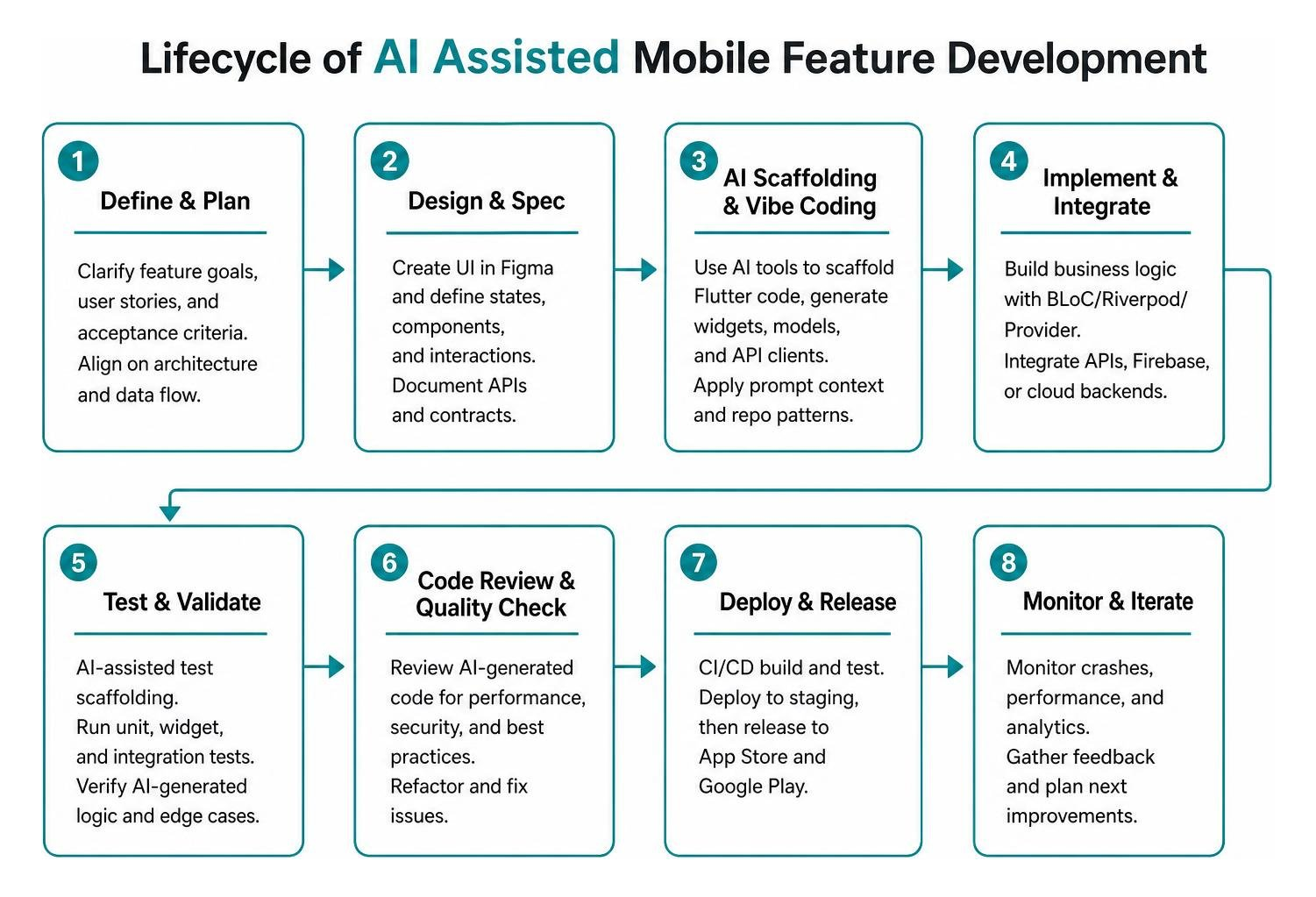
Top engineering teams expect developers to apply deliberate prompt engineering and hallucination mitigation strategies:
- Providing context files (e.g.,
SKILL.mdorARCHITECTURE.md) to ground AI models in specific repository patterns. - Using test scaffolding to verify AI-generated business logic before merging.
- Reviewing generated Dart code for performance bottlenecks, unnecessary widget rebuilds, and security misconfigurations.
Remote Flutter Developer Compensation and Employment Models
Remote compensation varies based on employment classification, geographic focus, and experience level. You can evaluate current benchmarks against Remote Mobile Developer Salaries and Remote Frontend Engineer Salaries.
Full-Time vs Freelance vs Early-Stage Startups
- Full-Time Employment (FTE): Offers predictable salaries, health insurance, paid time off (20–26 days per year), and equipment allowances.
- Freelance and B2B Contracts: Hourly or time-and-materials arrangements commonly range from 90 to 180 PLN/h net in Europe ($25 to $50+/hour) or $40 to $90+/hour for US-based contracts. Many consultancies use a 3-month contract-to-hire trial before extending permanent offers.
- Early-Stage Startups: Seed-funded startups often supplement base salaries with 0.1% to 4.0% equity grants, seeking self-directed generalists who can build rapid MVPs.
Benchmarks Across Experience Levels and Regions
- Junior / Entry-Level (0–2 years): $25,000 to $50,000 USD globally; ₹4L to ₹8L per annum in South Asia.
- Mid-Level (2–5 years): $65,000 to $110,000 USD in international markets; ₹10L to ₹18L in India.
- Senior / Lead (5+ years): $120,000 to $175,000+ USD in North America and Western Europe; up to $214,000 USD for specialized lead roles combining full-stack cloud and AI workflows.
How to Stand Out and Land Remote Flutter Developer Jobs
Because remote roles attract applicants worldwide, a generic resume listing “Dart, Flutter, Git” is rarely enough. Employers look for proof of real-world delivery and strong communication skills.
Portfolio Essentials and Live Store Deployments
Nothing proves mobile engineering competence like apps running in production. To build a compelling presence, check out our guide on how to build a Killer Remote Developer Portfolio: How to Land Your Dream Job.
Make sure your applications showcase:
- Live App Store & Google Play Links: Demonstrates that you can navigate provisioning profiles, keystores, store compliance, and release tracks.
- Production-Ready Code Repositories: Public projects highlighting structured state management (BLoC/Riverpod), clean directory architectures, and automated unit/widget test suites.
- Full-Stack Competency: Examples showing mobile apps integrated with real cloud backends (Firebase, AWS, GCP, or GoLang APIs).
Mastering Asynchronous Work and System Design Interviews
Remote hiring processes typically involve 2 to 3 interview rounds focusing on:
- System Design & State Architecture: Explaining architectural trade-offs, offline data synchronization, and state management choices.
- Live Code Review & Debugging: Reviewing code snippets, fixing widget rebuild loops, or walking through method channels.
- Async Communication: Demonstrating that you can write concise documentation, clear pull request descriptions, and proactive sprint updates.
Career Progression: Flutter vs Native Mobile Development in 2026
Evaluating Flutter against native iOS and Android tracks helps clarify long-term career choices.
| Dimension | Flutter (Cross-Platform) | Native iOS (Swift) | Native Android (Kotlin) |
|---|---|---|---|
| Codebase Scope | Single unified Dart codebase for iOS, Android, Web, Desktop | Platform-specific Swift / SwiftUI | Platform-specific Kotlin / Jetpack Compose |
| Startup / MVP Demand | Very High (fast time-to-market, unified teams) | Moderate (higher build cost for single platform) | Moderate (higher build cost for single platform) |
| Hardware & Deep OS Access | Method Channels / Platform Plugins required | Direct API access to Apple frameworks | Direct API access to Android SDK |
| AI Vibe Coding Efficiency | High (single UI paradigm across platforms) | Moderate-High | Moderate-High |
| Hiring Market Depth | Over 3,100 remote roles worldwide | See Remote Swift Developer Jobs | See Remote Kotlin Developer Jobs |
Flutter vs Native Swift and Kotlin
While native development remains important for platform-specific capabilities (such as complex ARKit features or low-level background services), Flutter continues to dominate greenfield startup projects and multi-platform SaaS products. Knowing native Swift or Kotlin fundamentals makes you a stronger Flutter developer when bridging custom platform channels.
Progression Paths from Junior to Mobile Lead
- Junior Developer: Focuses on UI translation from Figma, standard widget composition, and bug fixes.
- Mid-Level Engineer: Owns complete feature lifecycles, state management, API networking, and CI/CD releases.
- Senior / Lead Architect: Designs distributed mobile architectures, mentors engineers, manages app store compliance, and establishes AI-assisted coding standards.
Frequently Asked Questions About Remote Flutter Developer Jobs
What technical skills are most essential for landing a remote Flutter job?
Core Dart mastery, production state management (Riverpod, BLoC, or Provider), API integrations (REST, WebSockets, gRPC), mobile CI/CD pipelines, and experience deploying builds to both the Apple App Store and Google Play Store.
How do salaries for remote Flutter roles compare to native iOS and Android positions?
Remote Flutter salaries are generally comparable to native iOS and Android roles at similar seniority levels. Compensation is driven primarily by product complexity, backend knowledge, and geographic target market rather than the specific client framework.
How are AI coding tools changing daily workflows for remote Flutter engineers?
AI tools like Cursor, Claude Code, and Copilot handle boilerplate creation, test generation, and documentation. Engineers spend more time on architecture design, performance profiling, security audits, and reviewing generated code.
Conclusion
Remote Flutter engineering offers strong career flexibility in 2026. By mastering clean Dart architecture, deploying production apps, and adopting AI-assisted workflows, you can position yourself for competitive, location-independent roles.
Explore our latest opportunities and browse curated remote vibe coding and Flutter opportunities to find your next async-first role.