
The Remote AI Tools Dev Stack You Actually Need in 2026
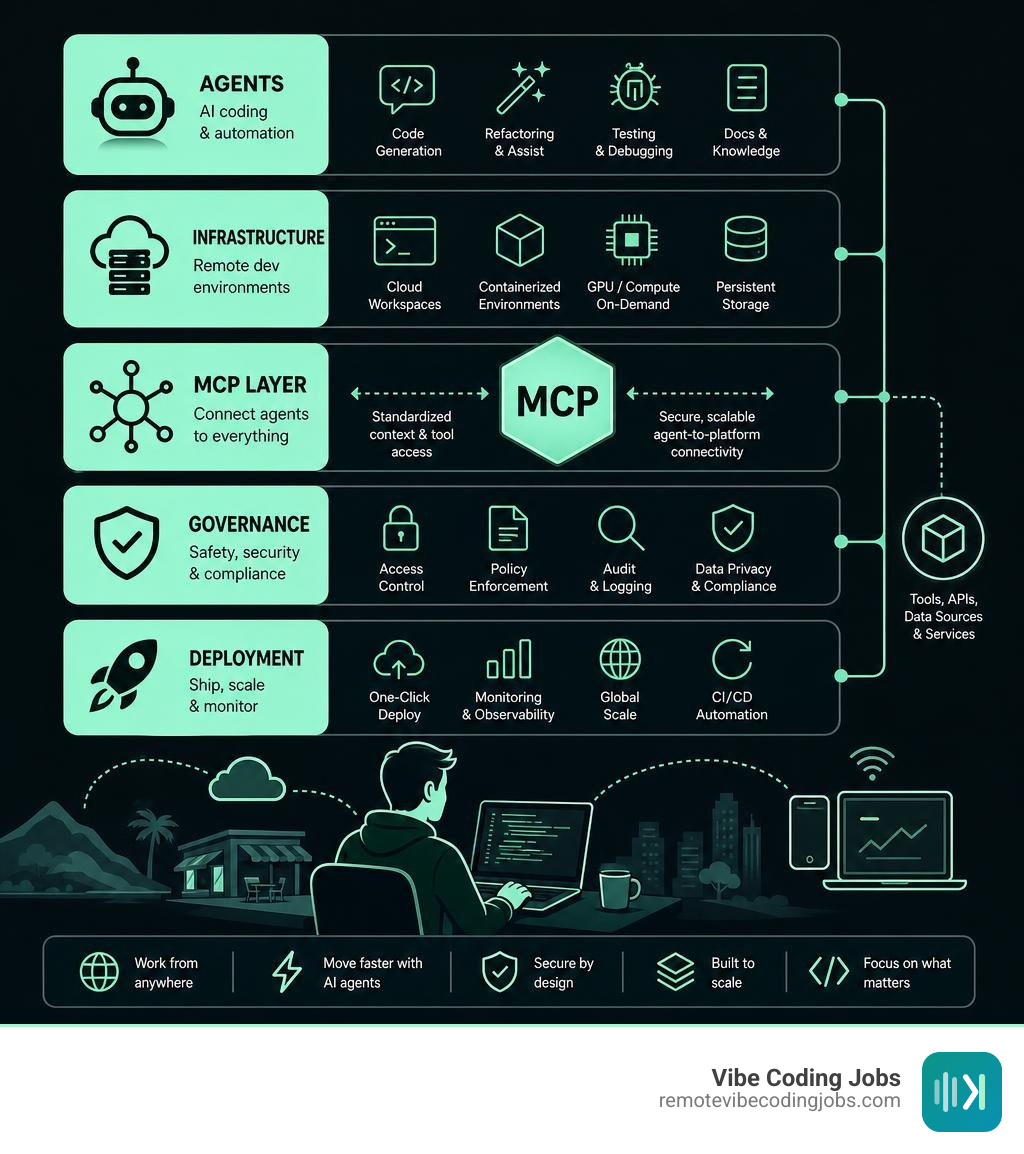
The fastest-growing category in remote AI tools dev right now isn’t a single app — it’s an entire ecosystem of agents, infrastructure layers, and protocols working together. Here’s a quick overview of the essential tools:
| Category | Top Tools |
|---|---|
| AI Coding Agents | Claude Code, Cursor, GitHub Copilot, Aider |
| Remote Infrastructure | Coder, Fleeks, YokeDev |
| Deployment & Cloud | NEXUS AI, Specific, Firebase Studio |
| Agent-to-Platform Connectivity | Model Context Protocol (MCP) |
| Mobile & Remote Access | Tailscale, Mosh, vibetunnel |
| Governance & Compliance | Coder Workspaces, Mainly.AI |
The modern remote developer isn’t just writing code anymore. They’re orchestrating AI agents, managing cloud infrastructure from their phone, and navigating a growing stack of tools that often weren’t designed to work together.
That fragmentation is real. Building a production AI system in 2026 typically means stitching together a notebook environment, a code editor, version control, an experiment tracker, and one or more LLM APIs — with no shared data model between any of them.
The good news? A new generation of tools is closing those gaps fast. Whether you’re running Claude Code from a coffee shop, monitoring a long-running agent on your commute, or helping an enterprise lock down its AI development pipeline, the right stack makes all the difference.
I’m Dominic Zijlstra — cofounder of Adaptify.ai and former data scientist and DevOps engineer, with hands-on experience building the kind of automated, remote-first infrastructure that sits at the heart of remote AI tools dev. In this guide, I’ll break down exactly which tools belong in your arsenal and why.
Simple guide to remote ai tools dev terms:
- What are the best daily-updated job boards for remote developers who prefer working with LLMs?
- ai playbook remote coding
- claude ai vibe dev
The Rise of the Remote AI Tools Dev Ecosystem
The traditional software engineering setup — a heavy IDE running locally on a high-spec laptop — is undergoing a massive evolutionary shift. Today, we are witnessing the rise of a highly integrated, remote-first AI development ecosystem. This change is driven by the sheer computational demands of running local models, the necessity of maintaining clean context windows, and the incredible speed of “vibe coding” (using natural language to guide AI code generation).

When we shift development to remote environments, we unlock immediate gains in developer efficiency. Rather than spending hours troubleshooting local dependency conflicts or waiting for massive Docker containers to build, developers can leverage cloud-hosted environments that scale on demand. This approach eliminates the physical limitations of local hardware, allowing even lightweight devices to orchestrate highly complex workflows.
However, this rapid transition has highlighted a significant challenge: tool fragmentation. Developers frequently find themselves jumping between disconnected applications—such as Jupyter Notebooks for initial research, VS Code for manual editing, Git for version control, and various proprietary LLM APIs for code assistance.
Without a unified data model, this constant context-switching degrades productivity. To understand how teams are integrating these tools smoothly, check out our guide on Remote Developer AI Tools Stack Integration Benefits. For a broader look at the landscape, you can also explore The best AI tools for developers .
Bridging the Gap from Prototyping to Production
One of the biggest friction points in modern AI engineering is transitioning from a working prototype to a stable, production-ready application. Too many projects start as a series of chaotic prompts or fragmented scripts and struggle to survive the jump to production infrastructure.
To solve this, pioneering platforms are introducing structured methodologies like “Grounded Vibing.” This approach combines the incredible speed of AI-assisted generation with the strict architectural discipline of versioned graph systems.
For instance, Mainly.AI | Become an AI Engineer provides a visual Graph-IDE that integrates prototyping, model training, and deployment into a single cohesive environment. By enforcing architecture within a directed acyclic graph, teams can train domain-specific PyTorch models and deploy them as endpoints without losing structural control.
Simultaneously, browser-based environments are simplifying full-stack prototyping. Firebase Studio unifies Project IDX with Gemini AI agents, allowing developers to rapidly prototype, test, and deploy applications directly from their browsers. By running virtual machines powered by Google Cloud and using Nix for system packages, it enables developers to toggle seamlessly between natural language prototyping and direct code control.
Standardizing Workspaces for Human-Agent Collaboration
To make AI-assisted development truly reliable, both human developers and autonomous AI agents must build side-by-side in consistent, standardized environments. When an AI agent modifies code in an environment that differs even slightly from the developer’s local setup, “environment configuration drift” occurs, leading to broken builds and silent failures.
Standardizing workspaces ensures that agents have the exact same toolchains, system packages, and environment variables as their human counterparts. By utilizing pre-configured development containers, teams can provide AI assistants with the precise context they need to run terminal commands, compile code, and run tests successfully. To see a curated list of utilities supporting this collaborative workflow, browse the Awesome AI-Powered Developer Tools repository.
Secure Infrastructure and Governance for Remote AI Development
As AI agents gain the ability to execute terminal commands, run shell scripts, and modify files, security can no longer be an afterthought. Giving an autonomous agent free rein over a local machine or a production cloud environment introduces severe risks, from accidental file deletion to malicious package execution.

Enterprises require robust guardrails to ensure that AI-assisted development remains secure, compliant, and fully auditable. To dive deeper into securing these automated workflows, read our detailed AI Coding Infrastructure Guide and explore how teams implement Remote Developer Jobs AI Tools Security Automation.
Self-Hosted Environments and Enterprise Guardrails
To scale AI development safely, forward-thinking organizations are moving away from local execution and shifting to self-hosted remote development environments. By running development workspaces on secure, centralized infrastructure, enterprises can implement policy-controlled guardrails, centralize model access, and maintain comprehensive audit logs of every command executed by both humans and AI agents.
The business impact of this shift is substantial. For example:
- A prominent cloud storage company boosted developer onboarding speeds by 4x by transitioning to self-hosted remote development environments.
- A major logistics enterprise reduced developer VDI costs by 90% by replacing traditional virtual desktop infrastructure with self-hosted remote workspaces.
By using self-hosted AI development infrastructure like Coder, enterprises can grant developers the freedom to use any LLM or coding agent while maintaining the strict governance needed to prevent data leaks and unauthorized code execution.
Data Sovereignty and Compliance in a Remote AI Tools Dev Workflow
With the enforcement of strict regulations like the EU AI Act and GDPR, data sovereignty has become a critical requirement for remote engineering teams. Routing sensitive source code or proprietary customer data through third-party, US-based SaaS APIs can quickly lead to compliance failures and massive regulatory penalties.
Maintaining compliance in a remote AI tools dev workflow requires strict control over data routing and model hosting origins. Teams must ensure that:
- Codebases and context data are processed within geographically compliant regions.
- Model hosting origins are continuously tracked and displayed transparently on every inference call.
- Generative AI tools are configured to strictly opt out of model training datasets.
By utilizing platforms designed with GDPR-by-design principles and employing local or self-hosted model deployments, organizations can confidently innovate without compromising data privacy.
Mastering the Model Context Protocol (MCP) for Remote Operations
One of the most transformative advancements in the AI developer space is the Model Context Protocol (MCP). Developed as an open standard, MCP enables developers to build secure, bi-directional connections between AI models and external data sources or tools.
Instead of writing custom, fragile API integrations for every new tool, developers can use MCP to turn databases, developer platforms, and cloud infrastructure into a live, queryable data layer for AI assistants.
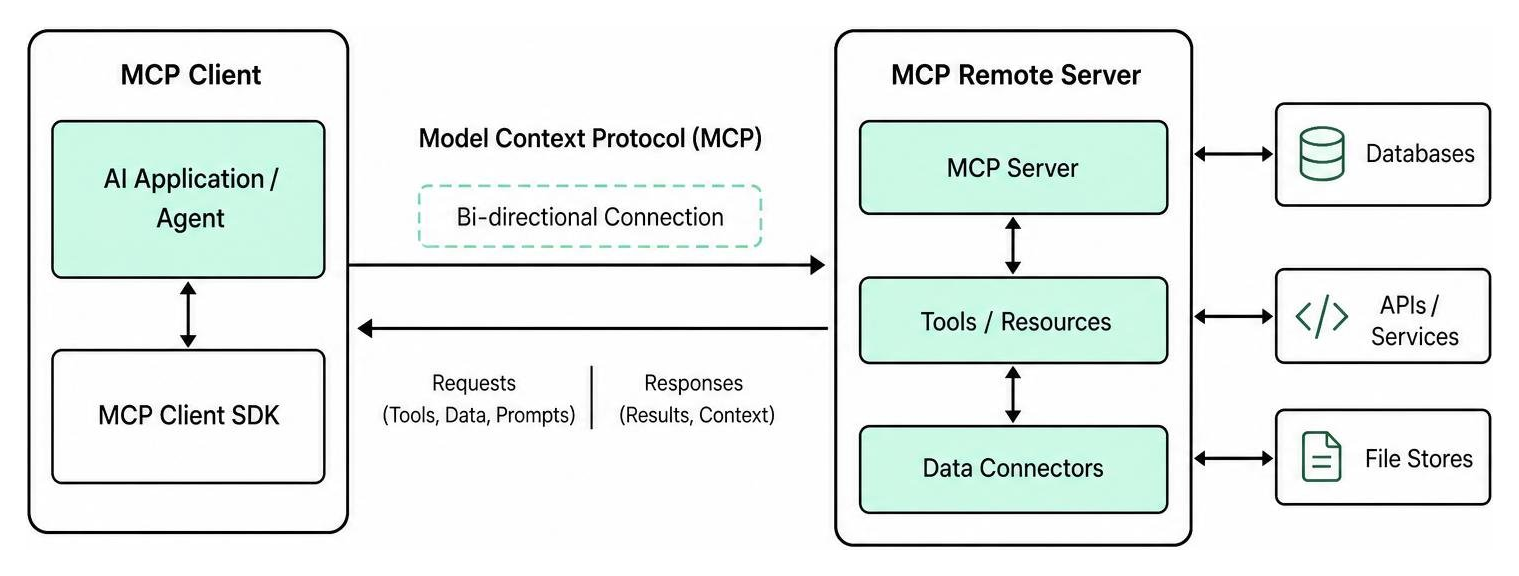
To understand how MCP compares to traditional integration methods, let’s look at the key structural differences:
| Feature | Model Context Protocol (MCP) | Traditional REST APIs |
|---|---|---|
| Integration Type | Standardized, bi-directional protocol | Proprietary, custom-built endpoints |
| Authentication | Dynamic client registration, OAuth 2.0 with PKCE | Static API keys or long-lived tokens |
| Context Awareness | Inherits user permissions & structural schemas | Requires manual parsing of raw JSON payloads |
| Agent Autonomy | Allows models to safely execute pre-approved tools | Requires hardcoded execution paths in application code |
Secure Workforce Data Integration via Remote MCP
A practical example of MCP in action is securely connecting AI tools to enterprise workforce databases. Instead of exporting sensitive HR spreadsheets and manually building complex formulas, developers can use dedicated MCP servers to query live data using natural language.
For instance, when connecting an AI client like Claude to a workforce management platform via MCP, the integration is highly secure:
- No Static Keys: It utilizes OAuth 2.0 with PKCE, eliminating the need to store or rotate static API secrets.
- Permission Inheritance: The AI assistant automatically inherits the existing Role-Based Access Control (RBAC) of the logged-in user, ensuring it never exposes unauthorized data.
- No Model Training: Queries are processed in real-time, and sensitive workforce data is excluded from model training datasets.
This allows developers or HR administrators to ask complex questions directly within their AI chat interface, such as identifying team members who haven’t had a compensation review in over 18 months, with complete security.
Agent-Operated Cloud Infrastructure and Deployments
Beyond querying data, MCP is revolutionizing how we deploy and manage cloud applications. By exposing infrastructure tools to AI agents through secure MCP servers, developers can delegate complex DevOps tasks directly to their coding assistants.
Platforms like Deploy Full-Stack AI Apps Without DevOps | NEXUS AI leverage this capability to deploy full-stack containerized applications — including databases, caches, and background workers — in about five minutes. By configuring an MCP server locally or in Cursor, an AI agent can trigger database backups, inspect runtime logs, and apply DDL schema fixes automatically.
Similarly, Specific – Cloud platform built for coding agents is designed from the ground up for agentic infrastructure management. Rather than relying on complex proprietary SDKs, it uses standard protocols and a declarative configuration file (specific.hcl). This allows coding agents to safely define, test, and deploy services, while restricting destructive actions — like deleting production databases — to human approval on a secure dashboard.
Running AI Coding Agents from Anywhere
As AI agents become more autonomous and capable of handling long-running, multi-step tasks, developers are no longer tied to their physical desks. You can now kick off a complex refactoring task on your office machine and monitor its progress on your phone while commuting, walking the dog, or traveling.
However, this freedom introduces a new psychological phenomenon: “agent anxiety.” Because these agents operate autonomously, developers often feel a constant urge to check in on their progress.
To manage this workflow effectively and maintain deep focus, it is vital to establish structured notification channels and isolated execution environments. To learn more about optimizing these workflows, check out Remote Developer Jobs AI Tools Workflow and read our guide on Remote Developer Jobs AI Tools Efficiency Collaboration Debugging.
Mobile Workflows and the DIY Remote Stack
For developers who prefer a hands-on, self-managed setup, a robust DIY remote stack is incredibly powerful. By combining time-tested terminal utilities with modern networking tools, you can securely access your home or office workstation from any mobile device.
An effective DIY stack typically includes:
- tmux: Keeps your terminal sessions and running AI agents active on your host machine, even if your connection drops.
- Tailscale: Creates a secure, private mesh VPN to connect your mobile device directly to your workstation without exposing ports to the public internet.
- Mosh (Mobile Shell): A replacement for SSH that is optimized for mobile connections, handling unstable cellular networks and IP handoffs seamlessly.
- vibetunnel: A popular open-source utility that proxies your local terminal to a secure web URL, allowing you to monitor tools like Claude Code directly from a mobile browser.
To avoid typing complex commands on a mobile keyboard, developers can use advanced SSH clients like Termius to store pre-configured snippets, or set up automated push notifications using services like ntfy to alert them when an agent completes a run.
Cloud-Hosted Computers Built for Autonomous Agents
While DIY setups are highly effective, running powerful, resource-intensive agents on a local laptop can quickly drain battery life and exhaust CPU resources. The industry is shifting toward provisioning dedicated cloud environments built specifically for AI agents.
With Fleeks — Give your agent a computer of its own | Fleeks , developers can instantly spin up isolated cloud environments for their coding agents. Each agent gets its own virtual machine complete with a terminal, file system, and preview URL. This allows multi-agent systems to collaborate persistently in the cloud, running long-term tasks asynchronously without consuming local hardware resources.
For an all-in-one conversational development experience, YokeDev – The AI Development Environment provides dedicated, isolated virtual machines connected to MCP-compatible AI models. Developers can program, deploy, and host entire full-stack software systems directly from a mobile phone using natural language, with built-in secrets management and zero vendor lock-in.
Hiring and Evaluating Elite Remote AI Developers
The rapid adoption of AI tools has fundamentally changed what companies look for when hiring software engineers. In 2026, the traditional metric of how fast a developer can type syntax is obsolete. Instead, forward-thinking organizations are looking for “AI-fluent” professionals who know how to maximize their productivity using advanced AI tools.
Hiring and vetting these developers requires a shift in evaluation strategies, focusing heavily on architectural thinking and prompt engineering. To future-proof your hiring process or your own career, read our guide on Remote Developer Skills in Demand 2026 Future Proof Your Career.
Essential Technical Skills for a Remote AI Tools Dev
While AI tools lower the barrier to entry for writing code, they actually increase the demand for deep foundational knowledge. An elite remote AI developer must possess a unique blend of traditional engineering principles and modern AI capabilities.
Key technical competencies to evaluate include:
- System Architecture: The ability to design scalable, secure, and modular systems that AI agents can easily navigate and modify.
- Foundational Machine Learning: Hands-on experience with frameworks like PyTorch or TensorFlow, and a solid understanding of data preprocessing and feature engineering.
- LLM Fine-Tuning & Optimization: Practical knowledge of fine-tuning techniques (such as LoRA and QLoRA) to adapt models for domain-specific enterprise tasks.
- Retrieval-Augmented Generation (RAG): The ability to design and optimize vector databases and semantic search pipelines to provide LLMs with accurate external context.
To explore how these skills translate into active career paths and high-paying roles, review AI Assisted Development Career Growth Job Market Opportunities.
Vetting Strategies and Cultural Fit for Async Teams
Evaluating an AI-fluent developer using traditional whiteboard coding tests is highly ineffective. Instead, recruitment strategies must evolve to test real-world problem-solving, prompt engineering, and async collaboration.
Effective vetting strategies include:
- AI-Permitted Take-Home Projects: Encourage candidates to use tools like Cursor, Claude Code, or GitHub Copilot, and evaluate how quickly they can deliver a fully functional, well-architected product.
- Prompting & Context Management Audits: Ask candidates to explain how they manage context windows, structure prompt chains, and handle non-deterministic AI behavior.
- Async Communication Assessments: In a remote-first team, clear writing is vital. Evaluate how well a candidate documents their architectural decisions in files like ARCHITECTURE.md or SKILL.md.
By focusing on these modern skills, companies can identify developers who achieve massive AI leverage while maintaining the deep focus required for remote productivity. To learn more about fostering this high-performance environment, read Remote Work Deep Focus Productivity.
Frequently Asked Questions about Remote AI Development
How do enterprises secure remote AI development environments?
Enterprises secure remote environments by moving development away from local machines and onto self-hosted, centralized cloud infrastructure. By using platforms like Coder, organizations can enforce strict policy guardrails, centralize model access, and maintain comprehensive audit logs of all developer and agent actions.
Additionally, integrating automated code review workflows ensures that AI-generated code is thoroughly scanned for vulnerabilities before merging. To learn more, read about how AI Code Review Tools for Remote Teams Boost Collaboration.
What is the Model Context Protocol (MCP) and why does it matter for remote devs?
The Model Context Protocol (MCP) is an open standard that establishes a secure, bi-directional connection between AI models and external data sources or tools. It matters for remote developers because it eliminates the need to build custom, fragile API integrations for every development tool.
With MCP, developers can securely connect their AI assistants to databases, cloud platforms, and internal tools using standardized, permission-aware protocols. For practical tips on leveraging these integrations, see our guide on how to Automate Coding Tasks How to Use AI for Efficiency.
Can I run and monitor AI coding agents from a mobile device?
Yes. Developers can run and monitor AI coding agents from anywhere using a combination of terminal utilities like tmux, secure mesh networks like Tailscale, and mobile-optimized protocols like Mosh.
Additionally, browser-based proxies like vibetunnel and dedicated cloud platforms like Fleeks or YokeDev allow developers to manage long-running agent tasks and inspect live preview URLs directly from their mobile devices. To find the best tools for your setup, explore our roundup of the Best AI Tools for Coding.
Conclusion
The shift toward AI-assisted development is fundamentally transforming software engineering. We are moving rapidly into an era where the primary role of a developer is shifting from a manual “code typist” to an active software architect and strategist.
Embracing this change means equipping yourself with the right secure infrastructure, mastering protocols like MCP, and leveraging dedicated remote environments to run autonomous agents safely from anywhere.
For developers and organizations ready to embrace this future, the opportunities are vast. To take the next step in your AI-native career, explore our curated resources:
- Find active, high-paying remote roles on our Remote AI Developer Jobs Boards Openings page.
- Learn more about navigating this evolving landscape in our guide on the AI Assisted Development Career and discover active AI Assisted Development Career Remote Jobs.
- Read our deep dive into the industry shift with AI Revolution How AI is Transforming Remote Software Development.
Ready to find your next remote vibe coding role? Visit RemoteVibeCodingJobs to browse curated daily listings at async-first companies that embrace the future of software development.