Why Every Remote Developer Needs an AI Playbook for Coding in 2026
Quick answer: An AI playbook for remote coding is a structured set of workflows, governance rules, and tooling choices that help developers and teams ship reliable software using AI agents — without chaos, runaway costs, or broken production systems.
Top AI playbooks for remote coding teams in June 2026:
- Claude Code Playbook (Anthropic) — terminal-based, agentic, built for AI-native companies
- AI Engineering Playbook (yimwoo/ai-engineering-playbook) — document-driven, task packets, tiered adoption
- Founder Playbook (Mehdys) — 5-phase gated workflow, agent-executable, stops vibe coding drift
- AI-Assisted Development Playbook (GitLab) — autonomy levels, CI-enforced constraints, harness framework
- 2026 AI Coding Agents Production Playbook — architecture patterns, sandboxing, cost engineering
Something fundamental shifted in AI-assisted development over the last 18 months. Over 70% of code at major tech companies is now AI-generated. Senior engineers using tools like Claude Code or Codex are producing 2x to 5x more pull requests than before. And yet — most teams are still winging it.
The gap isn’t in the tools. It’s in the playbook.
Without a structured approach, AI coding quickly becomes what some call “vibe coding” — prompting your way through features with no clear specs, no governance, and no safety net. One engineering team burned $9,900 in nine days from a single prompt loop bug before a billing alert fired. Another saw an orchestrator silently corrupt staging data across eleven subtasks before anyone noticed.
The tools are powerful. The missing piece is discipline.
That’s where a proper AI playbook comes in — whether you’re a solo remote developer trying to stay competitive, or an engineering lead managing a distributed team where AI agents are opening pull requests alongside humans.
I’m the RVCJ Editorial team at Remote Vibe Coding Jobs, where we cover ai playbook remote coding strategies, async engineering workflows, and the tools shaping remote developer careers in 2026. We track what’s actually working across real remote teams — so the guidance here is grounded in current, real-world practice.
The Evolution of AI-Assisted Development: Claude Code and Beyond
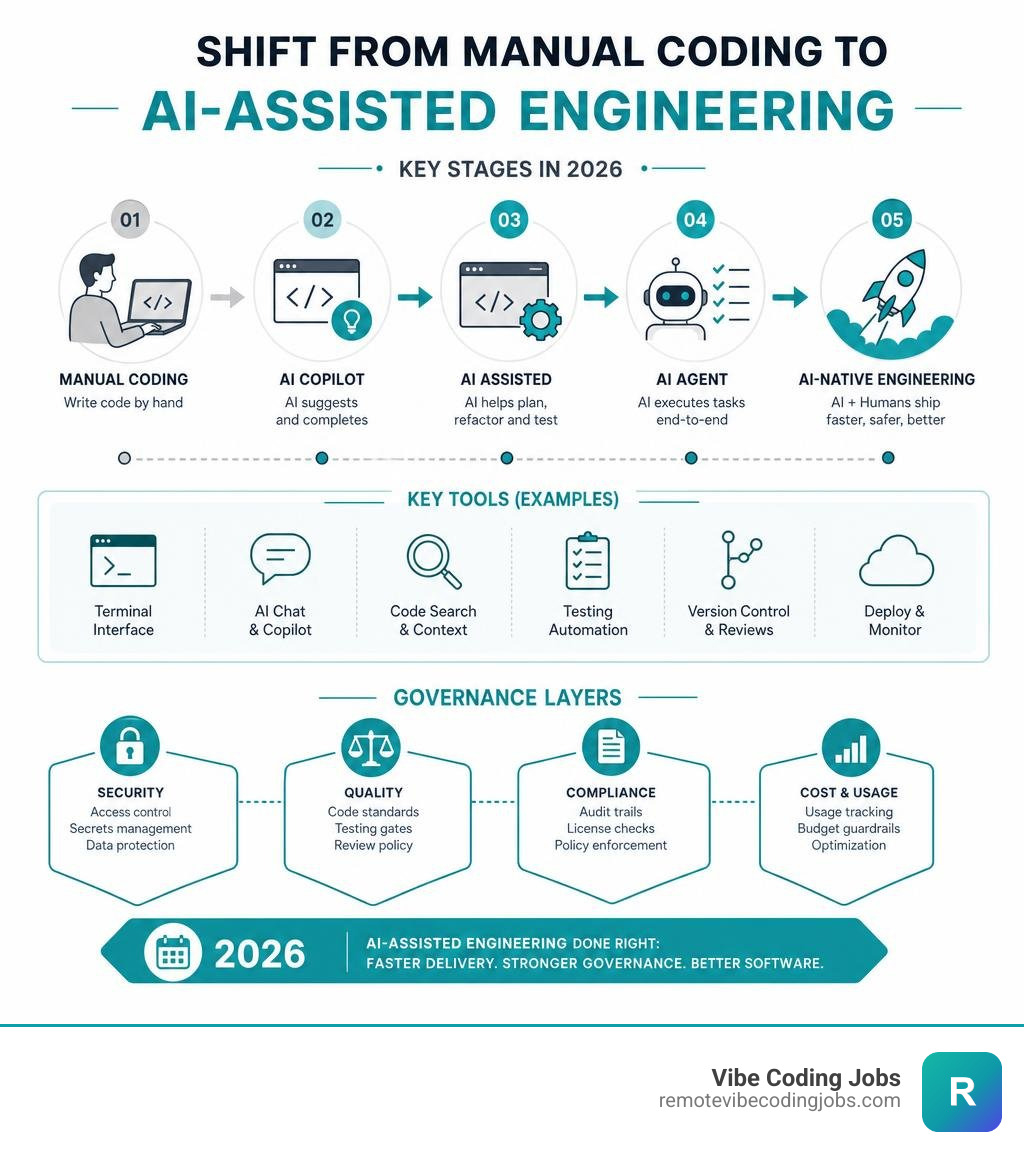
Not long ago, AI coding meant copying and pasting boilerplate code snippets from a chat interface into your IDE. Today, the landscape is dominated by terminal-based, agentic workflows that operate directly inside your codebase.
Leading this charge is Anthropic’s Claude Code, a command-line tool that represents a paradigm shift from conversational chat to terminal-level agency. Rather than waiting for human copy-paste steps, Claude Code runs tests, navigates directory trees, executes shell commands, and commits changes directly.
At the heart of this terminal-based ecosystem are key architectural components:
- The
CLAUDE.mdFile: This file serves as the permanent memory for your project. It stores project-specific instructions, development commands, architectural rules, and style preferences. When an agent initializes, it reads this file first to prevent the “context drift” that plagues standard LLM sessions. - Model Context Protocol (MCP) Servers: MCP allows AI agents to securely connect to external tools, databases, and APIs. Instead of being isolated in a sandbox, Claude can query your database, check your calendar, read Slack threads, or check GitHub issues to gather context before writing a single line of code.
This transition to agentic systems has enabled the rise of “fully automatic operations” in AI-native companies. In these environments, AI agents are increasingly treated as digital employees. They don’t just autocomplete text; they triage bugs, execute migrations, and build complete vertical slices of applications asynchronously.
For engineers working in Remote Developer Jobs: AI Tools & Workflow setups, this means your primary daily collaborator might not be sitting in your time zone—it might be an agent running in a terminal loop.
Debunking the Myths of AI Coding and Vibe Coding

As AI-assisted development has gone mainstream, several myths have emerged. To build an effective ai playbook remote coding strategy, we must first separate hype from production reality.
Myth 1: You should use cheap, open-source LLMs to code
While local, open-source models are excellent for privacy and basic autocomplete tasks, relying on them for complex, multi-file agentic workflows is often a false economy. Top-tier commercial models are estimated to be significantly ahead in reasoning and failure reduction. In this fast-moving space, three months of model advancement can equal three human years of engineering progress. The time spent debugging a hallucinated import from a cheaper model quickly wipes out any token savings.
Myth 2: No-code platforms are the future of AI development
While early playbooks like The No-Code Playbook: The Age of AI – Creatio and courses like the No-Code AI Playbook: Launch Your 1st AI Agent in 30 Mins – Maven are fantastic for non-technical builders launching simple automations, they do not scale for complex software architectures. With the arrival of MCP and advanced reasoning models, developers are finding that writing code-based agent SDKs with structured prompts is far more robust than clicking components together in a visual editor.
Myth 3: Vibe coding is either completely useless or entirely omnipotent
Some traditionalists dismiss “vibe coding” (building applications using natural language without writing syntax manually) as a recipe for spaghetti code. Others believe it makes human engineers obsolete.
The truth lies in the middle. Vibe coding is incredibly powerful, but only when paired with senior-level discipline. Think of an AI agent as a highly productive but infinitely distracted junior developer. If you don’t give them exact specifications, they will make assumptions—and those assumptions will break your system.
To keep vibe coding from turning into architectural drift, modern teams use frameworks like the Founder Playbook. This open-source framework enforces a strict, agent-executable workflow that requires passing gated checks (such as defining state canons and API contracts) before any production code is written.
Learning how to manage these agent gates is a core skill we highlight in our guide on How to Get a Vibe Coding Job: Skills, Courses & Advice.
Implementing an AI Playbook for Remote Coding in Modern Engineering
To transition from ad-hoc prompting to a disciplined development lifecycle, remote engineering teams need structured rules.
| Metric / Workflow | Traditional Development | AI-Playbook-Driven Development |
|---|---|---|
| PR Cycle Time | 24 – 48 Hours (Manual review & back-and-forth) | Under 2 Hours (Automated requirements & instant generation) |
| Developer Focus | Writing syntax, boilerplate, and debugging typos | High-level system architecture, testing, and AI auditing |
| Code Review | Human-only line-by-line inspection | Automated policy engines + human architectural oversight |
| Context Management | Stored in Slack, Wiki docs, and developer heads | Enforced in-repo files (AGENTS.md, CLAUDE.md) |
By shifting to an agentic framework, engineering teams have seen pull request cycle times drop by up to 60%, largely because agents can automate the tedious process of requirements gathering and draft generation.
To see how this works at scale, we can look to the AI-Assisted Development Playbook | The GitLab Handbook, which outlines how structured autonomy levels guide how much trust is handed over to an AI agent.
Core Components of an AI Playbook for Remote Coding
To build a robust, tool-agnostic environment for your agents, your repository should feature these core operational components:
- The
AGENTS.mdFile: Similar toCLAUDE.md, this file acts as a localized instruction manual for any agent entering the repository. It defines local build commands, linting rules, testing suites, and strict architectural conventions (e.g., “Always use functional components,” or “Database queries must use our custom ORM wrapper”). - Task Packets & Design-Change Packages: As detailed in the yimwoo/ai-engineering-playbook, you should never give an agent an open-ended goal like “make the checkout page faster.” Instead, break work down into structured “Task Packets” that define the exact files to modify, the expected inputs/outputs, and the success criteria.
- Git Worktrees for Parallel Agent Branches: Agents work fast. If you run multiple agents in the same working directory, they will constantly overwrite files and corrupt local state. Using Git worktrees allows you to check out multiple branches in parallel folders, letting agents run tests and build code in complete isolation.
- Context Window Management: The context window is your agent’s short-term memory. If you dump your entire terminal history or endless database logs into the window, you run out of tokens and cause “context rot.” Your playbook must instruct agents to filter terminal output and only load files relevant to the active task packet.
For remote developers working with Python, mastering these context-saving techniques is crucial. Check out our Remote Python Developer Jobs 2026: Your Ultimate Guide to see how modern teams structure their Python environments for agentic workflows.
Overcoming Security Risks with an AI Playbook for Remote Coding
Deploying autonomous agents into production codebases introduces significant security vulnerabilities. If an agent has access to run arbitrary shell commands, a malicious package dependency could hijack your deployment server.
An enterprise-grade ai playbook remote coding setup must incorporate strict guardrails, as outlined in The 2026 AI Coding Agents Production Playbook:
- Blast Radius Containment: Define exactly what an agent can touch. An agent working on a frontend UI component should have zero access to database credentials or payment processing code.
- Execution Sandboxing: Never run agent commands directly on your local machine or a shared development server. All agent executions (building, testing, linting) must run inside isolated Docker containers or microVMs.
- Policy Engines (Rego): Use policy engines to intercept and evaluate agent tool calls before they run. If an agent attempts to run a command like
rm -rfor tries to modify a system configuration file, the policy engine must immediately reject the action. - Credential Boundaries: Avoid giving agents long-lived API keys. Instead, use short-lived, scoped tokens generated dynamically via tools like AWS STS or HashiCorp Vault.
The CTO’s Playbook: Scaling AI Adoption and Governance

For CTOs and engineering leaders, the widespread adoption of AI coding agents requires a complete rethinking of team leadership.
As engineering veteran Peter Bell points out, the transition to AI-assisted development cannot be managed like a traditional cloud migration. CTOs cannot simply buy licenses, hand them to developers, and walk away. They must personally use these tools daily to understand their limitations, because natural language prompts are not lossless abstractions of code.
To scale AI adoption safely, leaders can look to established framework concepts like the CMS AI Organizational Maturity Model, which helps companies transition systematically:
- Stage 1: Exploratory: Developers use ad-hoc tools (like basic autocomplete) in isolation.
- Stage 2: Foundation Building: The team establishes shared repository rules (
AGENTS.md), standardizes on premium models, and implements basic CI/CD gates. - Stage 3: Agentic Scale: Agents operate as bounded contributors within structured pipelines, handling automated bug triage and feature drafting under human supervision.
A key part of this governance is defining your team’s Autonomy Levels:
- Baseline: Human writes all code; AI is used only for search and documentation.
- Pair: AI acts as an autocomplete partner, suggesting lines or block completions.
- Conductor: AI drafts entire functions or files based on a human’s detailed specification.
- Orchestrator: AI plans and executes multi-file changes, but a human must review and run every step.
- Harness: AI operates autonomously within a sandbox, opening pull requests that are automatically tested and gated by CI before human review.
To find companies that have successfully scaled these maturity models and offer healthy, forward-thinking engineering cultures, explore our list of the Best Companies Hiring AI Developers: Culture, Growth & Salaries.
Quality Assurance, Observability, and Cost Engineering in AI-Native Repos
When your repository is receiving dozens of pull requests generated by AI agents, traditional QA and observability practices quickly fall apart. If you cannot personally review every line of code, you must shift your focus to automated environments.
The New QA Rules for AI-Generated Code
- Failing Test Before Feature: Never allow an agent to write a feature without first writing (or being given) a failing test. This gives the agent a clear, mathematical definition of “done” and prevents it from hallucinating successful outcomes.
- Test Count Guard: A common failure mode of autonomous agents is deleting existing tests to make their broken code pass the build. Your CI pipeline must feature a “test count guard” that rejects any pull request where the total number of test cases decreases without explicit human approval.
Observability and Trajectory-Based Debugging
Standard application logs won’t tell you why an agent made a bad architectural decision. To debug agentic systems, you need trajectory-based debugging using OpenTelemetry GenAI traces. This allows you to inspect the exact prompt, retrieved context, tool calls, and model outputs that led to a specific code change, making it easy to spot where the agent’s reasoning went off course.
Cost Engineering: Managing the Token Budget
Running advanced reasoning models 24/7 can quickly become incredibly expensive. However, as noted in AI Coding: The Real Playbook and the vmishra/ai-coding-playbook, there is often an 11x cost spread between a naive pipeline and an optimized one.
To keep your API bills under control, your playbook should enforce:
- Prompt Caching: Ensure your agents leverage model providers that offer discounts for cached context. By keeping your system prompts and core codebase context cached, you can slash token costs significantly.
- Model Tier Routing: Don’t use your most expensive reasoning model to fix a typo or format a markdown file. Route simple tasks (linting, formatting, basic unit tests) to faster, cheaper models, reserving premium models for complex architectural changes.
These highly sought-after cost engineering and auditing skills are exactly why top-tier developers command premium compensation, as shown in our Vibe Coding Salary Range: Average Entry to Senior guide.
Frequently Asked Questions about AI Playbooks and Remote Coding
What is the difference between vibe coding and structured agentic coding?
Vibe coding refers to unstructured, conversational prompting where a developer builds software through natural language without strict rules. While excellent for rapid prototyping, it can lead to fragile codebases. Structured agentic coding, on the other hand, uses disciplined frameworks (like the 5-phase gated workflows found in the Founder Playbook) to force agents to define states, write test cases, and pass automated CI checks before writing production code. This disciplined approach is a key asset for developers navigating modern Vibe Coding Remote Career Paths.
How do engineering teams manage the cost of running AI agents 24/7?
Teams manage these costs through “cost engineering” practices. This includes implementing prompt caching (which reduces token costs for repeated context), model tier routing (sending simple tasks to cheaper models), and setting strict daily API billing limits. Implementing these guardrails prevents runaway loops where an agent repeatedly fails a test and burns thousands of dollars in tokens overnight. Understanding these efficiency patterns is a core requirement for many roles listed on our AI Coding Jobs: Entry Level, Growth & Remote Opportunities board.
What is the role of a human developer when AI generates over 70% of the code?
The role shifts from a “syntactician” (someone who types code) to a “systems architect and auditor.” Human developers are responsible for defining high-level system architecture, writing robust test suites, managing security sandboxes, and auditing AI-generated pull requests for logical flaws or security vulnerabilities. If you want to transition into this style of work, check out our Remote AI Developer Jobs: Your 2026 Guide.
Conclusion
The era of manual, line-by-line coding is rapidly evolving. In June 2026, the most productive developers aren’t those who type the fastest—they are the ones who can orchestrate networks of AI agents safely, cost-effectively, and reliably.
Whether you are a solo developer looking to scale your output or an engineering leader looking to establish secure guardrails, implementing a structured ai playbook remote coding framework is your key to success.
At RemoteVibeCodingJobs, we are dedicated to helping AI-fluent professionals find their next career step. We curate daily listings of remote, async-first “vibe coding” jobs that actively value your AI-assisted development skills.
Ready to put your AI playbook to work? Visit Vibe Coding Jobs to browse our curated job board, download our free developer playbook, and apply for your next remote role today!